Key takeaways
- AirOps and GrowthBar are content creation platforms with some AEO features bolted on — they help you write faster, but neither was built around AI search visibility as a core workflow.
- Promptwatch is purpose-built for GEO: it tracks how AI engines cite your brand, identifies gaps, generates content designed to be cited, and connects visibility to revenue.
- If your primary goal is producing SEO content at scale, AirOps or GrowthBar can work. If your goal is understanding and improving how ChatGPT, Perplexity, and Google AI Mode talk about your brand, you need a dedicated GEO platform.
- The biggest difference between these tools isn't features — it's the direction they're built in. Content tools start from writing and add some AI tracking. GEO platforms start from AI search behavior and build content workflows around that data.
The GEO market in 2026 is genuinely confusing. You've got traditional SEO content tools adding "AI visibility" badges, dedicated AEO platforms shipping new features every month, and marketing teams trying to figure out which category of tool they actually need.
AirOps, GrowthBar, and Promptwatch all show up in searches for "AI content tools for SEO teams." But they're solving different problems, and picking the wrong one means either paying for features you don't use or missing the visibility data you actually need.
This guide breaks down what each platform does well, where it falls short, and which type of team should use it.
What these tools are actually trying to do
Before comparing features, it's worth being clear about what each tool was built for.
AirOps started as a content operations platform and has evolved into what it calls a "growth platform for AI search and AEO." It launched its Quill agent in May 2026, which automates content workflows and helps teams produce pages optimized for AI search. The pitch is content engineering at scale — building the infrastructure to produce and update content systematically.
GrowthBar is an AI-powered SEO content tool that writes blog posts, generates outlines, and helps teams optimize for traditional search. It's more squarely in the "write content faster" category, with keyword research and on-page optimization built in. GEO features are present but not the core value proposition.
Promptwatch is built from the other direction entirely. It starts with AI search behavior — tracking how ChatGPT, Perplexity, Google AI Mode, Claude, and eight other models respond to prompts in your category — and builds content creation tools on top of that data. The goal is a closed loop: find where you're invisible, create content that fills those gaps, and track whether the new content gets cited.

Feature-by-feature comparison
| Feature | AirOps | GrowthBar | Promptwatch |
|---|---|---|---|
| AI search monitoring (ChatGPT, Perplexity, etc.) | Partial | No | Yes (10 models) |
| Prompt tracking & volume data | Limited | No | Yes |
| Citation & source analysis | No | No | Yes |
| AI crawler logs | No | No | Yes |
| Content gap analysis (vs AI responses) | Partial | No | Yes |
| AI content generation | Yes (Quill agent) | Yes | Yes (Content Agents) |
| Content briefs with prompt data | Partial | Yes | Yes |
| Traffic attribution from AI search | No | No | Yes |
| Reddit & YouTube insights | No | No | Yes |
| ChatGPT Shopping tracking | No | No | Yes |
| Competitor AI visibility heatmaps | No | No | Yes |
| Traditional SEO keyword research | Partial | Yes | No |
| Pricing (entry tier) | Custom | ~$29/mo | $99/mo |
| Free trial | Yes | Yes | Yes |
AirOps: content engineering for AI search
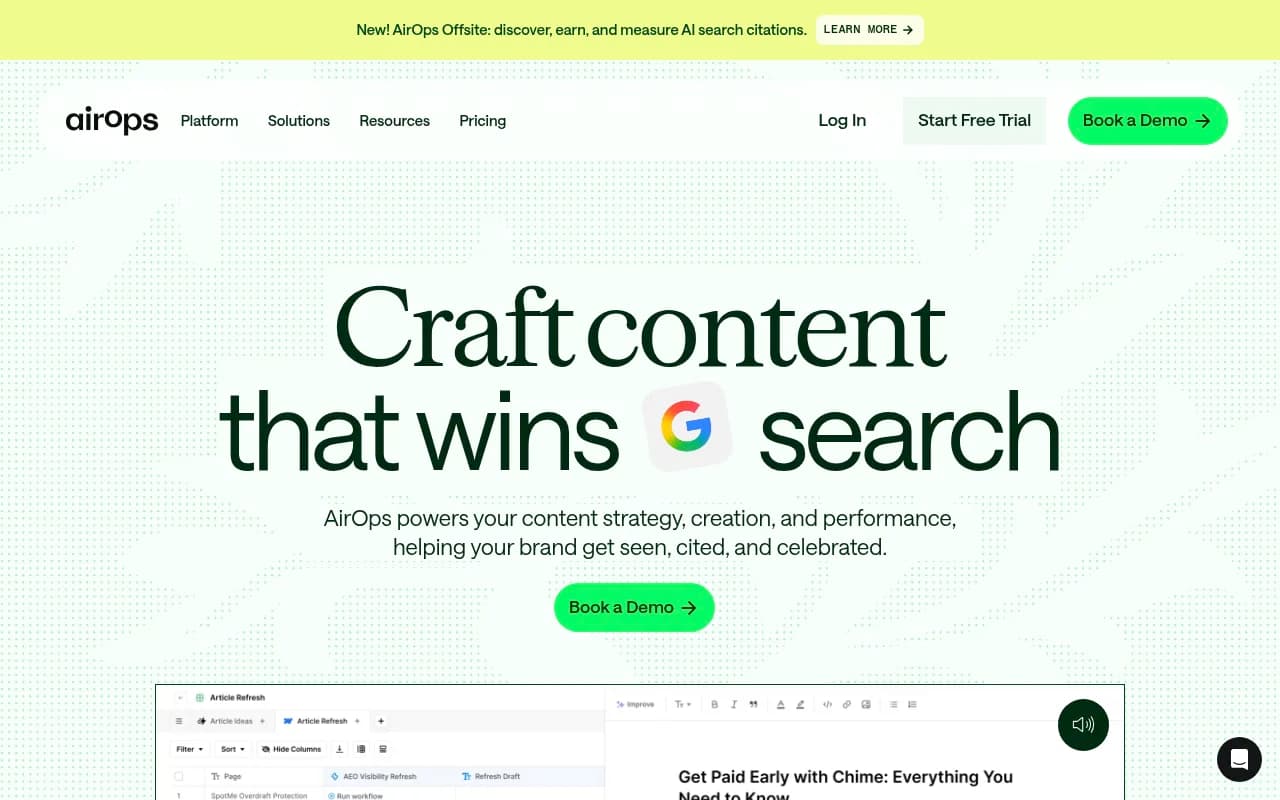
AirOps has made a genuine pivot toward AEO. The Quill agent, launched in mid-2026, automates content production workflows — it can research, draft, and publish content designed to rank in AI search. The platform integrates with CMSes and data sources, making it useful for teams that need to produce content at volume without a large editorial team.
Where AirOps shines is workflow automation. If you have a clear content strategy and need to execute it efficiently, Quill can handle a lot of the production work. The platform also has solid integrations and is built for teams that want to customize their AI workflows.
The gap is on the monitoring and intelligence side. AirOps doesn't give you a real-time view of how AI engines are citing your brand, which prompts you're winning or losing, or why a competitor is appearing in ChatGPT's answers when you're not. You're essentially flying blind on the visibility side — you can produce content, but you don't have the data to know if it's working in AI search specifically.
A webinar AirOps hosted with SEO expert Steve Toth made an interesting point: traffic from LLMs like ChatGPT converts at significantly higher rates than traditional Google traffic. That's a compelling reason to care about AI visibility. But caring about it and having the tools to measure and improve it are different things.

AirOps is a strong choice for content-heavy teams that have already figured out their GEO strategy and need to execute it at scale. It's less useful if you're still trying to understand where you stand in AI search.
GrowthBar: SEO content tool with limited GEO coverage
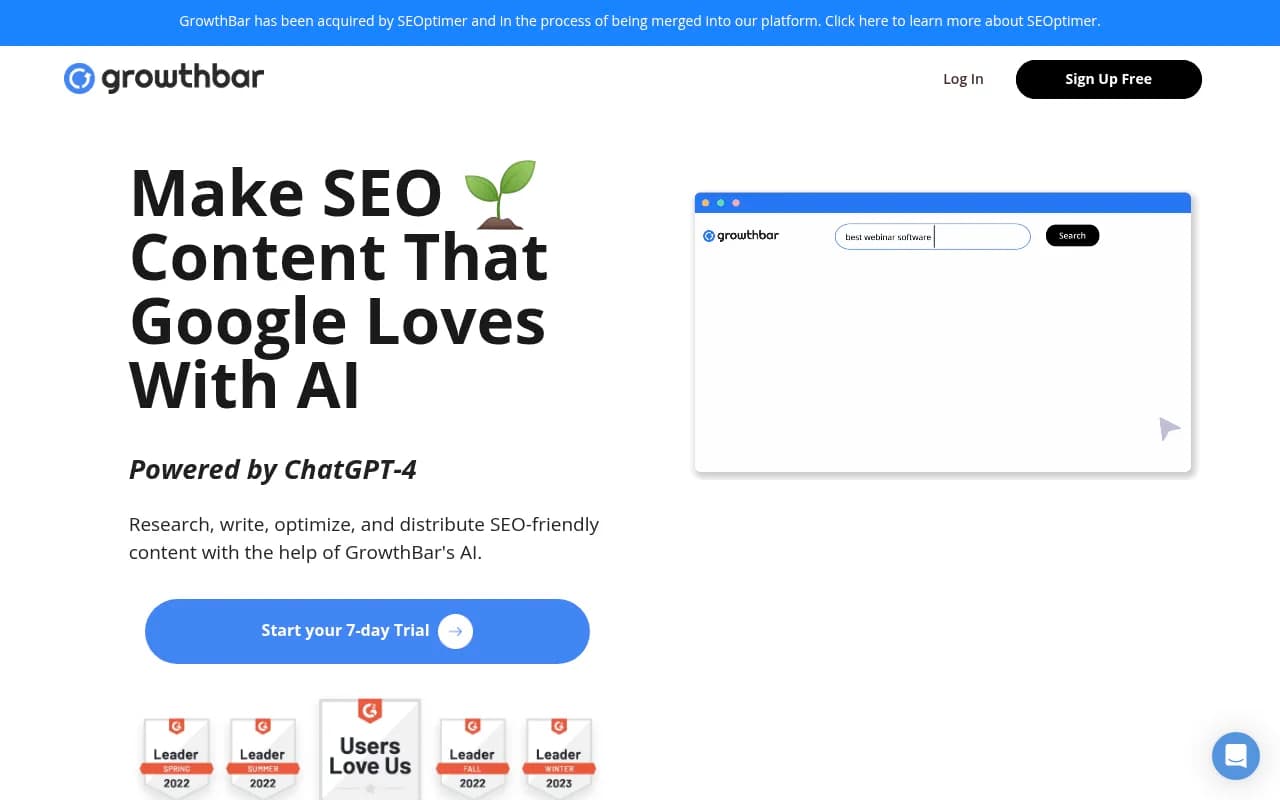
GrowthBar is a solid AI writing tool for traditional SEO. It generates blog posts, suggests keywords, builds outlines, and helps smaller teams produce optimized content without a dedicated SEO specialist. The interface is clean, pricing is accessible, and it covers the basics well.
For GEO purposes, though, GrowthBar is limited. There's no real AI search monitoring, no prompt tracking, no citation analysis, and no way to understand how AI models are responding to queries in your category. The content it generates is optimized for Google's traditional ranking signals, not for the retrieval patterns that determine whether an LLM cites your page.
That's not a criticism exactly — GrowthBar was built for a different job. But if you're evaluating it specifically for AI search visibility, it doesn't have the infrastructure to support that workflow.
Where GrowthBar makes sense is for smaller teams or solo marketers who need to produce SEO content efficiently and aren't yet running a dedicated GEO program. The price point is hard to beat for what it does.
Promptwatch: GEO-first with content built in
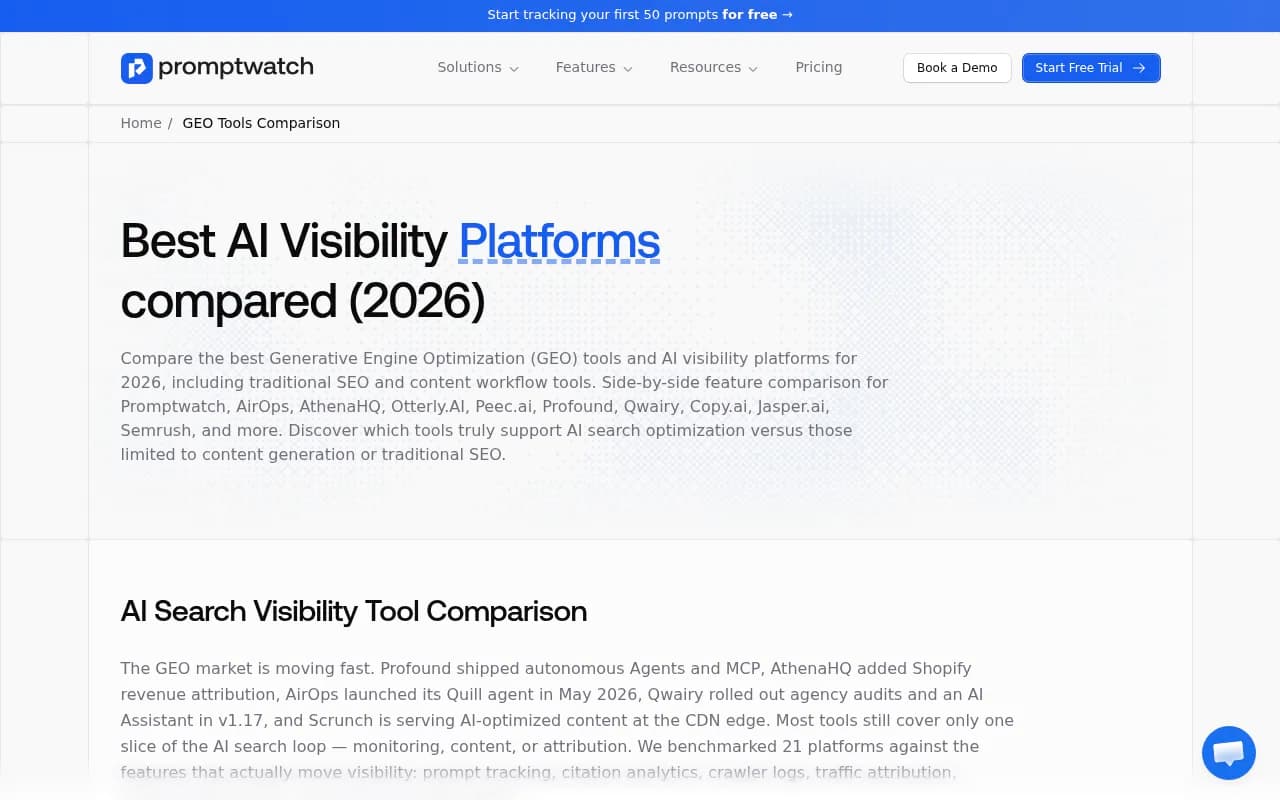
Promptwatch is the only platform in this comparison that was built specifically to answer the question: "Why are AI engines citing my competitors instead of me, and what do I do about it?"
The core workflow is a loop. Answer Gap Analysis shows you exactly which prompts competitors are visible for that you're not — not as a vague observation, but as specific content gaps with prompt volume data attached. Content Agents then generate articles, listicles, and comparisons grounded in that real prompt data. And page-level tracking shows you when new content gets crawled, when it starts getting cited, and how that visibility connects to actual traffic and revenue.
A few things stand out compared to AirOps and GrowthBar:
The AI crawler logs are genuinely useful. Promptwatch shows you when GPTBot, ClaudeBot, and other AI crawlers hit your pages, which pages they read, errors they encounter, and how often they return. Most content tools have no visibility into this at all. Understanding why your content isn't being indexed by AI engines is a different problem from understanding why it isn't ranking on Google.
The prompt intelligence layer is also distinct. Promptwatch tracks how AI search engines behave in real user interfaces, not just through APIs. This matters because what ChatGPT shows a user in its interface can differ from what the API returns. Prompt volume estimates and difficulty scores let you prioritize which gaps are worth filling first.
Reddit and YouTube insights are a feature most teams don't expect but end up using heavily. AI models cite Reddit threads and YouTube videos at a surprisingly high rate, and knowing which discussions are influencing recommendations in your category is actionable data.
Pricing starts at $99/month for the Essential tier (1 site, 50 prompts, 5 articles), which is higher than GrowthBar but lower than most dedicated GEO platforms. The Professional tier at $249/month adds crawler logs, more prompts, and location-level tracking.
How GEO readiness actually breaks down
"GEO readiness" is a phrase that gets thrown around loosely. Here's what it actually requires:
You need to know which prompts matter in your category and who's winning them. You need to understand why AI models cite certain sources and not others. You need content that's structured for retrieval — chunked, declarative, specific — not just content that's long and keyword-dense. And you need a feedback loop that tells you whether your content is actually getting cited after you publish it.
AirOps addresses the content production piece and is moving toward the strategy piece. GrowthBar addresses traditional content optimization. Promptwatch addresses all four parts of the loop.
That's not to say you can't use AirOps or GrowthBar alongside a GEO monitoring tool. Some teams do exactly that — use AirOps for content production and Promptwatch for visibility intelligence. But if you're looking for a single platform that handles the full GEO workflow, the comparison isn't close.
Which tool is right for your team?
The honest answer depends on what problem you're actually trying to solve.
If you're a content team that needs to produce SEO articles faster and has a separate strategy for AI visibility, GrowthBar is a cost-effective option. It does what it says and doesn't pretend to be something it's not.
If you're running a larger content operation and need to automate production workflows with some AEO awareness built in, AirOps is worth evaluating. The Quill agent is a real product, and the integrations are solid.
If your primary concern is understanding and improving how AI engines talk about your brand — which prompts you're winning, which pages are getting cited, why competitors are appearing in answers you should own — Promptwatch is the purpose-built choice. The content generation is there too, but it's grounded in actual AI search data rather than keyword research alone.
One thing worth noting: the 2026 GEO landscape has moved fast. Platforms that were monitoring-only dashboards a year ago are shipping content features. Content tools are adding AI visibility badges. The category is converging, but the depth of implementation varies enormously. A tool that says it supports GEO and a tool that was built from the ground up to support GEO are still very different things.
A few other tools worth knowing about
If you're evaluating this space more broadly, a few other platforms are worth a look depending on your needs.
For enterprise-scale AI visibility with deep analytics, Profound is a strong option — it's positioned at larger organizations and has invested heavily in "why did we appear" attribution.
Profound

For monitoring-focused teams that want broad coverage across AI engines without the full GEO workflow, Otterly.AI and Peec AI are lighter-weight options that are easier to get started with.
Otterly.AI


For traditional SEO teams that want to add AI visibility tracking to an existing workflow, Semrush has added AI search features, though they use fixed prompts and lack the depth of dedicated GEO platforms.
The bottom line
AirOps, GrowthBar, and Promptwatch are all legitimate tools. They're just solving different problems.
GrowthBar is a content writing tool. AirOps is a content operations platform with growing AEO capabilities. Promptwatch is a GEO platform that includes content generation as part of a broader visibility workflow.
If you're serious about AI search visibility in 2026 — not just producing content that might rank, but actually understanding and improving how AI engines cite your brand — the distinction matters. The tools that start from AI search behavior and build content workflows on top of that data are going to give you better leverage than tools that start from content production and add AI visibility as a secondary feature.
That's the core difference, and it's worth being clear-eyed about it when you're deciding where to invest.