Key takeaways
- AirOps, Jasper AI, and Copy.ai are primarily content creation tools — they help you produce content faster, but they don't track whether that content is getting cited by AI search engines.
- Promptwatch is the only platform in this comparison built around the full optimization loop: find gaps, create content grounded in real prompt data, then track whether AI models start citing you.
- If your goal is brand visibility in ChatGPT, Perplexity, Gemini, and Google AI Overviews, monitoring and content generation need to work together — tools that only do one of those things leave you guessing.
- The right choice depends on where you are: if you have zero AI visibility data, start with a dedicated GEO platform; if you already have a content workflow and just need tracking, a lighter tool might bridge the gap.
There's a question that's become unavoidable for marketing teams in 2026: when someone asks ChatGPT or Perplexity to recommend a product in your category, does your brand show up?
Most teams don't know. And the tools they're using weren't built to answer that question.
This comparison looks at four platforms that all get mentioned in the AI marketing conversation: AirOps, Jasper AI, Copy.ai, and Promptwatch. They're genuinely different products solving different problems, and the confusion between them is costing teams real time and budget. Let's sort it out.
What each platform actually is
Before comparing features, it's worth being honest about what these tools were built to do.
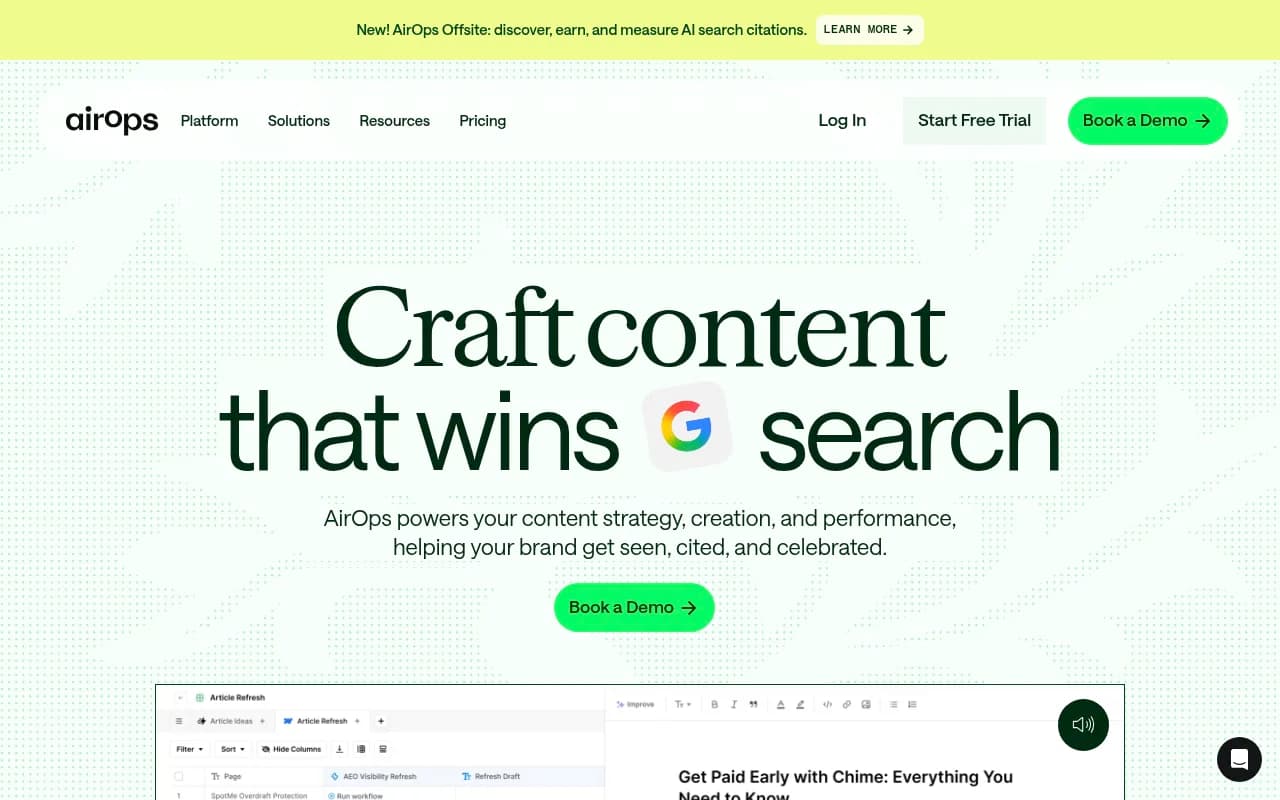
AirOps started as an AI workflow builder and has evolved into what it calls a "growth platform for AI search." It connects visibility insights, content execution, and measurement. Its Quill agent (launched May 2026) handles autonomous content creation, and it integrates with nine CMS platforms. The pitch is a closed loop from insight to publish to measurement.
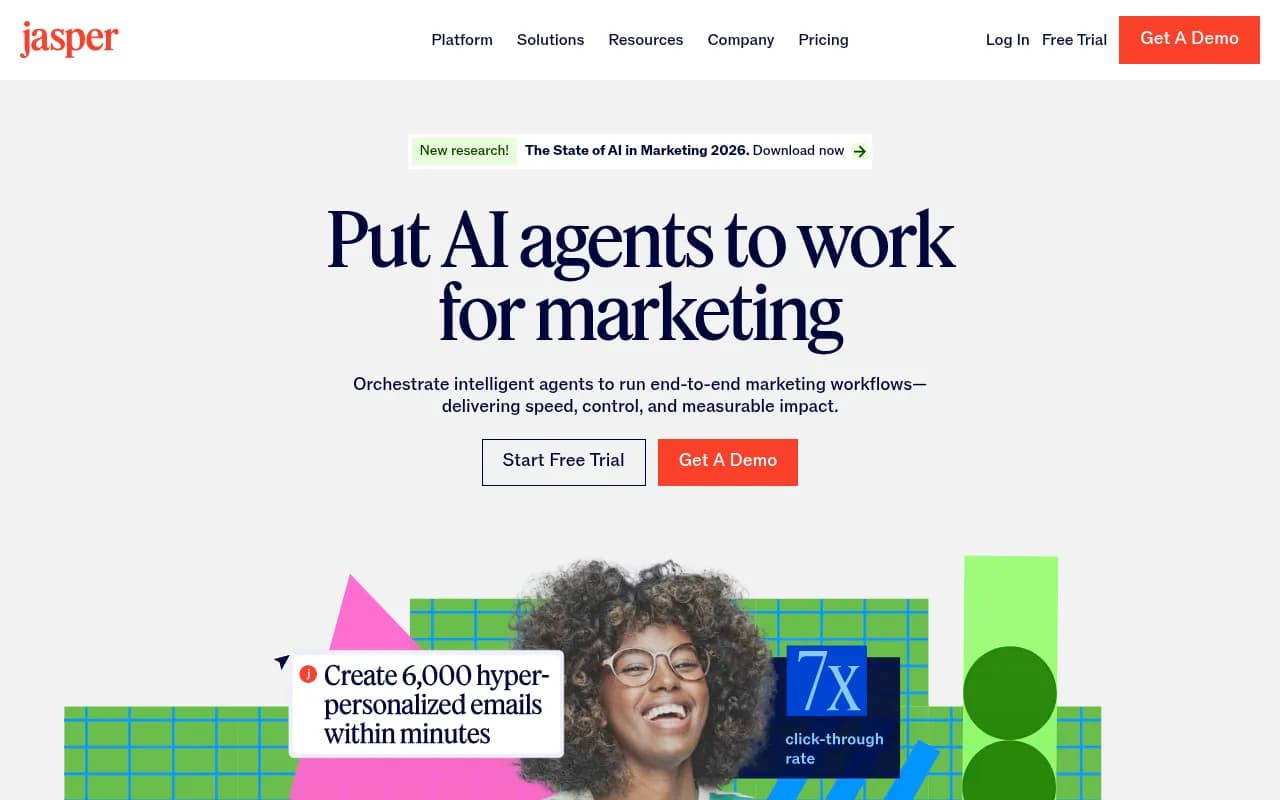
Jasper AI is a content creation platform with a library of 100+ marketing agents. Its strength is brand consistency at scale — Jasper IQ stores your brand voice, guidelines, and tone so every piece of content sounds like it came from the same team. It's built for high-volume content operations, not AI search analytics.
Copy.ai sits in a similar space to Jasper: fast, versatile AI copywriting. It's particularly strong for marketing copy — ads, emails, landing pages, social posts. It has workflow automation features and a GTM AI platform angle, but it's not a visibility tracking tool.

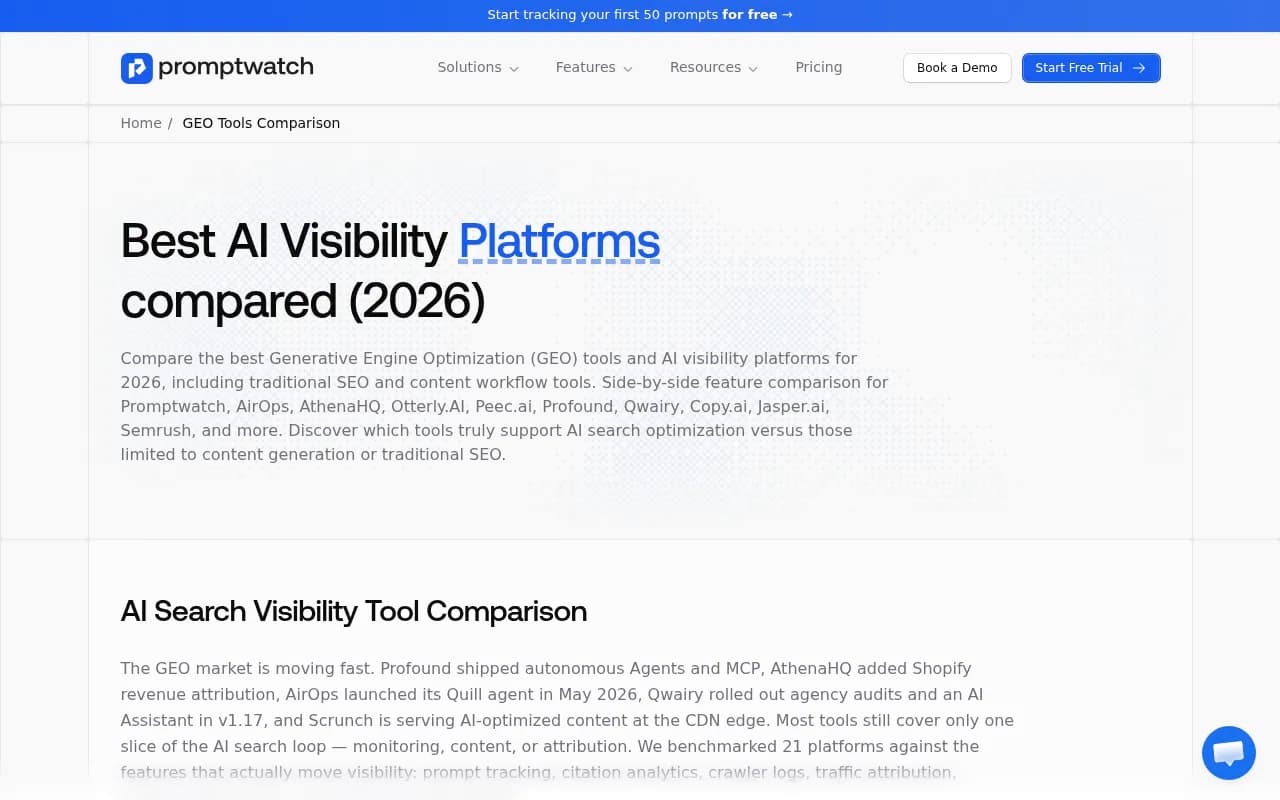
Promptwatch is built differently from the ground up. It's a GEO (Generative Engine Optimization) platform that tracks how your brand appears across 10 AI search engines, identifies exactly which prompts competitors are visible for that you're not, generates content designed to close those gaps, and then tracks whether that content gets cited. The loop is the product.

The core difference: monitoring vs. creating vs. optimizing
This is where most comparisons go wrong. People treat these as competing tools when they're actually solving different parts of a problem.
Think of AI search visibility as a three-step problem:
- Find out where you're invisible (and where competitors aren't)
- Create content that fills those gaps
- Track whether it worked
AirOps and Jasper both live in step 2. Copy.ai lives almost entirely in step 2. None of them were built to do step 1 or step 3 in any meaningful way.
Promptwatch covers all three. Its Answer Gap Analysis shows you the specific prompts where competitors get cited and you don't. Its Content Agents generate articles grounded in real citation data and prompt volumes. And its page-level tracking shows you exactly which pages AI models are citing, how often, and which models are doing the citing.
That's not a minor feature difference. It's a fundamentally different product philosophy.
Feature-by-feature comparison
| Feature | AirOps | Jasper AI | Copy.ai | Promptwatch |
|---|---|---|---|---|
| AI search visibility tracking | Partial | No | No | Yes (10 models) |
| Prompt/query monitoring | Limited | No | No | Yes |
| Citation analytics | Limited | No | No | Yes |
| AI crawler logs | No | No | No | Yes |
| Answer gap analysis | No | No | No | Yes |
| Content generation | Yes (Quill agent) | Yes (100+ agents) | Yes | Yes (Content Agents) |
| Brand voice/guidelines | Limited | Yes (Jasper IQ) | Partial | Yes |
| Traffic attribution to AI | Limited | No | No | Yes |
| Reddit/YouTube insights | No | No | No | Yes |
| ChatGPT Shopping tracking | No | No | No | Yes |
| Prompt volume & difficulty | No | No | No | Yes |
| CMS integrations | Yes (9) | Yes | Yes | Yes |
| Multi-language/region | Limited | Yes | Yes | Yes |
| Starting price | Free tier | ~$49/mo | ~$49/mo | $99/mo |
A few things stand out in that table. Jasper's brand governance is genuinely strong — if you're running a large content team and brand consistency is your main headache, Jasper IQ is real. AirOps has the most developed content-to-measurement loop of the three content tools. Copy.ai is the fastest for pure copywriting output.
But none of them tell you whether AI search engines are actually citing your content. That's the gap.
AirOps: the closest competitor to a full-stack approach
Of the four platforms, AirOps has made the most deliberate move toward AI search visibility. Its positioning as a "growth platform for AI search" isn't just marketing — it does have AEO analytics, and the Quill agent can execute content autonomously based on visibility data.
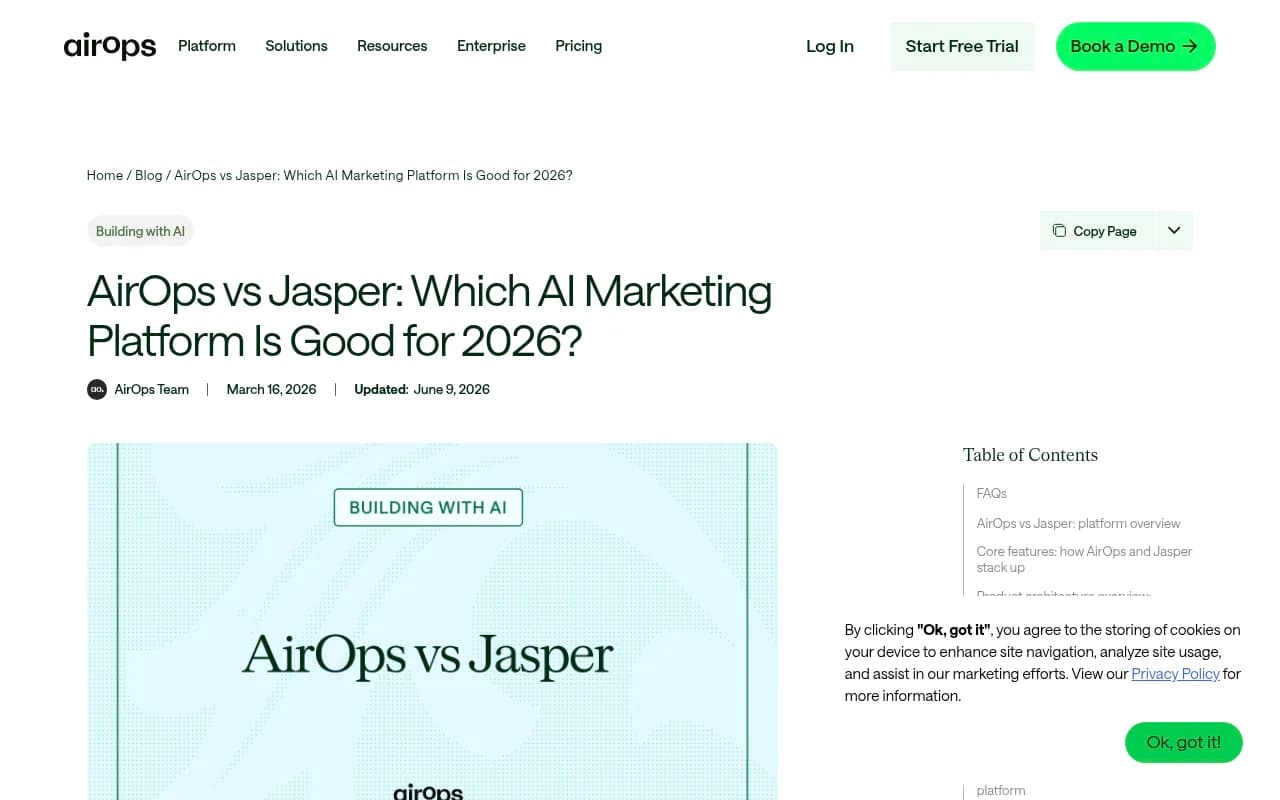
Where AirOps falls short is depth. It tracks up to four AI models (versus Promptwatch's ten). It doesn't have crawler logs that show you when AI agents are hitting your pages. It doesn't surface Reddit threads or YouTube videos that are influencing AI recommendations. And its prompt intelligence — volume estimates, difficulty scores, query fan-outs — is limited compared to a dedicated GEO platform.
For content operations teams that already have some visibility data and need help executing at scale, AirOps is a reasonable choice. For teams that need to understand why they're not showing up and fix it systematically, it's not enough on its own.
Jasper AI: excellent at content, silent on visibility
Jasper's 100+ agents and Jasper IQ brand governance system are genuinely impressive for what they do. If you're a marketing team producing hundreds of pieces of content per month and struggling to maintain consistency, Jasper solves that problem well.
But Jasper doesn't know whether any of that content is getting cited by ChatGPT. It doesn't track which prompts your competitors are winning. It doesn't show you AI crawler activity on your site. It's a content production tool that happens to be used by teams who care about AI search, not an AI search optimization tool.
The AirOps team's own comparison puts it plainly: Jasper builds outward from content creation, AirOps builds outward from AI visibility data. Both are honest framings. Neither is Promptwatch.
Copy.ai: fast content, no visibility layer
Copy.ai is the most straightforward of the four. It's a versatile AI writing tool that's particularly good at marketing copy — emails, ads, social content, landing pages. Its GTM AI platform angle adds some workflow automation, but it's not tracking AI search citations.
For teams that need to produce a lot of marketing content quickly and don't yet have an AI visibility strategy, Copy.ai is a reasonable starting point. But if your goal is to appear in AI-generated answers, you need something that tells you what to write and whether it worked.
Promptwatch: the only one built around the optimization loop
The honest case for Promptwatch is simple: it's the only platform here that treats AI search visibility as an optimization problem rather than a content production problem.
The Answer Gap Analysis shows you exactly which prompts competitors are visible for that you're not — not vague category data, but specific questions with volume estimates and difficulty scores. The Content Agents generate articles designed to answer those specific gaps, grounded in citation data, competitor analysis, and real prompt behavior. And the tracking layer closes the loop: page-level visibility scores, AI crawler logs, and traffic attribution that connects citations to actual revenue.
A few capabilities that don't exist in the other three tools:
- AI crawler logs showing when ChatGPT, Claude, Perplexity, and others are crawling your pages, what errors they encounter, and how often they return
- Offsite citation analysis tracking which Reddit threads, YouTube videos, and third-party pages are driving AI visibility for your competitors
- ChatGPT Shopping tracking for brands that appear in product recommendations
- Query fan-outs showing how one prompt branches into sub-queries, so you can prioritize content that covers the full topic cluster
Promptwatch's pricing starts at $99/month for one site and 50 prompts, which is more than Copy.ai's entry tier but less than what you'd pay for AirOps or Jasper at equivalent content volumes. The Professional plan at $249/month adds crawler logs, city/state tracking, and 15 articles per month.
Which platform should you actually use?
The answer depends on what problem you're actually trying to solve.
Use AirOps if you're a content operations team that already has some AI visibility data and needs a platform to execute content at scale with measurement built in. The Quill agent and CMS integrations are genuinely useful for teams managing high content volumes.
Use Jasper AI if brand consistency is your primary challenge and you're producing content at high volume across a large team. Jasper IQ is the best brand governance system in this comparison. Just don't expect it to tell you whether any of that content is getting cited.
Use Copy.ai if you need fast, versatile marketing copy and you're not yet at the stage where AI search visibility is a core KPI. It's a good entry point for teams building out their content workflow.
Use Promptwatch if your actual goal is to appear in AI-generated answers and you want to track whether your efforts are working. It's the only platform here that connects the visibility gap to content creation to citation tracking in one place. For marketing teams, SEO teams, and agencies that need to show AI search ROI, it's the most complete tool in the comparison.
The monitoring-only trap
One thing worth naming: a lot of teams in 2026 are paying for monitoring tools that show them they're invisible in AI search, then switching to content tools to try to fix it, then going back to the monitoring tool to see if it worked. That's three tools, three workflows, and a lot of manual work connecting the dots.
The platforms that will win this space are the ones that close that loop natively. AirOps is trying to do this. Promptwatch has done it. Jasper and Copy.ai aren't trying to.
If you're evaluating tools right now, the question to ask isn't "which AI writing tool is best?" It's "which platform can show me a gap, help me close it, and prove that it worked?" That's a different question, and it leads to a different answer.
Bottom line
AirOps, Jasper AI, and Copy.ai are all capable content tools. They'll help you produce more content faster. But content volume isn't the bottleneck for most teams trying to improve AI search visibility — knowing what to write and whether it's working is.
Promptwatch is the only platform in this comparison built around that problem. For teams that need to move their AI visibility score, not just their content output, that's the meaningful difference.