Key takeaways
- AirOps, Jasper, and Copy.ai have split into three different products. AirOps is a content operations/engineering platform for technical teams running high-volume SEO workflows, Jasper is now a brand-voice and marketing-agent platform, and Copy.ai is the execution layer inside Fullcast's RevOps stack after its October 2025 acquisition.
- None of the three wins outright on content quality. Independent testing from ContentMonk scored AirOps, Jasper, and Copy.ai between 3.0 and 3.2 out of 5 on overall content quality, all flagged as "high" AI slop, requiring 2-5 hours of editing per article.
- Pricing has gotten more complicated, not less. AirOps jumps from a free tier straight to roughly $200/month (Solo) with no mid-tier plan before a ~$2,000/month Pro plan. Copy.ai now runs $29/month for basic chat up to $3,000/month for its Scale plan. Jasper Pro starts at $59/month per seat but a second seat forces you into a custom Business quote.
- If your bottleneck is writing on-brand long-form content, Jasper is the safer default. If it's repetitive GTM tasks (outreach, lead research, CRM updates), Copy.ai fits better, though its roadmap now depends on Fullcast. If it's orchestrating complex, repeatable content pipelines across dozens of pages a month with a technical team, AirOps is built for that, at a price.
- Scaling output and getting cited by AI engines are two different goals. If AI search visibility is part of why you're scaling content, a dedicated tracking layer like Promptwatch matters more than which writing tool you pick.
Why this comparison looks different than it did two years ago
If you Googled this comparison in 2023, you'd have found three fairly similar AI writing tools competing on template count and word-count limits. That's gone. By 2026, all three have repositioned into adjacent but distinct categories, and the differences matter more than the similarities now.
AirOps calls itself a content engineering platform. It's a drag-and-drop workflow builder that connects keyword research, content generation across 40+ AI models, optimization, and publishing into repeatable pipelines. Jasper rebuilt itself around brand governance and, in June 2026, launched an autonomous GEO Agent that monitors AI visibility and executes optimization workflows on its own. Copy.ai stopped being a standalone content tool entirely when Fullcast acquired it in October 2025, folding it into a broader RevOps platform where Copy.ai's agentic workflows now execute against GTM plans built in Fullcast.
So the real question isn't "which one writes better copy." It's "which category of problem do you actually have."
AirOps vs Jasper vs Copy.ai at a glance
| AirOps | Jasper | Copy.ai | |
|---|---|---|---|
| Core identity | Content operations/engineering platform | Brand-voice marketing platform with agentic GEO tools | Execution layer inside Fullcast's RevOps stack |
| Best for | Technical teams running 200+ articles/month | Marketing teams needing on-brand content at scale | Sales-led teams automating outbound and GTM copy |
| Entry pricing | ~$200/mo (Solo), steep jump to ~$2,000/mo (Pro) | $59/mo per seat (Pro); Business is custom-quoted | $29/mo (Chat, 5 seats) up to $3,000/mo (Scale) |
| AI models | 40+ models (GPT, Claude, Gemini, etc.) | OpenAI/Anthropic/Gemini via Jasper IQ layer | OpenAI/Anthropic/Gemini via Chat |
| Governance | Brand Kits, Knowledge Bases | Brand Voice, Knowledge, Governance (Jasper IQ) | Brand voice setup via "intelligence layer" |
| AI visibility features | AI Insights across 7+ answer engines (Pro tier) | GEO Agent + GEO Hub (launched June 2026) | None native; relies on Fullcast integration |
| Independent quality score (ContentMonk) | 3.0/5 | 3.2/5 | 3.1/5 |
| Ease of use (ContentMonk) | 2.5/5 | 4.0/5 | 4.3/5 |
AirOps: built for technical teams, not for the faint of budget
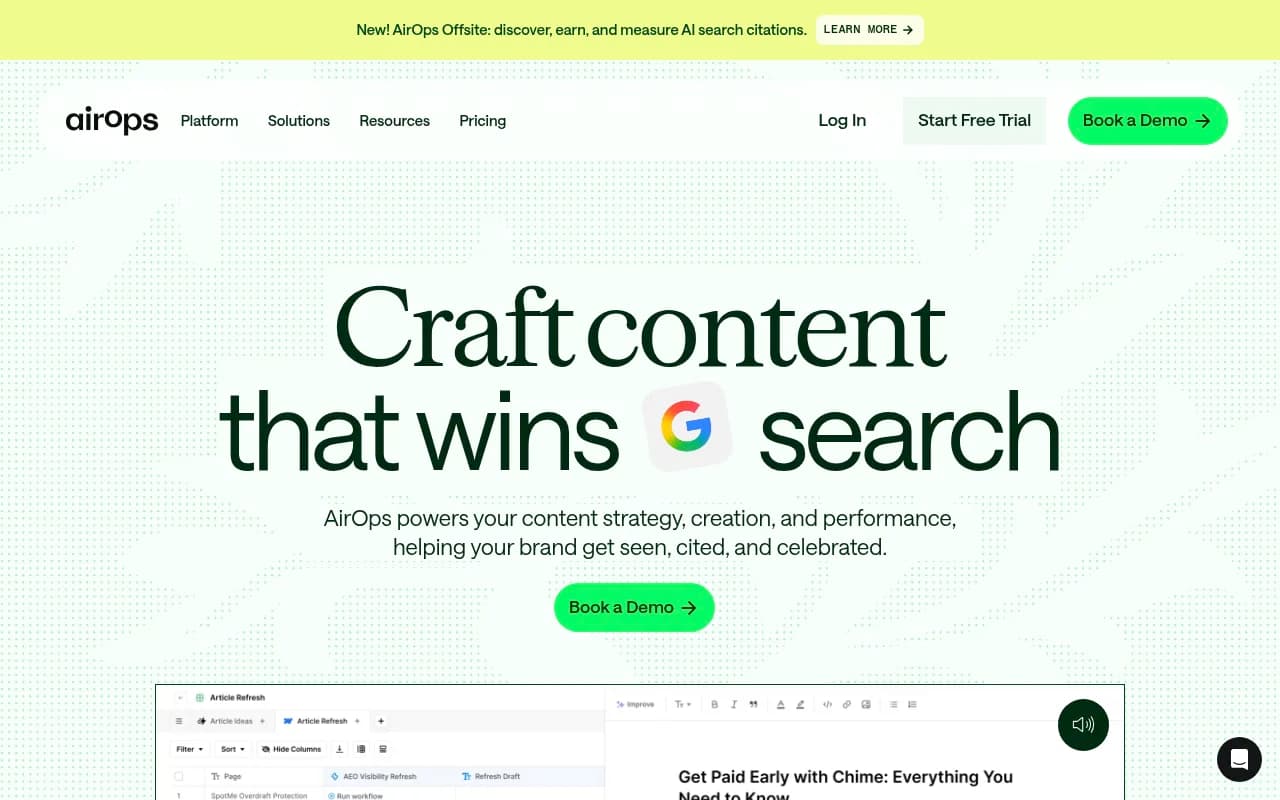
AirOps is the most technically ambitious of the three. You get a visual workflow builder, access to 40+ AI models, SOC 2 Type II compliance, and the ability to chain keyword research, content creation, optimization, and publishing into a single repeatable system. That's the pitch, and for teams that already know their content operation cold, it's a genuinely different tool than a chat-based writer.
The catch is the learning curve and the price. ContentMonk's hands-on testing found AirOps scored just 2.5 out of 5 on ease of use, the lowest of any tool in their comparison, and noted that its $200/month starter plan only covers enough tasks for roughly 6-7 articles before you're pushed to a $2,000/month Pro plan. There's no comfortable middle tier for a growing team that isn't ready to commit five figures a year. AirOps' own pricing page has since bumped included task volumes (35,000 on Solo, 100,000 on Pro) without publishing new headline prices, so expect to request a live quote rather than trust older third-party numbers.
Where AirOps genuinely differentiates is visibility data. Its Pro tier tracks AI Insights across seven or more answer engines and ties that data back into the workflow, so in theory you're not just producing content, you're producing content aimed at what's actually getting cited. Customers like Carta and Webflow have reported strong results tying AirOps workflows to AI citation growth. Whether that's the workflow tooling or the underlying content strategy doing the work is harder to separate from the outside.
Jasper: the safer default for brand-consistent content at scale
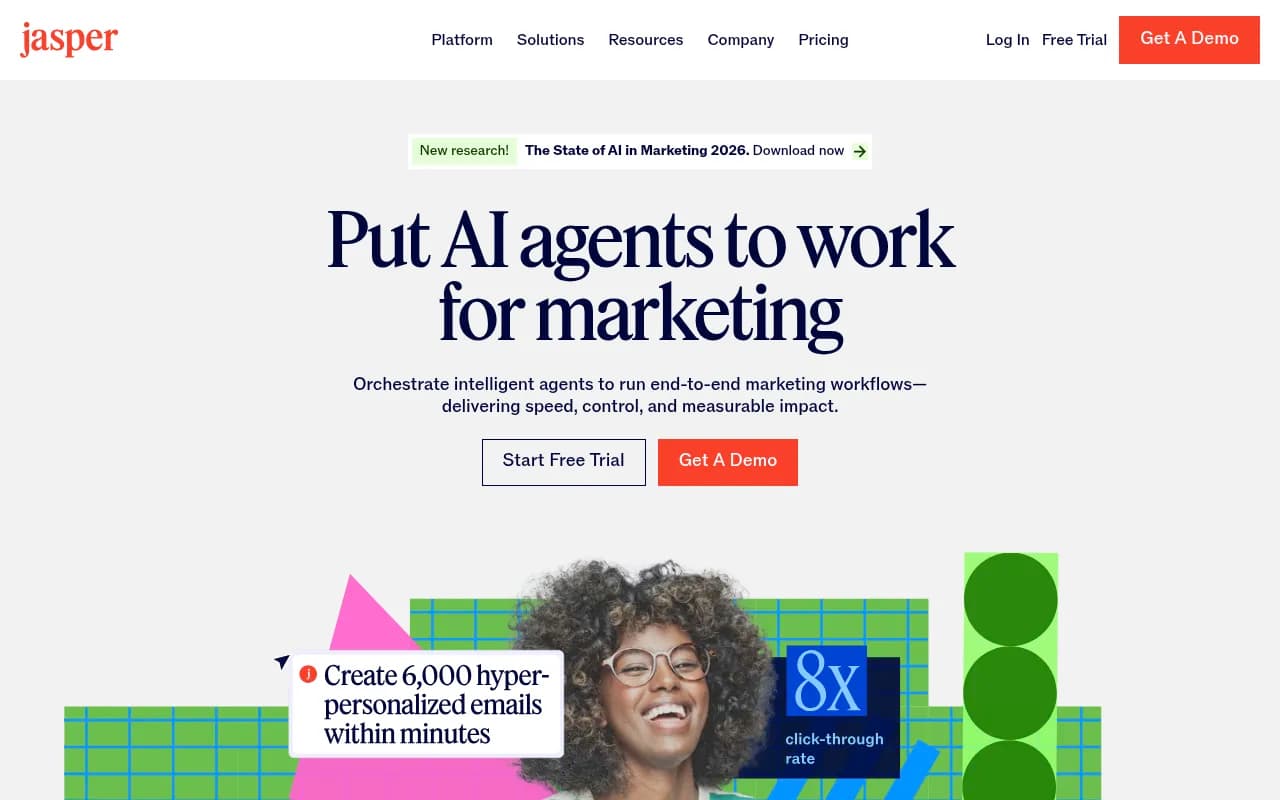
Jasper's repositioning has been the most coherent of the three. It's no longer trying to be everything; it's a marketing-specific platform built around what it calls "Jasper IQ," a layer of Brand Voice, Knowledge, Style Guide, and Governance context that gets applied to every piece of content, regardless of which agent or template produced it.
That consistency shows up in the numbers. Jasper Pro starts at $59/month for one seat, which is the most approachable entry price of the three platforms, though there's no self-serve path to a second seat, you're pushed straight to a custom Business quote. Jasper claims usage by roughly 20% of the Fortune 500, and case studies from SentinelOne and Wayfair back the enterprise positioning.
The bigger move: in June 2026, Jasper launched an end-to-end GEO Agent and GEO Hub, an autonomous system that monitors brand visibility across ChatGPT, Gemini, and Claude, flags discoverability gaps, and triggers content generation or updates tied to citation rates and sentiment. That's Jasper trying to close the same loop AirOps is chasing, monitoring plus execution, but bolted onto a writing tool with a decade of brand-voice muscle memory rather than built from a workflow-engineering foundation.
The honest caveat: independent testing still found Jasper's raw output quality middling (3.2/5 overall, "high" AI slop level, 3-5 hours of editing per article in ContentMonk's tests). Brand consistency and ease of use are Jasper's strengths. Zero-edit output quality is not one of them yet.
Copy.ai: strong GTM automation, uncertain roadmap

Copy.ai's story changed the most. Fullcast, a RevOps automation company, acquired it in October 2025 and has since folded it into what it calls an AI-native revenue operations platform. Copy.ai's agentic workflows now execute content and outreach tied to GTM plans built inside Fullcast's planning tools, which is a meaningfully different product than the standalone AI writer Copy.ai used to be.
Current pricing runs from $29/month for a bare-bones Chat plan (5 seats, unlimited words) up through $1,000, $2,000, and $3,000/month tiers as you add workflow credits and seats, with Enterprise custom-quoted. That's a steep ladder, and a few third-party trackers still cite an outdated $49/month "Pro" plan that no longer matches Copy.ai's live pricing page, worth double-checking before you commit.
Copy.ai genuinely fits a specific bottleneck well: sales-led teams that need research, outreach drafting, and CRM updates chained together rather than a marketing team that needs long-form articles. Its own claimed case studies (a 300% coverage improvement for a 100,000-plus product catalog site, $2.6M in cost savings across a sales channel) point at GTM and catalog-scale use cases, not editorial content. Capterra reviews flag a recurring complaint that's worth taking seriously: hallucinated or awkward output requiring more editing than expected, plus confusion around billing changes since the acquisition. If product-roadmap independence matters to you, Copy.ai is now a bet on Fullcast's direction, not just Copy.ai's.
What none of these three tools actually solves
Here's the uncomfortable part. ContentMonk tested all three platforms against identical content briefs and none of them scored above 3.2 out of 5 on overall quality. Every one was flagged "high" on AI slop and required two to five hours of editing per article before publication. Scaling output with AirOps, Jasper, or Copy.ai doesn't automatically scale quality, it scales the volume of drafts you need to fix.
That matters more in 2026 than it did two years ago, because AI engines are getting pickier about what they cite. Promptwatch's data on ChatGPT's citation inventory shows the platform typically surfaces around five sources per web-search answer, versus roughly ten for Google AI Overviews and Perplexity, meaning there's genuinely less room per query for mediocre content to sneak in (https://promptwatch.com/data/average-sources-per-response). And format matters: ChatGPT's August 2026 citation data shows how-to content more than doubled its citation share over the month while social posts collapsed after Reddit's citation share on ChatGPT fell from roughly 4% to 0.5% in mid-August (https://promptwatch.com/data/reddit-citations-are-dropping-in-chatgpt). Mass-producing listicles with a scaling tool, in other words, is increasingly betting on a format that's losing ground.
The good news for mid-market teams: you don't need top-tier domain authority to get cited. Promptwatch's domain-rank analysis found mid-authority sites (DR 46-75) account for nearly half of all ChatGPT citations, while the very highest-authority domains (DR 91-100) fell from about 7% to 3% of citations over the same period (https://promptwatch.com/data/chatgpt-citation-share-by-domain-rank-august-2026). If your content is genuinely useful and well-structured, scale doesn't require enterprise-grade domain authority to compete.
Which one should you actually pick
| Your bottleneck | Pick | Why |
|---|---|---|
| Producing on-brand content fast with strong governance | Jasper | Lowest entry price, most mature brand-voice tooling, new GEO Agent for visibility |
| Orchestrating complex, repeatable content pipelines at high volume | AirOps | Deepest workflow customization and model flexibility, if you have the budget and technical staff |
| Automating repetitive GTM and sales tasks tied to a revenue plan | Copy.ai | Purpose-built for research, outreach, and CRM-linked workflows, now inside Fullcast |
| Knowing whether any of this content is actually getting cited by AI | A dedicated visibility platform | None of the three above measure this well on their own |
On that last row: production tools and visibility tools solve different problems, and conflating them is a common mistake. AirOps and Jasper have both bolted on visibility features, but if AI search citations and AI-driven traffic are core to why you're scaling content in the first place, it's worth running a platform built specifically for that job alongside whichever writer you pick.
Promptwatch tracks citations, crawler behavior, and AI-driven traffic across ChatGPT, Gemini, Claude, Perplexity, Google AI Overviews, and more, then uses that data to generate and prioritize the content work that actually moves visibility, closing the loop that AirOps and Jasper are each trying to approximate from the content-production side.

If you're still deciding between a broader set of AI content and GEO tools, the directory at bestgeosoftware.com is a reasonable place to compare more of the field before committing budget to any single platform.
The bottom line
There's no single winner here because the three tools stopped competing for the same job. Jasper is the most defensible pick for a marketing team that needs consistent, on-brand content without a steep learning curve. AirOps makes sense only if you have the technical staff and budget to justify its workflow depth and its awkward pricing gap. Copy.ai fits a sales-automation bottleneck well, but you're buying into Fullcast's roadmap now, not Copy.ai's original one. And regardless of which you choose, plan on real human editing time, because none of the three, by independent testing, produce publish-ready copy on the first pass.