Key takeaways
- AirOps is a content operations and AI workflow platform, not a pure AI visibility tracker -- it's best for teams running multi-step content pipelines at scale.
- Surfer SEO is a page-level content optimization suite built around SERP analysis and real-time content scoring -- strong for writers, weaker for AI search.
- Promptwatch is the only platform of the three with a complete AI search visibility loop: prompt tracking, citation analysis, crawler logs, content generation, and traffic attribution in one place.
- If your goal is ranking in Google, Surfer SEO is still a solid choice. If your goal is appearing in ChatGPT, Perplexity, Gemini, and Google AI Overviews, you need a different tool.
- The right pick depends on your operating model: optimizer, workflow engine, or end-to-end AI visibility platform.
The way people find information is changing faster than most marketing teams can keep up with. ChatGPT alone now accounts for roughly 20% of buyer research in some categories. Google AI Overviews appear on the majority of informational queries. Perplexity is becoming a default research tool for tech-savvy buyers. And yet most content teams are still optimizing for a search engine that increasingly shares the stage with AI models that don't rank pages -- they synthesize them.
That's the context for this comparison. AirOps, Surfer SEO, and Promptwatch are three very different tools that often get lumped together under "AI content" or "SEO platform" labels. They shouldn't be. Each solves a different problem, and choosing the wrong one means you're either over-engineered for your actual workflow or completely blind to where your buyers are now searching.
Let's break down what each tool actually does, where it's genuinely useful, and where it falls short.
What each tool actually is
Before comparing features, it's worth being honest about what category each tool belongs to.
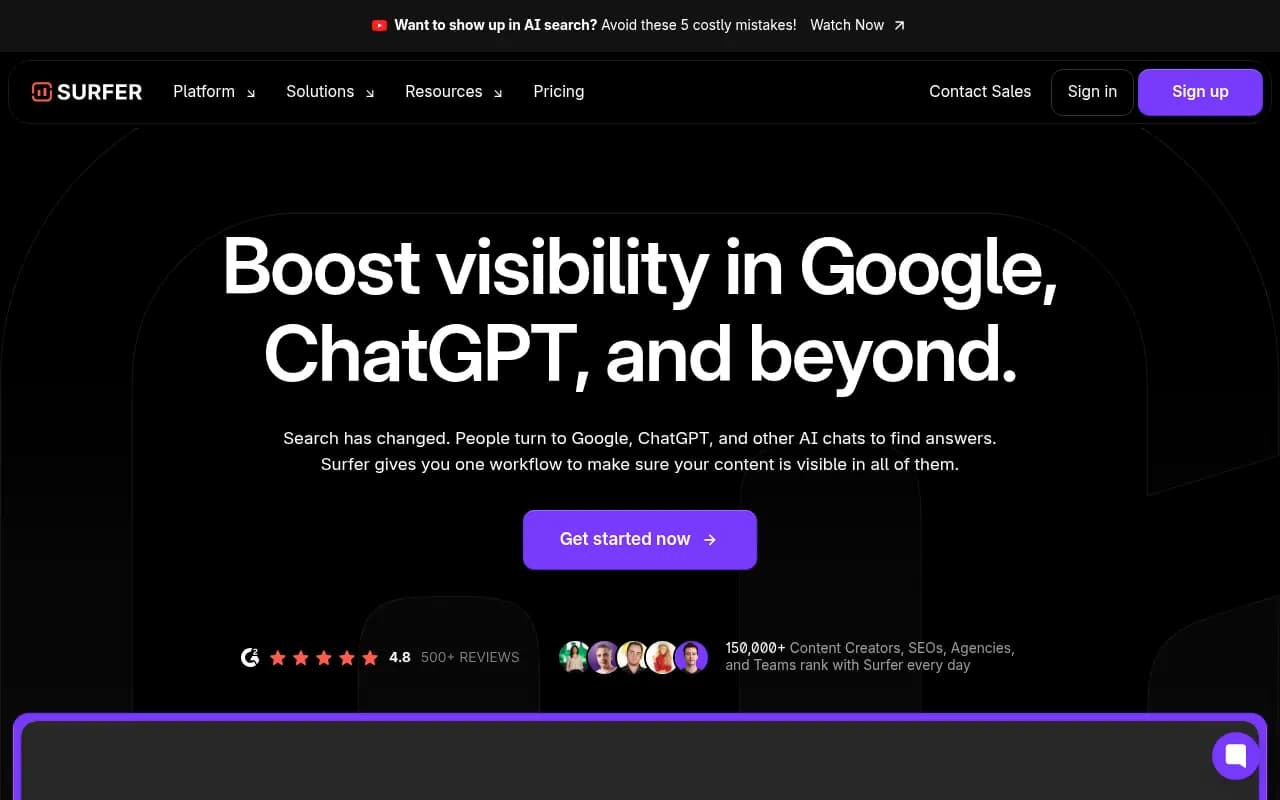
Surfer SEO: on-page optimization for Google
Surfer SEO is built around one core idea: analyze the top-ranking pages for a keyword, extract the patterns (word count, headings, NLP terms, structure), and give writers a real-time score as they write. It's a content optimization tool for traditional search. The Content Editor is its flagship feature -- you paste in a keyword, get a brief, write against a live score, and publish something that's more likely to rank on Google.
Surfer also has a keyword research tool, an audit feature for existing pages, and an AI writing assistant. But the core value is page-level optimization grounded in SERP data.
What Surfer doesn't do: track how your brand appears in ChatGPT responses, analyze which of your pages are being cited by Perplexity, show you which prompts competitors are winning that you're not, or help you understand why an AI model is or isn't recommending you.
AirOps: content operations and AI workflow orchestration
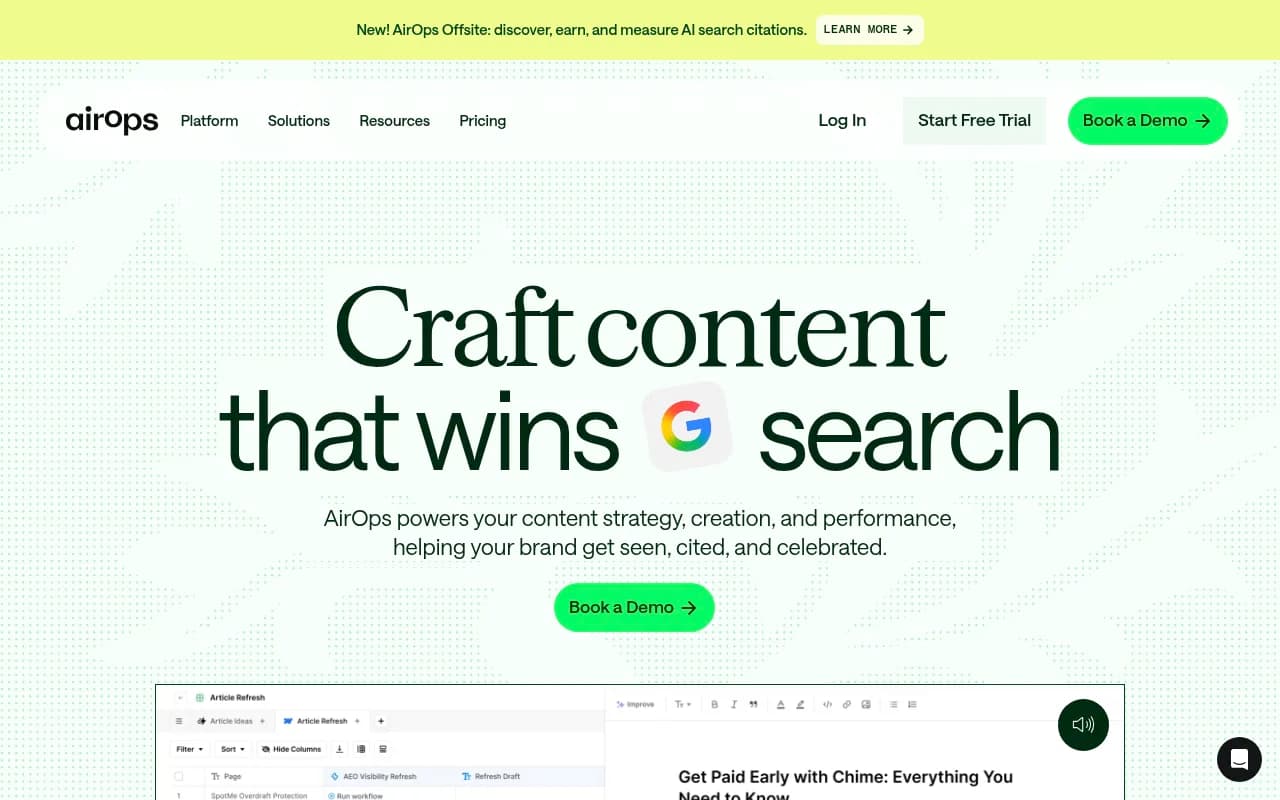
AirOps is harder to categorize because it's genuinely more of a platform than a point solution. It combines AI workflow automation, content generation pipelines, and -- more recently -- AI search visibility tracking. The Quill agent, launched in May 2026, added content generation capabilities. AirOps also published a 2026 State of AI Search report with Kevin Indig, which shows the company is serious about the AI search space.
The core strength of AirOps is workflow orchestration. If you need to run a multi-step pipeline -- pull data from a source, run it through an LLM, format the output, push it to a CMS -- AirOps handles that well. It's a good fit for content operations teams that need repeatable, scalable workflows.
Where AirOps is weaker: it tracks up to four AI models (compared to ten for some competitors), its AI visibility features are newer and less mature than dedicated GEO platforms, and it doesn't have the depth of citation analysis, crawler logs, or traffic attribution that a purpose-built AI visibility platform provides.
Promptwatch: end-to-end AI search visibility
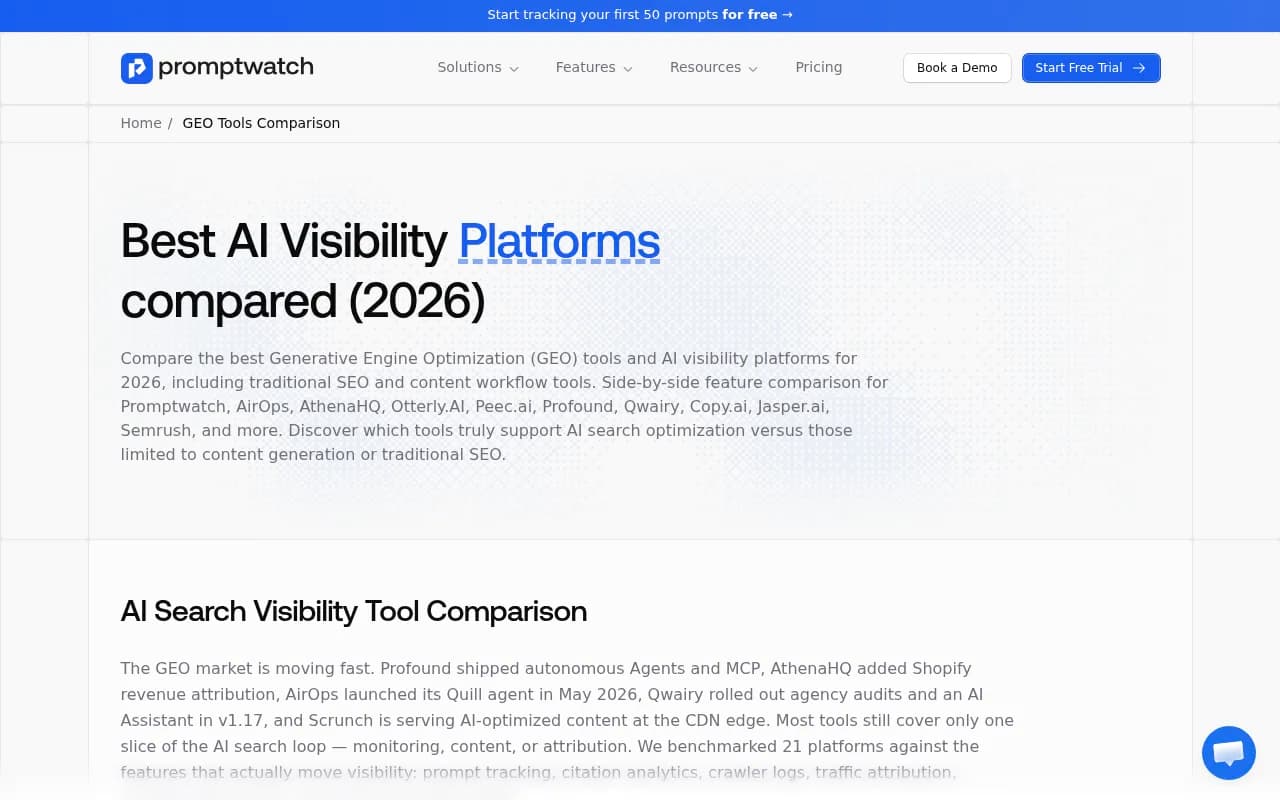
Promptwatch is built specifically for AI search visibility -- what the industry calls Generative Engine Optimization (GEO). It tracks how your brand appears across ten AI models (ChatGPT, Perplexity, Gemini, Claude, Google AI Overviews, Grok, DeepSeek, Copilot, Meta AI, and Mistral), shows you which pages are being cited and which aren't, logs AI crawler activity on your site in real time, and generates content designed to close the gaps it finds.
The key difference from the other two: Promptwatch is built around an action loop, not just a dashboard. It finds the prompts where competitors are visible and you're not (Answer Gap Analysis), generates content to fill those gaps (Content Agents), and tracks whether that content gets cited after it's published. That's a complete cycle. Most tools in this space stop at step one.

Feature-by-feature comparison
| Feature | Surfer SEO | AirOps | Promptwatch |
|---|---|---|---|
| AI models tracked | None (Google-focused) | Up to 4 | 10 |
| Prompt/query tracking | No | Partial | Yes |
| Citation analysis | No | Limited | Yes (page-level) |
| AI crawler logs | No | No | Yes |
| Content generation | Yes (Google-optimized) | Yes (Quill agent) | Yes (AI-grounded briefs) |
| Answer Gap Analysis | No | No | Yes |
| Traffic attribution from AI | No | No | Yes |
| Reddit/YouTube insights | No | No | Yes |
| ChatGPT Shopping tracking | No | No | Yes |
| Competitor heatmaps | No | No | Yes |
| Multi-language/region | Limited | No | Yes |
| Starting price | ~$89/mo | Free tier + custom | $99/mo |
| Best for | Writers optimizing for Google | Content ops teams at scale | Teams targeting AI search visibility |
Where Surfer SEO still wins
Surfer SEO is genuinely good at what it does. If your primary goal is ranking on Google, and you have writers who need real-time guidance as they produce content, Surfer's Content Editor is one of the best tools available. The SERP analysis is solid, the NLP term suggestions are useful, and the workflow from keyword to published article is smooth.
For agencies managing lots of client content, Surfer's audit feature helps identify which existing pages need refreshing. The brief generation is fast. The interface is clean. Writers can use it without a steep learning curve.
The problem is that Surfer was built for a world where Google was the only search engine that mattered. That world still exists -- Google still handles the majority of search volume -- but it's no longer the complete picture. A page that scores 85 in Surfer's Content Editor might still be invisible in ChatGPT responses, because the signals that make AI models cite a page are different from the signals that make Google rank it.
Surfer has no answer for that gap. It doesn't track AI citations, doesn't monitor how AI models respond to prompts in your category, and doesn't help you understand what content AI models actually want to see.
Where AirOps fits
AirOps makes the most sense for content operations teams that need to run workflows at scale -- pulling data, generating drafts, formatting outputs, pushing to CMS. If you have a complex content pipeline with multiple steps and multiple stakeholders, AirOps's orchestration capabilities are genuinely useful.
The AI search visibility features are real but newer. AirOps tracks some AI models and has added content generation through Quill. For teams that are already using AirOps for workflow automation and want to layer in some AI visibility tracking, it's a reasonable choice.
Where it gets complicated: AirOps isn't primarily a GEO platform. It's a workflow platform that has added GEO features. If AI search visibility is your primary goal rather than a secondary concern, you'll hit the ceiling of what AirOps can do faster than you'd expect. Four models tracked, limited citation depth, no crawler logs, no traffic attribution -- these are meaningful gaps if AI search is central to your strategy.
Where Promptwatch wins
Promptwatch is the right choice when AI search visibility is the actual goal, not a side feature. The platform tracks ten AI models, which matters because ChatGPT, Perplexity, and Google AI Overviews don't always agree on who to cite. A brand can be well-cited in Perplexity and invisible in ChatGPT Shopping -- and you need to know that.
The Answer Gap Analysis is the feature that separates Promptwatch from monitoring-only tools. It shows you the specific prompts where competitors are getting cited and you're not. That's not just interesting data -- it's a content brief waiting to be written. The Content Agents then generate articles, comparisons, and listicles grounded in that real prompt data, with brand guidance, competitor analysis, and citation context built in.
The AI crawler logs are worth calling out specifically. Most GEO platforms show you what's happening in AI responses. Promptwatch also shows you what's happening before that -- which pages AI crawlers are visiting, how often, what errors they're hitting, and when a page moves from "crawled" to "cited." That's a level of diagnostic detail that most competitors simply don't have.
For teams that want to connect AI visibility to revenue, the traffic attribution features tie AI citations to actual site visits and conversions. That closes the loop from "we're being cited more" to "here's what that's worth."
Pricing reality check
Pricing matters, so here's a straightforward look at what you're actually paying:
| Tool | Entry price | What you get |
|---|---|---|
| Surfer SEO | ~$89/mo | Content Editor, keyword research, audits, Google-focused |
| AirOps | Free tier + custom | Workflow automation, limited AI tracking, Quill agent |
| Promptwatch Essential | $99/mo | 1 site, 50 prompts, 5 articles, 10 AI models |
| Promptwatch Professional | $249/mo | 2 sites, 150 prompts, 15 articles, crawler logs, city tracking |
| Promptwatch Business | $579/mo | 5 sites, 350 prompts, 30 articles |
Surfer SEO and Promptwatch's Essential plan are close in price, but they're solving different problems. If you need both Google optimization and AI search visibility, you'd likely need both tools -- or you'd choose based on where your buyers actually are.
AirOps's pricing is less transparent at the enterprise level, which makes direct comparison harder. The free tier is useful for experimentation, but serious content operations work typically requires a paid plan.
Which tool for which team
The honest answer is that these three tools aren't really competing for the same buyer.
A writer-led team at a small agency that needs to produce Google-optimized content quickly should look at Surfer SEO. It's purpose-built for that workflow and does it well.
A content operations team at a mid-to-large company that needs to run multi-step AI workflows -- research, generation, formatting, publishing -- at scale should look at AirOps. The orchestration capabilities are real and the Quill agent adds useful generation capacity.
A marketing or SEO team that wants to understand and improve how their brand appears in AI search engines -- ChatGPT, Perplexity, Gemini, Google AI Overviews -- should look at Promptwatch. It's the only platform of the three built specifically for that problem, with the depth of features (crawler logs, citation analysis, gap analysis, content generation grounded in real prompt data) to actually move the needle.
If you're running an in-house SEO program and AI search is becoming a real part of your traffic picture, Promptwatch is the more future-proof investment. The brands that figure out AI search visibility now are going to have a meaningful head start over those that wait until it's obvious.
A note on the broader market
These three tools don't exist in isolation. The GEO and AI visibility market has expanded quickly in 2026, with platforms like Profound, AthenaHQ, Otterly.AI, and Peec.ai all competing for similar buyers.
Profound


Otterly.AI

Most of those platforms are monitoring-focused -- they show you data about where you appear in AI responses, but they don't help you fix the gaps. That's the core distinction worth keeping in mind as you evaluate any tool in this space: does it show you the problem, or does it help you solve it?
Surfer SEO doesn't address AI search at all. AirOps addresses it partially. Promptwatch is built around the full loop from discovery to execution to measurement.
That's not a knock on Surfer or AirOps -- they're good tools for their intended use cases. But if AI search visibility is your actual goal, you need a platform that treats it as the primary problem, not a secondary feature.
Bottom line
The "which tool is best" question is the wrong question. The right question is: what problem are you actually trying to solve?
Optimizing pages for Google rankings? Surfer SEO is purpose-built for that.
Running content operations workflows at scale with some AI search monitoring layered in? AirOps is worth evaluating.
Understanding and improving how your brand appears across ten AI search engines, with the ability to find gaps, generate content to fill them, and track the results? Promptwatch is the platform built for that specific problem -- and in 2026, that problem is increasingly the one that matters.
The brands showing up in ChatGPT and Perplexity responses aren't there by accident. They're there because they've figured out what AI models want to cite and built content that delivers it. That's what a purpose-built AI visibility platform makes possible.