Key takeaways
- Beehiiv is the strongest all-in-one newsletter growth platform in 2026, with built-in monetization, referral programs, and a website builder -- but it has a real learning curve.
- Substack is the easiest way to start a paid newsletter, but its 10% revenue cut and limited customization become painful as you grow.
- Kit (formerly ConvertKit) is built for course creators and digital product sellers, not pure newsletter publishers.
- Mailchimp is better suited for e-commerce email than content newsletters -- its pricing and complexity work against growing creators.
- Ghost is the best option if you want a blogging platform with email built in, strong SEO, and full control over paid subscriptions with no revenue share.
Picking a newsletter platform in 2026 is genuinely harder than it was three years ago. Every tool has added features, rebranded, or repositioned itself, and the differences that matter aren't always obvious from a features page. I've dug into how each of these five platforms actually works for content marketers -- the monetization math, the growth mechanics, the SEO story, and the pricing reality.
Here's the honest breakdown.
The five platforms at a glance
Before going deep, it helps to understand what each platform was actually built for. This shapes everything from the UI to the pricing model to which features get prioritized.
- Beehiiv was founded in 2021 by the team that built Morning Brew. It's designed specifically for newsletter operators who want to grow and monetize.
- Substack is a publishing platform that doubles as a discovery network. It's built around the idea that writers should be able to charge subscribers directly.
- Kit (formerly ConvertKit) started as an email marketing tool for bloggers and course creators. The newsletter features came later.
- Mailchimp was built for small business email marketing -- think promotional blasts and e-commerce workflows. It acquired newsletter features but they're not the core.
- Ghost is an open-source publishing platform. It combines blogging, email newsletters, and paid memberships, with a strong focus on SEO and content ownership.
Feature comparison table
| Beehiiv | Substack | Kit | Mailchimp | Ghost | |
|---|---|---|---|---|---|
| Built for newsletters | Yes | Yes | Partial | No | Partial |
| Free plan | Yes (up to 2,500 subs) | Yes | Yes (up to 10,000 subs) | Yes (up to 500 subs) | No (self-hosted only) |
| Revenue share | None | 10% | None | None | None |
| Paid subscriptions | Yes | Yes | Yes | No | Yes |
| Built-in website | Yes | Yes | Yes | No | Yes |
| SEO / blogging | Basic | Basic | Basic | No | Strong |
| Referral program | Yes (Boosts) | No | No | No | No |
| Ad network | Yes | No | No | No | No |
| Automation | Yes | No | Yes | Yes | Basic |
| Self-hosted option | No | No | No | No | Yes |
| Starting price | Free / $39/mo | Free | Free / $25/mo | Free / $13/mo | $9/mo (managed) |
Beehiiv: the newsletter operator's platform
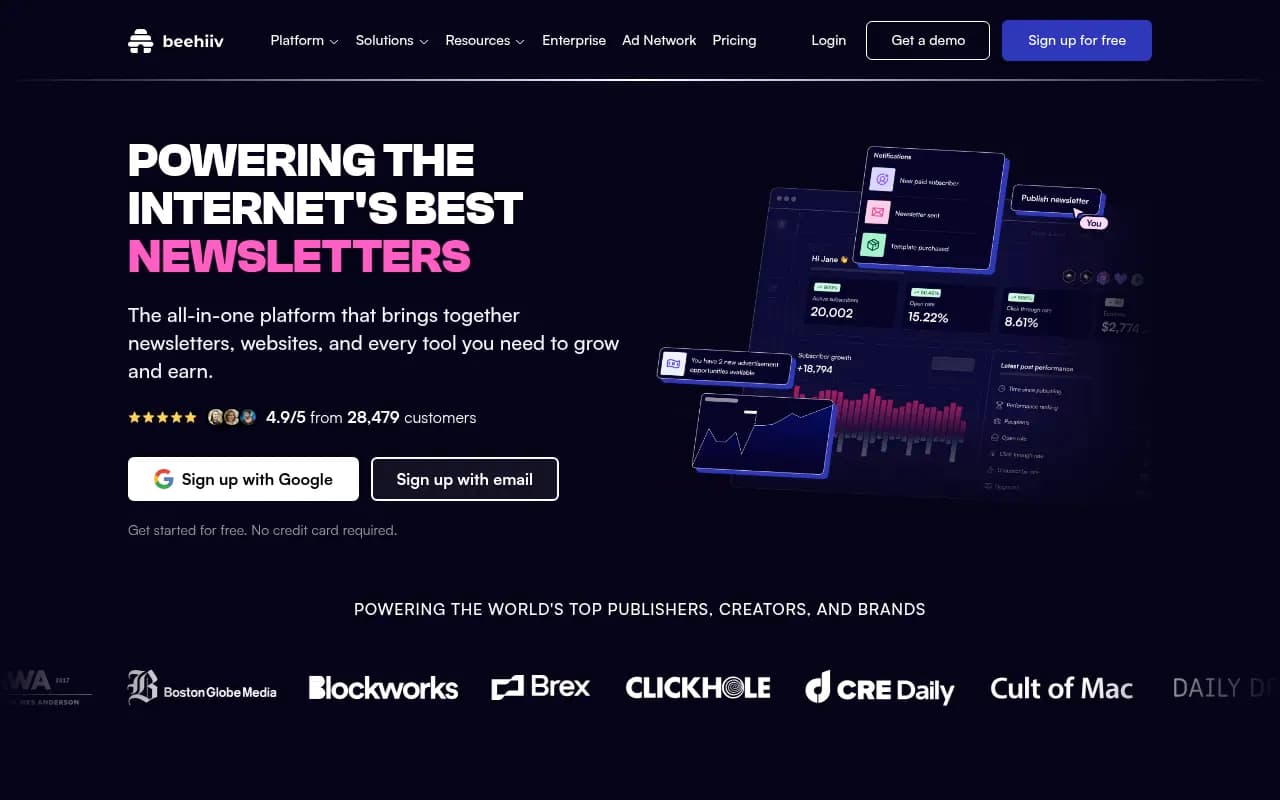
Beehiiv is the most newsletter-native platform in this comparison. It was built by people who ran a newsletter at scale, and that shows in the product decisions.
The standout feature is the Boost program. You can earn $1-$4 per new subscriber you send to other newsletters, and you can pay to acquire subscribers through the same network. This is a growth mechanic that no other platform in this list has. Combined with a built-in referral program, Beehiiv gives you actual tools to grow your list -- not just send to it.
The ad network is another differentiator. Once your list reaches a certain size, you can monetize through sponsored placements without having to find advertisers yourself. For newsletter operators who want to run a media business, this is significant.
The analytics are also genuinely useful -- open rates, click rates, subscriber growth, and revenue attribution all in one dashboard. The website builder is solid enough that many operators use it as their primary web presence.
Where Beehiiv struggles: the learning curve is real. There are a lot of settings, a lot of features, and the interface takes time to learn. If you just want to write and send, it can feel like overkill. The free plan is generous (up to 2,500 subscribers), but the paid plans start at $39/month and scale up based on subscriber count.
Best for: Serious newsletter businesses, media operators, anyone who wants to monetize through ads or paid subscriptions and grow aggressively.
Substack: the simplest path to paid newsletters
Substack's appeal is clarity. You sign up, you write, you publish. If you want to charge for access, you flip a switch and set a price. Substack handles payments, subscriber management, and delivery. There's no setup complexity.
The discovery network is genuinely valuable, especially early on. Substack recommends publications to readers based on their interests, and if your content resonates, you can pick up subscribers organically without any marketing spend. This is something Beehiiv and Ghost can't offer.
The problem is the 10% revenue cut. At small scale, this is fine. At $5,000/month in subscription revenue, you're handing Substack $500 every month. At $20,000/month, that's $2,000 gone. The math gets uncomfortable fast, and unlike Ghost or Beehiiv, you can't negotiate it away.
Substack also has limited customization. Your newsletter looks like a Substack newsletter. The automation is essentially nonexistent -- there are no drip sequences, no tagging, no segmentation. You can't build a welcome sequence or a sales funnel. It's a publishing tool, not a marketing tool.
Best for: Writers who want to start a paid newsletter quickly, journalists, essayists, and anyone who values simplicity over control. Less suited to operators who want to scale revenue or run sophisticated email sequences.
Kit (formerly ConvertKit): built for creators selling products

Kit rebranded from ConvertKit in 2024, but the core product philosophy hasn't changed much. It's an email marketing platform designed for creators who sell things -- courses, memberships, digital downloads, coaching.
The automation is Kit's strongest suit. Visual automation builders, tagging, segmentation, conditional sequences -- if you want to build a funnel that moves subscribers from free content to a paid product, Kit handles this better than any other platform in this list.
The newsletter features, though, are basic. There's no built-in referral program, no ad network, no Boost equivalent. The website and landing page tools are functional but not impressive. If your primary goal is growing and monetizing a newsletter as a media product, Kit isn't really designed for that.
The free plan is generous -- up to 10,000 subscribers -- which makes it attractive for early-stage creators. Paid plans start at $25/month.
One honest note from the community: people who've used all three of Beehiiv, Substack, and Kit tend to land on Kit for course creators specifically, and Beehiiv for newsletter-first businesses. The use cases don't overlap as much as the marketing suggests.
Best for: Course creators, coaches, and digital product sellers who use email as a sales channel. Not ideal if the newsletter itself is the product.
Mailchimp: the e-commerce tool that does email
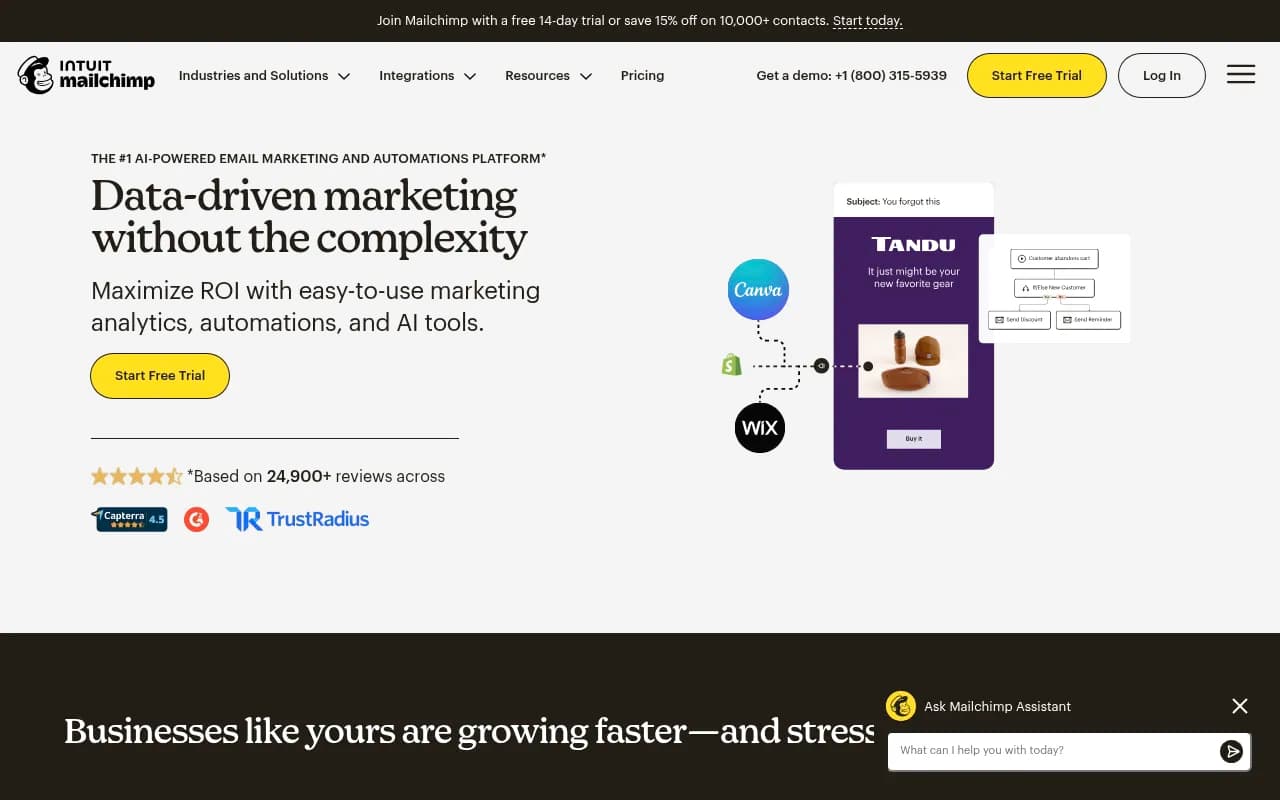
Mailchimp is the most recognized name in email marketing, but it's worth being direct: it wasn't built for content newsletters, and it shows.
Mailchimp's strengths are in e-commerce integrations, cart abandonment workflows, promotional campaigns, and transactional email. If you run an online store and want to send marketing emails to customers, Mailchimp is a reasonable choice.
For newsletter publishers, the experience is more frustrating. The interface is complex in ways that don't benefit content creators. There's no built-in monetization, no referral program, no ad network, no subscriber growth tools. The free plan caps at 500 contacts, which is quite low. Paid plans start at $13/month but scale quickly based on list size.
The analytics are solid, and the template library is extensive. But the overall product philosophy is promotional email, not content publishing.
Best for: Small businesses sending promotional or transactional email. Not recommended as a primary newsletter platform for content marketers.
Ghost: the blogging-first platform with email built in
Ghost takes a different approach from everyone else on this list. It's fundamentally a publishing platform -- a CMS with email and membership features layered on top, rather than an email tool with a website attached.
This distinction matters for SEO. Ghost publishes clean, fast, indexable content. It ranks well in search because it was designed to. If organic traffic is part of your growth strategy, Ghost has a meaningful advantage over Beehiiv and Substack, both of which have fairly basic SEO capabilities.
The paid membership model is straightforward: you set your own pricing, Ghost takes no revenue share (unlike Substack's 10%), and Stripe handles payments. You keep what you earn.
The tradeoff is that Ghost has no subscriber growth tools. No referral program, no ad network, no discovery network. Growth is entirely on you. The managed hosting (Ghost Pro) starts at $9/month for the Starter plan, which is affordable, but the self-hosted version requires technical setup.
As one creator put it: Ghost is the better choice if you want to blog, get organic search traffic, and email your list. Beehiiv is better if you want to run a weekly email newsletter as the primary product.
Best for: Bloggers who want email and memberships, publishers who care about SEO and content ownership, and anyone who wants to run paid subscriptions without a revenue share.
Monetization comparison: where the real differences show up
This is where the platform choice has the biggest financial impact.
Substack takes 10% of subscription revenue. Simple, but expensive at scale.
Beehiiv takes no revenue share on subscriptions. It also offers two additional revenue streams most platforms don't: the Boost program (earn per subscriber you refer) and the ad network (earn from sponsored placements). For newsletter operators, this is a genuinely different business model.
Ghost takes no revenue share. You pay a flat hosting fee and keep everything else. No growth mechanics built in, but full control.
Kit takes no revenue share, but its monetization is focused on selling your own products through email funnels, not newsletter subscriptions per se.
Mailchimp has no built-in paid subscription or monetization features for content.
If you're building a newsletter that generates $5,000+/month in subscription revenue, the Substack revenue share becomes a serious cost. At that point, migrating to Beehiiv or Ghost makes financial sense.
Pricing reality check
| Platform | Free plan | Entry paid | Notes |
|---|---|---|---|
| Beehiiv | Up to 2,500 subs | $39/mo | Scales by subscriber count |
| Substack | Unlimited (free newsletters) | Free + 10% on paid | Revenue share is the cost |
| Kit | Up to 10,000 subs | $25/mo | Most generous free tier |
| Mailchimp | Up to 500 contacts | $13/mo | Scales quickly, gets expensive |
| Ghost | No free managed hosting | $9/mo (Starter) | Self-hosted is free but technical |
The "free" label on Substack is a bit misleading -- you're not paying monthly, but you're paying a percentage of every dollar you earn. For a newsletter doing $2,000/month in subscriptions, that's $200/month to Substack. Beehiiv's $39/month looks different in that context.
SEO and content discoverability
If you want your newsletter content to rank in Google and bring in organic readers, Ghost is the clear winner. It's designed as a CMS first, and the technical SEO fundamentals (clean URLs, fast load times, proper metadata, RSS) are all handled well out of the box.
Beehiiv has improved its web publishing features, and you can build a real website with it, but it's not primarily a blogging platform. Substack's web presence is functional but limited in terms of customization and SEO control.
Kit and Mailchimp don't really compete on this dimension at all.
Which platform should you choose?
There's no universal answer, but the decision tree is fairly clear:
Choose Beehiiv if you're building a newsletter as a media business -- you want to grow your list aggressively, monetize through ads and subscriptions, and have analytics that tell you what's working. Be prepared for a learning curve.
Choose Substack if you're a writer who wants to start a paid newsletter with minimal setup and benefit from Substack's discovery network. Acceptable if your revenue is modest; the 10% cut becomes painful above $3-5K/month.
Choose Kit if you sell courses, coaching, or digital products and want to use email as a sales funnel. The newsletter features are secondary to the automation and product-selling tools.
Choose Mailchimp if you run a small business and need e-commerce email marketing. Don't use it as your primary newsletter platform.
Choose Ghost if you want to blog and build organic search traffic, run paid memberships without a revenue share, and own your content infrastructure. You'll need to handle your own growth.
A note on platform lock-in
One thing worth thinking about before you commit: how easy is it to leave?
Substack makes it reasonably easy to export your subscriber list (emails are yours). Beehiiv and Kit also allow full exports. Ghost, being open-source, gives you complete data portability. Mailchimp allows exports but the migration process can be messy.
The real lock-in risk with Substack isn't the data -- it's the discovery network. If a meaningful portion of your subscribers found you through Substack's recommendations, migrating means losing that acquisition channel.
Final thought
The newsletter platform market has matured. These tools have real, meaningful differences -- not just in feature lists but in the business models they're designed to support. A writer monetizing through paid subscriptions has different needs than a media operator running an ad-supported newsletter, who has different needs than a course creator using email to sell products.
Pick the platform that matches what you're actually building, not the one with the most features or the lowest price. The migration cost later is almost always higher than people expect.