Key takeaways
- Conductor is the strongest all-around pick for teams that need content-driven SEO plus AI search visibility in one platform.
- BrightEdge remains competitive for global enterprises but has slipped in AI-specific features relative to newer challengers.
- seoClarity wins on deep technical SEO at scale, with solid content tools layered on top.
- Botify is the right call when your primary problem is crawl budget, log file analysis, and JavaScript rendering at massive scale.
- Lumar (formerly DeepCrawl) is a specialist technical auditing platform -- excellent at what it does, but not a full-stack SEO solution.
- None of these five platforms fully solves AI search visibility on their own. For tracking how your brand appears in ChatGPT, Perplexity, Gemini, and Google AI Overviews, you need a dedicated GEO layer on top.
Enterprise SEO in 2026 is a different game than it was three years ago. Google still processes around 16 billion searches per day, but a growing share of those queries now return AI-generated answers -- and a lot of those answers don't send traffic anywhere. Meanwhile, ChatGPT, Perplexity, and Gemini are handling millions of queries that never touch Google at all.
The platforms in this comparison were all built for traditional enterprise SEO. They're good at it. But the question every marketing and SEO leader is now asking is: which one is actually ready for AI search? Which one helps you show up in the answers AI models generate, not just in the blue links below them?
That's what this guide is about.
The five platforms at a glance
Before going deep, here's a quick orientation on what each platform actually is:
- Conductor -- Content-forward enterprise SEO platform with AI search tracking, content intelligence, and workflow tools for large teams.
- BrightEdge -- One of the oldest enterprise SEO platforms, strong on global keyword tracking and opportunity forecasting, now pushing AI Catalyst features.
- seoClarity -- Deep technical SEO with strong rank intelligence, content gap analysis, and an AI content writer built in.
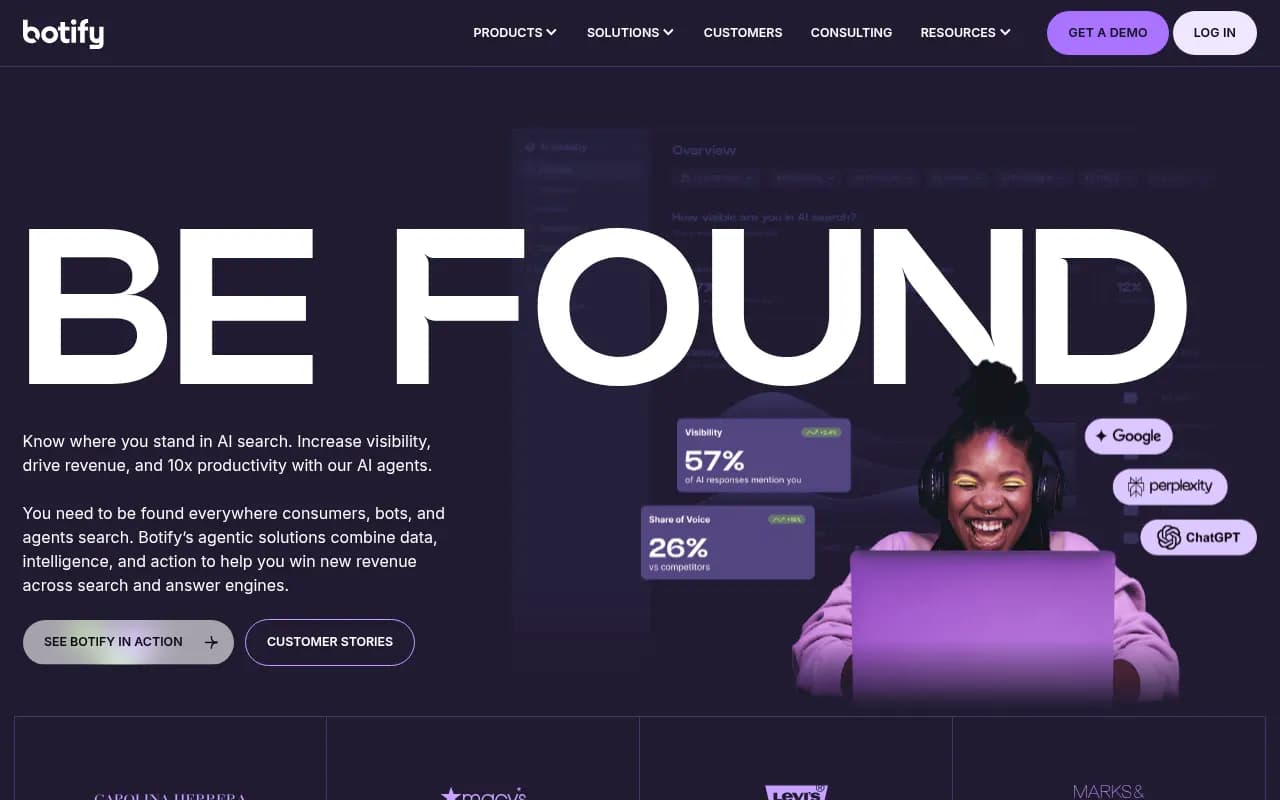
- Botify -- Specialized in technical SEO at scale: crawl analysis, log file processing, JavaScript rendering, and crawl budget optimization.
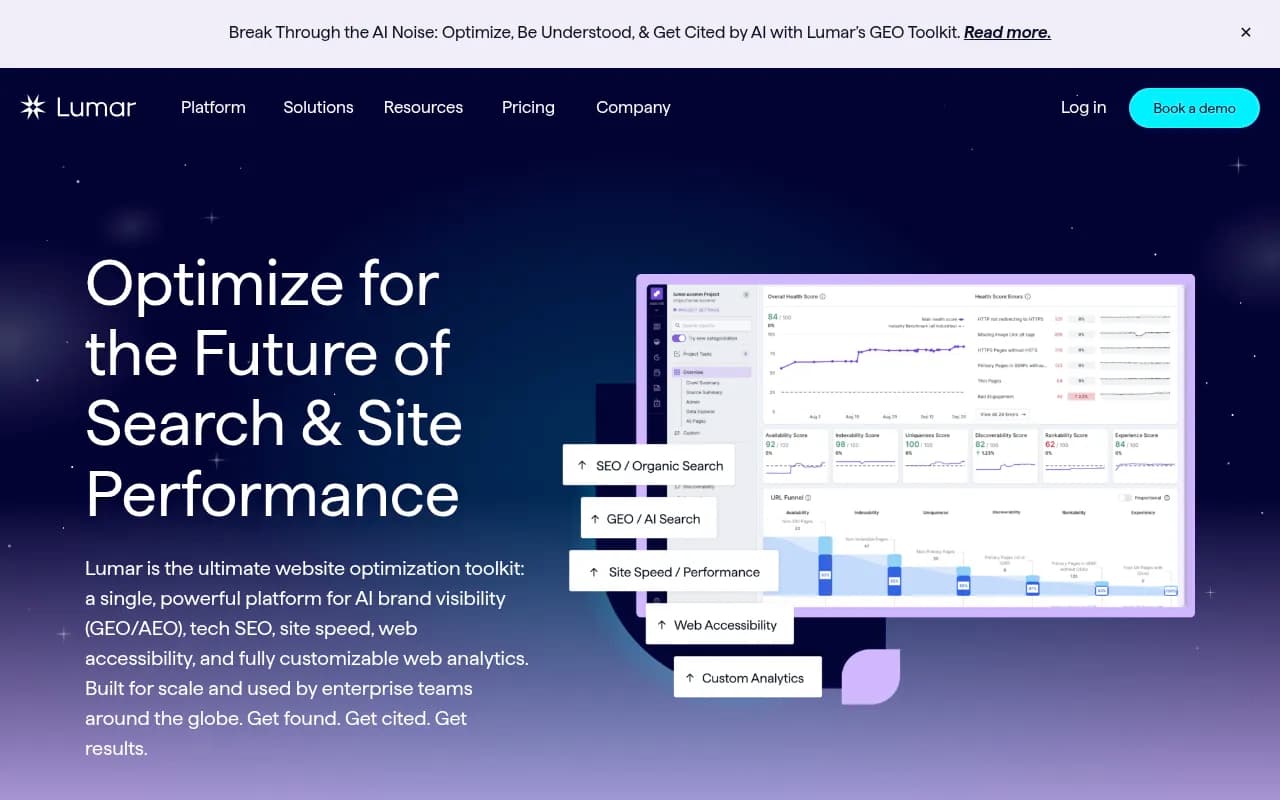
- Lumar -- Technical website auditing platform (formerly DeepCrawl), focused on crawlability, accessibility, and site health at enterprise scale.
Feature comparison table
| Feature | Conductor | BrightEdge | seoClarity | Botify | Lumar |
|---|---|---|---|---|---|
| Keyword rank tracking | Yes | Yes | Yes | Limited | No |
| Content recommendations | Strong | Strong | Strong | No | No |
| Technical SEO / crawling | Moderate | Moderate | Strong | Best-in-class | Best-in-class |
| Log file analysis | No | No | Yes | Yes | Yes |
| AI content generation | Yes | Partial | Yes | No | No |
| AI search tracking (LLMs) | Yes (basic) | Yes (AI Catalyst) | Limited | No | No |
| Google AI Overviews tracking | Yes | Yes | Limited | No | No |
| ROI / revenue attribution | Yes | Yes | Yes | Partial | No |
| Local SEO | Yes | Yes | Yes | No | No |
| API access | Yes | Yes | Yes | Yes | Yes |
| Best for | Content + AI search | Global enterprise | Technical + content | Crawl at scale | Technical audits |
Conductor: best for content-driven SEO teams moving into AI search
Conductor has positioned itself as the platform for teams that want to win visibility across both traditional SERPs and AI-powered discovery. That's a smart bet for 2026, and the product largely backs it up.
The content intelligence layer is genuinely strong. Conductor shows you which topics your site is missing, surfaces competitor content gaps, and helps teams prioritize work based on estimated traffic impact. The workflow tools -- task assignment, content briefs, approval flows -- make it easier to actually execute on recommendations rather than just generate reports nobody acts on.
On the AI search side, Conductor tracks AI Overviews and has added some LLM visibility features. It's not as deep as a dedicated GEO platform, but it's ahead of most traditional enterprise SEO tools.
Where Conductor is weaker: technical SEO depth. If your site has serious crawl budget problems, complex JavaScript rendering issues, or you're managing hundreds of millions of pages, Conductor won't give you the granular log file and crawl analysis that Botify or Lumar will.
Pricing is enterprise-only (custom quotes), which means you'll need to go through a sales process to get numbers.
Best fit: Marketing and SEO teams where content production is the primary lever, and where AI search visibility is becoming a strategic priority.
BrightEdge: the established player trying to stay relevant
BrightEdge has been around since 2007 and has the enterprise customer base to show for it. It's a serious platform with strong global keyword tracking, opportunity forecasting, and content recommendations. The Data Cube -- BrightEdge's proprietary keyword database -- is one of the larger ones in the industry.
The AI Catalyst feature set is BrightEdge's answer to the AI search moment. It tracks AI Overviews and has added some generative AI content tools. The honest assessment: it's functional but not leading. BrightEdge built its reputation on keyword tracking and content performance benchmarking, and those remain its strongest areas.
One consistent complaint from enterprise users (including in the r/bigseo community) is that BrightEdge can be slow to ship promised features. If you're evaluating it partly on its AI roadmap, factor in some skepticism about delivery timelines.
The platform is also known for being expensive and requiring long contract commitments. That's fine if you're getting full value from it, but it's worth pressure-testing before signing.
Best fit: Large global enterprises already invested in BrightEdge's ecosystem, where keyword tracking and content benchmarking are the primary use cases.
seoClarity: the technical-meets-content platform
seoClarity sits in an interesting position: it's more technically capable than Conductor or BrightEdge, but not as specialized as Botify or Lumar. That middle ground is actually useful for a lot of enterprise teams.
The rank intelligence is strong -- seoClarity tracks rankings at scale with good segmentation capabilities, which matters when you're managing thousands of pages across multiple regions. The Research Grid (their keyword research tool) is genuinely useful for content planning, and the content gap analysis is one of the better implementations in the enterprise space.
The AI content writer is a real feature, not just a marketing claim. It generates content briefs and drafts grounded in SEO data, which is more useful than generic AI writing tools that don't understand search intent.
On the technical side, seoClarity includes site audits, a crawler, page speed analysis, internal link analysis, and log file analysis. It's not Botify-level depth, but it covers the bases most enterprise teams need.
The AI search tracking is the weakest area. seoClarity has some Answer Box opportunity tracking, but it doesn't have robust LLM visibility monitoring. If AI search is a top priority, you'll need to supplement.
Best fit: Enterprise teams that need strong rank tracking, content gap analysis, and technical SEO in one platform, without the extreme specialization of Botify.
Botify: when crawl scale is the actual problem
Botify is a different kind of tool. It's not trying to be your all-in-one SEO platform -- it's trying to be the best possible solution for the specific problem of making large websites crawlable, indexable, and technically sound at scale.
If you're running a site with millions of pages, Botify's log file analysis is genuinely impressive. It shows you exactly which pages Googlebot is crawling, how often, and where crawl budget is being wasted. The JavaScript rendering analysis helps you understand what search engines actually see versus what users see. For e-commerce sites, news publishers, and other large-scale operations, this level of technical insight is hard to get anywhere else.
Botify has also added some AI-specific features -- it now positions itself as covering GEO alongside traditional SEO. But the core strength is still technical, and that's where it earns its price tag.
What Botify doesn't do well: content strategy, keyword research, and anything related to AI search visibility in LLMs. It's a technical platform, and it's honest about that.
Best fit: Large e-commerce sites, media publishers, and any organization where crawl budget, JavaScript rendering, and technical indexability are the primary bottlenecks.
Lumar: the technical audit specialist
Lumar (rebranded from DeepCrawl in 2022) is the most focused platform in this comparison. It does technical website auditing -- crawlability, accessibility, Core Web Vitals, structured data, and site health -- and it does it very well.
The platform has added GEO and AI search features to its positioning, but the honest picture is that Lumar's strength is technical auditing. It's excellent for teams that need to run comprehensive site audits, track technical health over time, and catch regressions before they affect rankings.
What Lumar is not: a keyword tracking platform, a content strategy tool, or an AI search visibility solution. If you're looking for a platform to manage your full SEO program, Lumar needs to be paired with other tools.
Best fit: Technical SEO teams that need deep auditing capabilities, particularly for accessibility compliance and site health monitoring alongside SEO.
The AI search gap all five platforms share
Here's the honest truth about all five platforms: none of them were built for the AI search era, and all of them are retrofitting AI features onto traditional SEO infrastructure.
Conductor and BrightEdge are furthest along -- they track Google AI Overviews and have some LLM visibility features. But tracking whether your brand appears in ChatGPT responses, understanding which prompts drive AI citations, or analyzing why Perplexity cites a competitor instead of you -- that's not what these platforms were designed to do.
For teams where AI search visibility is becoming a real business priority, the practical answer is to run a dedicated GEO platform alongside your enterprise SEO tool. Promptwatch is built specifically for this -- it tracks how your brand appears across ChatGPT, Perplexity, Gemini, Google AI Overviews, Claude, Grok, and more, and it goes beyond monitoring to help you actually fix visibility gaps through content gap analysis and AI-optimized content generation.

The two layers complement each other. Your enterprise SEO platform handles keyword rankings, technical health, and content at scale. A GEO platform handles the AI search layer that traditional tools weren't built to address.
How to choose between the five
The right platform depends almost entirely on what your biggest problem is right now.
Choose Conductor if: Your SEO program is content-driven, you need workflow tools to coordinate a large team, and you want AI search tracking included without managing a separate tool for it.
Choose BrightEdge if: You're a large global enterprise already in the BrightEdge ecosystem, your primary needs are keyword tracking and content benchmarking, and you're willing to accept slower feature velocity in exchange for platform stability.
Choose seoClarity if: You need strong rank intelligence with good segmentation, content gap analysis, and an AI content writer, and you want more technical depth than Conductor without going full Botify.
Choose Botify if: You're running a site with millions of pages and your primary problems are crawl budget, log file analysis, and JavaScript rendering. Technical SEO at scale is Botify's reason for existing.
Choose Lumar if: Technical auditing and site health monitoring are your primary needs, particularly if accessibility compliance is part of your remit alongside SEO.
Pricing reality check
All five platforms are enterprise-priced, which means custom quotes and sales conversations rather than published pricing pages. A few things worth knowing going in:
- BrightEdge is generally considered the most expensive, with multi-year contracts common.
- Botify pricing scales with page volume, which can get expensive quickly for very large sites.
- seoClarity publishes some pricing tiers but enterprise contracts are negotiated.
- Conductor and Lumar are similarly opaque on pricing.
Budget at least $2,000-$5,000/month for any of these platforms at the enterprise tier, and often significantly more depending on scale and features.
Supplementary tools worth considering
None of these five platforms covers everything. Depending on your gaps, a few tools worth adding to your stack:
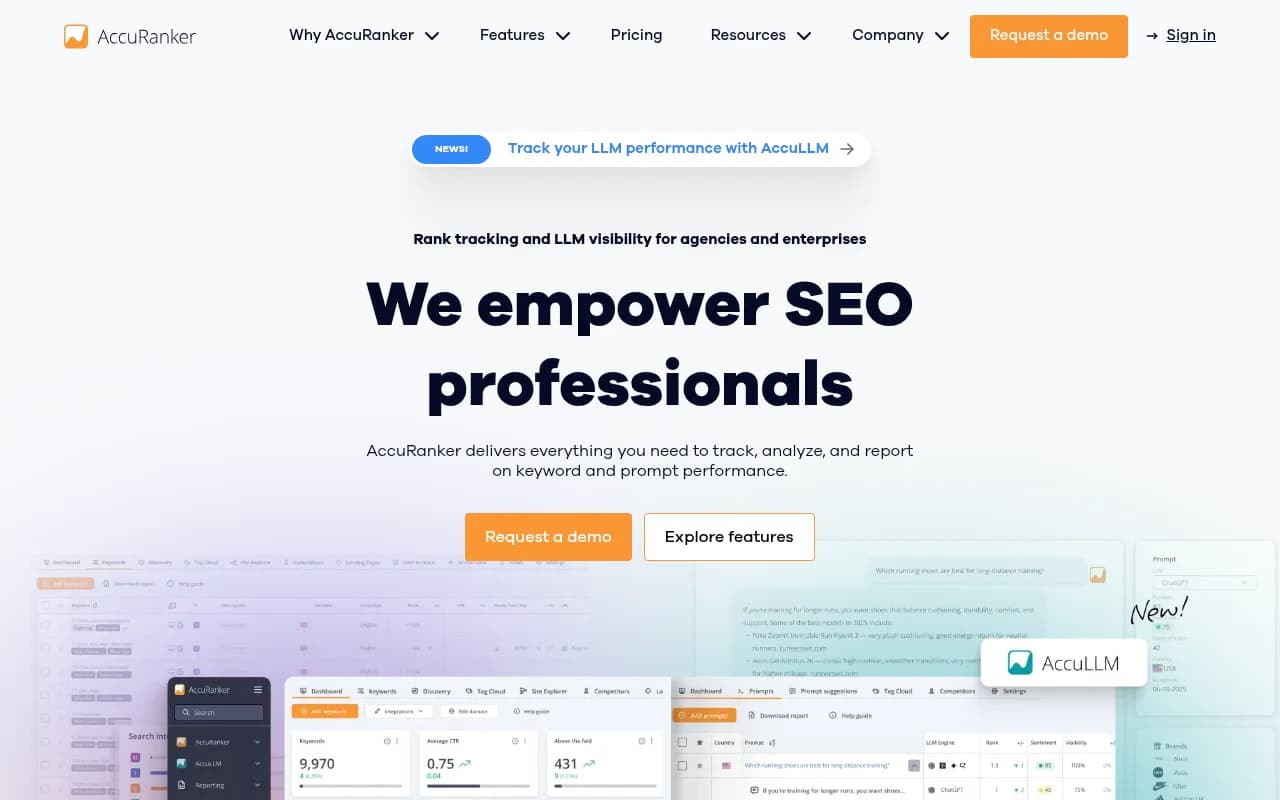
For rank tracking at scale with on-demand updates, AccuRanker is a strong standalone option.
For technical crawling at a lower price point than Botify or Lumar, Screaming Frog SEO Spider remains the most capable desktop crawler available.
For content optimization grounded in real search data, Clearscope or MarketMuse integrate well with any of the five platforms above.

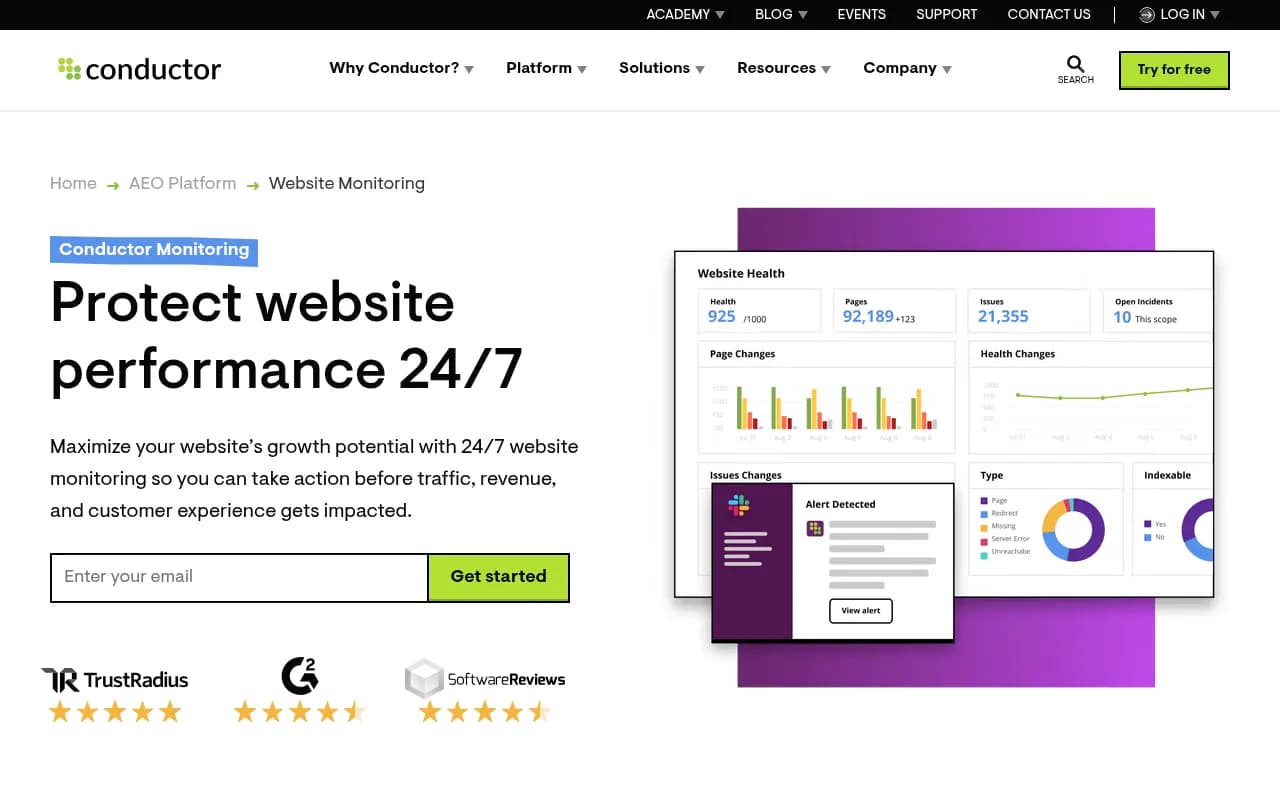
For real-time SEO auditing and change tracking (particularly useful alongside Conductor or BrightEdge), ContentKing monitors your site continuously rather than running periodic crawls.
The bottom line
Conductor is the most complete platform for most enterprise teams in 2026 -- it covers content strategy, AI search tracking, and workflow management better than the alternatives. seoClarity is the strongest runner-up if technical depth matters more than content workflow. Botify is the right choice when crawl scale is genuinely the bottleneck. BrightEdge is defensible if you're already in the ecosystem but harder to recommend as a new purchase given the pace of change. Lumar is excellent at what it does but too narrow to serve as a primary SEO platform.
The more important point: whichever platform you choose, you'll need to think separately about AI search visibility. The traditional enterprise SEO platforms are catching up, but they're not there yet. The brands showing up consistently in ChatGPT and Perplexity answers in 2026 are the ones that treated AI search as its own discipline, not as a checkbox on their existing SEO platform's roadmap.