Key takeaways
- Several tools once marketed as "under $100" have quietly repriced upward in 2026. Peec AI's Starter is now $95/month (not €89 for 25 prompts), and Promptwatch's cheapest paid plan, Essential, is $95/month, both right at the ceiling.
- Otterly AI's $29/month Lite plan looks cheapest on paper, but Claude, Gemini, and Google AI Mode are paid add-ons. Track all seven engines and you're paying roughly $76-$149/month, not $29.
- RankScale Essentials ($20/month) and LLM Pulse Starter (€49/month) are the genuinely cheapest ways to get daily, multi-engine monitoring without add-on surprises.
- Profound's $99 Starter only covers ChatGPT. If you need Perplexity or AI Overviews too, you're looking at its $399/month Growth tier, which blows the budget entirely.
- Under $100 buys you tracking. It rarely buys you the ability to act on what you find, no content generation, no crawler logs, no CMS publishing. Know what you're giving up before you commit.
Why this category got confusing in 2026
A year ago, "AI brand monitoring under $100" was a fairly simple shopping list. Now it's a minefield of asterisks. Vendors have raised prices, split features into add-ons, and renamed tiers, and a lot of the roundup articles floating around the internet are quoting numbers that are already stale.
I pulled current, verified pricing pages for a dozen tools while writing this, and the gap between what older "best of" lists say and what vendors currently charge is bigger than you'd expect. Peec AI, for instance, shows up in older comparisons at "€89 for 25 prompts." Its actual current pricing (confirmed against peec.ai/pricing and an independent review from Geoptie) is $95/month for 50 prompts, covering 3 of 7 possible AI engines, with a fourth engine costing an extra $35/month on top. That's a meaningfully different deal than the one being advertised in half the articles ranking for this topic right now.
So before recommending anything, it's worth being blunt about what "under $100" actually buys in each case, because the sticker price and the real price are often not the same number.
What you're actually monitoring, and why volume matters
Before comparing tools, it helps to know what a "prompt" or "response" quota is buying you. Different AI engines return different numbers of cited sources per answer, which changes how many response-checks you need to get a reliable signal.
According to Promptwatch's data on average sources per response, ChatGPT typically cites around 5 sources per web-search response, the smallest inventory among major engines, while Google AI Overviews and Perplexity cite roughly 10 sources each, and Microsoft Copilot swings wildly, from under 2 to nearly 17 sources within a few weeks as Microsoft keeps re-architecting its retrieval system. Practically, this means tracking ChatGPT well requires fewer checks than tracking AI Overviews or Perplexity, which is worth factoring in when a vendor advertises "50 prompts" without telling you how many engines those prompts run against.
It also matters because citation patterns move fast. Reddit's share of ChatGPT Search citations fell from about 6.11% in May 2026 to 3.71% in June, a roughly 40% drop in a single month, and then reportedly collapsed further, from around 4% to 0.5%, in a single day on August 14, 2026, according to Promptwatch's Reddit citation data. A tool that refreshes monthly would completely miss that. If your budget tool only checks weekly or monthly, you're seeing a blurry photo of something that changes daily.
The under-$100 field, ranked by what you actually get
Here's how the realistic options stack up once you account for add-on pricing and engine limits, not just the headline number on the pricing page.
| Tool | Real monthly cost | Engines included | Prompts/responses | Refresh | Catch |
|---|---|---|---|---|---|
| RankScale Essentials | $20 | 54+ engines available, credit-based | ~378 credits (~1,500 answers) | Configurable, up to hourly | Credits burn fast if you track many engines per prompt |
| LLM Pulse Starter | €49 (~$53) | 5 models included, no add-on fees | 50 prompts | Daily | Smaller prompt volume than Growth tier |
| Otterly AI Lite | $29 advertised / ~$76-149 realistic | 4 base engines; Claude, Gemini, AI Mode are paid add-ons | 15 prompts | Daily | The advertised price rarely matches what most brands need |
| Waikay Early Adopter | $19.95 | 4 engines | 120 prompts (8 credits) | Not daily | No daily refresh at entry tier |
| Promptwatch Essential | $95 | 4 of 8 models simultaneously (OpenAI, Perplexity, Google, Claude, Gemini, Meta, DeepSeek, Grok) | 50 prompts, 6,000 responses | Daily | Right at the $100 ceiling, but includes MCP/API access and agent credits most budget tools skip |
| Peec AI Starter | $95 | 3 of 7 engines (4th costs +$35/mo) | 50 prompts | Daily | Multi-engine coverage gets expensive fast |
| Knowatoa Starter | $59 | 3 of 7 (ChatGPT, AI Overviews, AI Mode) | Not published | Not published | No transparent volume limits on the pricing page |
| Profound Starter | $99 | ChatGPT only | 50 prompts, 1,500 responses | Daily | Widely described by reviewers as a funnel toward the $399 Growth plan, not a standalone tool |
| Astiva Lite | $29 | 3 platforms (ChatGPT, Perplexity, Gemini) | Not published | Daily | Citation gap analysis and content generation only unlock at $99+ |
A few things jump out from that table. RankScale and LLM Pulse are the closest thing to "honest" pricing in this range, no surprise add-ons, clear per-engine coverage. Otterly's headline price is the most misleading once you actually need more than four engines. And Promptwatch and Peec AI, despite both starting at $95, sit right at the edge of "under $100" rather than comfortably inside it, which matters if your budget is genuinely capped.
Promptwatch is worth a closer look even at this price point, because its Essential tier includes MCP and API access and daily tracking across four models at once, features that some competitors reserve for plans well above $200. It won't get you the crawler logs, automated content generation, or CMS publishing that live in its Professional tier ($245/month), but as a pure monitoring entry point it's more capable than most tools charging the same amount.

RankScale AI: the cheapest real option
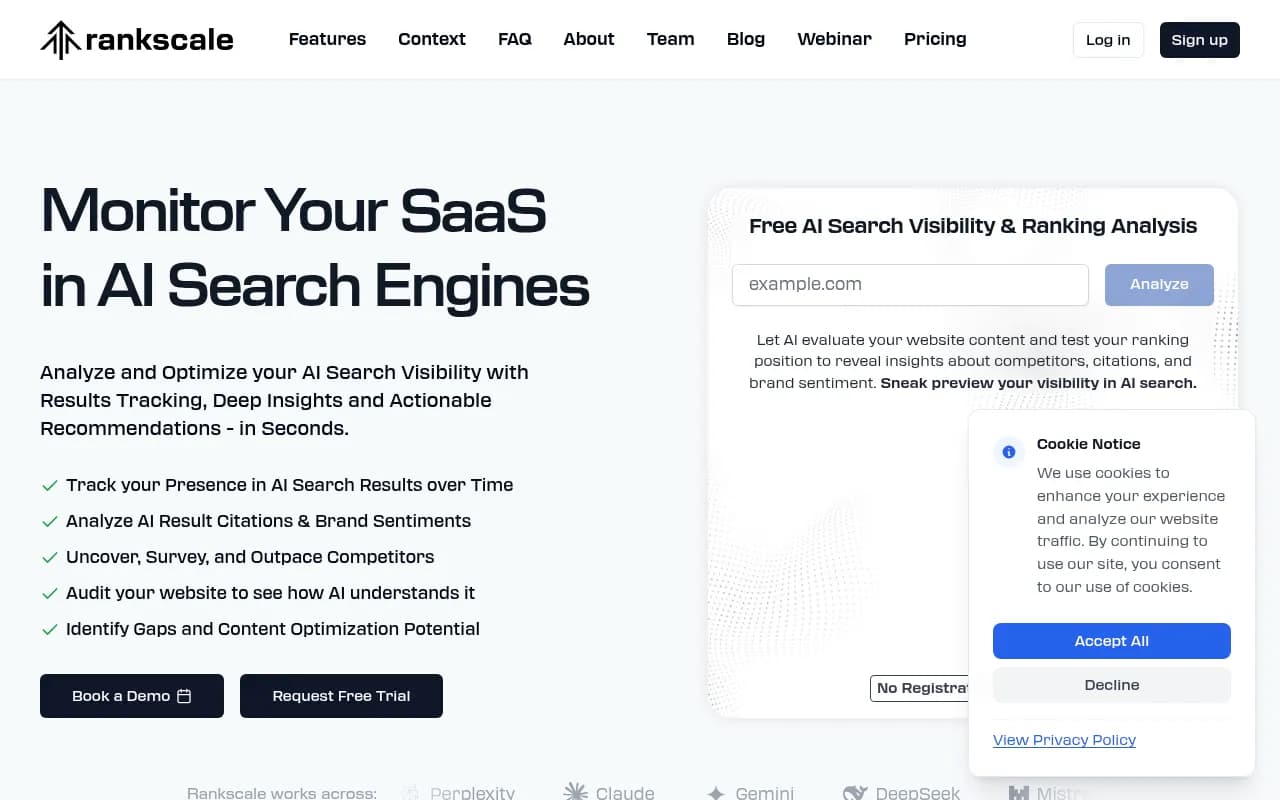
RankScale's Essentials plan at $20/month uses a credit system rather than a flat prompt count, covering more than 54 AI engines including ChatGPT, Gemini, Perplexity, Claude, DeepSeek, Mistral, Grok, and Copilot. Unlimited search terms are included on every tier, and scheduling can run as often as hourly. The tradeoff is that credits get consumed per engine-query, so if you're tracking the same prompt across five engines, that's five times the credit burn. Still, for a solo operator or small team watching a handful of core prompts, it's hard to beat on price.
LLM Pulse: no add-on traps
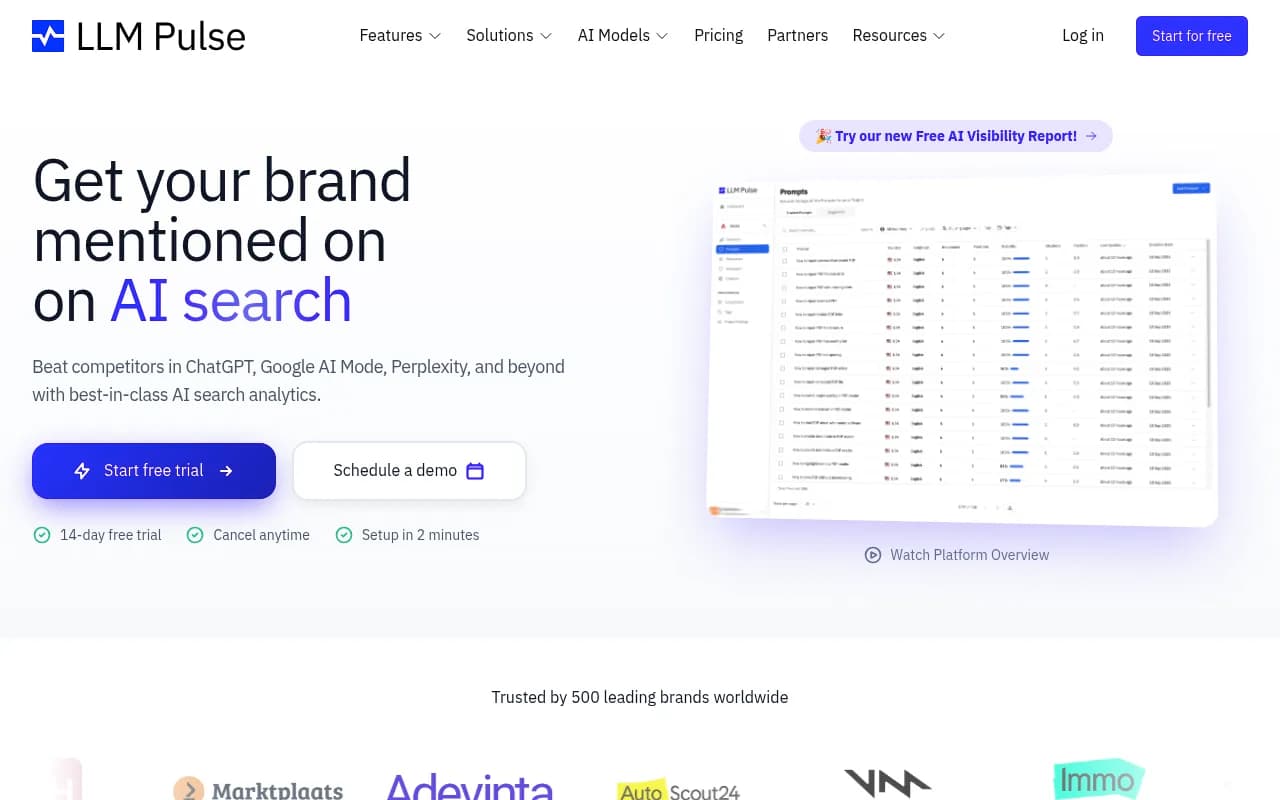
LLM Pulse's Starter plan at €49/month (roughly $53) includes all five standard models, AI Mode and Gemini included, with no per-engine add-on fees. That's the opposite of Otterly's model, where each additional engine costs extra. At roughly €0.98 per prompt tracked on Starter, it's not the cheapest per-unit option (Growth, at €99/month, actually works out cheaper per prompt at around €0.66), but the flat structure makes budgeting predictable.
Otterly AI: cheap headline, pricier reality
Otterly's Lite plan is genuinely $29/month, and it does include unlimited team seats, which is unusual at this price point. But the four base engines (ChatGPT, Google AI Overviews, Perplexity, Microsoft Copilot) leave out Claude, Gemini, and AI Mode entirely. Add those back in and you're paying $9 for Gemini, $9 for AI Mode, and $29 for Claude, pushing the real cost to around $76/month for full coverage. It's still under $100, but it's not the $29 tool the marketing implies.
Otterly.AI

Promptwatch Essential: the most capable entry tier
At $95/month, Promptwatch Essential tracks four models simultaneously out of eight available, runs 50 prompts against 6,000 monthly responses, and throws in MCP and API access plus 500 agent credits, features that most sub-$100 competitors simply don't offer at this tier. The catch is that it's priced right at the edge of this guide's budget, and the real value of the platform, content gap analysis, automated AEO article generation, crawler log analytics, only shows up once you move to Professional at $245/month.
Peec AI Starter: multi-engine, but it adds up
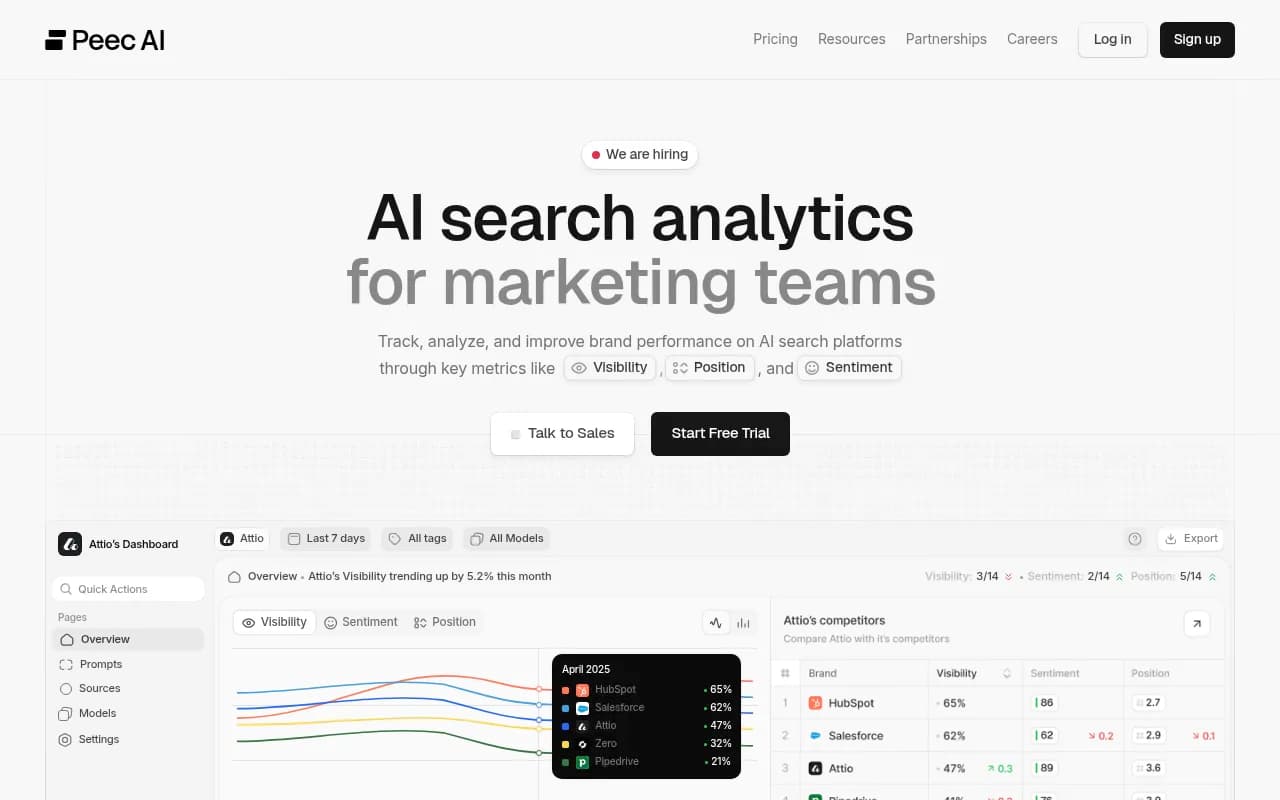
Peec AI's current Starter tier is $95/month for 50 prompts across 3 of 7 available engines. Adding a fourth engine costs $35/month more on Starter (and considerably more on higher tiers), so a brand that wants ChatGPT, Perplexity, AI Overviews, and Claude tracked together will end up paying $130/month, comfortably outside this guide's budget.
Profound Starter: know what you're skipping
Profound's $99/month Starter plan tracks ChatGPT only, with 50 prompts and 1,500 responses on a single seat. Multiple independent reviews describe it as a limited preview meant to funnel buyers toward the $399/month Growth plan, which adds Perplexity and AI Overviews. If your brand's audience lives mostly in ChatGPT, this might be fine. If you need multi-engine coverage, Profound isn't really a sub-$100 tool at all.
Profound

What content types are actually worth tracking
One pitfall that comes up again and again in expert guidance on this category: brands set up monitoring for their own name and stop there. The real opportunity is topic and problem queries, the ones where a buyer doesn't yet know your brand exists but is asking an AI assistant for a recommendation.
It's also worth knowing what kind of content AI engines are actually citing right now. In July 2026, product pages were the single most-cited content type on ChatGPT Search, at 32.8% of daily citations, according to Promptwatch's citation type breakdown, nearly double their roughly 18% share back in March. Listicles were the fastest-growing format within the month, climbing from about 8% to over 10% of citations. That's useful context when deciding which of your own pages to prioritize for monitoring and, eventually, optimization.
Common mistakes buyers make in this price range
- Tracking monthly instead of daily. Citation patterns shift fast. Reddit's ChatGPT citation share reportedly dropped from roughly 4% to 0.5% in a single day in mid-August 2026, per Promptwatch's data. Monthly snapshots miss shifts like that entirely.
- Assuming quantity of citations equals quality. Being mentioned fifth in a list carries different weight than being the primary cited source. Cheap tools that only report raw mention counts overstate progress.
- Ignoring share of voice. A single citation means little without knowing how often your competitors show up in the same response set.
- Trusting a single prompt run. AI output varies by model version, location, and even prior conversation context. A "visibility score" built on one-off samples is noisy; look for tools that disclose sample size and run frequency before trusting the number on the dashboard.
So which one should you actually buy?
If your budget genuinely has to stay under $50, RankScale Essentials ($20) or LLM Pulse Starter (€49) are the least misleading options, what you see on the pricing page is close to what you'll pay. If you can stretch closer to $100 and want the most capable single platform at that price, Promptwatch Essential ($95) gives you daily tracking across four major models plus API access, more than most competitors bundle at the same tier. If you only care about ChatGPT specifically and nothing else, Profound's $99 Starter is fine, just don't expect it to scale with you.
Whatever you choose, treat this tier as a monitoring budget, not an optimization budget. None of these plans include the ability to close the gaps they find, content generation, crawler log analysis, CMS publishing all live in higher tiers across the category. If your monitoring turns up real problems worth fixing, you'll eventually need to budget beyond $100. For a broader look at what's available once you're ready to move past pure tracking, the GEO software directory at bestgeosoftware.com covers the wider field, including the platforms that combine monitoring with actual content execution.