Key takeaways
- AI search visibility is now a core B2B marketing metric -- when buyers ask ChatGPT or Perplexity to recommend a vendor, the brands that appear win deals before a website is ever visited
- Most platforms in this space are monitoring dashboards only -- they show you where you're invisible but don't help you fix it
- Promptwatch is the only platform in this comparison rated as a "Leader" across all categories in a 2026 review of 12 GEO tools, largely because it closes the loop from gap analysis to content creation to traffic attribution
- Profound is the strongest pure-monitoring alternative, with solid enterprise dashboards and broad LLM coverage
- AthenaHQ and Scrunch both have real strengths but are narrower in scope -- useful for specific use cases, not as a primary optimization platform
Why B2B brands need to care about AI search right now
A buyer at a mid-size company is evaluating project management software. They don't open Google. They open ChatGPT and type: "What's the best project management tool for a 50-person software team?" The AI gives them three names. If yours isn't one of them, you weren't considered.
That's the situation B2B brands are in right now. According to Yotpo's 2026 research, AI-referred traffic converts at roughly 14.2% compared to 2.8% for traditional search. The volume is still smaller than Google, but the intent is extraordinary. These are buyers who've already asked for a recommendation and received one.
The problem is that most B2B marketing teams are still measuring success with traditional SEO metrics -- keyword rankings, organic traffic, backlink counts. Those metrics don't tell you whether ChatGPT is recommending you or your competitor when a prospect asks a buying-stage question.
That's what this category of tools is built to answer. And in 2026, the platforms have matured enough that the differences between them really matter.
The four platforms compared
Before diving into each tool, here's a quick orientation on what we're comparing and why these four specifically.
Promptwatch, Profound, AthenaHQ, and Scrunch are the four most commonly evaluated platforms by B2B marketing teams with a serious GEO (Generative Engine Optimization) mandate. They're not the only options -- there are 12+ tools in this space -- but these four represent the full spectrum from "monitoring dashboard" to "end-to-end optimization platform."
Comparison table
| Promptwatch | Profound | AthenaHQ | Scrunch | |
|---|---|---|---|---|
| AI models tracked | 10+ (ChatGPT, Claude, Perplexity, Gemini, Grok, DeepSeek, Copilot, Meta AI, AI Overviews, AI Mode) | 10+ (ChatGPT, Perplexity, Claude, Gemini, Grok, Copilot, Meta AI, DeepSeek, AI Overviews) | 8 (ChatGPT, Perplexity, AI Overviews, AI Mode, Gemini, Claude, Copilot, Grok) | Not publicly specified |
| Answer gap analysis | Yes | Limited | No | No |
| AI content generation | Yes (built-in writing agent) | No | No | No |
| Crawler log monitoring | Yes | No | No | No |
| Reddit/YouTube tracking | Yes | No | No | No |
| ChatGPT Shopping tracking | Yes | No | No | No |
| Prompt volume + difficulty | Yes | Yes (prompt volumes) | No | No |
| Traffic attribution | Yes (snippet, GSC, server logs) | No | No | No |
| Starting price | $99/mo | $99/mo | $95/mo (annual) | Custom/enterprise |
| Best for | Full GEO optimization cycle | Enterprise monitoring + exec dashboards | YC-backed; strong case studies | Enterprise GEO at scale |
Promptwatch
Promptwatch is the platform I'd recommend to most B2B marketing teams, and the reason isn't complicated: it's the only one in this comparison that actually helps you do something about what you find.

The core workflow is what Promptwatch calls the "action loop." First, Answer Gap Analysis shows you exactly which prompts competitors are being cited for but you're not. You see the specific topics, questions, and angles that AI models want to answer but can't find on your site. Second, the built-in AI writing agent generates content -- articles, listicles, comparisons -- grounded in real citation data from over 880 million citations analyzed. Third, page-level tracking shows which pages are getting cited, how often, and by which models. Traffic attribution closes the loop by connecting AI visibility to actual revenue.
That third step is where most competitors simply stop. Promptwatch connects visibility to pipeline.
A few capabilities that matter specifically for B2B brands:
AI Crawler Logs show in real time which AI crawlers (ChatGPT, Claude, Perplexity, etc.) are hitting your website, which pages they read, and what errors they encounter. For B2B sites with complex architectures or gated content, this is genuinely useful for diagnosing why certain pages aren't getting cited.
Prompt Intelligence gives you volume estimates and difficulty scores for each prompt, plus query fan-outs that show how one prompt branches into sub-queries. In B2B, where buying prompts are highly specific ("best CRM for mid-market SaaS companies with a field sales team"), this kind of prioritization data is valuable.
Competitor Heatmaps let you see who's winning for each prompt across different LLMs. Some competitors dominate on Perplexity but are weak on Claude -- knowing that shapes where you focus.
Multi-language and multi-region monitoring matters for B2B brands selling internationally. You can monitor AI responses in any language, from any country, with customizable personas.
Pricing runs from $99/month (Essential: 1 site, 50 prompts, 5 articles) to $249/month (Professional: 2 sites, 150 prompts, 15 articles, crawler logs) to $579/month (Business: 5 sites, 350 prompts, 30 articles). Agency and enterprise pricing is available separately. There's a free trial.
The one honest caveat: if you're a very early-stage company with no content strategy yet, the content generation features require some strategic input to use well. The tool gives you the data and the writing agent, but someone still needs to make editorial decisions. That's not a flaw -- it's just reality.
Profound
Profound is the strongest pure-monitoring platform in this comparison. It tracks 10+ AI models, has solid prompt volume data, and its executive dashboards are genuinely well-designed for reporting up to a CMO or VP of Marketing.
Profound

Where Profound shines is in the breadth and reliability of its data. For enterprise B2B teams that need to report on AI share of voice across a large prompt set, it's a credible choice. The interface is clean, the data is actionable at the monitoring level, and it covers all the major models.
Where it falls short is everything after monitoring. There's no content gap analysis that shows you what to create. No built-in writing tools. No crawler logs. No Reddit or YouTube tracking to understand what sources are influencing AI recommendations. No traffic attribution.
One data point worth noting: a 2026 comparison on nicklafferty.com found that Profound itself ranks #1 in AI search with 47.1% AI visibility in its own category -- which is either a testament to their product working or a sign that they've invested heavily in their own GEO. Either way, it's interesting context.
Profound starts at $99/month, putting it at the same entry price as Promptwatch. For teams that genuinely only need monitoring and have a separate content team handling optimization, Profound is worth evaluating. For teams that want the full cycle, it's a partial solution.
AthenaHQ
AthenaHQ is a YC-backed platform that tracks 8 AI models and has built a reputation for strong customer case studies. The interface is clean, the data is reliable, and at $95/month (annual billing) it's the most affordable entry point in this comparison.

The honest assessment: AthenaHQ is a solid monitoring tool. It tracks your brand mentions across ChatGPT, Perplexity, AI Overviews, AI Mode, Gemini, Claude, Copilot, and Grok. It shows share of voice and citation data clearly.
What it doesn't do is help you optimize. There's no content gap analysis, no writing tools, no crawler logs, no traffic attribution. It's monitoring-focused, which is fine if that's what you need -- but most B2B brands evaluating this category want to move from "we know we're invisible" to "we fixed it."
For smaller B2B teams that want a clean, affordable way to track AI visibility and report on it internally, AthenaHQ is a reasonable starting point. For teams that want to actually improve their numbers, it's a first step that will quickly feel limiting.
Scrunch
Scrunch (scrunch.com) is positioned as an enterprise GEO platform. It's frequently cited in "best alternatives" lists for enterprise-scale AI visibility tracking, and it does have genuine capabilities for large organizations.
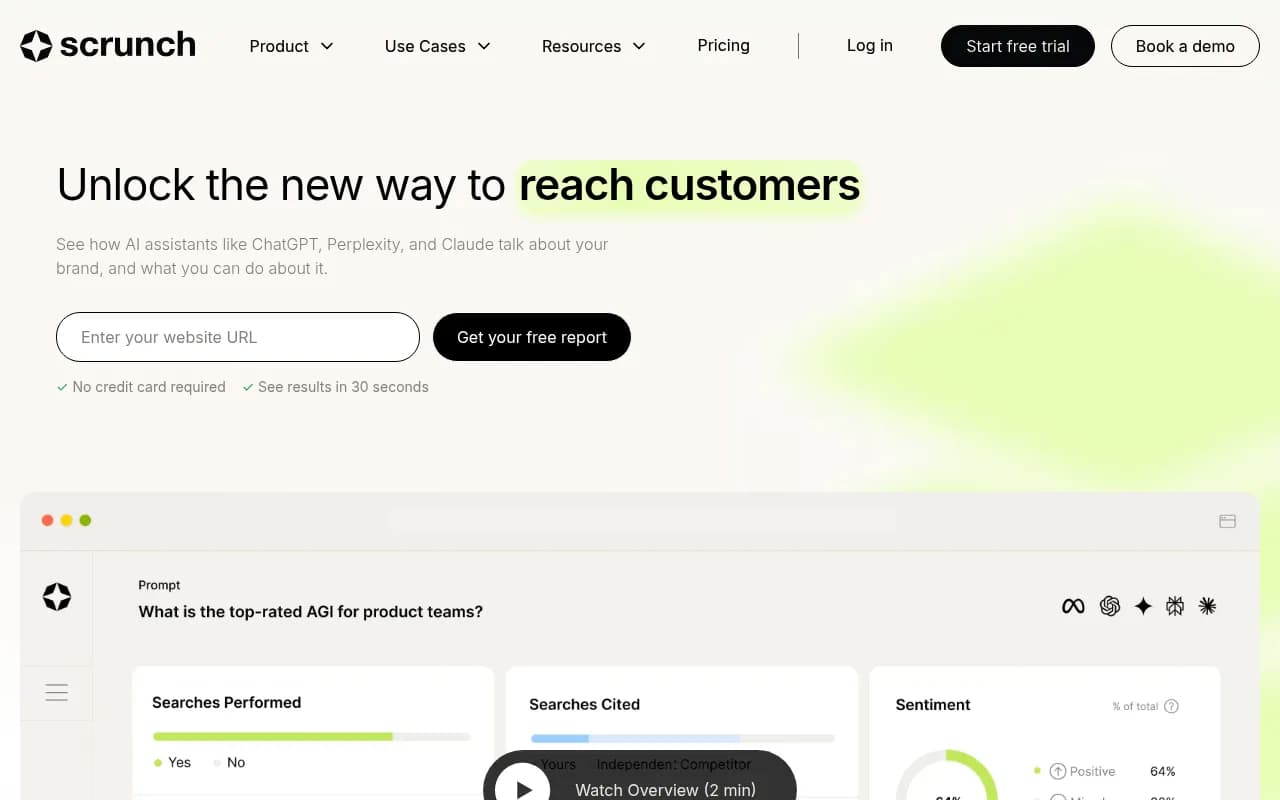
The challenge with Scrunch for most B2B brands is the same as with AthenaHQ: it's primarily a monitoring platform. The enterprise positioning means pricing is custom, which creates friction for teams that want to evaluate it quickly. And the feature set, while solid for tracking, doesn't extend into the content optimization and generation side.
For enterprise B2B brands with dedicated GEO teams and a need for custom reporting, Scrunch is worth a conversation. For mid-market B2B teams that need to move fast and show results, the lack of content tools is a real gap.
How to choose
The right platform depends on what you're actually trying to accomplish.
If you want to track visibility and report on it -- any of these four tools will work. Profound has the best dashboards for executive reporting. AthenaHQ is the most affordable. Scrunch is built for enterprise scale.
If you want to actually improve your AI visibility -- Promptwatch is the only platform in this comparison that closes the full loop. Gap analysis, content generation grounded in citation data, crawler diagnostics, traffic attribution. The others show you the problem. Promptwatch helps you solve it.
If you're an agency managing multiple clients -- Promptwatch has agency and enterprise pricing with multi-site support. The Looker Studio integration and API make custom reporting straightforward.
If you're just starting out and want to understand the space -- AthenaHQ's entry price and clean interface make it a low-friction way to get your bearings. Just know you'll likely outgrow it.
One thing worth saying directly: the gap between "monitoring" and "optimization" is the defining split in this category right now. Most platforms launched as trackers because tracking is the easier technical problem. Building content generation that's actually grounded in citation data -- not just generic SEO content -- is harder. That's why most competitors haven't done it.
What B2B brands specifically need from a GEO platform
A few things that matter more for B2B than for B2C:
Persona-based monitoring. B2B buyers search differently depending on their role. A CFO asking about financial software uses different language than a VP of Engineering. Platforms that let you customize personas to match how your actual buyers prompt will give you more accurate data.
Long-tail, high-specificity prompts. B2B buying prompts tend to be longer and more specific than consumer queries. "Best enterprise CRM for a 200-person B2B SaaS company with a field sales team and Salesforce integration" is the kind of prompt that actually drives pipeline. You need a platform that can handle this kind of prompt complexity and give you meaningful data on it.
Traffic attribution. B2B sales cycles are long. If AI search is driving awareness at the top of the funnel, you need to connect that to pipeline eventually. Platforms that stop at visibility metrics leave you unable to justify the investment.
Competitor intelligence. In B2B, you're often competing against a small set of known competitors. Heatmaps that show you exactly which prompts a competitor is winning -- and why -- are more actionable than aggregate share-of-voice numbers.
Promptwatch addresses all four of these. The others address some of them partially.
The bottom line
AI search is already influencing B2B buying decisions. The brands that show up in ChatGPT and Perplexity answers when buyers ask category-level questions have a real advantage -- and right now, most B2B brands have no idea whether they're visible or invisible.
Getting a platform in place to measure this is the first step. But measurement alone doesn't move the needle. The platforms that will matter most in 2026 are the ones that help you go from "we know we're invisible" to "we created the content that got us cited."
That's the distinction that separates Promptwatch from the rest of this field.