Key takeaways
- Most AI visibility platforms track whether your brand appears in AI responses, but very few tell you how it's described — the tone, framing, and context that actually influence buyer decisions.
- Promptwatch goes beyond monitoring by combining sentiment tracking with content gap analysis and an AI writing agent, so you can fix negative or missing narratives, not just observe them.
- Profound has strong enterprise analytics and daily sentiment updates, but its price point and limited content optimization tools make it harder to act on what you find.
- Conductor brings traditional SEO authority into AI search, but its sentiment capabilities are more surface-level compared to platforms built specifically for LLM visibility.
- If your goal is to understand and improve how AI engines talk about your brand, the platform you choose needs to do more than count citations.
Why "brand mentions" is the wrong metric to optimize
There's a version of AI search monitoring that feels useful but isn't. You set up a dashboard, it tells you your brand appeared in 34% of responses to a given prompt, and you feel like you're on top of things.
But here's the problem: appearing isn't the same as being recommended. And being recommended isn't the same as being recommended well.
When someone asks ChatGPT "what's the best project management tool for remote teams," and the response says "Asana is a popular option, though some users find it overly complex for smaller teams" -- that's a mention. It's also a soft negative that could cost you a conversion. You'd never know it from a citation count.
This is why brand sentiment in AI search has become the metric that actually matters in 2026. It's not just about showing up. It's about what the AI says when it talks about you, whether it recommends you confidently or hedges, whether it surfaces your strengths or your competitors' talking points, and whether the framing matches what you'd want a potential buyer to hear.
The platforms that understand this are built differently from the ones that just count mentions. Let's look at how Promptwatch, Profound, and Conductor each approach the problem.
What "sentiment tracking" actually means in AI search
Before comparing tools, it's worth being precise about what we're measuring.
In traditional brand monitoring, sentiment analysis runs on social media posts, reviews, and news articles. It's relatively straightforward: text classification into positive, neutral, or negative buckets.
AI search sentiment is more complex. When an LLM responds to a prompt, it doesn't just mention your brand -- it constructs a narrative. That narrative includes:
- Whether your brand is listed first, second, or as an afterthought
- Whether it's described with confident language ("the leading platform for...") or hedged language ("some users prefer...")
- Which attributes are associated with your brand vs. competitors
- Whether objections or limitations are mentioned
- How your brand compares to alternatives in the same response
Tracking this properly requires analyzing full AI responses, not just detecting brand name occurrences. It also requires running prompts at scale across multiple AI models, since ChatGPT, Perplexity, Claude, and Gemini often frame the same brand quite differently.
Promptwatch: sentiment tracking built into an optimization loop
Promptwatch takes a different approach from most platforms in this category. The core insight behind the product is that tracking sentiment is only useful if you can do something about it.

When Promptwatch detects that your brand is being described negatively or incompletely in AI responses, it doesn't just flag the issue. The Answer Gap Analysis feature shows you exactly which prompts competitors are visible for but you're not -- and what content your site is missing that would change the AI's framing. From there, the built-in AI writing agent generates articles, comparisons, and listicles grounded in real citation data from over 880 million citations analyzed. The content is designed to shift how AI models describe you, not just to add more pages to your site.
The sentiment picture is detailed. Promptwatch tracks responses across 10 AI models -- ChatGPT, Perplexity, Claude, Gemini, Grok, DeepSeek, Copilot, Meta AI, Mistral, and Google AI Overviews -- and shows you page-level citation data so you can see which specific pages are being cited, how often, and with what context. The Competitor Heatmaps feature lets you compare how your brand is framed versus competitors across each model, which is where sentiment differences become most visible.
The AI Crawler Logs feature is worth calling out specifically for sentiment work. Knowing which pages AI crawlers are actually reading (and which they're ignoring) tells you why certain narratives are sticking. If Perplexity keeps citing a three-year-old blog post that doesn't reflect your current positioning, you can see that directly and act on it.
Pricing starts at $99/month for the Essential plan (1 site, 50 prompts, 5 articles), with the Professional plan at $249/month adding crawler logs, city/state tracking, and 15 articles per month.
Profound: strong enterprise analytics, limited optimization
Profound is a well-regarded platform in the enterprise AI visibility space, and its analytics are genuinely impressive. The Agent Analytics feature delivers daily updates on brand mentions, citation frequency, and sentiment across 10+ AI engines including ChatGPT, Perplexity, Claude, Gemini, Grok, Copilot, Meta AI, DeepSeek, and Google AI Overviews.
Profound
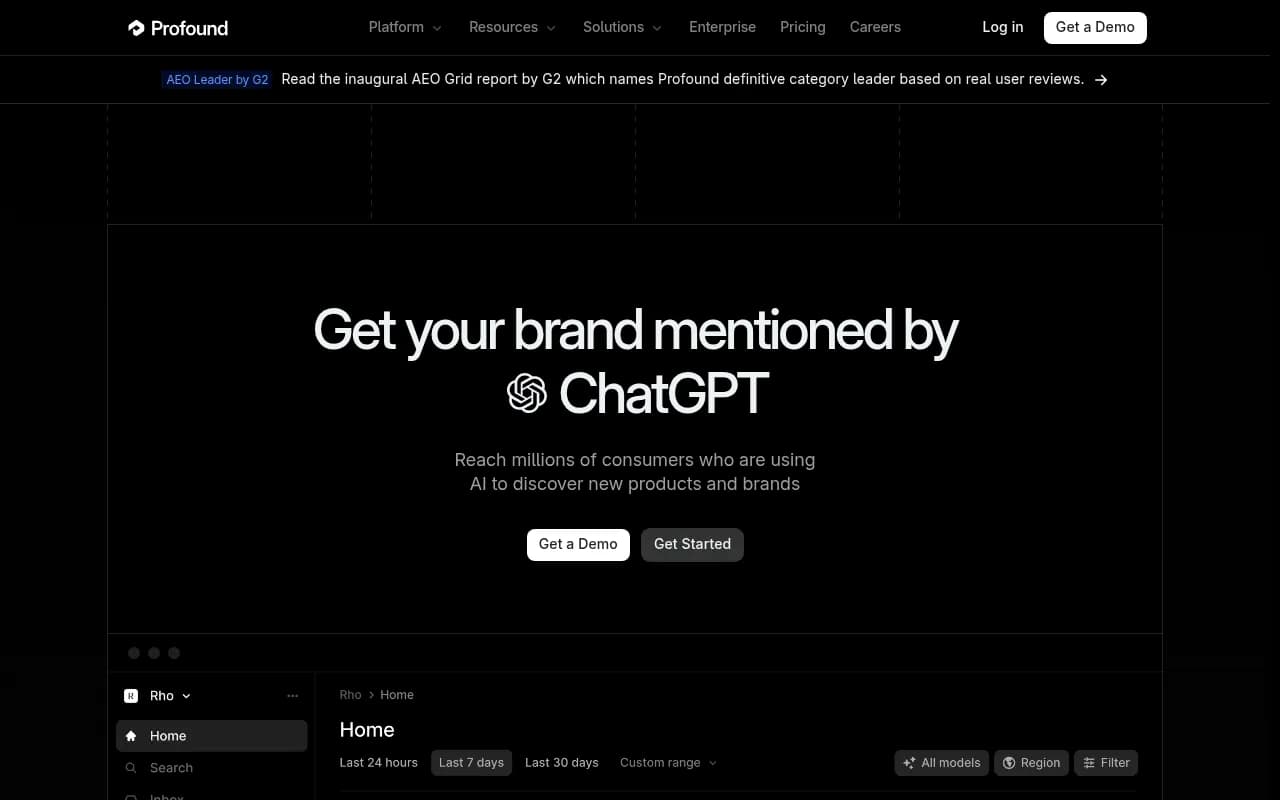
Where Profound excels is in data depth. It tracks prompt volumes, which gives enterprise teams a way to prioritize which queries are worth optimizing for. The reporting is clean and the dashboards are built for stakeholder presentations -- useful if you're reporting AI visibility metrics to a CMO or board.
The sentiment analysis in Profound is real but relatively high-level. It surfaces whether brand mentions are positive, neutral, or negative, and tracks changes over time. What it doesn't do well is connect that sentiment data to a clear action path. If Profound tells you that your brand is being described negatively in responses about enterprise security, the next step is on you -- you'd need to take that insight to your content team and figure out what to create.
That gap between insight and action is the main limitation. Profound is a monitoring and analytics platform. It's excellent at showing you what's happening. It's less useful for teams who need to know what to do next.
Pricing is also a consideration. Profound starts at $499/month and scales significantly for enterprise plans, which puts it out of reach for many marketing teams and agencies.
Conductor: traditional SEO authority meets AI search
Conductor comes from a different direction than the other two. It's primarily an enterprise SEO and content intelligence platform that has added AI search tracking capabilities, including brand visibility in AI Overviews and other LLM-powered results.
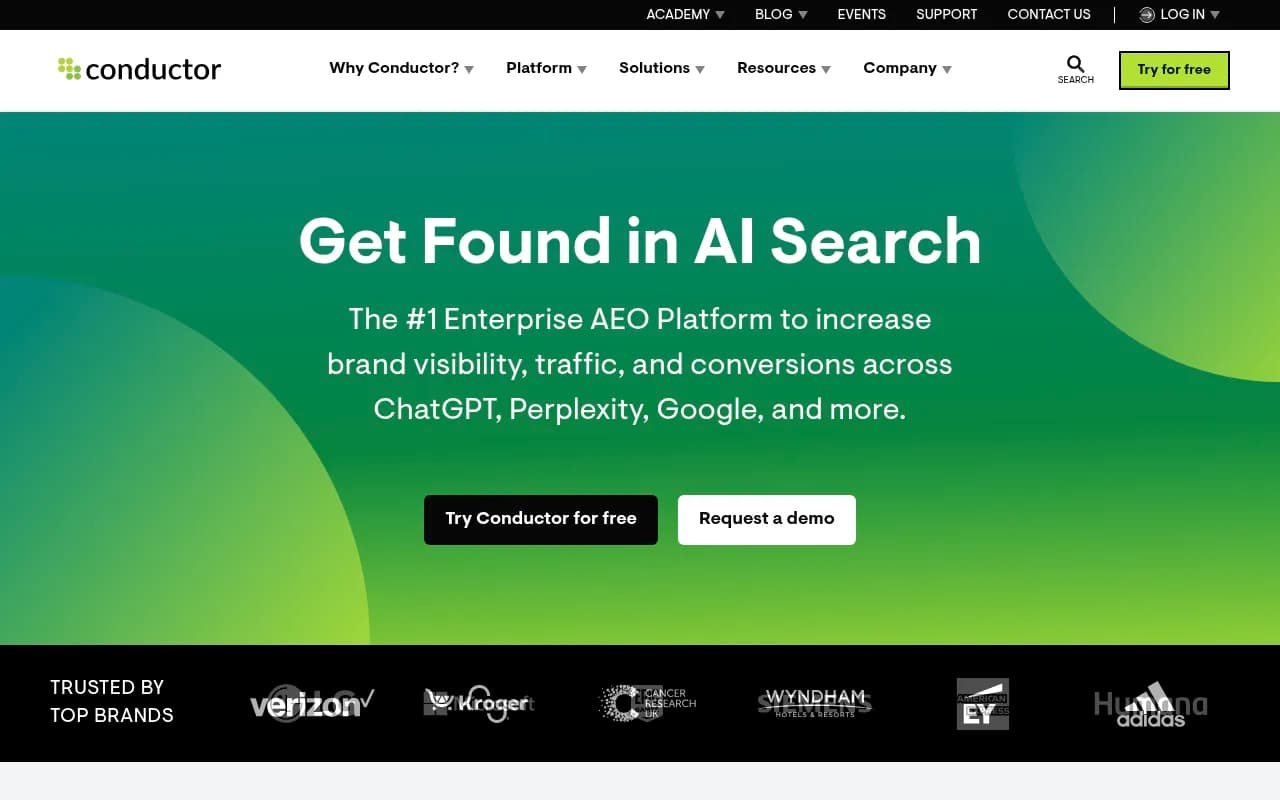
The AI search features in Conductor include tracking brand citations across AI engines and monitoring how your content performs in AI-generated responses. The sentiment layer is present but limited compared to platforms built specifically for LLM visibility. Conductor is better at telling you whether your content is being cited than at analyzing the qualitative framing of those citations.
Where Conductor genuinely adds value is for teams that are managing both traditional SEO and AI search from a single platform. If you have a large content operation and need to see how your pages perform across Google rankings, AI Overviews, and LLM citations in one view, Conductor's unified approach has real appeal.
The tradeoff is depth. For teams that specifically need to understand and improve brand sentiment in AI responses, Conductor's AI search features feel like an add-on to a traditional SEO tool rather than a purpose-built solution. It lacks the crawler log visibility, prompt intelligence depth, and content generation capabilities that platforms like Promptwatch offer.
Conductor's pricing is enterprise-tier and typically requires a custom quote, which means it's generally aimed at large organizations with existing SEO infrastructure.
Head-to-head comparison
| Feature | Promptwatch | Profound | Conductor |
|---|---|---|---|
| AI models tracked | 10 (ChatGPT, Perplexity, Claude, Gemini, Grok, DeepSeek, Copilot, Meta AI, Mistral, AI Overviews) | 10+ | ChatGPT, AI Overviews, select others |
| Sentiment analysis | Yes, with framing and context | Yes, positive/neutral/negative | Basic, citation-focused |
| Content gap analysis | Yes (Answer Gap Analysis) | Limited | No |
| Built-in content generation | Yes (AI writing agent) | No | No |
| AI crawler logs | Yes | No | No |
| Prompt volume data | Yes | Yes | Limited |
| Reddit/YouTube tracking | Yes | No | No |
| ChatGPT Shopping tracking | Yes | No | No |
| Competitor heatmaps | Yes | Limited | Limited |
| Page-level citation tracking | Yes | Yes | Yes |
| Traffic attribution | Yes (GSC, snippet, server logs) | Limited | Yes (SEO-focused) |
| Starting price | $99/mo | $499/mo | Custom/enterprise |
| Best for | Teams that want to monitor and fix AI sentiment | Enterprise analytics and reporting | Large SEO teams adding AI tracking |
The core difference: monitoring vs. optimization
The most important distinction between these platforms isn't features -- it's philosophy.
Profound and Conductor are fundamentally monitoring tools. They're built to help you understand what's happening with your brand in AI search. That's valuable, but it leaves you with a gap: you have data, and then you have to figure out what to do with it.
Promptwatch is built around closing that gap. The platform's design assumes that the point of tracking sentiment isn't to produce a report -- it's to improve the sentiment. So the workflow is: find where AI models are describing you poorly or not at all, identify what content is missing, generate that content, and watch your visibility scores change as AI models start citing the new material.
This matters especially for sentiment work. Negative or weak AI framing usually comes from one of two sources: the AI is citing outdated content, or it's not finding authoritative content that makes your case. Both are fixable problems. But you need tools that help you fix them, not just observe them.
Which platform is right for your team?
The honest answer depends on what you're trying to accomplish.
If you're an enterprise team with a dedicated analytics function and you need deep, daily reporting on AI visibility across a large brand portfolio, Profound's data depth is hard to argue with -- if the price is workable.
If you're already running a large SEO operation and want to add AI search tracking without switching platforms, Conductor's unified approach makes sense, even if the AI-specific features aren't best-in-class.
If you're a marketing team, SEO team, or agency that wants to actually move the needle on how AI engines describe your brand -- not just measure it -- Promptwatch is the more complete solution. The combination of sentiment tracking, gap analysis, content generation, and crawler logs means you're not just watching the problem. You're fixing it.
The gap between "we track AI sentiment" and "we improve AI sentiment" is where most platforms fall short. It's worth knowing which side of that gap your tool sits on before you commit.
A note on what to look for beyond these three
The AI visibility space has expanded quickly. Beyond Promptwatch, Profound, and Conductor, there are a number of other platforms worth knowing about depending on your needs.

AthenaHQ is a strong monitoring-focused option with good case studies and a lower entry price than Profound.
Otterly.AI

Otterly.AI covers the basics of brand mention tracking across ChatGPT, Perplexity, and AI Overviews, though it lacks the content optimization and crawler log features of more complete platforms.
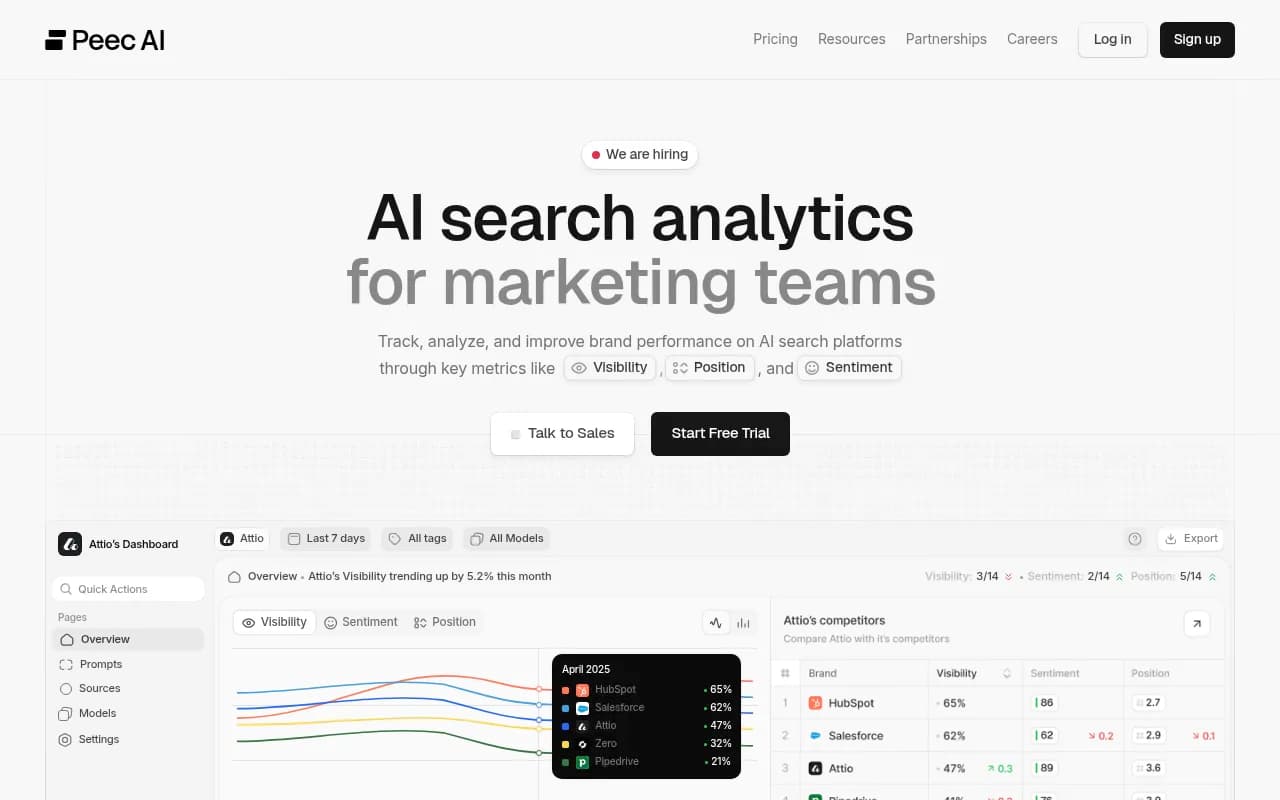
Peec AI is accuracy-focused and popular with agencies, though it's primarily a reporting tool without content generation or gap analysis.
For teams that are just starting to think about AI search visibility, any of these tools will give you a baseline. But if sentiment -- the quality of how AI describes your brand, not just the frequency -- is the goal, the platform you choose needs to be built around changing that narrative, not just measuring it.
That's the bar worth holding these tools to in 2026.