Key takeaways
- Most AI visibility tools are built for single-brand teams, not agencies managing 5, 10, or 20+ client accounts simultaneously
- The core agency need is a combination of multi-brand management, white-label reporting, and the ability to take action on gaps — not just surface data
- Platforms like Promptwatch and Profound offer the most complete agency workflows, including content generation and crawler-level insights
- Monitoring-only tools (Otterly.AI, Peec.ai, AthenaHQ) can work for basic reporting but leave agencies without a way to actually improve client visibility
- Pricing and seat structures vary significantly — some tools charge per brand, others per prompt, which matters a lot when you're scaling across clients
Running AI visibility for a single brand is hard enough. Running it for a portfolio of client brands — each with different industries, audiences, competitors, and goals — is a completely different operational challenge.
The tools that work fine for an in-house marketing team often fall apart at agency scale. You need multi-brand dashboards, white-label reporting, flexible seat structures, and ideally some way to act on what you find rather than just staring at a visibility score that's going the wrong direction.
This guide covers the platforms that actually hold up for agency use cases in 2026, what to look for before you commit, and an honest comparison of the major players.
What agencies actually need from an AI visibility platform
Before getting into specific tools, it's worth being precise about what makes an agency use case different from a typical in-house one.
Multi-brand management without chaos. You need to switch between client accounts cleanly, ideally with separate dashboards, prompt sets, and reporting views. Tools that were built for single-brand monitoring often bolt on "multi-account" as an afterthought — and it shows.
White-label reporting. Client-facing reports need to look like they came from your agency, not from whatever SaaS tool you're using. This is a basic requirement that surprisingly few platforms handle well.
Prompt flexibility per client. Each client has different competitors, different customer personas, and different questions their buyers ask AI engines. A rigid prompt library that can't be customized per brand is useless.
Actionability, not just monitoring. This is the big one. Agencies are paid to move the needle, not to deliver dashboards. A tool that shows you a client's visibility score but gives you nothing to do about it puts all the hard work back on your team. The best platforms close this loop — they show you the gap, then help you create content that fills it.
Coverage across models. ChatGPT gets the most attention, but clients are being cited (or not cited) across Perplexity, Google AI Overviews, Claude, Gemini, Grok, and more. You need cross-model visibility, not just one engine.
Crawler and traffic data. Understanding which of a client's pages AI engines are actually reading — and which ones they're ignoring — is increasingly important for diagnosing why visibility is low.
The platforms worth evaluating
Promptwatch
Promptwatch is the platform that comes closest to a complete agency solution in 2026. It's used by 1,480+ brands and agencies including Booking.com and Center Parcs, and the core reason agencies gravitate toward it is that it doesn't stop at monitoring.

The workflow agencies get from Promptwatch looks like this: Answer Gap Analysis shows exactly which prompts competitors rank for that a client doesn't. Content Agents then generate articles, listicles, and comparisons grounded in that real prompt data — not generic SEO filler, but content engineered to answer the specific gaps AI models are exposing. Then page-level tracking shows which new pages are getting crawled and cited, and when.
That loop — find gaps, create content, track results — is what separates it from the monitoring-only tools. Most competitors stop at step one.
For agencies specifically, the AI Crawler Logs feature is worth calling out. You can see in real time which AI crawlers (ChatGPT, Claude, Perplexity) are hitting a client's site, which pages they're reading, what errors they encounter, and how often they return. Most competitors don't offer this at all.
Coverage spans 10 AI models: ChatGPT, Perplexity, Google AI Overviews, Google AI Mode, Claude, Gemini, Meta/Llama, DeepSeek, Grok, Mistral, and Copilot. Multi-language and multi-region monitoring is included, which matters for agencies with international clients.
Pricing: Essential $99/mo (1 site, 50 prompts), Professional $249/mo (2 sites, 150 prompts, crawler logs), Business $579/mo (5 sites, 350 prompts). Agency/Enterprise pricing is available for larger portfolios.
Profound
Profound is the other platform that comes up consistently in agency conversations. It has an explicit Agency mode with brand configurations and pitch environments, and it's positioned toward enterprise and larger agency accounts.
Profound

The feature set is genuinely strong — prompt volumes, shopping tracking, agent analytics, and content generation capabilities. The tradeoff is price: Profound sits at a higher price point than most alternatives, and the agency-specific features are concentrated in the upper tiers. For agencies managing a handful of high-value enterprise clients, it makes sense. For agencies with a larger number of mid-market clients, the math gets harder.
It doesn't include Reddit tracking or ChatGPT Shopping monitoring, which are increasingly relevant as AI engines pull from social discussions and product recommendation surfaces.
Rankscale
Rankscale is explicitly built for agency workflows and is one of the more focused tools in this space.
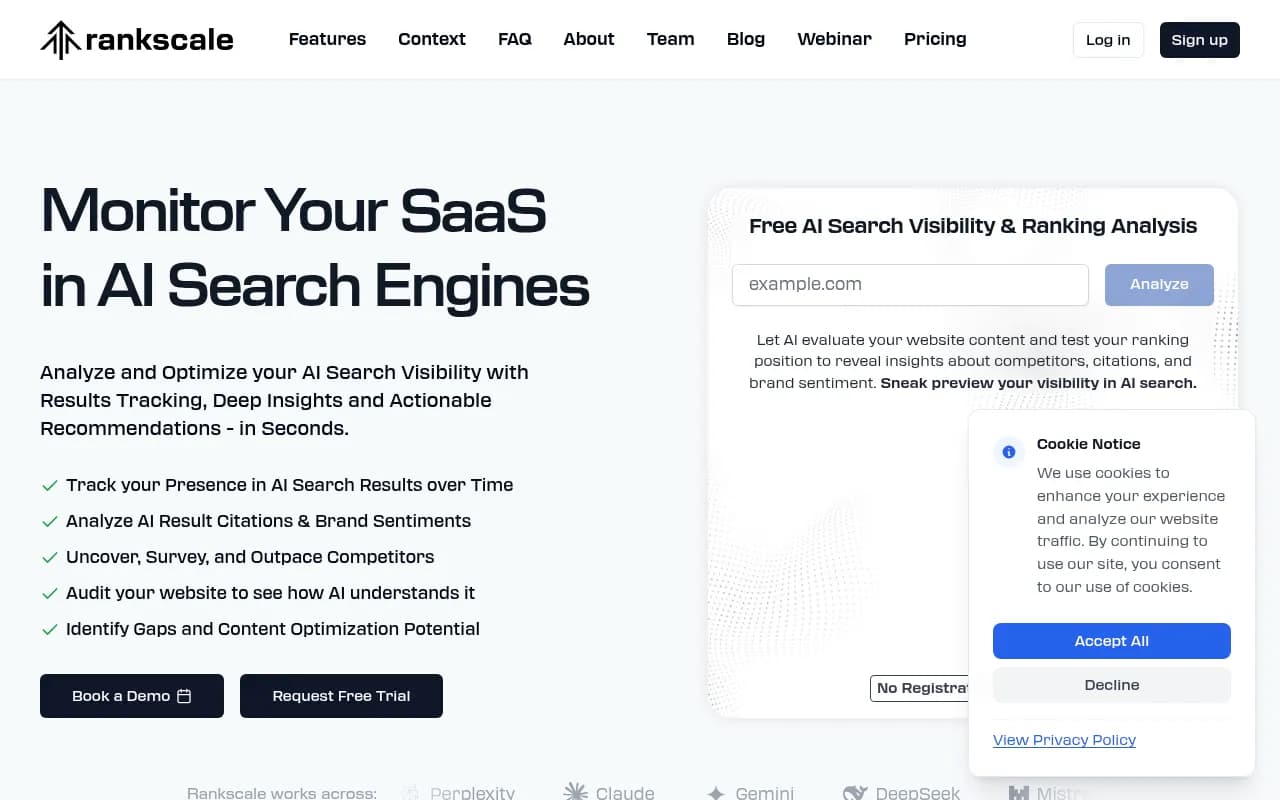
It handles multi-brand management cleanly and has reporting features designed for client delivery. The monitoring coverage is solid. Where it falls short is on the action side — like most tools in this category, it's primarily a tracking platform rather than an optimization one. You'll see what's happening with a client's AI visibility, but you'll need to bring your own content strategy and creation process.
For agencies that already have strong content operations and just need reliable multi-brand monitoring, Rankscale is worth a look.
Otterly.AI
Otterly.AI is a monitoring tool that tracks brand mentions across ChatGPT, Perplexity, and Google AI Overviews. It's clean, relatively easy to set up, and has been popular with agencies that are just getting started with AI visibility tracking.
Otterly.AI

The honest limitation: it's a monitoring dashboard. There's no crawler log data, no content generation, no gap analysis that tells you what to do next. If you're using Otterly.AI, you're getting visibility data and then figuring out the rest yourself. That's fine as a starting point, but it puts the optimization burden entirely on your team.
Peec.ai
Peec.ai covers similar ground to Otterly.AI — brand mention tracking across major AI engines, with a reasonably clean interface.

Same limitation applies: monitoring-only, no content tools, no crawler data. It works for agencies that want a lightweight, lower-cost option for basic AI visibility reporting. It won't help you explain to a client why their visibility is low or what to do about it.
AthenaHQ
AthenaHQ is monitoring-focused with a clean interface and decent cross-model coverage.

It's been positioned as an enterprise option, but the feature set is primarily observational. No content optimization, no generation capabilities, no crawler logs. For agencies, it can serve as a reporting layer, but you'll need other tools to actually move the needle for clients.
Scrunch AI
Scrunch AI tracks brand mentions across LLMs and has some competitive analysis features.
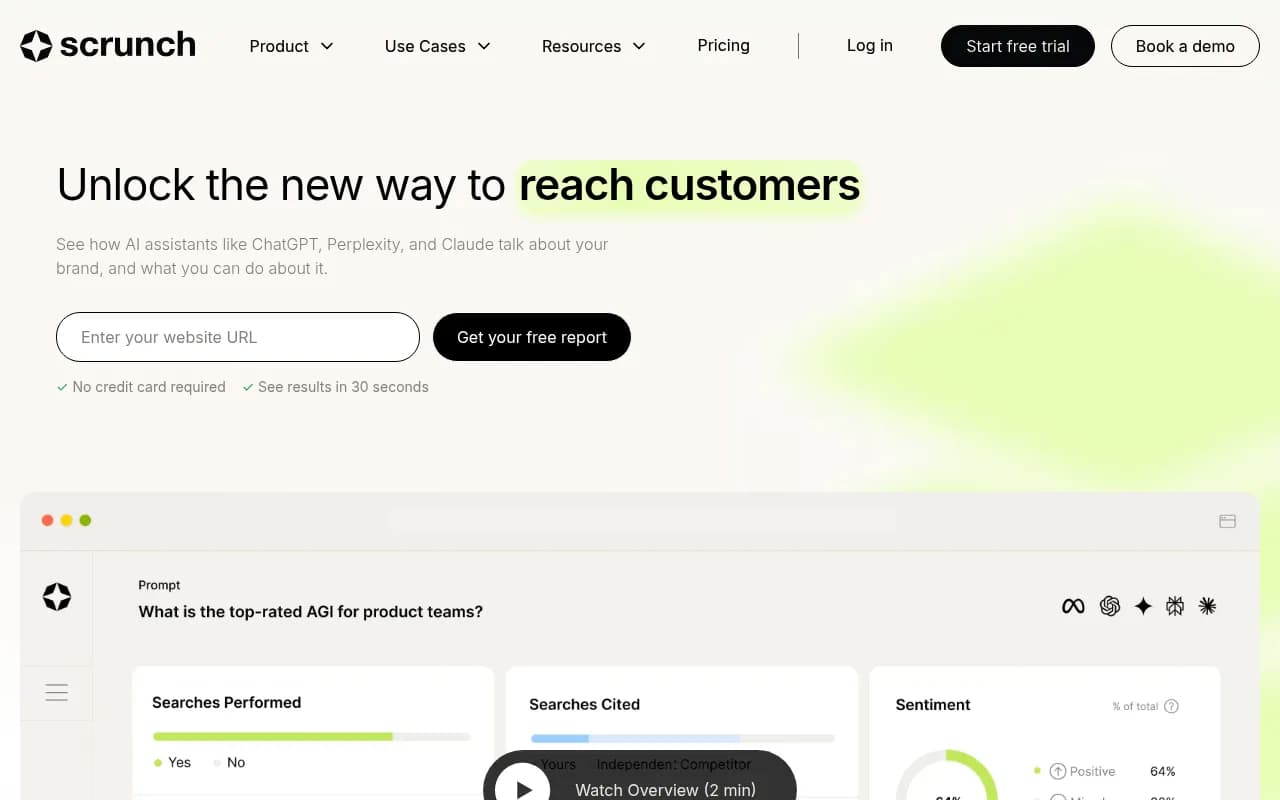
It's a reasonable monitoring tool but sits in the same category as Otterly.AI and Peec.ai — useful for tracking, limited for optimization. The price point is higher than some alternatives for what you get.
Semrush (AI Visibility Toolkit)
Semrush has added AI visibility tracking to its existing platform, which makes it appealing for agencies already paying for Semrush's traditional SEO features.
The integration with existing keyword data and site audit tools is genuinely useful. The limitation is that Semrush's AI tracking uses fixed prompts rather than custom ones, which means you can't tailor the monitoring to each client's specific competitive landscape. There's also no AI traffic attribution connecting visibility to actual revenue. For agencies that want everything in one platform and can live with those constraints, it's a reasonable option.
Ahrefs (Brand Radar)
Similar story to Semrush. Ahrefs Brand Radar adds AI search visibility to an existing SEO platform that many agencies already use.
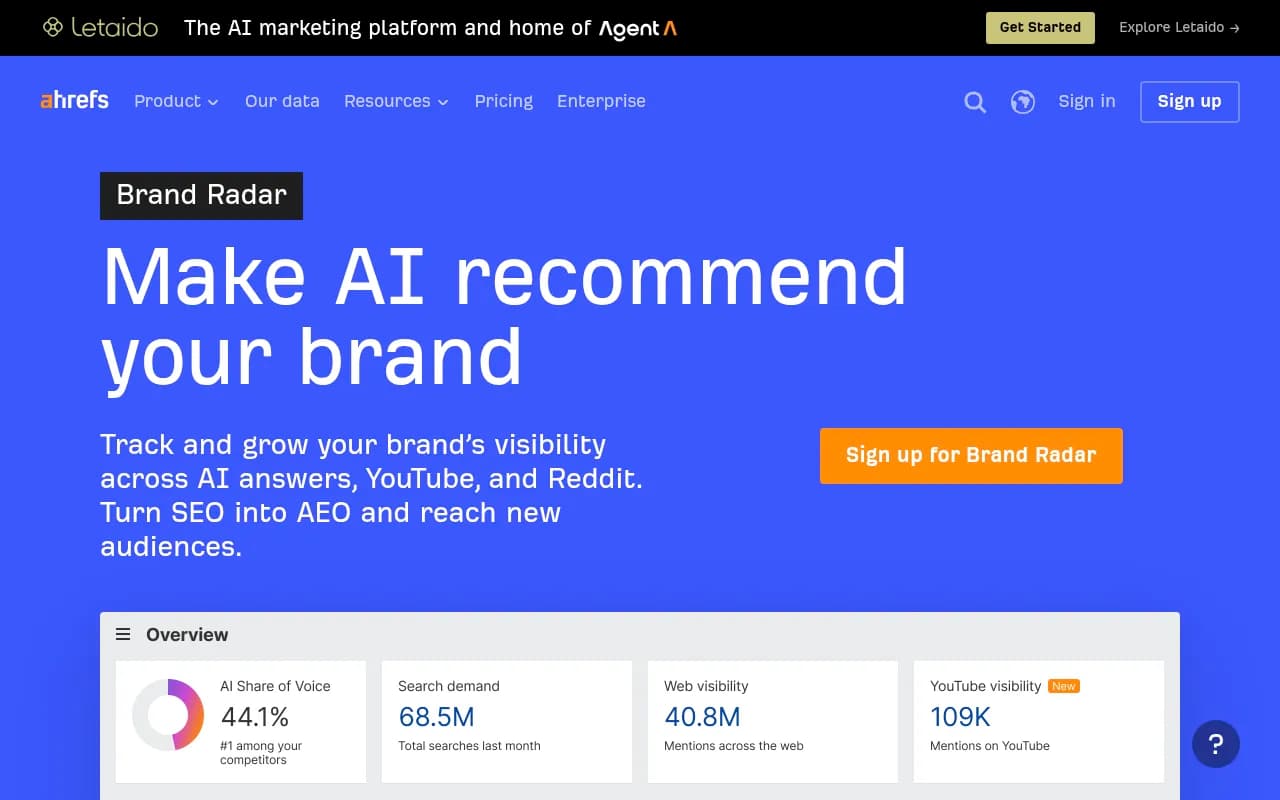
Fixed prompts, no AI traffic attribution. The advantage is consolidation — if your team lives in Ahrefs for traditional SEO, having some AI visibility data in the same interface reduces context switching. But it's not a purpose-built GEO platform.
SE Ranking
SE Ranking has an AI Search Toolkit that covers the basics of brand monitoring across AI engines.
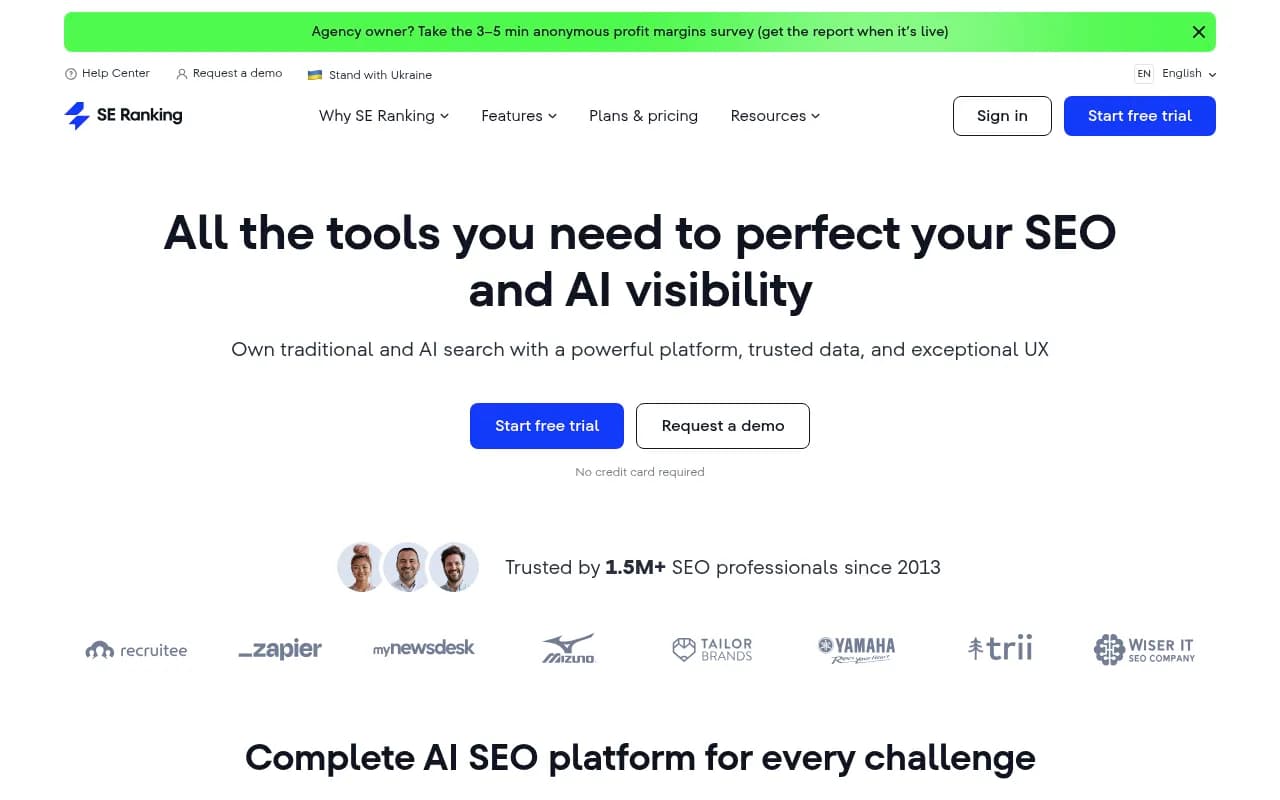
It's one of the more affordable options and integrates with SE Ranking's broader SEO feature set. Coverage is narrower than dedicated GEO platforms, and the agency-specific features (multi-brand management, white-label reporting) are less developed than the purpose-built tools.
Feature comparison
| Platform | Multi-brand | White-label reporting | Content generation | Crawler logs | Prompt customization | AI models covered | Agency pricing |
|---|---|---|---|---|---|---|---|
| Promptwatch | Yes | Yes | Yes (Content Agents) | Yes | Yes | 10 | Custom |
| Profound | Yes (Agency mode) | Yes | Yes (Agents) | Yes | Yes | 9+ | Custom |
| Rankscale | Yes | Yes | No | No | Yes | 6+ | Yes |
| Otterly.AI | Limited | Basic | No | No | Yes | 4 | No |
| Peec.ai | Limited | Basic | No | No | Yes | 5 | No |
| AthenaHQ | Limited | Basic | No | No | Yes | 5 | No |
| Scrunch AI | Limited | Basic | No | No | Yes | 5 | No |
| Semrush | Yes | Yes | No | No | Fixed prompts | 3 | Yes |
| Ahrefs Brand Radar | Yes | Yes | No | No | Fixed prompts | 3 | Yes |
| SE Ranking | Yes | Basic | No | No | Yes | 4 | Yes |
How to choose the right platform for your agency
The right answer depends on what kind of agency you are and what you're selling to clients.
If you're building a GEO service from scratch and want to offer clients a complete workflow — monitoring, gap analysis, content creation, and results tracking — you need a platform that handles the full loop. Promptwatch and Profound are the two options that come close to this. Promptwatch's pricing structure is more accessible for agencies with mixed-size client portfolios; Profound skews toward larger enterprise engagements.
If you're adding AI visibility as a reporting add-on to existing SEO retainers, a monitoring-only tool might be enough to start. Otterly.AI, Peec.ai, or SE Ranking's toolkit can give you something to put in client reports without a major new investment. Just be honest with yourself that you're buying a dashboard, not a service.
If your clients are already on Semrush or Ahrefs, the built-in AI visibility features are worth exploring before adding another tool. The fixed-prompt limitation matters, but if clients just want to see a visibility trend over time, it might be sufficient.
If you have international clients, make sure the platform supports multi-language and multi-region monitoring. Not all of them do. Promptwatch handles this natively; others require workarounds or don't support it at all.
If you're selling to enterprise clients, look hard at the crawler log and traffic attribution features. Enterprise clients want to know not just that their visibility is improving, but that it's driving actual traffic and revenue. Platforms that connect AI citations to site visits and conversions are much easier to justify in a QBR.
What the monitoring-only gap actually costs agencies
It's worth being direct about this. If you're using a monitoring-only tool, you're essentially delivering a problem statement to clients every month without a solution. "Your AI visibility score went down 8 points" is not a service — it's a data point.
The agencies that are building durable GEO practices in 2026 are the ones that can say: "Here's where you're invisible, here's the content we created to fix it, and here's the visibility improvement we've seen since we published." That loop requires a platform that goes beyond tracking.
The monitoring-only tools aren't useless — they're fine for the first conversation with a client, or for agencies that are still figuring out what GEO services look like for them. But they're not a long-term foundation for a repeatable service.
Practical setup advice for agencies
A few things that matter in practice when you're setting up AI visibility tracking for multiple clients:
Prompt design is everything. Generic prompts like "what's the best CRM?" will give you generic data. The prompts that actually matter are the ones your client's buyers are asking — specific, intent-driven questions that reflect real purchase decisions. Take time to build a prompt set for each client based on their buyer personas and competitive landscape.
Set baseline measurements before you do anything else. You can't show improvement if you don't have a starting point. Run a full baseline across all target prompts and models before any optimization work begins.
Separate owned from earned citations. Some platforms distinguish between citations to a client's own website and citations to third-party sources that mention the client (Reddit threads, review sites, industry publications). Both matter, but they require different strategies. Know which you're tracking.
Check crawler logs early. If a client's site has technical issues that prevent AI crawlers from reading it properly — JavaScript rendering problems, blocked bot access, slow response times — no amount of content optimization will fix the visibility problem. Crawler logs surface these issues quickly.
Build reporting cadences that clients actually understand. Visibility scores and citation counts are meaningful to you, but clients care about business outcomes. Connect the data to something they care about: leads, brand mentions in competitive deals, share of voice against named competitors.
The AI search visibility space is moving fast, and the gap between monitoring tools and optimization platforms is widening. For agencies, the question isn't just which tool tracks the most models — it's which tool helps you deliver a service that clients can see the value of. That means finding gaps, acting on them, and showing the results. The platforms that support that full workflow are the ones worth building your GEO practice around.