Key takeaways
- Most AI visibility platforms are monitoring dashboards -- they show you where you're invisible but don't help you fix it
- Promptwatch is the only platform in this comparison rated as a "Leader" across all categories, because it closes the loop from gap analysis to content creation to traffic attribution
- Profound and AthenaHQ are strong enterprise monitoring tools but stop short of content optimization
- Otterly.AI is the easiest entry point for beginners, but its feature ceiling is low
- Pricing ranges from $29/month (Otterly.AI) to $499+/month (Profound) -- and the gap in capabilities is real
There's a version of this market that made sense two years ago: AI search was new, nobody knew what to track, and just having a dashboard that showed you whether ChatGPT mentioned your brand felt like progress.
That version is over.
In 2026, there are now dozens of platforms claiming to help you "win AI search." Most of them do roughly the same thing: run your prompts through a few LLMs, count how often your brand appears, and show you a score. That's useful context. It's not a strategy.
This guide cuts through the noise. I've looked at how Promptwatch, Otterly.AI, AthenaHQ, and Profound actually work -- what they track, what they help you do with that data, and where each one makes sense.
Why "monitoring" isn't enough anymore
When someone asks ChatGPT "what's the best project management tool for remote teams," your brand either appears in that answer or it doesn't. If it doesn't, you need to know two things: why not, and what to do about it.
Most platforms answer the first question reasonably well. Very few answer the second.
The distinction matters because AI search isn't like Google rankings. You can't just tweak a title tag and wait. AI models cite content based on what they've indexed, what they trust, and what actually answers the question. Getting cited requires creating the right content, in the right format, targeting the right prompts -- and then tracking whether it worked.
That's the loop most platforms are missing.
The four platforms compared
Promptwatch
Promptwatch is the most complete platform in this space right now. It monitors 10 AI models (ChatGPT, Perplexity, Claude, Gemini, Grok, DeepSeek, Copilot, Meta AI, Mistral, and Google AI Overviews), but the monitoring is almost secondary to what it does with that data.
The core workflow is built around three steps:
- Find the gaps. The Answer Gap Analysis shows you exactly which prompts your competitors are visible for that you're not. Not vague categories -- specific questions, with the content angle AI models want answered.
- Create content that gets cited. The built-in AI writing agent generates articles, listicles, and comparisons grounded in real citation data. It's trained on 880M+ citations, so it knows what formats and angles actually get picked up by LLMs.
- Track what changed. Page-level tracking shows which of your pages are being cited, by which models, and how often. Traffic attribution (via code snippet, GSC integration, or server log analysis) connects visibility to actual revenue.
Beyond that core loop, Promptwatch also has AI crawler logs (real-time logs of GPTBot, ClaudeBot, PerplexityBot hitting your site), prompt volume and difficulty scoring, Reddit and YouTube citation tracking, ChatGPT Shopping monitoring, and competitor heatmaps. It's a lot -- but it's organized around a coherent purpose.
Pricing starts at $99/month for the Essential plan (1 site, 50 prompts, 5 articles). Professional is $249/month (2 sites, 150 prompts, 15 articles, crawler logs). Business is $579/month (5 sites, 350 prompts, 30 articles). Agency and enterprise pricing is custom.

Otterly.AI
Otterly.AI is the friendliest entry point in this category. It starts at $29/month, tracks ChatGPT, Perplexity, and Google AI Overviews, and the interface is clean enough that you can be up and running in under an hour.
What it does well: brand mention tracking, sentiment analysis, share of voice against competitors, and basic prompt monitoring. For a small business or solo marketer who just wants to know whether they're showing up in AI answers, it's genuinely useful.
What it doesn't do: there's no content gap analysis, no AI writing tools, no crawler logs, no prompt volume data, and no traffic attribution. You get the "where are you" picture but not the "what do you do about it" answer.
The Standard tier unlocks unlimited brand tracking, which is where it becomes more interesting for agencies managing multiple clients. But even then, the ceiling is low compared to the platforms above it.
Otterly.AI

AthenaHQ
AthenaHQ is a well-built monitoring platform, YC-backed, with strong case studies and a clean product. It tracks 8 AI models (ChatGPT, Perplexity, AI Overviews, AI Mode, Gemini, Claude, Copilot, and Grok) and starts at $95/month on annual billing.
The data quality is good. The interface is polished. Where it falls short is the same place most monitoring tools fall short: it shows you what's happening but doesn't help you change it. There's no content generation, no gap analysis that tells you what to write, and no crawler monitoring.
For teams that already have a strong content operation and just need reliable visibility data to feed into their workflow, AthenaHQ is a solid choice. For teams that need the full loop -- find gaps, create content, track results -- it's not enough on its own.

Profound
Profound is the enterprise option. It tracks 10+ AI models, has strong prompt volume data, and is built for large organizations with dedicated analytics teams. Pricing starts at $99/month but the plans that actually matter for enterprise use are significantly higher ($499+/month).
The platform has real depth in analytics -- you can slice visibility data by model, by topic, by competitor, and over time. The prompt volume features are genuinely useful for prioritizing which queries to target.
What Profound doesn't have: content generation, AI crawler logs, Reddit/YouTube citation tracking, and ChatGPT Shopping monitoring. It's a monitoring and analytics platform, not an optimization platform. That's a deliberate choice, and for enterprise teams with separate content teams, it might be the right one. But it means you're paying a lot for data without the tools to act on it.
Profound

Head-to-head comparison
| Feature | Promptwatch | Otterly.AI | AthenaHQ | Profound |
|---|---|---|---|---|
| AI models tracked | 10 | 3 | 8 | 10+ |
| Starting price | $99/mo | $29/mo | $95/mo (annual) | $99/mo |
| Content gap analysis | Yes | No | No | No |
| AI content generation | Yes | No | No | No |
| AI crawler logs | Yes | No | No | No |
| Prompt volume data | Yes | No | Limited | Yes |
| Reddit/YouTube tracking | Yes | No | No | No |
| ChatGPT Shopping tracking | Yes | No | No | No |
| Traffic attribution | Yes | No | No | No |
| Competitor heatmaps | Yes | Basic | Yes | Yes |
| Best for | Full optimization loop | Beginners | Enterprise monitoring | Enterprise analytics |
Other tools worth knowing about
These four aren't the only options. A few others are worth a mention depending on your situation.
Peec AI is accuracy-focused and popular with agencies. It tracks ChatGPT, Perplexity, and AI Overviews (with additional models available at extra cost), and starts at $85/month. Clean reporting, no content tools.

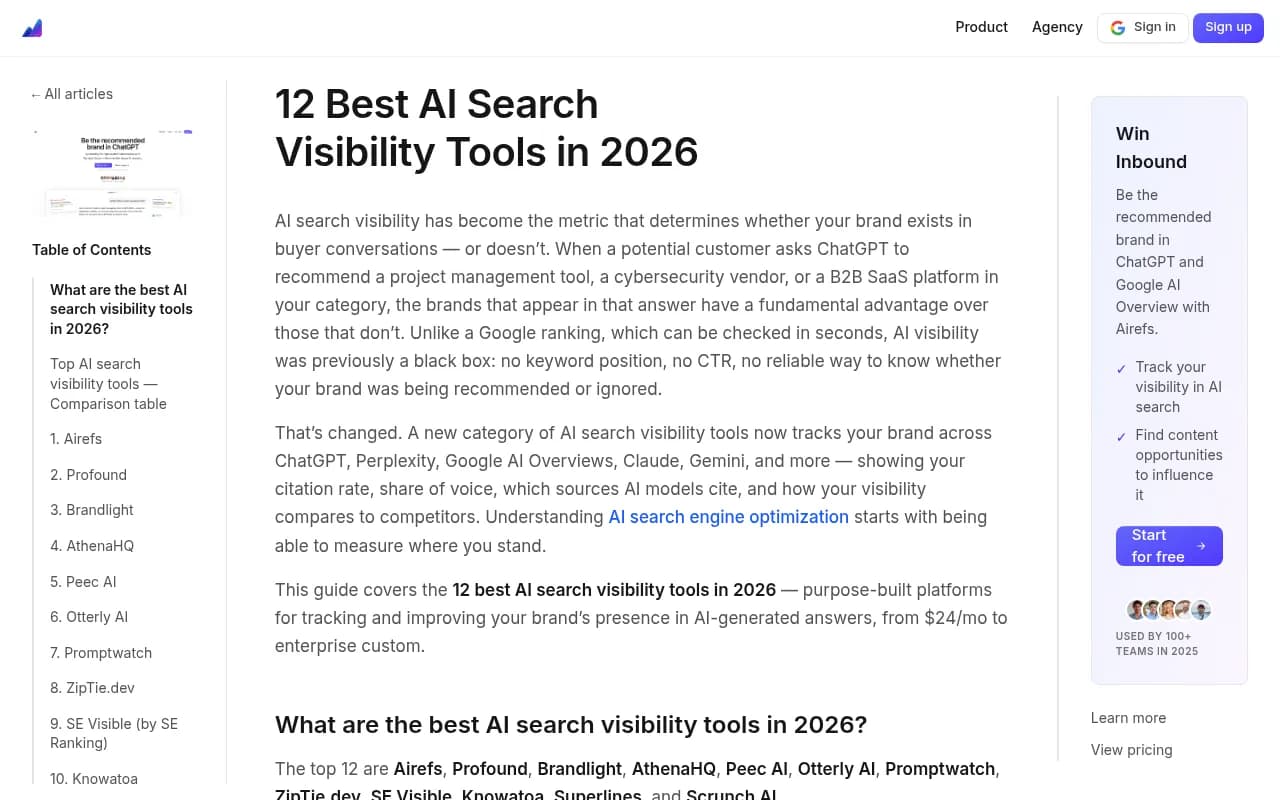
Scrunch AI has a reasonable feature set and is often mentioned alongside Profound for enterprise use, but it lacks Reddit tracking and ChatGPT Shopping monitoring.
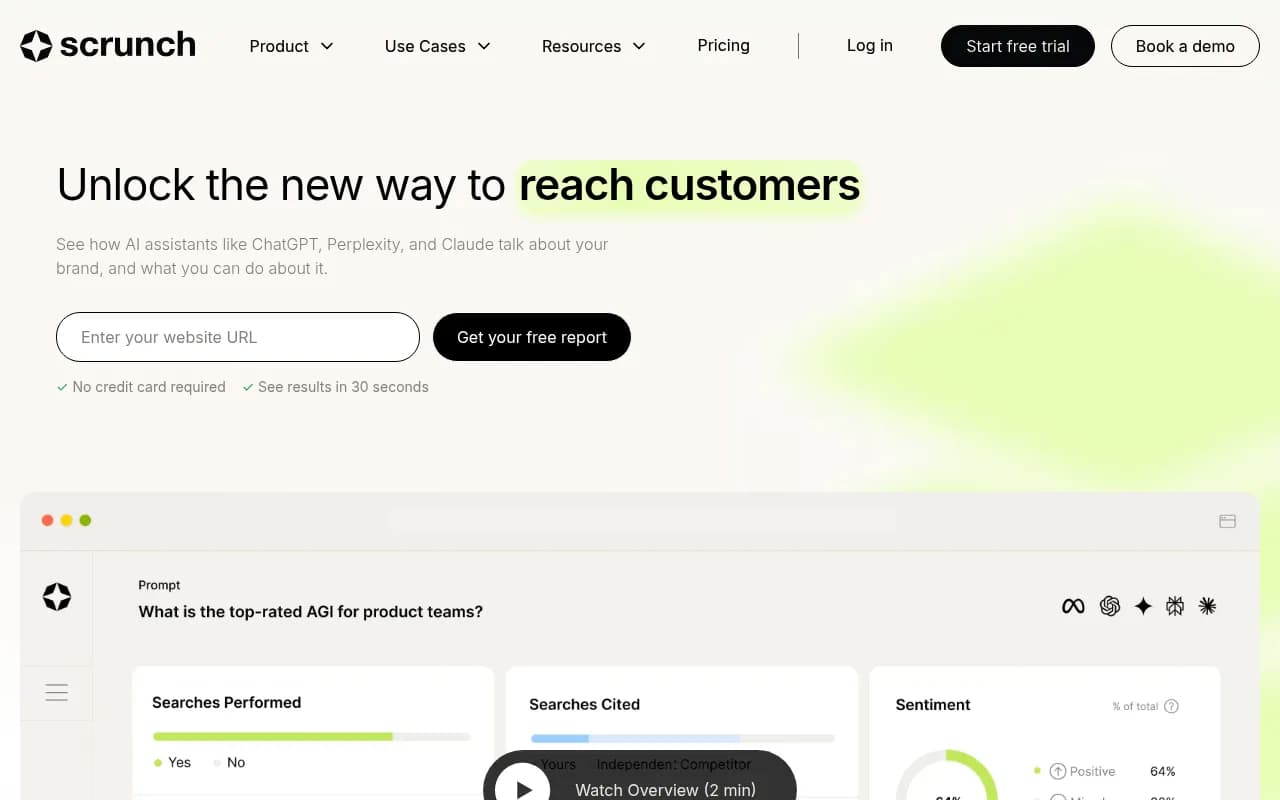
SE Visible (SE Ranking's AI visibility product) is worth considering if you're already a SE Ranking customer -- it integrates neatly into an existing SEO workflow. But it uses fixed prompts and doesn't have AI traffic attribution.
Rankshift is a simpler tracker for teams that just need to monitor brand visibility across ChatGPT, Perplexity, and a few other models without the complexity of a full platform.

How to choose
The honest answer is that the right tool depends on what you're actually trying to accomplish.
If you're just starting out and want to understand whether AI models mention your brand, Otterly.AI is the lowest-friction way to find out. The $29/month entry point is reasonable, and you'll learn a lot just from seeing the data.
If you're an enterprise team that needs deep analytics and already has content resources to act on the data, Profound or AthenaHQ both do the monitoring job well. AthenaHQ is cleaner and cheaper; Profound has more depth.
If you want to actually improve your AI visibility -- not just measure it -- Promptwatch is the only platform that closes the full loop. The combination of gap analysis, AI content generation grounded in citation data, crawler logs, and traffic attribution is genuinely different from what the monitoring-only tools offer. The 6,700+ brands using it (including Booking.com and Center Parcs) are there because they need results, not just reports.
The broader pattern in this market is that most platforms were built to answer "where are you?" Promptwatch was built to answer "how do you get there?" Those are different products solving different problems.
What to watch for when evaluating any platform
A few things worth checking before you commit to any tool in this space:
Prompt flexibility. Some platforms (Semrush, Ahrefs Brand Radar) use fixed prompt sets you can't customize. That's a real limitation -- the prompts that matter for your brand are specific to your category, your competitors, and how your customers actually search.
Model coverage. Tracking only ChatGPT and Perplexity misses a lot. Google AI Overviews and AI Mode now drive significant traffic. Claude and Gemini are growing. A platform that covers 3 models gives you an incomplete picture.
What "visibility" actually means. Some platforms count any mention of your brand name as a visibility event. Others distinguish between being cited as a source, being recommended, being mentioned in passing, and being named negatively. That distinction matters a lot for how you interpret the data.
Traffic connection. Visibility scores are interesting. Revenue impact is what actually matters. Very few platforms connect AI visibility to actual traffic and conversions -- and that's the number your CMO will ask about.
The bottom line
AI search visibility is now a real marketing channel, and the tools to manage it have matured significantly in the past 18 months. The monitoring-only platforms are fine for awareness. If you're serious about improving your position in AI-generated answers -- and connecting that to business outcomes -- you need a platform that goes beyond the dashboard.
That's the gap Promptwatch fills, and it's why it sits in a different category from the rest of the tools in this comparison.