Key takeaways
- Finseo isn't really competing with Jasper, Rytr, and Copy.ai. It's an AI visibility and GEO tracking platform that happens to bolt on content generation, not a dedicated writing tool built around drafting and editing workflows.
- Jasper ($59-69/mo on its current Pro plan) is the strongest pick for teams that need brand voice control and long-form marketing content, but it still hands you a draft that needs editing, not a finished article.
- Rytr is the budget option, now priced at $7.50-$24.16/mo on its current tiers, and works fine for short-form copy but isn't built for full SEO blog posts.
- Copy.ai has drifted from "AI copywriter" toward a broader GTM/workflow platform, with its self-serve entry tier now called Chat at $29/mo (or $24/mo annually).
- If your actual goal is showing up in ChatGPT, Google AI Overviews, or Perplexity answers rather than just publishing blog posts, that's a different problem than any of these four tools were built to solve on their own.
Why this comparison is a little unfair to Finseo
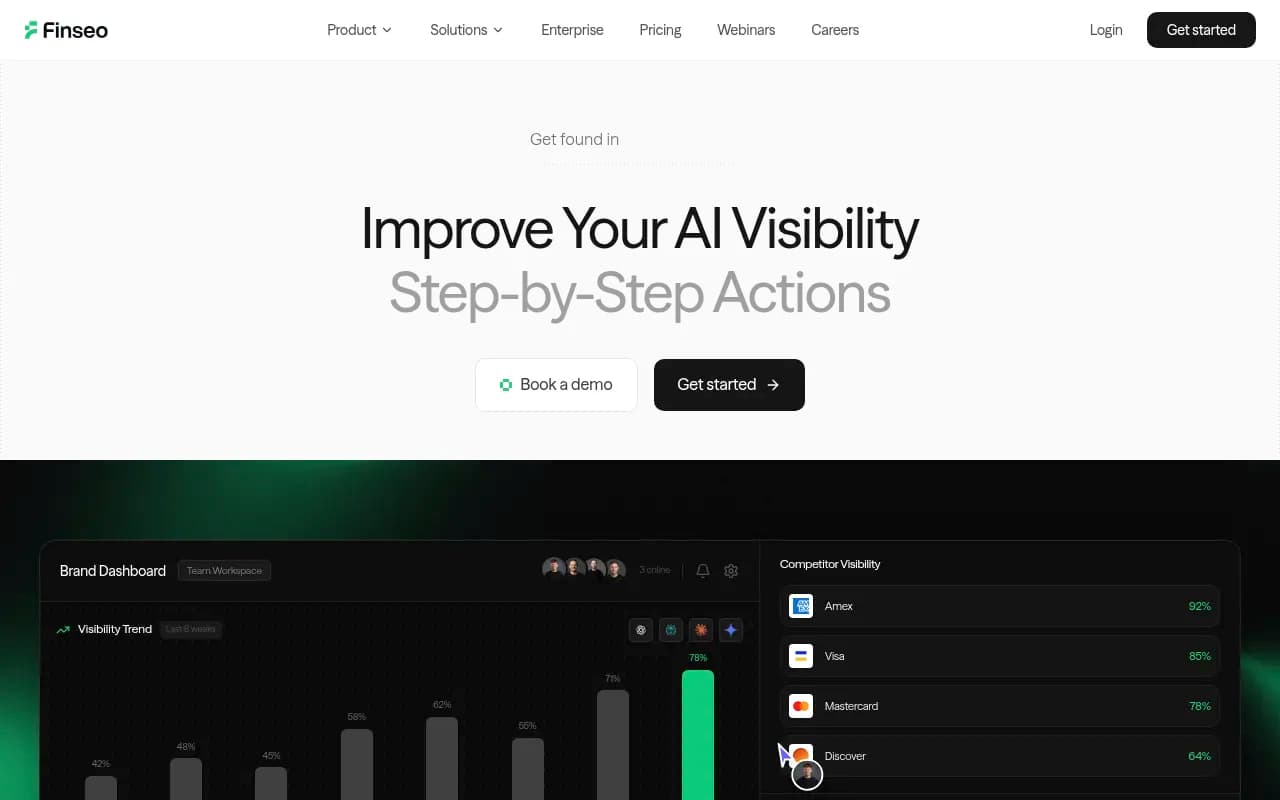
I'll say this upfront because it changes how you should read the rest of this guide: Finseo doesn't describe itself as a content writing tool. On its own site, Finseo pitches itself as "the AI visibility platform for brands that want to be the answer, not a link," with tracking across ChatGPT, Claude, Gemini, Google AI Overviews and AI Mode, Perplexity, Copilot, Grok, DeepSeek, and Mistral. Content generation is a feature bolted onto that tracking stack, not the core product. Finseo itself lists its real competitive set as Profound, Semrush's AI Visibility Toolkit, Ahrefs Brand Radar, Peec AI, Otterly.ai, Searchable, Promptwatch, and Scrunch AI, which tells you exactly what category it thinks it plays in.
So when someone asks "how does Finseo compare to Jasper, Rytr, and Copy.ai," the honest answer is: it's comparing a GEO tracking platform's side feature against three dedicated writing tools. That's worth knowing before you make a purchase decision based on a spec sheet.
Finseo's content module generates articles it describes as "backed by expert data," pulling from Notion, Google Drive, Slack, and Gmail integrations and tracking a content "score" per published piece. That's a genuinely different workflow than Jasper's templates or Rytr's use-case picker. Whether it's better depends entirely on whether you want writing-first software or visibility-tracking software with a writing bolt-on. Worth noting too: Finseo's AppSumo listing sits at a rough 2.8/5 from just four reviews, a contrast to the much higher ratings on its main G2 and OMR profiles, small sample sizes on both ends.
Quick comparison table
| Tool | Starting price (2026) | Primary use case | Output quality | Best for |
|---|---|---|---|---|
| Jasper | $59-69/mo (Pro, 1 seat) | Long-form marketing copy, brand voice | Solid drafts, needs editing | Marketing teams, agencies |
| Rytr | Free / $7.50 / $24.16/mo | Quick short-form copy | Usable but basic for long-form | Freelancers, solopreneurs |
| Copy.ai | $29/mo (Chat tier) | Sales copy, GTM workflows | Good for conversion copy | Sales and marketing ops |
| Finseo | €84-479/mo | AI visibility tracking + article generation | Data-informed, but writing is secondary | Brands prioritizing AI search presence |
Pricing on all four of these moves around enough that you should double-check the live pricing page before you commit. Rytr in particular has quietly renamed and re-priced its tiers more than once this year, so older reviews floating around the web (some still quoting a $9/$29 Saver/Unlimited structure) are stale.
Jasper: the enterprise content generalist
Jasper has repositioned itself in 2026 marketing copy away from "50+ templates" and toward "100+ specialized AI agents and connected content pipelines," which tells you the direction the product is heading: less template picker, more workflow automation. The current self-serve lineup is Pro ($69/mo monthly or $59/mo annually) and a custom-quoted Business tier that requires a 12-month term. One catch worth flagging: annual billing on Pro only becomes cheaper than monthly after about 11 months, so don't lock in a year before you know you'll actually use it.
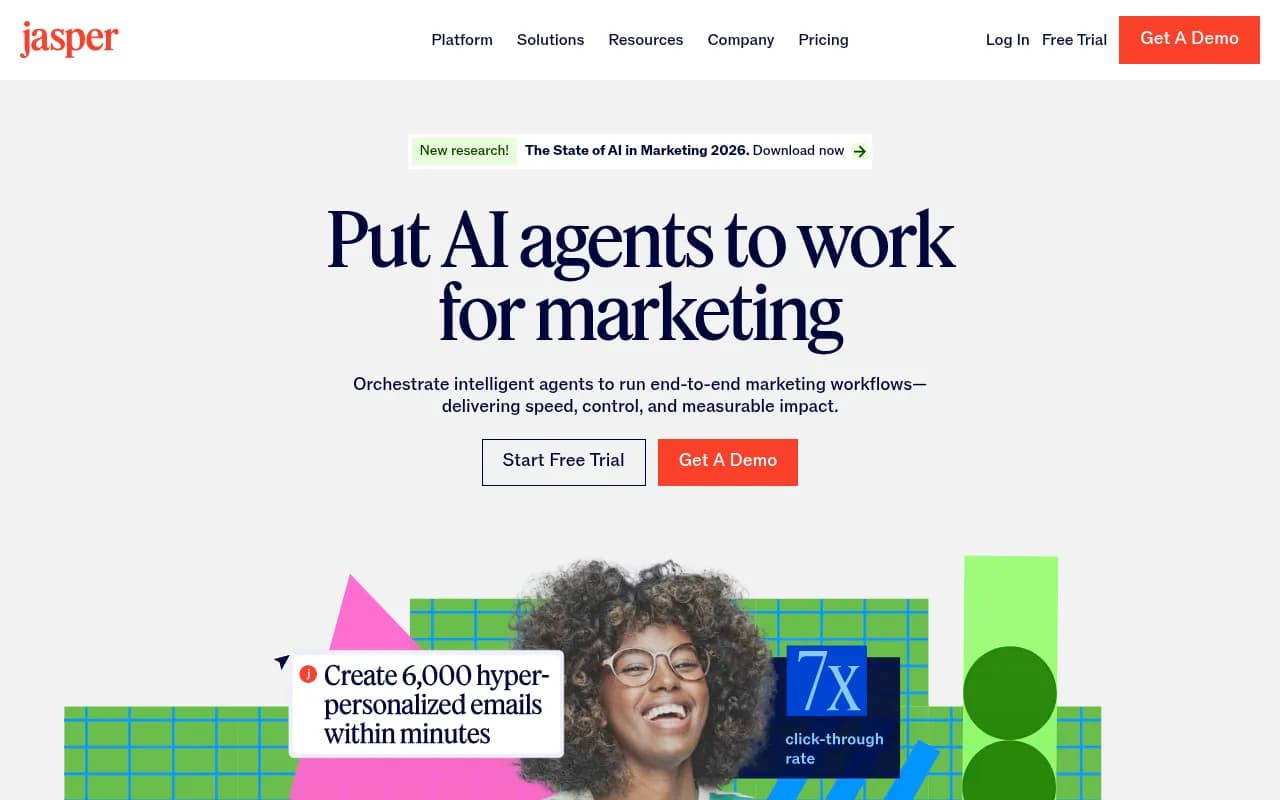
Jasper's strength is brand voice control and long-form output across emails, ads, landing pages, and blog posts. It's still a drafting tool, though. You get a solid first pass, but formatting, fact-checking, and sourcing images are on you. For teams producing marketing collateral across many channels with consistent brand tone, that tradeoff is usually worth it. For a solo blogger trying to publish SEO content fast, it's often more tool than you need.
Rytr: cheap, fast, and fine for what it is
Rytr is built around simplicity. Pick a use case from its 40+ options, add context, choose a tone, generate. The current official pricing (rytr.me/pricing) runs Free (10,000 characters/month, no tone matching), Unlimited (around $7.50/mo, unlimited characters, one tone match, 50 plagiarism checks), and Premium (around $24.16/mo, multiple tone matches, 35+ languages, 100 plagiarism checks). That's meaningfully cheaper than several secondary sources still quoting, so verify live before you buy.
One Reddit user summed up why people stick with Rytr despite its limits: it "helped with generating well-formatted texts, and quickly." That's the whole pitch. It's not trying to be a strategic SEO content engine, and it shows once you push it toward full-length, research-heavy blog posts. No brand voice training on lower tiers, limited integrations, and output quality noticeably behind Jasper or Copy.ai on anything longer than a product description or social caption.
Copy.ai: drifting toward sales and GTM
Copy.ai has quietly repositioned from "AI copywriter" toward a broader go-to-market automation platform. Its current self-serve entry tier is called Chat, priced at $29/mo ($24/mo annual), a step down from the older $49/mo "Pro" framing you'll still see referenced in some third-party pricing breakdowns (worth noting the discrepancy, Copy.ai appears to be actively restructuring its tiers this year). At the top end, Enterprise is now listed at $1,000/mo for five seats on Copy.ai's own pricing page.

Copy.ai's sweet spot is conversion-oriented copy: product descriptions, landing pages, email sequences. If your content need is "write persuasive sales copy at volume," it's a reasonable pick. If your need is "write a 2,000-word SEO article that ranks," it's not really built for that job, and its own pricing page increasingly reflects a pivot toward RevOps and workflow automation rather than pure writing.
What none of these three actually do
Here's the thing that gets lost in side-by-side spec comparisons: Jasper, Rytr, and Copy.ai are all generation tools. None of them tell you why a piece of content isn't getting cited in ChatGPT, whether Google AI Overviews are pulling from your product pages or your competitor's, or what an AI crawler actually saw when it hit your site last Tuesday. That's a different job, and it's the job Finseo is actually trying to do (with writing as a secondary feature) rather than the reverse.
If AI search visibility is the actual goal behind "I need AI SEO content," it's worth understanding what AI engines are citing right now before you generate anything. Promptwatch's citation data shows ChatGPT's citation mix shifted meaningfully in August 2026: product pages held roughly 28.7% of citations for most of the month, how-to content share more than doubled from about 4.3% to 9.1% over the back half of the month, and social post citations collapsed from 4.4% to under 1% after August 14. Google AI Overviews told a slightly different story in July 2026: listicles led the month average at 18%, but product pages overtook listicles as the single most-cited daily format from July 28 onward.
That matters for how you brief any of these writing tools. Promptwatch also tracks how many sources these engines cite per answer, ChatGPT typically cites around 5 sources per web-search response (roughly half a traditional Google results page), while Google AI Overviews and Perplexity each cite closer to 10. Fewer citation slots on ChatGPT means each one is more contested, and the practical takeaway is to build narrow, fully-answered pages rather than broad ones that half-cover many topics. None of the four tools in this comparison surface that kind of citation-behavior data on their own.
Where Promptwatch fits into this
This is the part where I'll be direct: if what you actually want is to know where your content shows up in AI answers, and to get help fixing the gaps, Promptwatch is built for exactly that in a way none of Jasper, Rytr, or Copy.ai attempt. It tracks brand and content visibility across ChatGPT, Claude, Gemini, Perplexity, Grok, DeepSeek, Copilot, Mistral, Meta Llama, Google AI Overviews, and AI Mode, and it goes further than pure monitoring: AI crawler logs show which of your pages ChatGPTBot, ClaudeBot, and PerplexityBot actually read (and where they hit errors), citation analytics show which pages get cited and which Reddit threads or YouTube videos drive AI recommendations about your brand, and Content Agents plan, write, and publish GEO-optimized articles directly to Webflow, Framer, or WordPress.

It's used by 1,840+ brands and agencies, including Duolingo, Yelp, and Shutterstock, and rates 4.7/5 on G2 off a much larger review base than Finseo's current sample. Crisp, one of its customers, saw 2x higher conversion rates from AI traffic compared to traditional channels after scaling their content output through the platform. That's a meaningfully different value proposition than "generate an article and hope it gets cited," which is closer to what Jasper, Rytr, Copy.ai, and even Finseo's own content module offer.
How to actually pick between these
If your goal is purely fast, cheap copy for ads, captions, and product blurbs, Rytr's $7.50-$24.16/mo tiers are hard to argue with on price alone. If you're running a marketing team producing brand-consistent content across many channels and can absorb $59-69/mo per seat, Jasper's the more capable generalist. If your priority is sales and conversion-focused copy at volume, Copy.ai's Chat tier at $29/mo is the more targeted fit.
But if the real question behind "which AI SEO writing tool" is "how do I get my brand showing up when people ask ChatGPT or Google AI Mode about my category," none of the three classic writing tools, and honestly not Finseo's bolted-on content feature either, are built to answer that with the depth a dedicated GEO platform provides. That's a fair comparison to make, just not the one most "Finseo vs Jasper" articles are actually making. You can browse more options built specifically for that job in the GEO software directory at bestgeosoftware.com, or compare rank-tracking-focused alternatives at ai-rank-tools.com if visibility tracking, not drafting, is your real bottleneck.