Key takeaways
- Most AI visibility platforms added Mistral support in 2025-2026, but coverage depth varies significantly -- some track it properly, others just check a box.
- Monitoring-only tools (Peec AI, Otterly.AI) show you where you're invisible in Mistral but don't help you fix it.
- Promptwatch is the only platform in this comparison that closes the loop: find gaps, generate content, track results.
- Profound is the strongest enterprise alternative but comes at a higher price point with no Reddit tracking or ChatGPT Shopping.
- If you're serious about Mistral visibility specifically, the platform you choose matters less than whether it can tell you why you're not being cited -- and what to do about it.
Mistral has quietly become one of the more interesting AI search engines to track. It's not as dominant as ChatGPT or Perplexity in terms of raw user volume, but it's increasingly used in enterprise contexts, European markets, and developer workflows -- which means if your brand sells to those audiences, Mistral citations matter.
The problem is that most AI visibility platforms treat Mistral as an afterthought. They'll list it in their feature matrix, run a few test prompts against it, and call it "supported." But actually tracking citation patterns, understanding why Mistral cites certain sources, and doing something about gaps? That's where most tools fall short.
This guide breaks down how four of the leading platforms -- Promptwatch, Profound, Peec AI, and Otterly.AI -- handle Mistral tracking specifically, and what you actually get from each.
Why Mistral tracking is different from ChatGPT or Perplexity
Before getting into the tool comparison, it's worth understanding why Mistral is its own challenge.
Mistral's citation behavior differs from ChatGPT in a few notable ways. It tends to favor structured, authoritative content -- technical documentation, well-organized blog posts, and pages with clear entity signals. It's also more likely to surface European sources for European queries, which makes multi-region tracking more important.
Most platforms built their prompt testing infrastructure around ChatGPT and Perplexity first. Mistral was added later, and in some cases the implementation is shallower -- fewer prompts tested, less frequent refresh cycles, and no real differentiation in how results are analyzed.
If you're tracking Mistral specifically, you want to know: which of your pages is Mistral citing? Which competitors is it citing instead? What prompts trigger those citations? And critically -- what content gaps are causing you to be invisible?
The four platforms compared
Promptwatch
Promptwatch monitors 10 AI models including Mistral, and it's one of the few platforms that tracks how AI search engines behave in real user interfaces rather than just through API calls. That distinction matters because user-facing responses, citations, and recommendations can differ from what you'd see hitting an API directly.

What separates Promptwatch from the others in this comparison is what happens after you see your Mistral visibility data. The Answer Gap Analysis shows you exactly which prompts competitors are appearing for in Mistral (and other models) that you're not. You see the specific topics, questions, and angles that Mistral wants to answer but can't find on your site.
From there, Content Agents generate articles, comparisons, and briefs grounded in that real prompt data -- not generic SEO filler, but content engineered to fill the specific gaps Mistral is exposing. Then page-level tracking shows when Mistral starts citing your new content, with a timeline from publish to crawl to citation.
The AI Crawler Logs feature is particularly useful for Mistral tracking. You can see when Mistral's crawler hits your site, which pages it reads, any errors it encounters, and how often it returns. Most competitors don't have this at all.
Pricing starts at $99/month (Essential: 1 site, 50 prompts, 5 articles), $249/month (Professional: 2 sites, 150 prompts, 15 articles, crawler logs), and $579/month (Business: 5 sites, 350 prompts, 30 articles). Free trial available.
Profound
Profound is a strong enterprise-focused platform with solid multi-model coverage including Mistral. It tracks brand mentions, citation patterns, and competitive positioning across major AI engines, and the data quality is generally good.
Profound

Where Profound shines is depth of enterprise features -- it handles large-scale tracking well and the interface is polished. But it's primarily a monitoring platform. You get good data on where you stand in Mistral, but the path from "I'm invisible here" to "I fixed it" isn't built into the product the way it is in Promptwatch.
Profound also lacks Reddit tracking and ChatGPT Shopping monitoring -- two channels that increasingly influence what AI models like Mistral cite. If a Reddit thread is driving Mistral to recommend a competitor, Profound won't surface that.
Price points are higher than Promptwatch, which makes the monitoring-only limitation more notable at that tier.
Peec AI
Peec AI is a monitoring-focused tool that does daily prompt tracking across several AI models including Mistral. It's reasonably fast to set up and gives you a clear view of visibility scores over time.
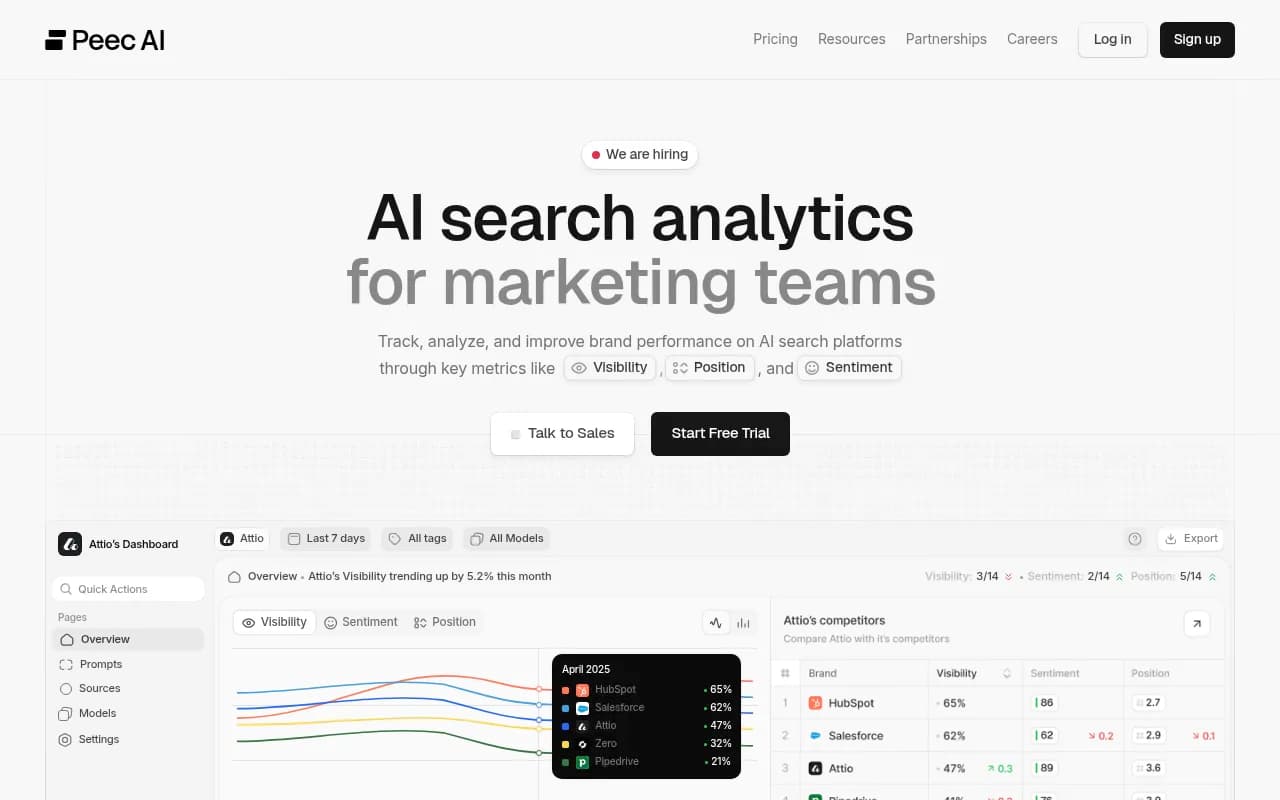
The honest assessment: Peec AI is a charting tool. It shows you visibility trends, citation rates, and competitive comparisons in clean dashboards. For teams that just need a quick read on where they stand across AI models, it works fine.
But there's no crawler log access, no content generation, no answer gap analysis, and no traffic attribution. You can see that your Mistral visibility dropped last Tuesday -- you can't find out why, and you can't do anything about it from within the platform. That's a significant limitation if you're trying to actually improve your Mistral citations rather than just monitor them.
Otterly.AI
Otterly.AI was one of the earlier entrants in AI search monitoring and has built a reasonably broad feature set for tracking brand mentions across ChatGPT, Perplexity, Google AI Overviews, and other models including Mistral.
Otterly.AI

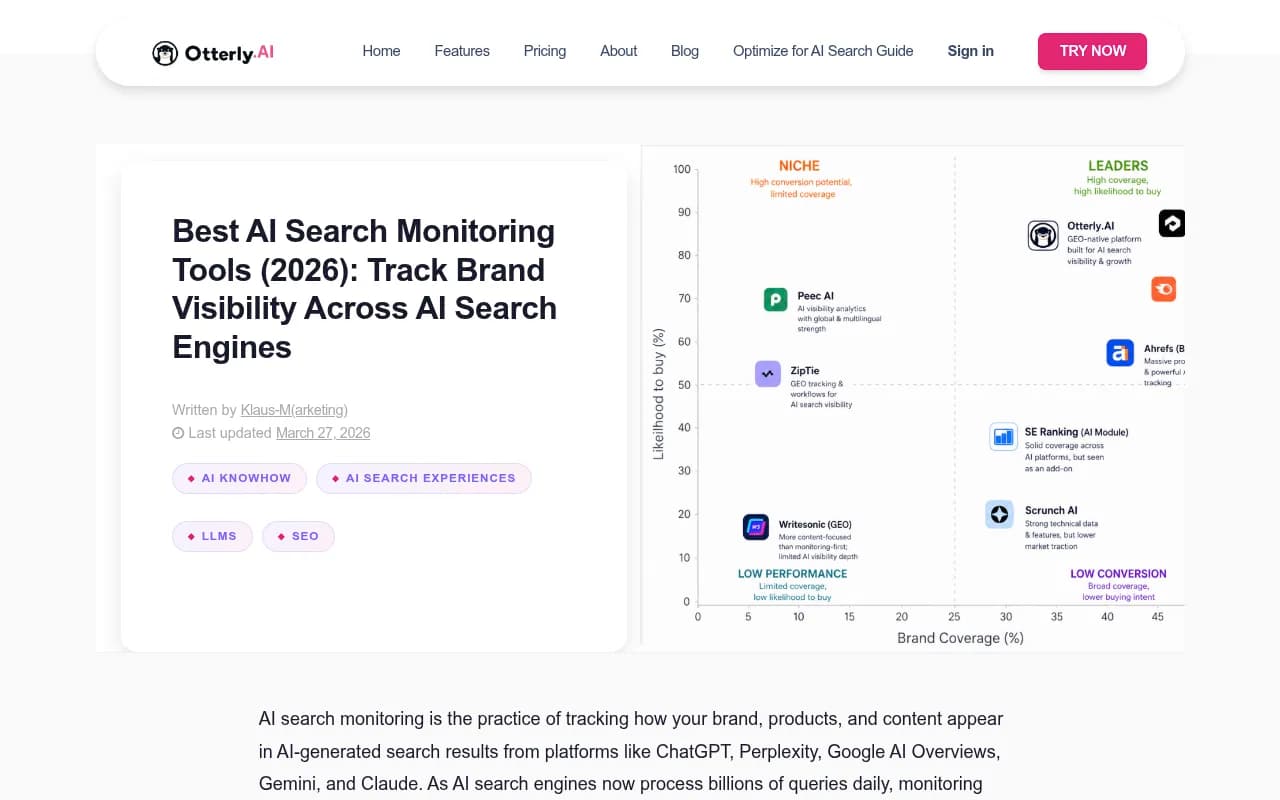
It's the most accessible option in this comparison from a cost and setup perspective. The interface is clean, onboarding is quick, and the monitoring data is updated regularly.
The limitation is similar to Peec AI: Otterly.AI is built around monitoring, not optimization. There's no content generation, no crawler log access, and no mechanism to close the gap between "you're not visible in Mistral" and "here's what to do about it." For teams with a small budget who just need basic visibility data, it's a reasonable starting point. For teams that want to actually grow their Mistral presence, it's a first step that requires other tools to complete the workflow.
Feature comparison
| Feature | Promptwatch | Profound | Peec AI | Otterly.AI |
|---|---|---|---|---|
| Mistral tracking | Yes | Yes | Yes | Yes |
| Models covered | 10 (incl. Mistral) | 9+ | Limited | 5+ |
| Real UI tracking (not just API) | Yes | Partial | No | No |
| AI Crawler Logs | Yes | No | No | No |
| Answer Gap Analysis | Yes | Limited | No | No |
| Content generation | Yes (Content Agents) | No | No | No |
| Page-level citation tracking | Yes | Yes | No | No |
| Traffic attribution | Yes | No | No | No |
| Reddit/YouTube tracking | Yes | No | No | No |
| ChatGPT Shopping tracking | Yes | No | No | No |
| Multi-region / multi-language | Yes | Yes | Limited | Limited |
| Prompt volume + difficulty scores | Yes | No | No | No |
| Free trial | Yes | Yes | Yes | Yes |
| Starting price | $99/mo | Higher | Lower | Lower |
Which tool is right for your situation
The right choice depends on what you actually need from Mistral tracking.
If you want to monitor Mistral visibility and nothing else, Peec AI or Otterly.AI will do the job at a lower price point. You'll get dashboards, trend lines, and competitive comparisons. What you won't get is any help fixing what you find.
If you're at an enterprise scale and need deep multi-model tracking with a polished reporting layer, Profound is worth evaluating. Just go in knowing it's a monitoring platform and you'll need separate tools for content optimization.
If you want to actually grow your Mistral citations -- not just watch them -- Promptwatch is the only platform in this comparison that covers the full loop. The combination of Answer Gap Analysis, Content Agents, crawler logs, and page-level tracking means you can go from "Mistral isn't citing us for this prompt" to "we published content that addresses the gap" to "Mistral is now citing that page" all within one platform.
What good Mistral tracking actually looks like
A few things worth checking when evaluating any platform for Mistral specifically:
Prompt coverage. How many Mistral-specific prompts is the platform running? Some tools run the same prompt set across all models, which misses the fact that Mistral users tend to ask different questions than ChatGPT users. You want a platform that lets you customize prompts for Mistral's actual user base.
Refresh frequency. Mistral's citation patterns can shift as it updates its models. Daily refresh is the minimum; on-demand querying is better for catching sudden changes.
Source-level visibility. It's not enough to know your brand was mentioned. You want to know which specific page was cited, what prompt triggered the citation, and whether the citation included a link. Promptwatch tracks this at the page level; some competitors only track brand mentions.
Crawler behavior. Mistral's web crawler has its own behavior patterns -- which pages it prioritizes, how often it returns, what errors it encounters. If a platform can't show you crawler logs, you're flying blind on the technical side of Mistral visibility.
Competitive context. Knowing you're not cited is less useful than knowing who is cited instead, and for which prompts. Competitor heatmaps that show Mistral citation share by prompt category are significantly more actionable than overall visibility scores.
The monitoring-only trap
One pattern worth naming directly: a lot of teams buy a monitoring tool, get good data on their Mistral visibility, and then... don't know what to do with it. The data shows gaps. The tool doesn't help fill them. Six months later, the visibility scores haven't moved.
This isn't a knock on monitoring tools specifically -- data is valuable. But if your goal is to improve Mistral citations, monitoring is the starting point, not the destination. The platforms that help you act on the data (content gap analysis, content generation, crawler diagnostics) tend to produce better outcomes than the ones that just show you where you stand.
That's the core argument for Promptwatch in this comparison. It's not just that it has more features -- it's that the features are connected in a way that creates an actual workflow: find the gap, create the content, track the result. Most competitors stop at step one.
Bottom line
Mistral is a real AI search engine with real citation patterns that real users and enterprises rely on. Tracking your visibility there matters, and the four platforms in this comparison all offer some version of that tracking.
But there's a meaningful difference between knowing you're invisible and knowing how to fix it. If you're evaluating these tools, that's the question to ask each vendor: after I see my Mistral visibility data, what does your platform help me do about it?
For most teams, the answer from Promptwatch will be the most complete one.