Key takeaways
- Travel and hospitality brands are uniquely exposed to AI search shifts -- when someone asks ChatGPT "best boutique hotels in Lisbon," the brands that appear in that answer win bookings, not just clicks
- Most AI visibility platforms are monitoring-only dashboards; they show you where you're invisible but don't help you fix it
- Promptwatch is the only platform in this comparison that closes the full loop: find gaps, generate content, track results
- Profound is a strong enterprise option with deep analytics but comes at a higher price point and lacks content generation
- Otterly.AI is the budget-friendly entry point but is best suited for small teams that just need basic monitoring
Why travel and hospitality brands need to care about AI visibility right now
When someone types "best family resort in the Maldives" into ChatGPT or asks Perplexity for "boutique hotels near the Amalfi Coast," they're not browsing -- they're ready to book. The brands that show up in those AI-generated answers have a massive advantage over those that don't.
This is different from traditional SEO in a few important ways. Google rankings are competitive but at least somewhat predictable. AI search is a black box. ChatGPT doesn't show you a list of 10 blue links -- it picks two or three sources and presents them as definitive answers. If your hotel, airline, or OTA isn't one of those sources, you simply don't exist in that moment.
The travel sector has some specific challenges that make AI visibility harder to manage:
- Multi-location complexity. A hotel chain with 200 properties needs visibility across hundreds of location-specific queries, not just brand-level mentions.
- OTA dominance. Booking.com, Expedia, and TripAdvisor are heavily cited by AI models. Independent hotels and smaller chains are fighting for the remaining share.
- Seasonal and intent-driven queries. "Best ski resorts in January" and "cheap flights to Barcelona in summer" require different content strategies, and both need to be tracked.
- Review and reputation signals. AI models pull from Reddit, TripAdvisor reviews, and travel forums -- channels that most SEO tools completely ignore.
The good news: brands that act now have a real first-mover advantage. Most competitors in travel haven't figured out AI visibility yet.
The three platforms compared
Here's a quick overview before we go deeper.
| Feature | Promptwatch | Profound | Otterly.AI |
|---|---|---|---|
| AI models tracked | 10+ (ChatGPT, Perplexity, Claude, Gemini, Grok, DeepSeek, Copilot, Meta AI, Google AI Overviews, Google AI Mode) | 9+ | ChatGPT, Perplexity, Google AI Overviews |
| Content gap analysis | Yes (Answer Gap Analysis) | Limited | No |
| Built-in content generation | Yes (AI writing agent) | No | No |
| AI crawler logs | Yes | No | No |
| Reddit/YouTube tracking | Yes | No | No |
| ChatGPT Shopping tracking | Yes | No | No |
| Prompt volume/difficulty scores | Yes | Partial | No |
| Multi-location/multi-region | Yes | Yes | Limited |
| Traffic attribution | Yes (GSC, snippet, server logs) | Partial | No |
| Starting price | $99/mo | $99/mo | $29/mo |
| Best for | Marketing teams that want to act, not just monitor | Enterprise analytics teams | Freelancers and small teams |
Promptwatch: the platform built for action
Promptwatch is the one platform in this comparison that doesn't stop at showing you data. The core workflow is a loop: find the gaps, create content to fill them, then track whether it worked.

For travel brands, this matters a lot. Knowing that you're invisible for "luxury safari lodges Kenya" is useful. But what do you do with that information? Promptwatch's Answer Gap Analysis shows you exactly which prompts your competitors rank for that you don't -- and then the built-in AI writing agent generates content specifically engineered to get cited by AI models, not just rank in Google.
The content generation isn't generic. It's grounded in 880M+ citations analyzed across AI models, so the output reflects what ChatGPT, Claude, and Perplexity actually want to cite. For a travel brand, that means articles and comparison pages written in the format and depth that AI models pull from.
A few capabilities that are particularly relevant for travel and hospitality:
Reddit and YouTube tracking. AI models cite Reddit threads and YouTube videos constantly. When someone asks Perplexity for "honest review of [hotel name]," it might pull from a Reddit thread you didn't even know existed. Promptwatch surfaces these discussions so you can understand what's shaping AI recommendations about your brand -- and respond accordingly.
AI crawler logs. This is genuinely rare. Promptwatch shows you in real time which AI crawlers (ChatGPT's GPTBot, Perplexity's bot, etc.) are hitting your website, which pages they're reading, and what errors they encounter. For a hotel chain with hundreds of property pages, this is how you find out why certain locations aren't getting cited.
Multi-language and multi-region. A resort brand operating across Europe, Southeast Asia, and the Americas needs visibility in multiple languages. Promptwatch handles this with customizable personas that match how customers in different markets actually prompt.
ChatGPT Shopping tracking. If you sell directly (rooms, packages, experiences), this matters. Promptwatch monitors when your brand appears in ChatGPT's product recommendations and shopping carousels -- a channel that's growing fast in travel.
Pricing starts at $99/mo for the Essential plan (1 site, 50 prompts, 5 articles). The Professional plan at $249/mo adds crawler logs, multi-location tracking, and 15 articles per month. For a hotel chain or travel agency managing multiple brands, the Business plan at $579/mo covers 5 sites and 350 prompts.
Profound: strong analytics, but you'll need to bring your own content team
Profound is a serious platform built for enterprise teams that have analysts and content teams ready to act on data. It tracks brand mentions across 9+ AI models and offers near real-time monitoring with solid API access.
Profound

For large travel brands with dedicated analytics resources, Profound's depth is genuinely impressive. You get granular data on how your brand appears across models, competitive benchmarking, and the ability to slice data in ways that smaller tools can't match.
The limitation is that Profound stops at the data layer. It shows you where you're invisible -- but generating content to fix that is your problem. For a lean marketing team at a mid-size hotel group, that gap is a real blocker. You'd need to export the data, brief a content team, write the articles, publish them, and then come back to Profound to see if anything changed.
Profound also lacks a few features that matter specifically for travel:
- No Reddit or YouTube tracking (significant, given how much AI models pull from travel forums)
- No AI crawler logs
- No ChatGPT Shopping monitoring
- No built-in content generation
That said, if you're a large enterprise with a full content operation and you need raw data and API access, Profound is a solid choice. It's just not an optimization platform -- it's an analytics platform.
Pricing starts at $99/mo, but enterprise-level features push the cost significantly higher.
Otterly.AI: good entry point, limited ceiling
Otterly.AI is the most affordable option here, starting at $29/mo, and it does what it says: tracks your brand mentions across ChatGPT, Perplexity, and Google AI Overviews.
Otterly.AI

For a small independent hotel or a freelance travel content creator who just wants to know whether they're showing up in AI answers, Otterly.AI is a reasonable starting point. Setup is quick, the interface is clean, and the price is hard to argue with.
But the ceiling is low. Otterly.AI doesn't offer:
- Content gap analysis or generation
- AI crawler logs
- Reddit or YouTube tracking
- Prompt volume or difficulty scoring
- Traffic attribution
- Multi-language or multi-region monitoring at any real depth
For a travel brand that's serious about AI visibility as a growth channel, Otterly.AI will quickly feel like a dashboard that tells you what's wrong without any tools to fix it. You'll know you're invisible -- and then you'll be stuck.
How to choose based on your situation
The right platform depends on your team size, budget, and what you actually want to do with the data.
If you're a marketing or SEO team at a mid-size to large travel brand -- hotel group, airline, tour operator, OTA -- Promptwatch is the clear choice. The action loop (find gaps, generate content, track results) is exactly what you need, and the Reddit/YouTube tracking plus crawler logs give you visibility into channels that competitors are ignoring.
If you're an enterprise with a large analytics team and a separate content operation -- and you primarily need deep data, API access, and competitive benchmarking -- Profound is worth evaluating. Just budget for the content production separately.
If you're a small independent hotel, a travel blogger, or a freelancer just starting to explore AI visibility -- Otterly.AI is a low-risk way to get started. Upgrade when you're ready to move from monitoring to optimization.
What travel brands should actually track
Before you pick a platform, it's worth being specific about what you need to monitor. Here are the prompt categories that matter most for travel and hospitality:
- Destination queries: "best hotels in [city]", "where to stay in [region]", "top resorts in [country]"
- Comparison queries: "[Brand A] vs [Brand B]", "is [hotel] worth it", "better: [hotel] or [competitor]"
- Intent-driven queries: "family-friendly resorts with kids clubs", "adults-only all-inclusive Caribbean", "boutique hotels with rooftop pools"
- Review-influenced queries: "honest review of [brand]", "is [hotel] overrated", "what's [brand] like in [season]"
- Shopping/booking queries: "book [hotel] direct vs Booking.com", "best price for [hotel]"
Each of these requires a different content strategy, and a good AI visibility platform should help you understand which ones you're winning and which ones you're losing.
A note on the broader competitive landscape
Beyond these three platforms, there are other tools worth knowing about if you're building out a full AI visibility stack.

Peec AI is a solid mid-market option with clean competitor benchmarking. It's simpler than Profound and more capable than Otterly.AI, but it doesn't generate content either.
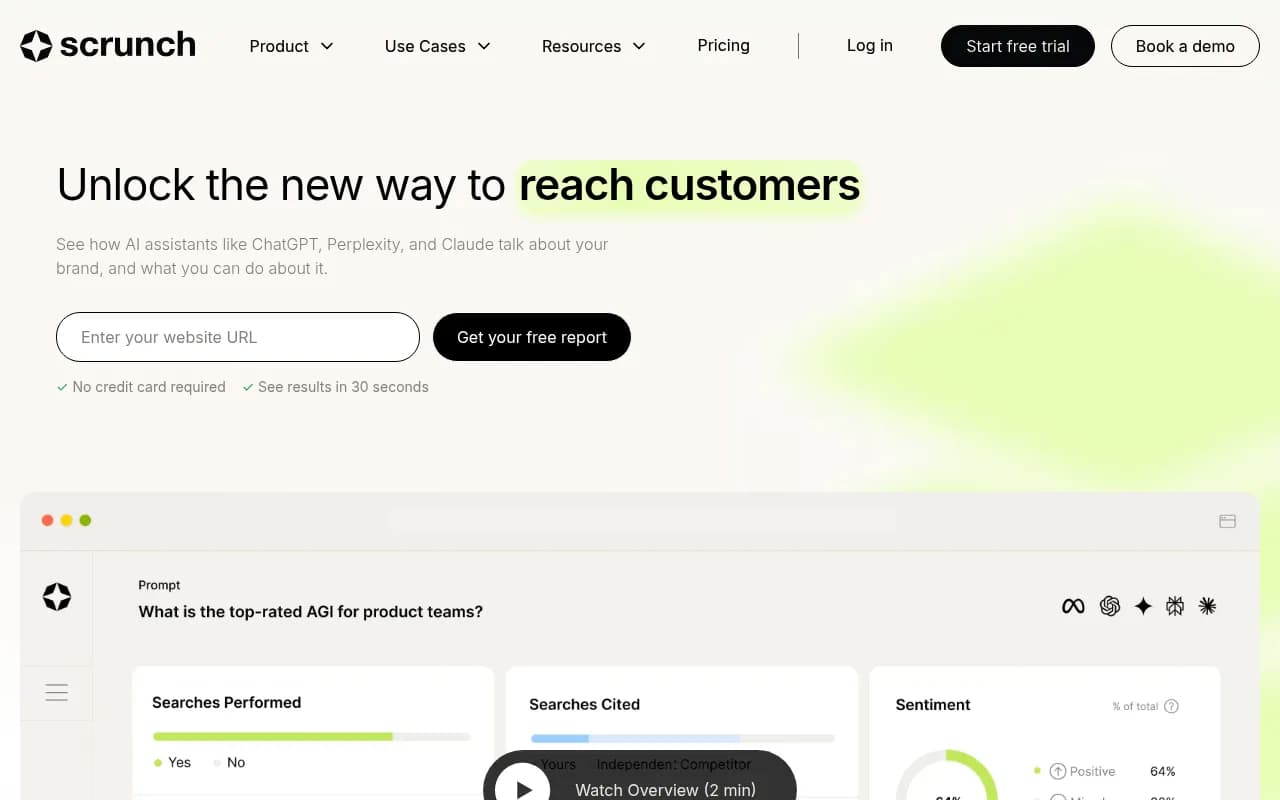
Scrunch AI has a strong feature set with good enterprise capabilities, though it comes at a higher price point and doesn't include Reddit tracking or ChatGPT Shopping monitoring.

AthenaHQ is monitoring-focused and works well for teams that need clean dashboards, but like most competitors, it stops before the content optimization layer.
For travel brands that want to go beyond tracking and actually improve their AI visibility, the combination of gap analysis and content generation is what separates Promptwatch from the rest of the field.
The bottom line
AI search is already influencing travel decisions. When someone asks ChatGPT to plan a trip to Japan, the hotels and experiences it recommends are going to get bookings. The brands that understand this now -- and build content strategies around it -- will have a durable advantage over those that figure it out in 2027.
The platform you choose matters less than the decision to start. But if you want a tool that helps you act on what you find, not just observe it, Promptwatch is the most complete option available for travel and hospitality teams in 2026.