Summary
- Agency-specific features matter more than raw data: Client workspaces, white-label reporting, pitch environments, and bulk prompt management separate real agency tools from rebranded single-brand platforms.
- Action beats monitoring: Most tools show you where clients are invisible in AI search—but only a few help you fix it with content gap analysis, AI writing agents, and optimization workflows.
- Promptwatch leads for agencies that want to close the loop: Track visibility, generate content that ranks in AI, and prove ROI with traffic attribution—all in one platform.
- Pricing scales fast: Managing 20+ clients means you'll hit tier limits quickly. Budget for $500-2000/month per platform depending on prompt volumes and feature depth.
- Multi-client dashboards are non-negotiable: Switching between 20 separate logins kills productivity. Look for platforms with unified views, bulk operations, and API access for custom reporting.

What agencies actually need in an AI visibility platform
Most AI visibility tools were built for single brands. They work fine if you're tracking one website with 50 prompts. They fall apart when you're managing 20 clients with different industries, geographies, and competitive landscapes.
Agencies need:
- Client workspaces: Separate dashboards per client with isolated data, custom branding, and role-based access for client teams
- Bulk prompt management: Upload 500 prompts across 10 clients without manually entering each one
- White-label reporting: Export PDFs and dashboards with your agency logo, not the platform's
- Pitch environments: Demo tracking for prospects before they sign—show them what they're missing in ChatGPT and Perplexity
- Multi-region and multi-language support: Track prompts in Spanish for a Miami client, Dutch for an Amsterdam client, and English for everyone else
- API access: Pull data into your existing reporting stack (Looker Studio, Tableau, custom dashboards)
- Optimization tools, not just tracking: Show clients where they're invisible, then help them fix it with content recommendations, gap analysis, and AI writing
The platforms below are ranked by how well they handle agency use cases at scale.
Top AI visibility platforms for agencies in 2026
Promptwatch — action-first platform for agencies that want to optimize, not just monitor
Promptwatch is the only AI visibility platform rated as a "Leader" across all categories in a 2026 comparison of 12 GEO tools. The difference: most competitors stop at showing you data. Promptwatch shows you what's missing, then helps you fix it.
The core workflow:
- Answer Gap Analysis shows exactly which prompts competitors rank for but your client doesn't. You see the specific content gaps—topics, angles, and questions AI models want answers to but can't find on the client's site.
- Built-in AI writing agent generates articles, listicles, and comparisons grounded in real citation data (880M+ citations analyzed), prompt volumes, persona targeting, and competitor analysis. This isn't generic SEO filler—it's content engineered to get cited by ChatGPT, Claude, and Perplexity.
- Track results with page-level visibility scores, citation tracking, and traffic attribution (code snippet, GSC integration, or server log analysis). Close the loop from visibility to revenue.
Agency-specific features:
- Multi-site management: Professional plan supports 2 sites, Business plan supports 5 sites. Each site gets isolated tracking, prompts, and content generation.
- AI Crawler Logs: Real-time logs of ChatGPT, Claude, and Perplexity crawlers hitting client websites. See which pages they read, errors they encounter, and how often they return. Most competitors lack this entirely.
- Prompt Intelligence: Volume estimates and difficulty scores for each prompt, plus query fan-outs that show how one prompt branches into sub-queries. Prioritize high-value, winnable prompts.
- Reddit & YouTube Insights: Surface discussions that directly influence AI recommendations—a channel most competitors ignore.
- ChatGPT Shopping Tracking: Monitor when client brands appear in ChatGPT's product recommendations.
- Looker Studio Integration & API: Export data for white-label reporting or build custom workflows.
Monitors 10 AI models: ChatGPT, Perplexity, Google AI Overviews, Google AI Mode, Claude, Gemini, Meta/Llama, DeepSeek, Grok, Mistral, Copilot.
Pricing: Essential $99/mo (1 site, 50 prompts, 5 articles), Professional $249/mo (2 sites, 150 prompts, 15 articles, crawler logs), Business $579/mo (5 sites, 350 prompts, 30 articles). Agency/Enterprise custom pricing available. Annual billing discounts.
Best for: Agencies that want to deliver optimization, not just reports. If you're tired of showing clients "you're invisible in ChatGPT" without being able to fix it, Promptwatch is the answer.
Profound — enterprise platform with dedicated agency mode
Profound is the go-to for agencies managing Fortune 500 clients. Their Agency mode includes brand configurations, pitch environments, and white-label reporting out of the box.
Profound

Key agency features:
- Pitch environments: Create demo dashboards for prospects showing their current AI visibility before they sign. This alone closes deals.
- Brand configurations: Separate workspaces per client with custom prompt sets, competitor tracking, and isolated data.
- White-label reporting: Export PDFs and dashboards with your agency branding.
- Shopping insights: Track product recommendations in ChatGPT Shopping—critical for ecommerce clients.
- Prompt volume data: See estimated search volumes for each prompt to prioritize high-impact optimization.
Profound monitors ChatGPT, Perplexity, Google AI Overviews, Claude, Gemini, and other major models. The platform is monitoring-focused—it shows you where clients are invisible but doesn't include built-in content generation or gap analysis tools.
Pricing: Custom enterprise pricing. Expect $1500-5000/month for agency plans depending on client count and prompt volumes.
Best for: Agencies with enterprise clients that need pitch-ready demos and white-label reporting. If you're selling to Fortune 500 brands, Profound's polish and agency-specific features justify the cost.
Otterly.AI — affordable entry point for agencies testing AI visibility
Otterly.AI is the most affordable platform in this category. It's lightweight, covers the basics, and works well for agencies just starting to offer AI visibility services.
Otterly.AI

What you get:
- Basic monitoring: Track brand mentions and citations across ChatGPT, Perplexity, and Google AI Overviews.
- Multi-client support: Manage multiple brands from one dashboard.
- Affordable pricing: Starts around $50-100/month per brand, making it feasible to test with a few clients before committing to enterprise platforms.
What you don't get:
- No AI crawler logs
- No visitor analytics or traffic attribution
- No content generation or gap analysis
- Limited prompt intelligence (no volume estimates or difficulty scoring)
Otterly.AI is a tracker, not an optimizer. You'll see where clients are invisible, but you're on your own for fixing it.
Best for: Agencies testing AI visibility as a service offering without committing $2000/month upfront. Good for small clients with limited budgets.
Peec AI — smart suggestions and competitive intelligence
Peec AI differentiates itself with actionable recommendations. Instead of just showing you data, it suggests specific optimizations based on competitor analysis and citation patterns.

Agency-relevant features:
- Smart suggestions: Platform analyzes citation patterns and recommends content topics, angles, and formats that work for competitors.
- Competitive intelligence: See which competitors rank for each prompt and what content they're getting cited for.
- Multi-brand dashboards: Manage multiple clients from one interface.
Peec AI monitors ChatGPT, Perplexity, Claude, and Google AI Overviews. The platform is stronger on analysis than raw data volume—you get fewer prompts per plan tier but more actionable insights per prompt.
Pricing: Mid-tier pricing around $300-800/month depending on client count and prompt volumes.
Best for: Agencies that want recommendations, not just data dumps. If you're tired of staring at dashboards wondering what to do next, Peec AI's suggestions help prioritize.
ZipTie — deep analysis and custom reporting
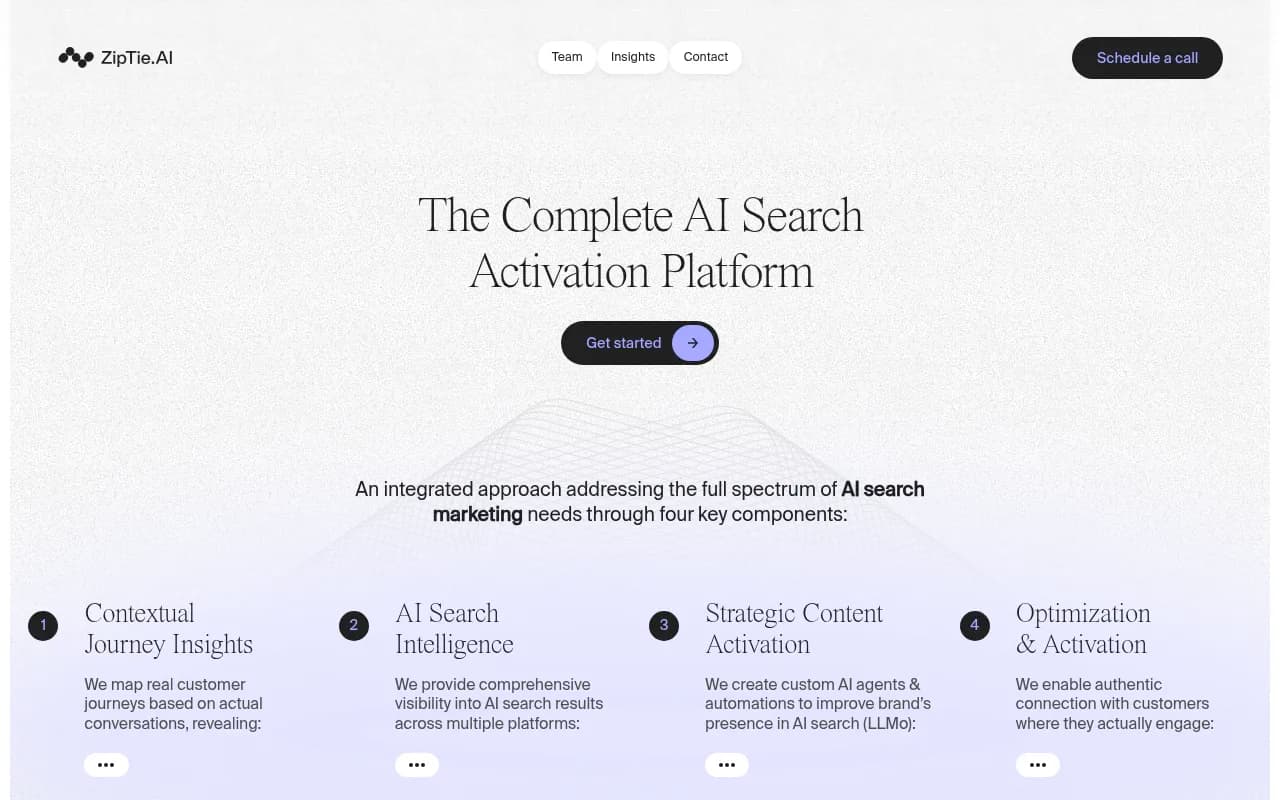
ZipTie focuses on analysis depth over breadth. You get fewer prompts per plan tier, but each prompt comes with detailed breakdowns of citations, sources, and sentiment.
Agency features:
- Deep citation analysis: See exactly which pages, Reddit threads, and YouTube videos AI models cite in responses.
- Custom reporting: Export data in formats that fit your existing reporting stack.
- Multi-client support: Manage multiple brands with separate dashboards.
ZipTie monitors ChatGPT, Perplexity, and Google AI Overviews. The platform is analysis-heavy—great for agencies that need to explain why a client is invisible, not just show that they are.
Pricing: Mid-tier pricing around $400-1000/month depending on client count.
Best for: Agencies selling to technical clients that want detailed explanations and root cause analysis.
Similarweb — side-by-side SEO and AI visibility tracking
Similarweb added AI visibility tracking to their existing competitive intelligence platform. If you're already using Similarweb for traditional SEO and traffic analysis, adding AI visibility tracking is a natural extension.
Agency benefits:
- Unified platform: Track traditional SEO, paid search, and AI visibility in one dashboard.
- Competitive benchmarking: Compare client AI visibility against competitors across multiple dimensions.
- Traffic attribution: Connect AI visibility to actual website traffic using Similarweb's existing analytics.
Similarweb monitors ChatGPT, Perplexity, and Google AI Overviews. The AI visibility features are newer and less mature than dedicated platforms, but the integration with traditional SEO data is valuable.
Pricing: Enterprise pricing, typically $2000-5000/month for agency plans with full feature access.
Best for: Agencies already using Similarweb for competitive intelligence. Adding AI visibility tracking is cheaper than buying a separate platform.
Semrush — AI visibility for existing Semrush users
Semrush added AI visibility tracking to their all-in-one SEO platform. If you're already paying for Semrush, the AI visibility features are included at higher plan tiers.
Agency features:
- Integrated with existing Semrush workflows: Track AI visibility alongside keyword rankings, backlinks, and site audits.
- Multi-client dashboards: Manage all clients from one Semrush account.
- White-label reporting: Export branded reports with AI visibility data.
Limitations:
- Fixed prompt sets: Semrush uses predefined prompts—you can't add custom prompts for specific client needs.
- No AI traffic attribution: Can't connect AI visibility to actual website traffic.
- Monitoring-only: No content generation or optimization tools.
Semrush monitors ChatGPT, Perplexity, and Google AI Overviews.
Pricing: AI visibility features included in Guru ($249/mo) and Business ($499/mo) plans. Agency plans start around $1000/month.
Best for: Agencies already using Semrush for traditional SEO. Adding AI visibility tracking costs nothing extra at higher plan tiers.
Feature comparison: what you get at each price point
| Platform | Starting price | Client workspaces | Content generation | Crawler logs | Traffic attribution | White-label reports |
|---|---|---|---|---|---|---|
| Promptwatch | $249/mo | Yes (2 sites) | Yes (15 articles/mo) | Yes | Yes | Via API |
| Profound | Custom ($1500+) | Yes | No | No | No | Yes |
| Otterly.AI | $50-100/brand | Yes | No | No | No | No |
| Peec AI | $300-800/mo | Yes | No | No | No | Limited |
| ZipTie | $400-1000/mo | Yes | No | No | No | Yes |
| Similarweb | $2000+/mo | Yes | No | No | Yes | Yes |
| Semrush | $249-1000/mo | Yes | No | No | No | Yes |
What agencies should track (and ignore)
Not all AI visibility metrics matter equally. Here's what to prioritize:
Track these metrics:
- Visibility score by prompt category: Group prompts by intent (informational, comparison, product, local) and track visibility separately. A client might rank well for "what is X" prompts but be invisible for "best X alternatives" prompts.
- Citation sources: Which pages, Reddit threads, and YouTube videos are AI models citing? This tells you where to publish and what to optimize.
- Competitor share of voice: What percentage of citations go to your client vs competitors for high-value prompts?
- Prompt volumes and difficulty: Prioritize prompts with high volume and low difficulty—quick wins that move the needle.
- Traffic attribution: Connect AI visibility to actual website traffic. Visibility scores mean nothing if they don't drive revenue.
Ignore these vanity metrics:
- Total mention count: A client mentioned 1000 times for irrelevant prompts is worse than 10 mentions for high-intent prompts.
- Overall visibility score: Averages hide the truth. A 50% visibility score could mean you're invisible for all high-value prompts but visible for junk.
- Model-specific rankings: Clients don't care if they rank in Claude but not ChatGPT. They care about total traffic and revenue.
Pricing reality: what 20+ clients actually costs
Most platforms price per site or per prompt. Managing 20 clients means you'll hit limits fast.
Budget scenarios:
- Bare minimum (monitoring only): Otterly.AI at $75/brand = $1500/month for 20 clients. You get basic tracking but no optimization tools.
- Mid-tier (tracking + analysis): Peec AI or ZipTie at $800/month covers 5-10 clients. You'll need 2-3 accounts for 20 clients = $1600-2400/month.
- Premium (tracking + optimization): Promptwatch Business plan at $579/month covers 5 sites. You'll need 4 accounts for 20 clients = $2316/month. Add agency/enterprise pricing for higher volumes.
- Enterprise (white-label + pitch tools): Profound or Similarweb at $2000-5000/month covers unlimited clients with full agency features.
Most agencies land in the $1500-3000/month range across one or two platforms.
How to sell AI visibility services to clients
Clients don't care about "AI visibility." They care about traffic, leads, and revenue. Here's how to position it:
The pitch:
"Your competitors are showing up in ChatGPT and Perplexity when people search for [client's product category]. You're not. That's traffic and leads going to them instead of you. We can fix it."
The demo:
Use a pitch environment (Profound) or free trial (Promptwatch, Otterly.AI) to show:
- Specific prompts where competitors appear but the client doesn't: "When someone asks ChatGPT for 'best CRM for small businesses,' here's what it recommends. You're not on the list."
- Traffic opportunity: "These prompts get an estimated 10,000 searches per month. If we capture 10% visibility, that's 1,000 new visitors."
- Content gaps: "Here's what your competitors have that you don't—case studies, comparison pages, and how-to guides that AI models cite."
The close:
"We'll track your visibility across 10 AI models, identify content gaps, and create optimized content that gets you cited. You'll see results in 60-90 days."
Price it as a retainer: $2000-5000/month depending on client size and prompt volumes. Bundle AI visibility with traditional SEO to justify higher pricing.
Common mistakes agencies make
Mistake 1: Tracking too many prompts
Clients don't need 500 prompts tracked. They need 50 high-value prompts tracked well. Focus on:
- Prompts with commercial intent ("best X," "X alternatives," "X vs Y")
- Prompts with high volume and low difficulty
- Prompts where competitors are visible but the client isn't
Drop informational prompts with no conversion potential.
Mistake 2: Reporting visibility scores without context
A 40% visibility score means nothing without context. Always report:
- Visibility score vs competitors
- Visibility score by prompt category (informational vs commercial)
- Traffic attribution (how many visitors came from AI search)
Mistake 3: Monitoring without optimizing
Showing clients "you're invisible in ChatGPT" without helping them fix it is a fast way to lose the account. Use platforms with optimization tools (Promptwatch, Peec AI) or hire writers to create content based on gap analysis.
Mistake 4: Ignoring AI crawler logs
If ChatGPT's crawler can't access a client's website (blocked by robots.txt, JavaScript rendering issues, slow load times), visibility will stay at zero no matter how much content you create. Check crawler logs first.
What's next: AI visibility in 2026 and beyond
AI search is growing fast. ChatGPT usage is soaring, Google AI Overviews appear in nearly half of all searches, and Perplexity is becoming the default search engine for technical users.
Agencies that build AI visibility services now will own the market in 12 months. Agencies that wait will be playing catch-up.
The platforms above give you the tools. The rest is execution: pick a platform, sign 3-5 pilot clients, prove ROI, and scale.
Start with Promptwatch if you want to optimize, not just monitor. Start with Otterly.AI if you're testing the market on a budget. Start with Profound if you're selling to enterprise clients that need white-label polish.
But start. AI search isn't the future—it's happening now.