Key takeaways
- Dutch agencies need four things most AI visibility tools handle badly: Dutch-language prompts, per-city or per-region tracking, GDPR-friendly handling, and client workspaces you can white-label.
- Per-domain pricing gets expensive fast. A $99 per domain tool costs roughly $1,485 a month at 15 clients, so model your roster size before you commit.
- Monitoring alone doesn't keep a retainer. Pick a tool that also shows crawler access, AI-referred traffic and content gaps, so you can turn a finding into billable work.
- Track each AI engine separately. Visibility in ChatGPT does not predict visibility in Google AI Overviews.
- Most vendor comparison lists are written by vendors. Treat their rankings and prices as a starting point and check the pricing pages yourself.
Why a Dutch agency needs a different shortlist
Most roundups of AI visibility tools for agencies are written for US shops managing a dozen SaaS brands. That is a different job from yours. A Dutch agency typically has a plumber in Utrecht, a dental chain across the Randstad, a webshop selling in NL and BE, and maybe a regional housing provider. The prompts are in Dutch. The answers change by city. And the client's procurement person will ask where the data is stored.
When I went through the research available for this guide, the gap was obvious. The big agency roundups from Profound, Yotpo, Cognizo and Brandlight rank the vendor that published them near the top, and none of them test Dutch-language tracking or city-level answers. The only Europe-focused list (from WebGlazer) leans toward DACH. So the criteria below are the ones I would actually use, and the tool notes are labelled with what is and isn't verified.
What to evaluate before you look at pricing
Dutch-language and Netherlands tracking
Ask any vendor to run a Dutch prompt such as "beste loodgieter in Utrecht" and show you the raw response, citations included. Some tools translate your English prompts or only track in English. You want prompts stored and run in Dutch, from a Dutch location, against the real interface of each engine. Responses from the actual ChatGPT or Google AI Overviews interface can differ from API output, which matters when you report to a client.
Local and per-city granularity
Country-level tracking is not enough for a local client. If a client has five branches, the answer for Rotterdam may differ from the one for Groningen. Look for state, city or coordinate-level tracking. This is the feature that separates a local-agency tool from a brand-monitoring tool.
Multi-client structure and white-labeling
Check how clients are separated: workspaces, seats, read-only client logins, branded PDF exports. Also check whether pitch or prospect projects count against your limits, because you will want to audit a prospect before the first call.
GDPR and security
Dutch clients, especially in finance, healthcare and the public sector, will ask. ISO/IEC 27001 certification and a clear GDPR position make security reviews shorter. Most smaller trackers don't publish either, so ask.
Action, not just reporting
Knowing a client appears in 12% of answers is useful. Being able to fix the gap inside the same tool is what keeps the retainer. Look for content gap analysis, crawler logs and traffic attribution, not just a mention counter.
Cost at your actual roster size
Do the arithmetic at 5, 15 and 30 clients. Per-domain pricing scales linearly with your roster. Flat agency tiers with unlimited projects usually win once you pass about eight clients.
The shortlist at a glance
Prices below come from vendor pages and third-party listicles in the research and may be stale. Confirm on each vendor's site before you quote anything to a client.
| Tool | Best for | Agency angle | Watch out for |
|---|---|---|---|
| Promptwatch | Agencies that want to fix visibility, not only report it | Unlimited projects on agency plans, white-label workspaces, city-level tracking, crawler logs | Agency plans exclude the Content Agent and Knowledge Base |
| Briljant | Dutch-market focus | Dutch GEO platform tracking ChatGPT and Perplexity | Narrower engine coverage and fewer agency features listed |
| Peec AI | 10 to 50 clients on a budget | Reported at about $205/mo with unlimited seats | Mainly monitoring, price unverified |
| Semrush AI toolkit | Agencies already living in Semrush | Reports land in your existing client decks | Reported from $99/mo per domain, so cost grows with roster |
| Profound | Enterprise-style delivery | Agency Mode with client workspaces and pitch environments | Likely overkill and pricey for small local clients |
| Otterly.AI | Solo and small agencies | Fast, cheap setup | Basic tracking, no content generation |
| Rankscale | Agency-focused tracking | Built with agency workflows in mind | Lighter on action features |
| SISTRIX | European SEO-first agencies | Reported from about 100 EUR/mo, DACH strength | AI features are an add-on to an SEO suite |
A full browsable list of options lives at the GEO software directory at bestgeosoftware.com, and the AI rank tracker category at ai-rank-tools.com is useful if you only need tracking.
Tool notes
Promptwatch
Promptwatch is the one I would put first for a multi-client Dutch roster, mostly because it goes past monitoring. It tracks the real interfaces of ChatGPT, Google AI Overviews, Google AI Mode, Gemini, Perplexity, Copilot and others, in each country and language, so Dutch prompts return Dutch answers. Local GEO/SEO targeting lets you pin a monitor to exact coordinates (20 m to 5 km radius), which is what you need to see what ChatGPT says to someone standing in a specific Dutch town. That feature sits on the Scale agency tier and above, so check the plan before you promise it to a client.

For agencies, the structure is straightforward. Kick-off is $199/mo, Growth $399/mo and Scale $799/mo, all with unlimited projects, pitch projects and prompts, 10 seats, crawler logs, visitor analytics, site audit, content gap analysis, Agent Chat, MCP and API. White-label workspaces and branded read-only client access are there for the reporting side. Confirm current numbers at promptwatch.com/pricing.
The part that matters for local clients is the diagnosis layer. IP-verified AI crawler logs show whether GPTBot, ClaudeBot or PerplexityBot can actually read a client's site and where they hit errors. Visitor analytics connect AI-referred visits to conversions. Promptwatch's own data on AI crawler traffic, covering June 8 to September 6, 2026, shows OpenAI's share of verified crawler requests falling from 94.8% to 79.8%, which is a good reason to check robots.txt and CDN rules for every provider rather than only OpenAI's. If a provider is big in that report but near zero in a client's logs, the client is probably blocked.
It is also ISO/IEC 27001 certified, GDPR compliant and based in Amsterdam, and Dutch names like Rabobank, ABN AMRO, KVK, Independer, Pararius and agencies such as Adwise, Seeders and Wortell use it. That helps when a Dutch client's security reviewer starts asking questions.
One caveat: agency plans don't include the Content Agent, Knowledge Base or 360 Insights. If you want automated content publishing for a client, that is a Business plan conversation.
Briljant
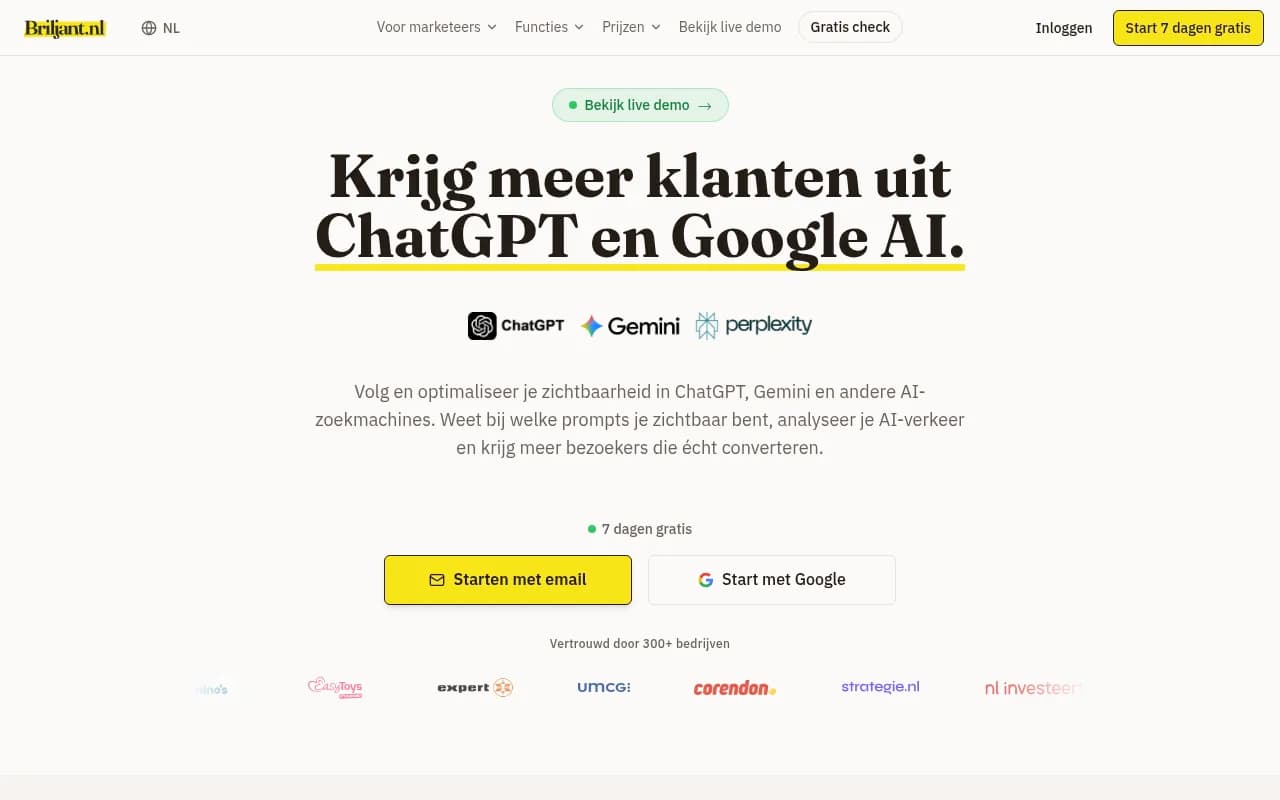
Briljant is a Dutch GEO platform that tracks visibility in ChatGPT and Perplexity. The appeal is obvious: Dutch-built, Dutch-market understanding, Dutch support. I could not verify agency pricing, white-label options or city-level tracking from the research, so ask for a demo and test it with the same Dutch local prompts you give everyone else.
Peec AI
Brandlight's roundup names Peec AI as having the best mid-market economics for 10 to 50 clients, at about $205 a month with unlimited seats. That claim comes from a competitor's list, so verify it. Peec is a prompt tracker, which means you will pair it with other tools for crawler analysis and content work.

Semrush AI visibility toolkit
If your agency already reports from Semrush, the AI toolkit keeps everything in one deck, and clients recognise the brand. The cost is the problem. Per-domain pricing at 15 clients lands around $1,485 a month before anyone has done any work, and nothing in it turns a finding into billable scope. Fine for three to five clients, hard to justify at twenty.
Profound
Profound is strong on data and has an Agency Mode with client workspaces and pitch environments. It is built for scaled AEO programs and enterprise delivery. For a plumber in Utrecht it is probably too much tool, and the comparison list that ranks it first is Profound's own.
Profound

Otterly.AI and Rankscale
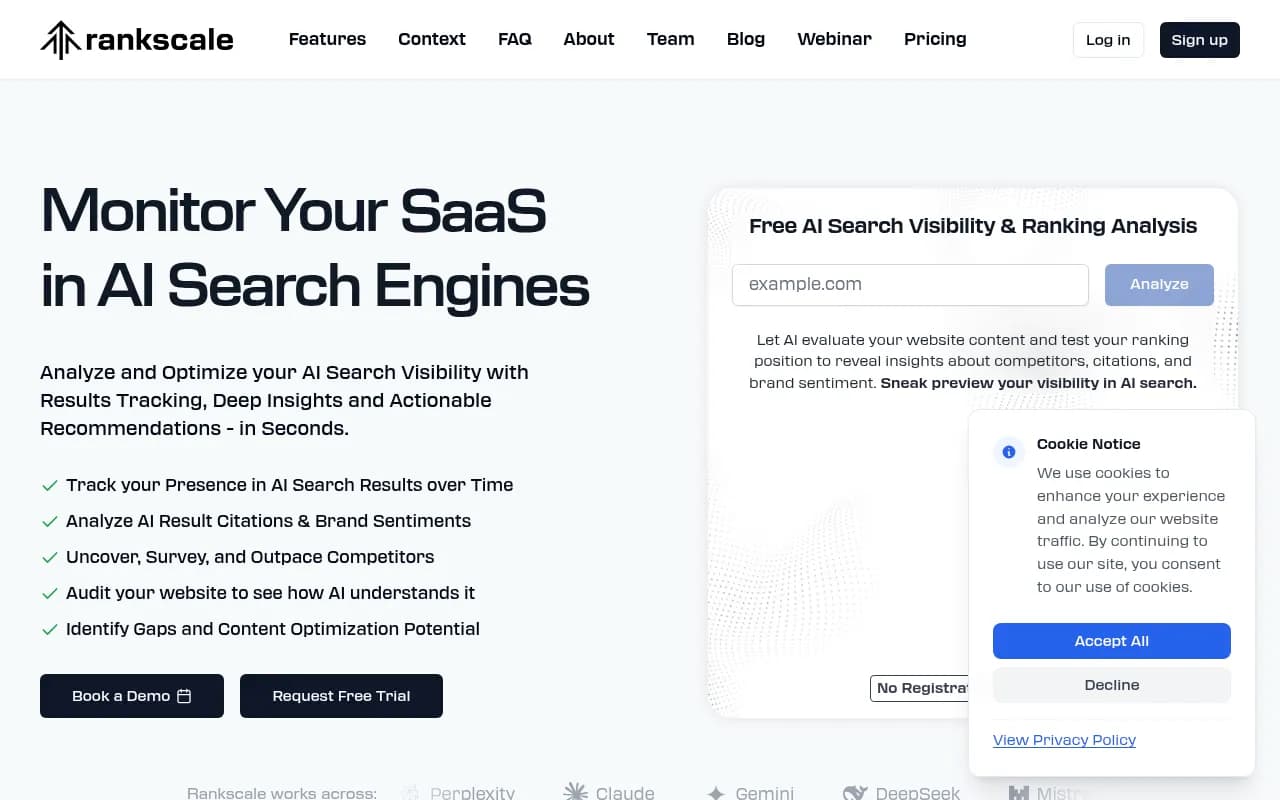
Both are cheaper, lighter options. Otterly suits solo marketers and small agencies starting out; it has no in-platform content generation. Rankscale is positioned toward agencies. Either works as a starter tool while you learn what clients actually ask for.
Otterly.AI

SISTRIX
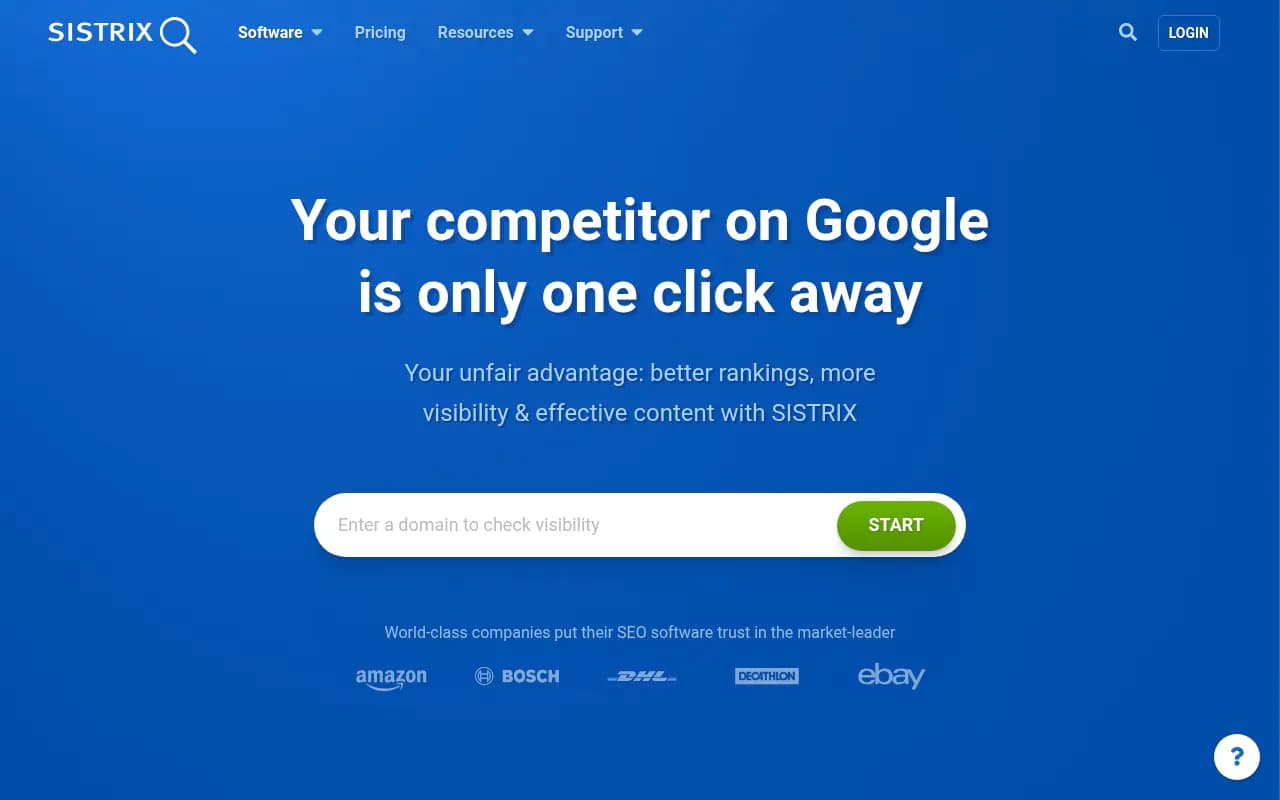
SISTRIX is a familiar name in Dutch and German agencies. WebGlazer's European list shows it from about 100 EUR a month with ChatGPT and Gemini tracking plus multi-client consoles and white-label exports. It makes sense if your team already reports Google visibility from SISTRIX and you want AI numbers next to it.
Pair AI tracking with local SEO tools
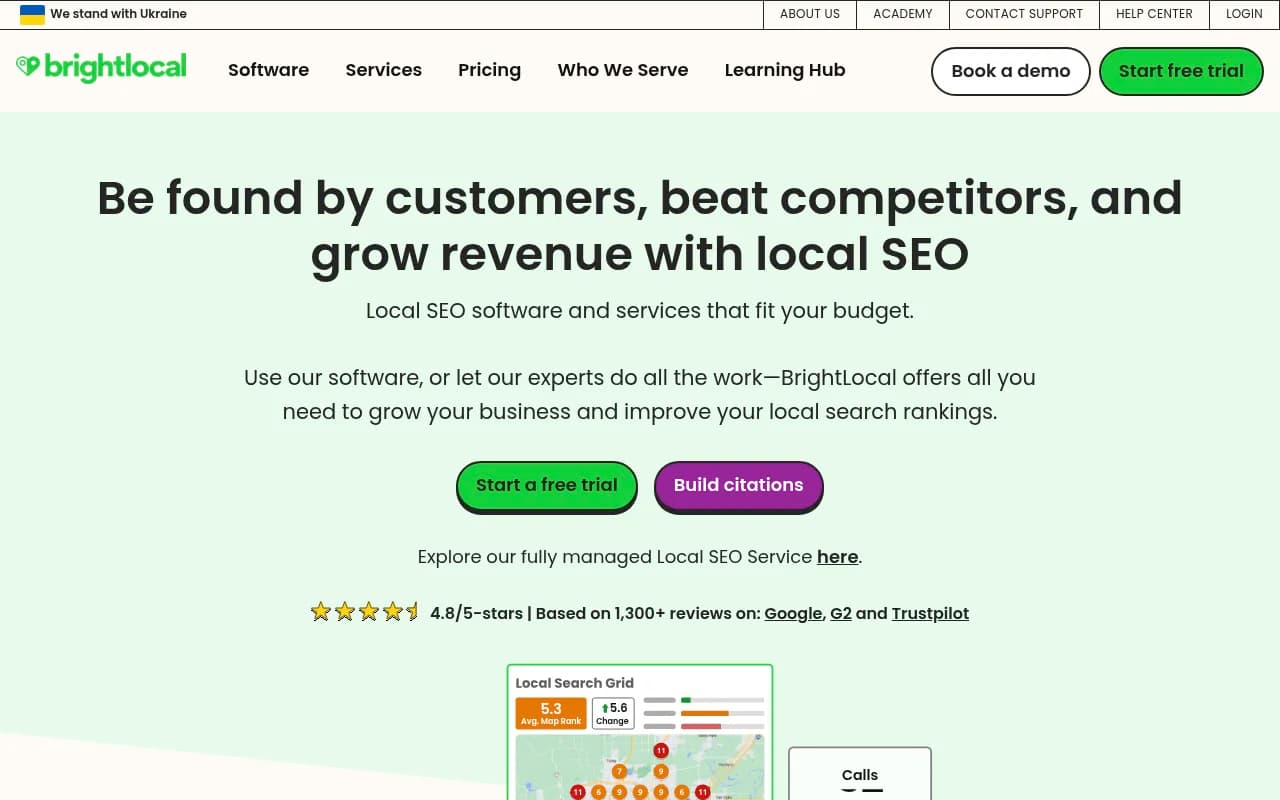
AI visibility for a local client sits on top of basics: consistent listings, reviews and a crawlable site. For citation and listing management across many branches, tools like BrightLocal or Synup cover what an AI tracker will not. For client reporting across channels, Whatagraph is a common choice.
Why you must track engines separately
Promptwatch Data's average sources per response report shows how different the engines behave. ChatGPT cites about 5 sources per web-search answer, Google AI Overviews about 10, and Perplexity almost exactly 10 every day. Copilot swung from under 2 to nearly 17 within a few weeks. For a mid-authority local client, that means AI Overviews has far more slots to break into than ChatGPT. Report each engine as its own line item, or you will tell a client everything is fine while one engine ignores them.
A practical way to choose
- Write 20 Dutch prompts per vertical, such as "beste tandarts in Haarlem" or "hypotheek adviseur Eindhoven", and run the same list through two or three trial accounts.
- Check the raw responses. Are they Dutch, from the right city, and do the citations match what you see by hand?
- Model the monthly cost at 5, 15 and 30 clients, including seats and any pitch projects.
- Ask each vendor about GDPR, data location and security certification, and get it in writing.
- Look for the follow-through. Can the tool show a crawler error, a content gap and the traffic that arrived afterwards? If not, you are buying a dashboard.
Which to pick, by agency profile
A small agency with fewer than eight clients and mostly monitoring needs can start with Otterly or Peec and keep costs low. A Dutch-focused shop that wants local-market support should trial Briljant. An agency already deep in Semrush can use its toolkit for a handful of accounts. An agency with 10 or more local clients, a need for city-level answers and a wish to sell fixes rather than reports will get the most from Promptwatch's agency tiers, because unlimited projects and white-label client access keep margin intact as the roster grows.
Whatever you choose, run the Dutch prompt test before signing. A tool that can't answer in Dutch from the right city isn't a tool for your clients.