Key takeaways
- People increasingly ask ChatGPT, Google AI Mode, and Perplexity for restaurant recommendations instead of scrolling Google Maps results, and the answers come from a mix of review sites, menus, local listings, and food media, not just your website.
- 5W's 2026 restaurant research found the fast-casual category losing AI citation share while chicken, coffee, and Mediterranean concepts gained ground, which tells you category and menu framing matter as much as location pages.
- Multi-location brands need two things at once: local listings accuracy (hours, menus, locations) feeding AI answer engines, and a way to see which specific prompts and cities mention you versus competitors.
- General-purpose AI visibility platforms like Promptwatch cover restaurants well for brand-level tracking and content generation, while local-marketing-first tools like Birdeye, Yext, and Uberall handle the listings plumbing that feeds AI answers.
- Don't skip citation sources unique to food: Reddit threads, YouTube reviews, and local news roundups show up constantly in AI answers about where to eat, so your visibility strategy has to go past your own website.
Why restaurants need a different playbook for AI visibility
A SaaS company worries about being cited in a comparison answer. A restaurant worries about being recommended when someone in a specific neighborhood asks "best brunch spot near me" or "where can I get good ramen that's open right now." That's a fundamentally more local, more time-sensitive, more review-driven question, and it changes which tools and which data actually matter.
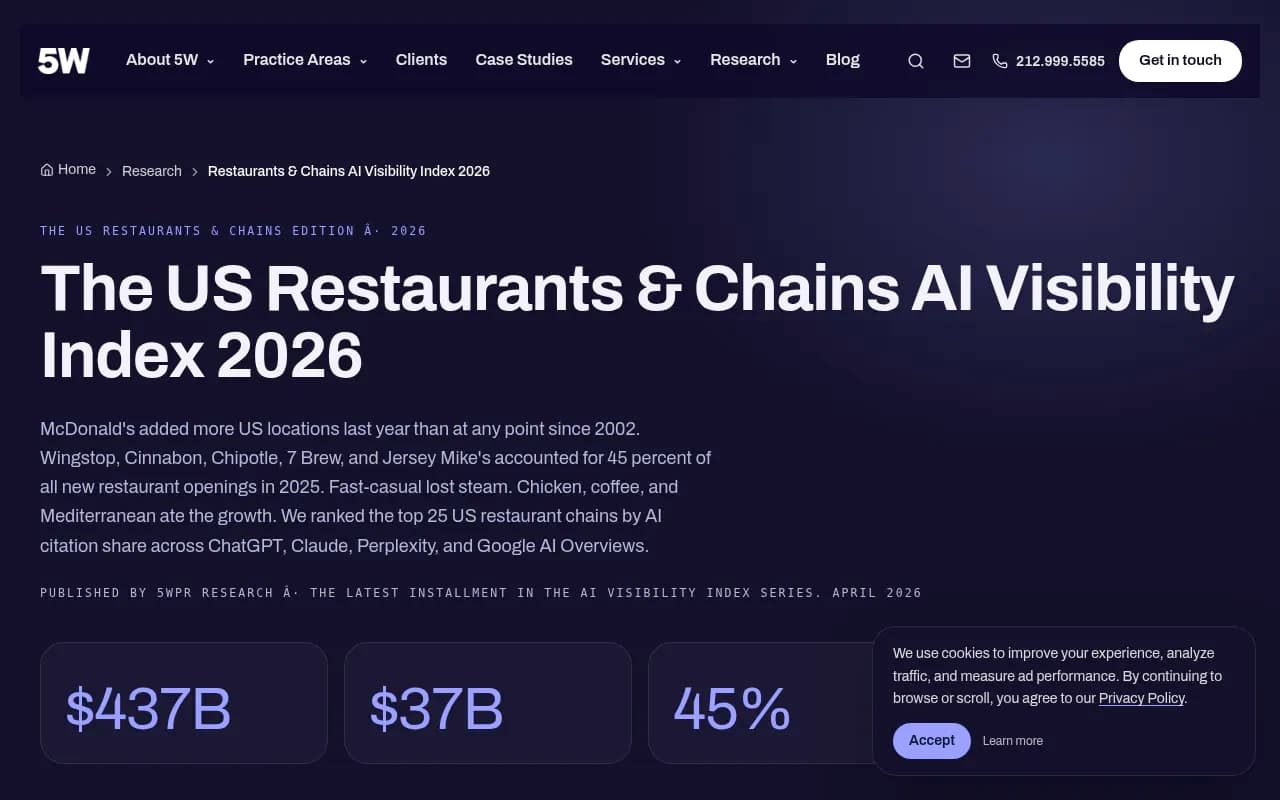
5WPR's US Restaurants & Chains AI Visibility Index 2026 is worth reading in full if you run a multi-unit brand. The headline finding: fast-casual, the category that dominated the last decade of restaurant growth, is losing ground in AI citation share, while chicken concepts, coffee, and Mediterranean brands are picking it up. That's not a menu trend, it's a visibility trend. If AI models are reshaping which categories get recommended, your competitive set in AI search might look nothing like your competitive set on Google Maps.
The practical implication: you can't just optimize your own site and call it done. AI answers about restaurants pull heavily from third-party review content, local roundup articles, Reddit threads about neighborhood favorites, and YouTube food reviews. Promptwatch's data on citation types ChatGPT favored in July 2026 shows product pages and listicles leading citations across categories generally, and restaurant queries lean hard into that listicle format, think "10 best tacos in Austin" style content that AI models lift directly.
What AI visibility actually means for a restaurant brand
Before picking tools, get clear on what you're trying to measure. For restaurants, AI visibility breaks into four distinct questions:
- Does ChatGPT, Gemini, or AI Overviews mention your restaurant when someone asks a category or location-based question? ("best pizza in Brooklyn")
- Is your business information correct in the places AI pulls from? Hours, menu items, price range, dietary options.
- What review and social content about you is AI citing, and is the sentiment positive?
- For multi-location brands, which cities or regions show you prominently and which are blind spots?
That split matters because no single tool does all four equally well. Local listings platforms nail question two. Dedicated AI visibility trackers nail questions one and four. Review and reputation platforms nail question three. Most restaurant brands end up stitching together at least two categories of tool.
The core AI visibility and GEO trackers
These are the platforms built specifically to answer "does AI mention us, and where are we losing to competitors."
Promptwatch is the most complete option if you want to go past monitoring into actually fixing gaps. It tracks brand mentions across ChatGPT, Gemini, Claude, Perplexity, Grok, and Google AI Overviews and AI Mode, with state and city-level tracking on its Professional plan, which matters a lot for a chain with locations across multiple metros. It also tracks Reddit and YouTube citations specifically, two sources that show up constantly in food recommendation answers, and it has a content gap analysis feature that can tell you which prompts your competitors own and generate AEO-optimized content to close the gap, publishing straight to Webflow, Framer, or WordPress.

For a restaurant group running a blog or local-guide content strategy, that's a meaningfully different workflow than just getting a weekly "you were mentioned 4 times" report. The crawler log feature (Agent Analytics) also shows when ChatGPTBot or PerplexityBot actually visit your menu pages or location pages, which is useful diagnostic data if a location page isn't showing up in answers at all.
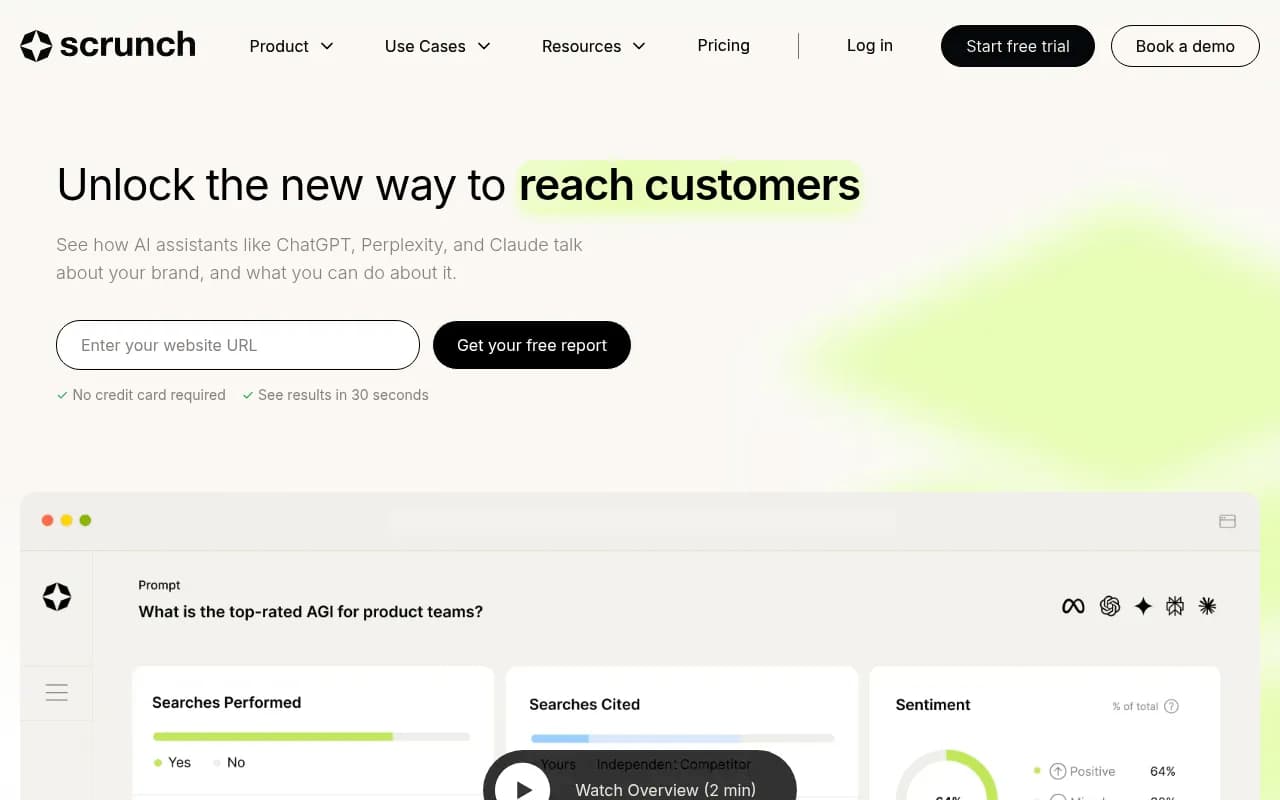
Profound and ScrunchAI are strong enterprise-grade monitoring platforms if your brand has the budget and mainly needs broad multi-engine tracking without the content generation layer.
Profound

Peec AI and Otterly.AI are lighter, more affordable trackers, good starting points for a single-location restaurant or a small regional chain that just wants a basic read on ChatGPT and Perplexity mentions before committing budget to a bigger platform.

Otterly.AI

Local-marketing platforms that feed the AI answer
This is the category most restaurant brands underweight. AI models don't recommend a restaurant from thin air, they pull from aggregated listings data, review platforms, and structured business information. If your hours are wrong on one directory, or your menu hasn't been updated in two years, that's the kind of inconsistency that keeps you out of AI answers even if your brand is well known.
Birdeye built its Listings AI specifically around this problem for restaurant brands, synchronizing business information, menus, and location data across the platforms AI search draws from, and it also tracks AI answer appearances as part of its Agentic Marketing Platform.
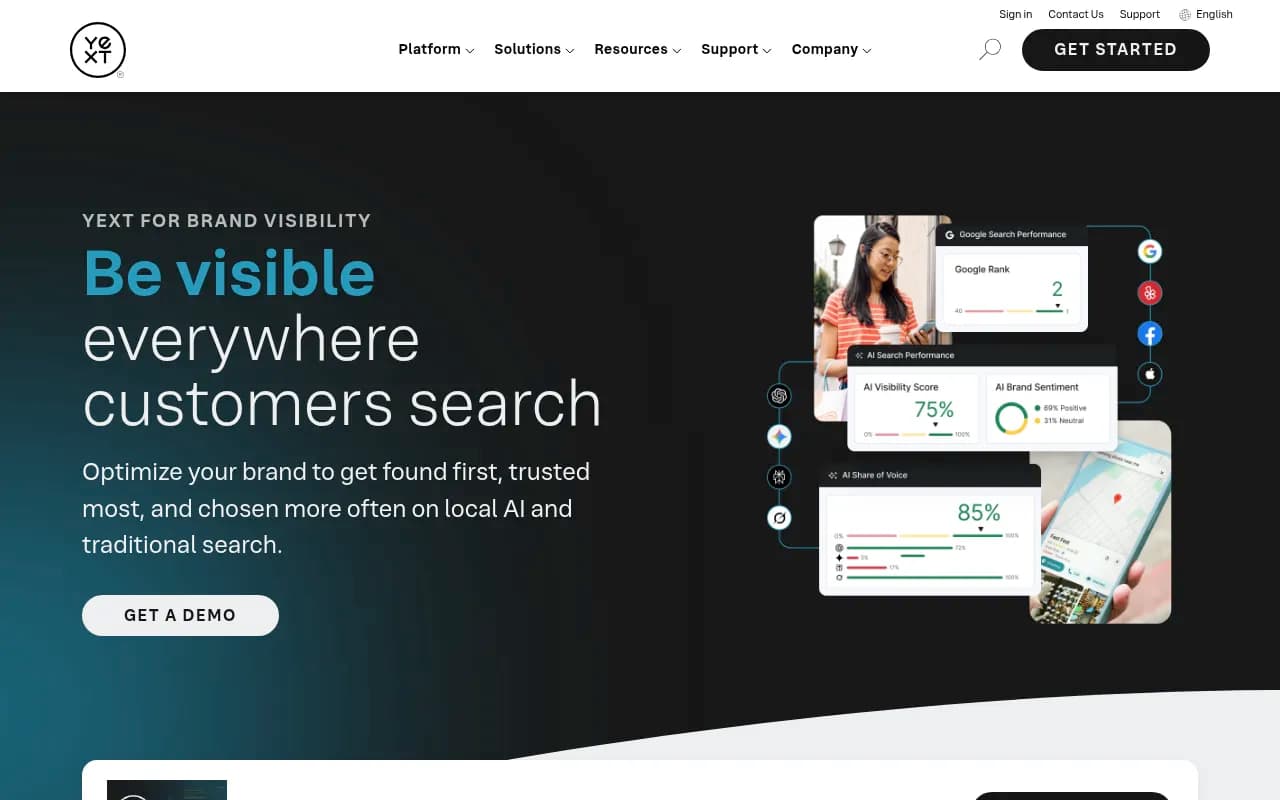
Yext and Uberall serve a similar role for multi-location brands, managing listings accuracy at scale across hundreds of locations and feeding both traditional and AI search surfaces.
BrightLocal is a solid, more affordable option for smaller chains that need listings management and local rank tracking without enterprise pricing.
Comparing the options
| Tool | Best for | AI engines tracked | Local listings management | Content generation | Starting price |
|---|---|---|---|---|---|
| Promptwatch | Multi-location chains wanting monitoring plus content fixes | ChatGPT, Gemini, Claude, Perplexity, Grok, AI Overviews, AI Mode | No (pairs well with Birdeye/Yext) | Yes, automated AEO content with CMS publishing | $95/mo |
| Birdeye | Listings accuracy plus reputation at scale | AI answer tracking via Listings AI | Yes, purpose-built for multi-location | Limited | Custom/enterprise |
| Yext | Enterprise multi-location listings sync | Partial AI tracking | Yes, strong | No | Custom/enterprise |
| Profound | Enterprise brand-level AI monitoring | Broad, 9+ engines | No | No | Custom/enterprise |
| Peec AI / Otterly.AI | Single location or small chain, budget-conscious | ChatGPT, Perplexity, AI Overviews | No | No | Low-cost entry tiers |
| BrightLocal | Small chains needing affordable local SEO + listings | Local rank tracking | Yes | No | Budget-friendly |
What to actually track as a restaurant brand
A few prompt categories matter more than others for food brands, and your tracking setup should reflect that rather than copying a generic B2B template:
- Category plus location queries: "best [cuisine] in [city/neighborhood]"
- Occasion-based queries: "good spot for a first date near [area]", "family-friendly brunch in [city]"
- Dietary and feature queries: "vegan options near me", "restaurants with outdoor seating open now"
- Comparison queries against named competitors in your category
- Branded queries: "is [your restaurant] good", "what's on the menu at [your restaurant]"
If you're setting up prompt tracking in a tool like Promptwatch, build your prompt list around these five buckets per market rather than tracking only branded terms. Most of the AI visibility opportunity for restaurants sits in the unbranded, discovery-intent queries, not the ones where someone already knows your name.
Where AI actually pulls restaurant recommendations from
Worth knowing before you spend money chasing the wrong channel. Promptwatch's research on social media citations by AI model shows how often platforms like Reddit, YouTube, and Instagram get cited across different AI engines, and for local discovery queries specifically, Reddit city subreddits and YouTube food vlogger content punch well above their general citation share. A restaurant that gets mentioned organically in a r/Chicago food thread or shows up in a local food YouTuber's video can see that surface in an AI answer weeks or months later.
That means part of your visibility strategy isn't a tool purchase at all, it's community engagement: responding to reviews, encouraging food bloggers and local creators to cover you, and making sure your Google Business Profile, Yelp, and TripAdvisor listings are current. Tools can tell you this is happening or not happening. They can't manufacture the underlying mentions for you.
A practical setup for different restaurant brand sizes
Single location or small group (1-5 locations): Start with a free or low-cost prompt tracker like Otterly.AI or Peec AI to get a baseline read, paired with BrightLocal for listings hygiene. Spend the saved budget on actual content and reputation work rather than an enterprise platform you don't need yet.
Regional chain (5-50 locations): This is where Promptwatch's city-level tracking earns its price tag, because you need to know which specific markets you're invisible in, not just a national average. Pair it with Birdeye or Yext for the listings side so the underlying data feeding AI answers stays accurate as you open and close locations.
National or enterprise chain (50+ locations): You likely need both an enterprise listings platform (Yext or Uberall) and a dedicated AI visibility and content layer. Profound or Promptwatch's Business tier both scale here, with Promptwatch adding the advantage of automated content generation if you're trying to build out location-specific or cuisine-specific content at volume.
For agencies managing multiple restaurant clients, it's worth browsing the broader GEO software directory at bestgeosoftware.com before committing, since pricing and feature depth vary a lot between platforms built for enterprise brand monitoring versus platforms built for local multi-location management.
A final word on category shifts
The 5W data point about fast-casual losing ground to chicken, coffee, and Mediterranean concepts isn't just restaurant trivia, it's a warning about how fast AI's version of "what's popular" can move independent of actual foot traffic trends. If your category is shifting in AI's eyes before it shifts in the real world, the brands tracking this will adjust their content and positioning months before the brands that only check Google rankings. That gap is the whole opportunity here.