Key takeaways
- ChatGPT has no fixed "shopping rank." A carousel belongs to one response, so any rank claim needs many runs over time to mean anything.
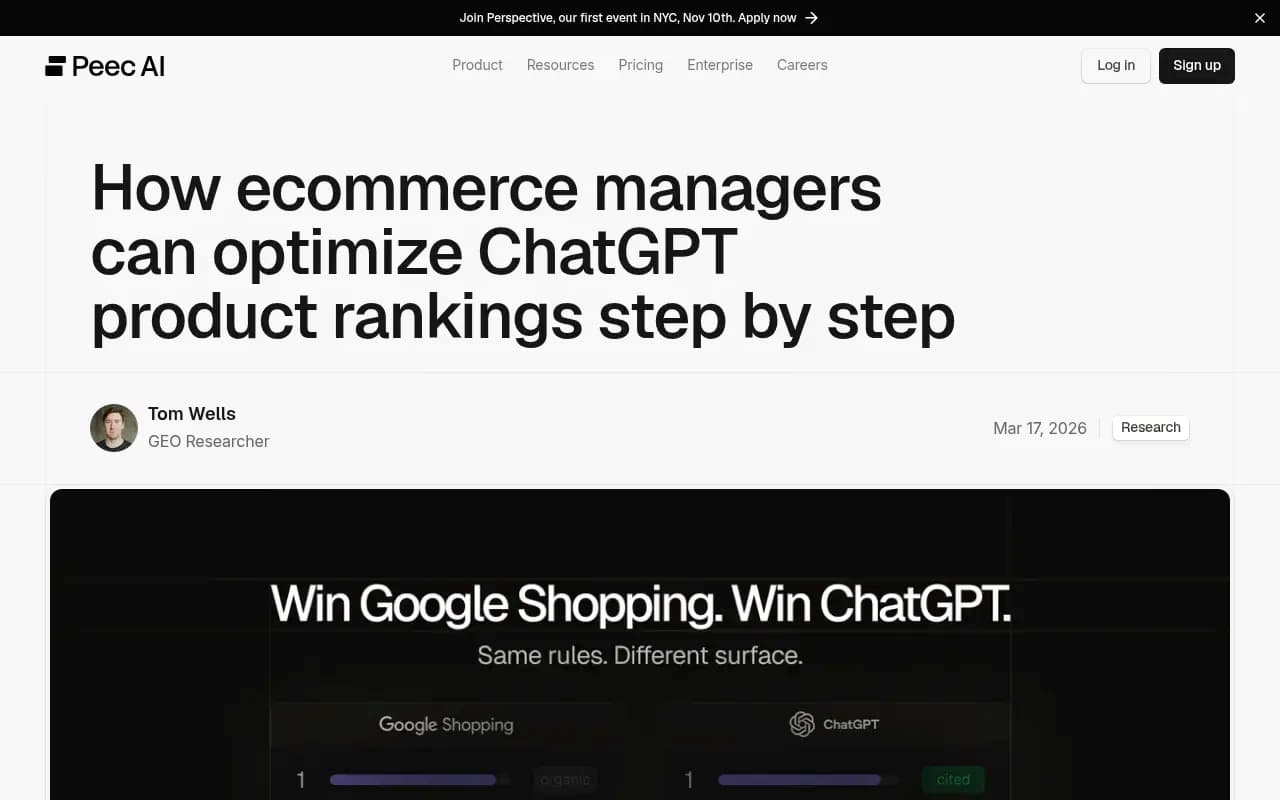
- Most carousel products come from Google Shopping. Peec AI's study of 43,000+ carousel products found 83% strongly matched Google Shopping's top 40 organic results.
- For ecommerce, a good tracker needs three things: repeated runs of category and purchase-ready prompts, capture of actual product cards (price, merchant, position), and a way to tie results to your catalog.
- Generic brand-mention trackers are fine for awareness, but they miss the product-level detail that matters in a carousel.
- Track organic carousels and sponsored ones separately. They are different channels now.
Why ecommerce needs a different kind of ChatGPT tracker
If you sell products online, "are we mentioned in ChatGPT?" is the wrong question. The right one is closer to "when someone asks for the best trail running shoes under $150, do our products show up in the cards, in which slot, and at what price?"
Most ChatGPT rank trackers were built for brands and SaaS. They count mentions and citations in written answers. That works for a B2B software company. For a retailer it leaves out the part that drives clicks: the product carousel.
There is a second problem. Carousels are not stable. According to Promptwatch's carousel guide, a carousel attaches to an individual response. The same prompt can show cards on Monday and plain text on Tuesday, and the products can change between runs. A single manual check tells you almost nothing.
Promptwatch Data's ChatGPT Shopping feature usage report backs this up. Shopping features attach to only a low single-digit share of web-search responses, they concentrate on commercial and transactional prompts, and the trigger rate moves in steps. It roughly doubled overnight in late May, then fell back weeks later. That looks like OpenAI tuning when cards appear, which is one more reason a tracker needs repeated runs over time.
How ChatGPT builds a shopping carousel
You can't pick a tracker well without knowing what it is measuring. Here is the mechanism, based on Peec AI's study published on Search Engine Land (March 2026; 5,000 carousels, 43,000+ products, 1.1M shopping fan-outs across 10 retail verticals).
A shopper's prompt gets split into two kinds of fan-out queries:
- Contextual fan-outs, around 12 words on average, gather background on the category, leading brands and sentiment.
- Shopping fan-outs, around 7 words on average, hit Google Shopping with short queries. A long prompt about waterproof trail running shoes might turn into "waterproof trail running shoes men".
The two sets were 98.3% distinct. So the query that decides your placement is not the one the shopper typed. It is the short one ChatGPT writes.
The study's numbers on where products come from:
- 83% of carousel products strongly matched Google Shopping's top 40 organic results
- About 60% came from Google's top 10, and about 84% from the top 20
- Bing-exclusive products were 0.16%
- 45.8% were exact title matches to a Google Shopping listing
The practical rule from that research: use the same product title string in Merchant Center, your OpenAI feed and your product page. Carousels typically hold around 8 products.
OpenAI's own help documentation says organic product results are chosen independently, are not ads, and rank merchants by availability, price, quality and whether the seller is the maker or primary seller. In August 2026 OpenAI also added sponsored product carousels to ChatGPT Ads, built from feed data. So you now have two channels to measure separately.
What to look for in an ecommerce ChatGPT rank tracker
I'd score any tool on these before looking at price.
Prompt coverage that matches shopper journeys
The common prompt types for shopping are category-based ("best [category] for [audience]"), budget-focused ("best [category] under [budget]") and purchase-ready ("where to buy [product] online"). Short, purchase-ready prompts trigger carousels most reliably, according to Promptwatch's research, which is a vendor claim about its own data, so weigh it accordingly. Your tracker should let you organize prompts by category and product type, not just dump them in a flat list.
Repeated runs
Daily is the minimum. Faster cadences help during launches, sales and the holiday period when OpenAI may be adjusting card triggers.
Product-card capture
Can the tool store the cards themselves? Title, image, price, merchant, rating, review count and position in the row. Without that you only know whether your brand name appeared in text.
Catalog matching
A useful tracker maps cards back to your SKUs, ideally by product ID, so you can see which products win and which competitor products fill the slot instead.
Real interface data
Carousels are a front-end feature. Tools that rely only on API outputs can't see them. Ask how data is collected.
Organic versus paid separation
If a tool blends sponsored and organic placements, your numbers will be muddy. Promptwatch Data's ChatGPT Ads report shows ads appeared in an average of 20.1% of ChatGPT responses that ran a web search between May 20 and August 17, 2026, with daily peaks of 43.9%. That is too large to ignore.
Comparison table: ChatGPT rank trackers for ecommerce
I have not verified every competitor's current pricing, so the table sticks to positioning and what each is generally used for. Check each vendor's site before buying.
| Tool | Shopping carousel angle | Best for | Notes |
|---|---|---|---|
| Promptwatch | Stores every product card with price, merchant and carousel position; matches to your catalog by product ID; Ads Radar for sponsored placements | Retailers and brands that want tracking plus action | Shopping is on Business and Enterprise |
| Rankscale | Positioned for tracking product appearance across the customer journey | Ecommerce businesses wanting journey-level views | Searchable's roundup recommends it for this use |
| Peec AI | Published the carousel sourcing research; prompt tracking | Marketing teams wanting a straightforward tracker | Check product-card depth before committing |
| Otterly.AI | Cross-engine brand monitoring | Agencies managing many brands | Brand-level, not SKU-level |
| Profound | Enterprise AI visibility | Large brands | Higher price point |
| ZipTie | Deep analysis of AI visibility | Teams wanting detailed analysis | Verify shopping support |
| Nightwatch | Hybrid SEO and AI tracking | Agencies already using rank tracking | Add-on pricing for AI |
The tools, one by one
Promptwatch
Promptwatch is the one I would shortlist first for a retailer, mostly because it treats the carousel as data rather than a footnote. Its ChatGPT Shopping tracking stores each product card from your tracked prompts, with price, merchant and carousel position, and matches cards to your catalog by product ID. You see which of your products appear, which competitors get picked instead, and how the picture changes across runs.

It also covers the rest of the loop. Ads Radar shows which advertisers bid on your prompts, their copy and landing pages. Crawler logs show whether OpenAI's bots can read your product pages. The Action Board turns gaps into a prioritized to-do list. Read the ChatGPT Shopping feature page and the Ads Radar page for detail.
Pricing, quoted from the site and worth confirming at promptwatch.com/pricing: Business is $579/month and is the first plan with Shopping insights, Ads Radar, the Content Agent, state and city tracking, and tracking every 12, 6 or 1 hours. Essential ($95) and Professional ($245) track ChatGPT but not the Shopping module. There is a 7-day free trial on monthly billing, and a free AI visibility report if you just want a first look.
If you want comparison context, see Promptwatch vs Peec and Promptwatch vs Profound.
Rankscale
Searchable's 2026 roundup says Rankscale is best for ecommerce businesses that want to track how products appear in ChatGPT Shopping and measure visibility across the customer journey, from awareness to purchase. I haven't tested that claim, so treat it as the vendor-adjacent view and run a trial with your own category prompts.
Peec AI

Peec deserves credit for the carousel research itself. Its Search Engine Land study is the clearest public picture of how ChatGPT sources products, and its guide for ecommerce managers turns that into action items. As a tracker it is a good fit for marketing teams that want something simple. Ask specifically how it handles product cards and catalog matching before you rely on it for SKU-level work.
Otterly.AI and ZipTie
Otterly.AI

Both are solid for brand-level monitoring. The KIME roundup lists Otterly from $29/month and ZipTie.dev from $69/month, but that comparison is a competitor's blog and dates to April 2026, so confirm current numbers. For a retailer with a small catalog and no need for SKU-level data, a brand-level tracker can be enough.
Profound and Nightwatch
Profound

Profound is aimed at enterprise narrative control. Nightwatch is a fit if you already track Google rankings there and want AI visibility in the same place. Neither is where I would start for shopping carousels, but check their current product coverage, since this category moves fast.
For wider browsing, the GEO software directory at bestgeosoftware.com lists far more options than I can cover here.
How to set up ecommerce tracking that actually works
Step 1: Build a prompt set by journey stage
Start with 30 to 50 prompts. Mix three types:
- Category: "best running shoes for flat feet"
- Budget: "best trail running shoes under $150"
- Purchase-ready: "where to buy [your product type] online"
Tag them by category and product line so you can see which journeys you win.
Step 2: Record cards, not just mentions
For every run, log whether a carousel appeared, which products filled it, their positions, prices and merchants. If your tool doesn't do this, you are guessing.
Step 3: Read results over weeks
One good run is luck. Look for patterns: which categories trigger cards consistently, which competitors keep showing up, where your products sit across dozens of responses.
Step 4: Fix the feed and the pages
The fixes are mostly boring, and that is the point:
- Identical product title strings across Merchant Center, your OpenAI feed and the product page
- Complete Product schema
- Accurate price and availability
- A clean merchant feed
- Strong review volume, since cards show ratings and counts (and OpenAI says it does not verify the public reviews it summarizes)
Because 83% of carousel products map back to Google Shopping's top 40, your Google Shopping performance for short queries is the lever that matters most.
Step 5: Check that ChatGPT can reach your pages
Access problems and content problems look alike in a dashboard. Crawler logs show whether AI bots actually read your product pages, which saves weeks of rewriting content that was never fetched.
Step 6: Measure organic and paid separately
Sponsored product carousels run through ChatGPT Ads and come from feed data. Don't blend them with organic results. Check ad visibility across several days, because a single run can land on an outlier.
What the citation data says about product pages
Shopping carousels are only part of the picture. In the written answer, product pages are the most cited content type in ChatGPT at 22.4% of citations, according to Promptwatch Data's content-type report for Sep 28 to Oct 4, 2026. That is good news for retailers: your own product and landing pages are what the model wants to cite.
But domain authority isn't a moat. Promptwatch's domain rank data shows sites with DR 46-75 earned almost half of ChatGPT citations in August 2026, while DR 91-100 sites fell to about 3%. Mid-sized retailers have a real shot.
And don't assume one stable channel. In the same period, ChatGPT got only 0.46% of its citations from social platforms, per Promptwatch's social citation report, so a strategy built on getting discussed on social sites won't carry the way it might in AI Overviews.
A caution on the big numbers
You will see claims like "more than 84 million shopping questions a week in the US." The Raccoon AI guide attributes that to Stackline, but I couldn't verify the source, so I wouldn't build a business case on it. Similarly, one roundup claims roughly 60% of organic traffic now originates from AI responses. I'd treat that with skepticism until someone shows the method. Your own analytics and AI referral data are a better basis. The Academy guide on attributing AI traffic covers how to measure it.

Which tracker should you choose?
- Large catalog, need SKU-level card data and Ads Radar: Promptwatch Business, since it is built around product cards matched to your catalog.
- Early stage, want to test the idea cheaply: start with a free AI visibility report, a trial, or a lower-priced brand-level tracker.
- Agency managing several ecommerce clients: look at agency plans (Promptwatch Kick-off is $199/month, but note agency plans don't include ChatGPT Shopping) and tools like Otterly or Rankscale, and verify what each covers.
- Already living in an SEO suite: Nightwatch or Semrush may be enough for brand-level tracking, but check the product-card question.
Whatever you pick, run a one-week trial with your real prompts and ask one question at the end: can I see which cards appeared, where, and for which of my products? If the answer is no, it is a brand monitor, not an ecommerce tracker.
To explore more rankers, the AI rank tracking directory at ai-rank-tools.com is a good next stop.