Key takeaways
- Copy.ai completed a deliberate pivot in 2024 toward enterprise GTM automation, making it a poor fit for marketers who just need to write and rank content
- Most "Copy.ai alternatives" lists conflate two very different problems: content generation and AI search visibility tracking -- you may need both
- The best platforms in 2026 don't just write content; they show you whether ChatGPT, Perplexity, and Google AI Overviews are actually citing what you publish
- Promptwatch is the only platform in this comparison that closes the full loop: find content gaps, generate content engineered for AI citation, then track whether it worked
- Budget, team size, and whether you need AI visibility data (not just writing) should drive your choice
Why people are leaving Copy.ai in 2026
Copy.ai used to be a self-serve playground. You'd pick a template, fill in a few fields, and get usable marketing copy in seconds. Over 17 million people used it that way.
Then in 2024, the company repositioned as "the world's first GTM AI platform" -- targeting enterprise sales and marketing operations teams with complex multi-step workflow automation. The self-serve experience quietly disappeared. The only publicly listed plan is a Chat tier at $24/month, while the serious features require enterprise contracts. Copy.ai was also acquired by Fullcast, which signals even more of a B2B enterprise focus going forward.
If you're a solo marketer, a small team, or an agency trying to produce content that ranks in AI search results, Copy.ai's current roadmap simply isn't for you.
But here's where it gets interesting: a lot of people searching for "Copy.ai alternatives" are actually looking for something Copy.ai never did in the first place. They want to know whether their content is being cited by ChatGPT when users ask questions in their industry. They want to see if Perplexity is recommending their competitors instead of them. That's a completely different problem -- and it requires a different kind of tool.
This guide covers both. The 8 platforms below split into two categories: pure content generation tools (for teams that just need better writing) and platforms that generate content AND track whether AI engines cite it.
The two problems you might actually be trying to solve
Before picking a tool, it's worth being honest about what you need.
Problem 1: You need better content, faster. Copy.ai's writing templates were genuinely useful. You want something that generates blog posts, ad copy, email sequences, and social content without requiring an enterprise contract.
Problem 2: You need to know if AI engines are citing your content. Traditional SEO metrics are declining as ChatGPT, Perplexity, and Google AI Overviews handle more queries. You need to understand your brand's visibility in these systems -- and ideally, do something about it.
Some teams have both problems. The platforms below are organized to help you figure out which category you fall into.
Quick comparison
| Platform | Best for | Content generation | AI citation tracking | Starting price |
|---|---|---|---|---|
| Promptwatch | Full GEO loop: gaps + content + tracking | Yes (AI writing agent) | Yes (10 AI models) | $99/mo |
| Jasper | Marketing content at scale | Yes | No | $59/mo |
| Writesonic | SEO-focused blog automation | Yes | Limited | $20/mo |
| Surfer SEO | On-page SEO optimization | Yes (with Surfer AI) | No | $89/mo |
| Frase | Content briefs + SEO/GEO | Yes | Partial | $45/mo |
| AirOps | Content engineering workflows | Yes | Limited | Custom |
| Anyword | Performance-predicted copy | Yes | No | $49/mo |
| Rytr | Budget short-form copy | Yes | No | $9/mo |
The 8 best Copy.ai alternatives in 2026
1. Promptwatch -- best for teams that need content AND AI visibility proof
Most tools on this list do one thing: write content. Promptwatch does something harder -- it shows you which content gaps are costing you AI citations, generates content specifically engineered to close those gaps, then tracks whether ChatGPT, Perplexity, Claude, Gemini, and seven other AI models start citing you.
That cycle matters because writing content and ranking in AI search are no longer the same thing. You can publish 50 blog posts and still be invisible in ChatGPT's responses if you're not answering the right prompts in the right way. Promptwatch's Answer Gap Analysis shows you exactly which prompts your competitors appear for but you don't -- down to the specific questions AI models want answered that your site doesn't address.
The built-in AI writing agent then generates articles, listicles, and comparisons grounded in real citation data (880M+ citations analyzed), so the output isn't generic SEO filler. It's content with a real shot at getting cited.
For teams that have been burned by the "publish and pray" approach to AI search, this is the most complete solution available.

Pricing: Essential $99/mo (1 site, 50 prompts, 5 articles), Professional $249/mo (2 sites, 150 prompts, 15 articles, crawler logs), Business $579/mo (5 sites, 350 prompts, 30 articles). Free trial available.
Best for: Marketing teams, SEO teams, and agencies that want to understand and improve their AI search visibility -- not just generate content blindly.
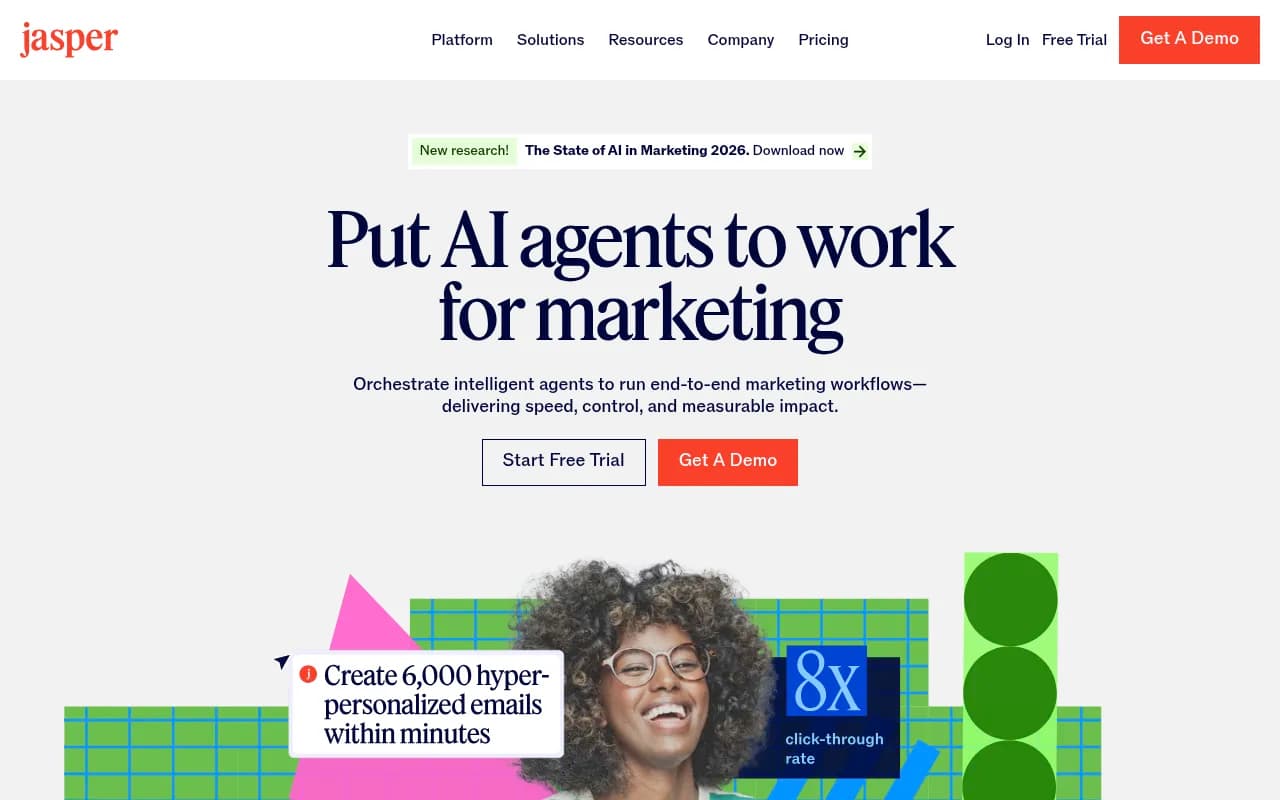
2. Jasper -- best for marketing content at scale
Jasper is the closest thing to a true Copy.ai successor for marketing teams. It started as a template-based writing tool, evolved into a full AI content platform, and now includes AI agents that can run multi-step content workflows.
Where Jasper shines is brand consistency. You can train it on your brand voice, tone guidelines, and existing content, and it'll produce copy that actually sounds like you -- not like a generic AI assistant. The platform covers blog posts, ad copy, email sequences, landing pages, and social content.
What Jasper doesn't do is tell you whether any of that content is getting cited in AI search engines. It's a content production tool, not a visibility platform. If you know you need to write more and write better, Jasper is excellent. If you're trying to understand why ChatGPT recommends your competitor instead of you, Jasper won't help with that.
Pricing: Starts at $59/month (annual billing). No free plan.
Best for: Marketing teams that need high-volume, brand-consistent content across multiple formats.
3. Writesonic -- best for SEO-focused blog automation
Writesonic has quietly become one of the more capable content platforms for teams focused on search. It generates long-form blog posts, handles keyword research integration, and includes Botsonic (an AI chatbot builder) as part of the package.
The SEO angle is real -- Writesonic integrates with tools like Semrush and pulls in keyword data to inform content structure. For teams that want to produce optimized blog content without stitching together five different tools, it's a solid choice.
The AI visibility piece is limited, though. Writesonic can help you write content that might rank in traditional search, but it doesn't show you how you're performing in ChatGPT or Perplexity responses. You'd need a separate tool for that.

Pricing: Starts around $20/month for individuals. Team plans available.
Best for: Content marketers who want SEO-integrated blog automation at a reasonable price.
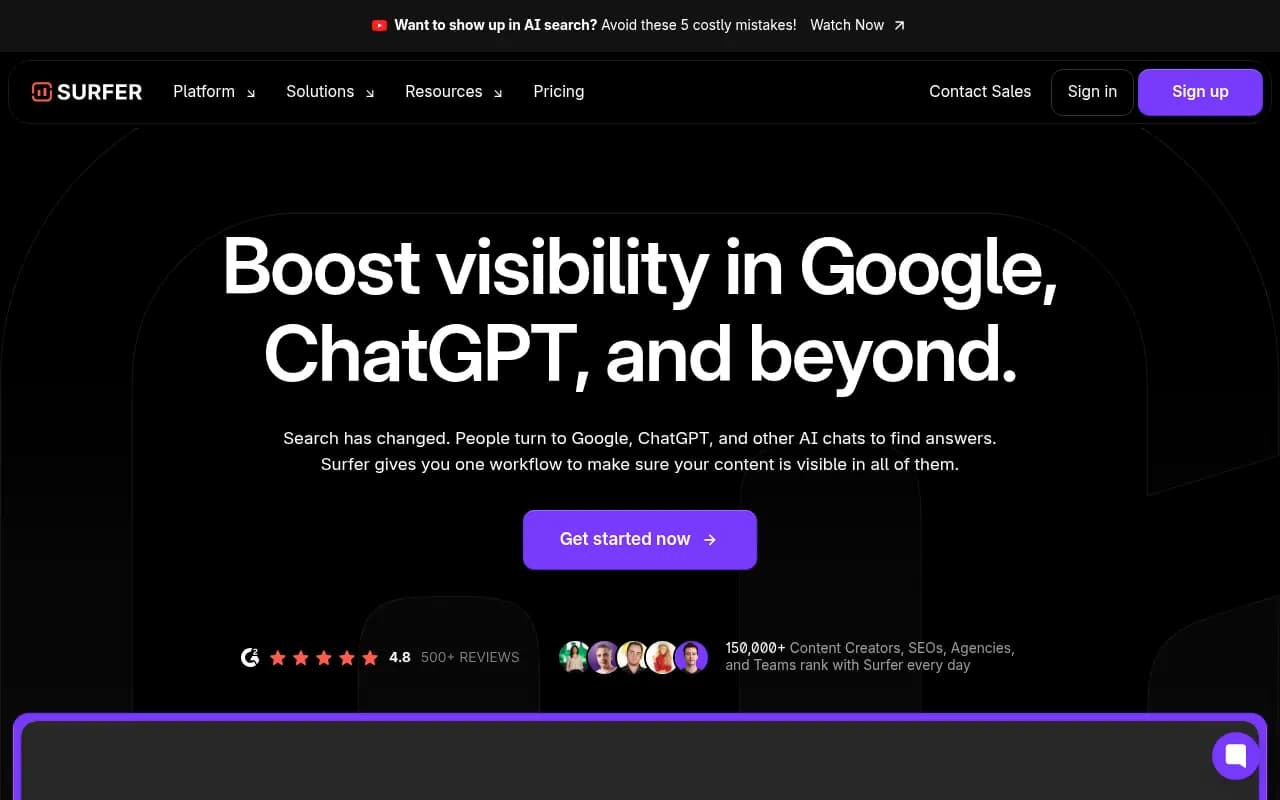
4. Surfer SEO -- best for on-page optimization with AI writing
Surfer SEO is primarily an optimization tool -- it analyzes top-ranking pages for a given keyword and tells you exactly what your content needs to include to compete. The AI writing feature (Surfer AI) generates content that's already structured around those signals.
The workflow is genuinely useful: research a topic, get a content score target, write (or generate) content that hits the target, publish. For traditional SEO, it's one of the cleaner loops available.
The limitation in 2026 is that Surfer's optimization model is built around Google's traditional ranking signals. AI search engines like ChatGPT and Perplexity use different signals -- they care about citation patterns, entity coverage, and source authority in ways that don't map cleanly to keyword density and content scores. Surfer is excellent for what it does; just don't expect it to tell you anything about your AI search visibility.
Pricing: Starts at $89/month. Annual discounts available.
Best for: SEO teams that want data-driven content optimization for traditional search, with AI writing built in.
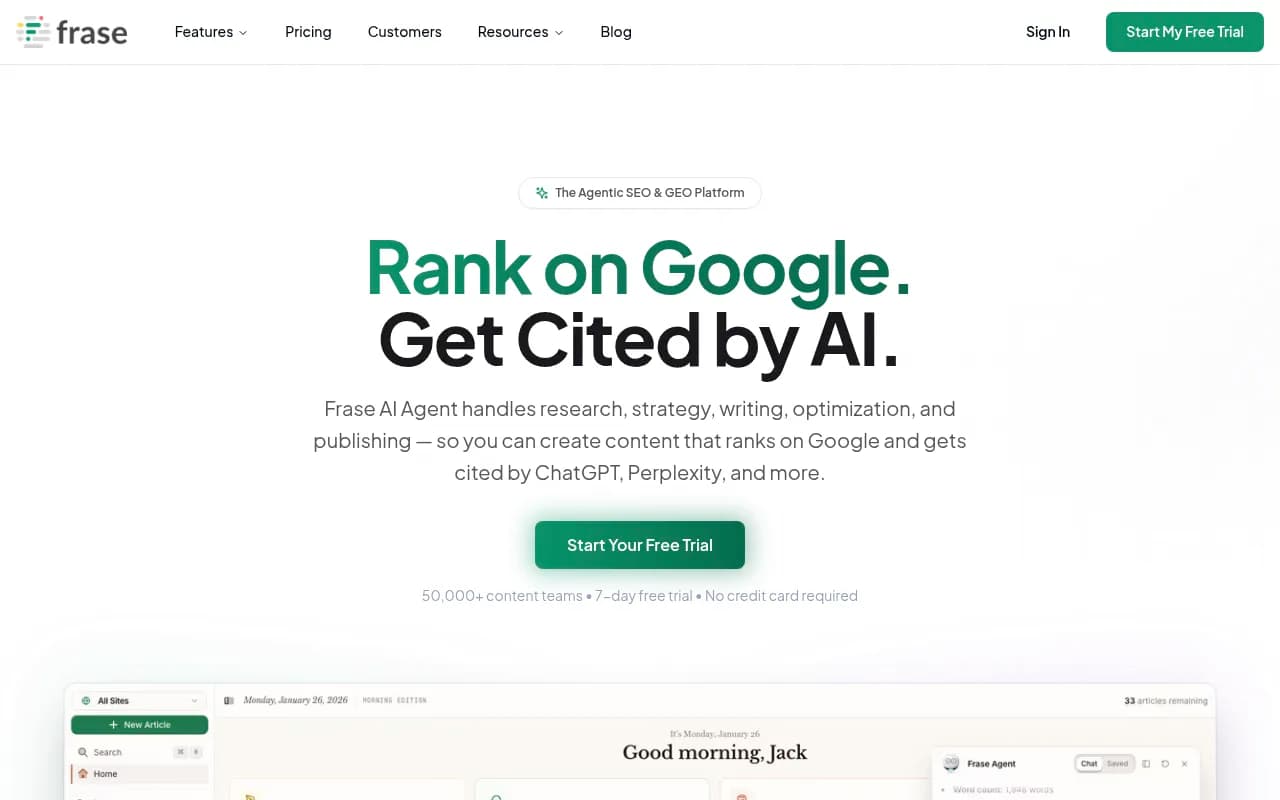
5. Frase -- best for dual SEO and GEO content briefs
Frase sits in an interesting middle ground. It's primarily a content brief and optimization tool, but it's been adding features that touch on generative engine optimization (GEO) -- the practice of optimizing content to appear in AI-generated answers.
The brief generation is strong: Frase pulls together what's ranking, what questions people are asking, and what topics the top pages cover, then builds a structured brief you can write against. The AI writing assistant can fill in sections based on that research.
The GEO angle is partial rather than complete. Frase surfaces some signals relevant to AI search, but it doesn't actively monitor whether your published content is being cited by ChatGPT or Perplexity. It's a step in the right direction compared to pure writing tools, but it's not a full visibility platform.
Pricing: Starts at $45/month. Higher tiers unlock more documents and team features.
Best for: Content teams that want research-driven briefs and are starting to think about GEO without committing to a full AI visibility platform.
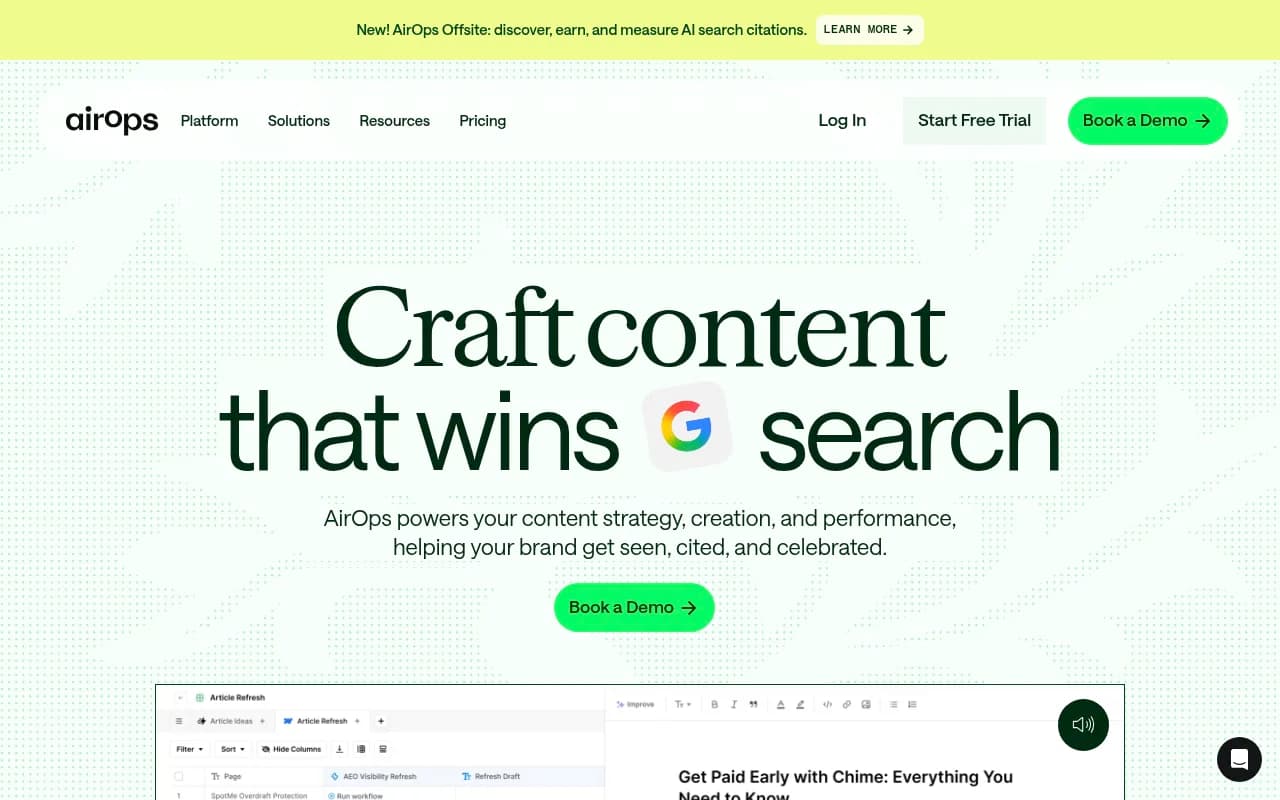
6. AirOps -- best for content engineering workflows
AirOps takes a different approach than most writing tools. Instead of templates and one-click generation, it's built around structured content workflows -- you define the inputs, the research steps, and the output format, and AirOps runs the process at scale.
This makes it particularly useful for teams producing large volumes of structured content: product pages, comparison articles, location pages, FAQ content. The platform integrates with data sources and can pull in real-time information to keep content accurate.
The AI search visibility angle is limited. AirOps can help you produce content that's structured well for AI citation (clear answers, factual claims, good entity coverage), but it doesn't tell you whether that content is actually being cited. It's a production tool, not a monitoring platform.
Pricing: Custom pricing. Contact for details.
Best for: Teams that need to produce large volumes of structured, data-driven content at scale.
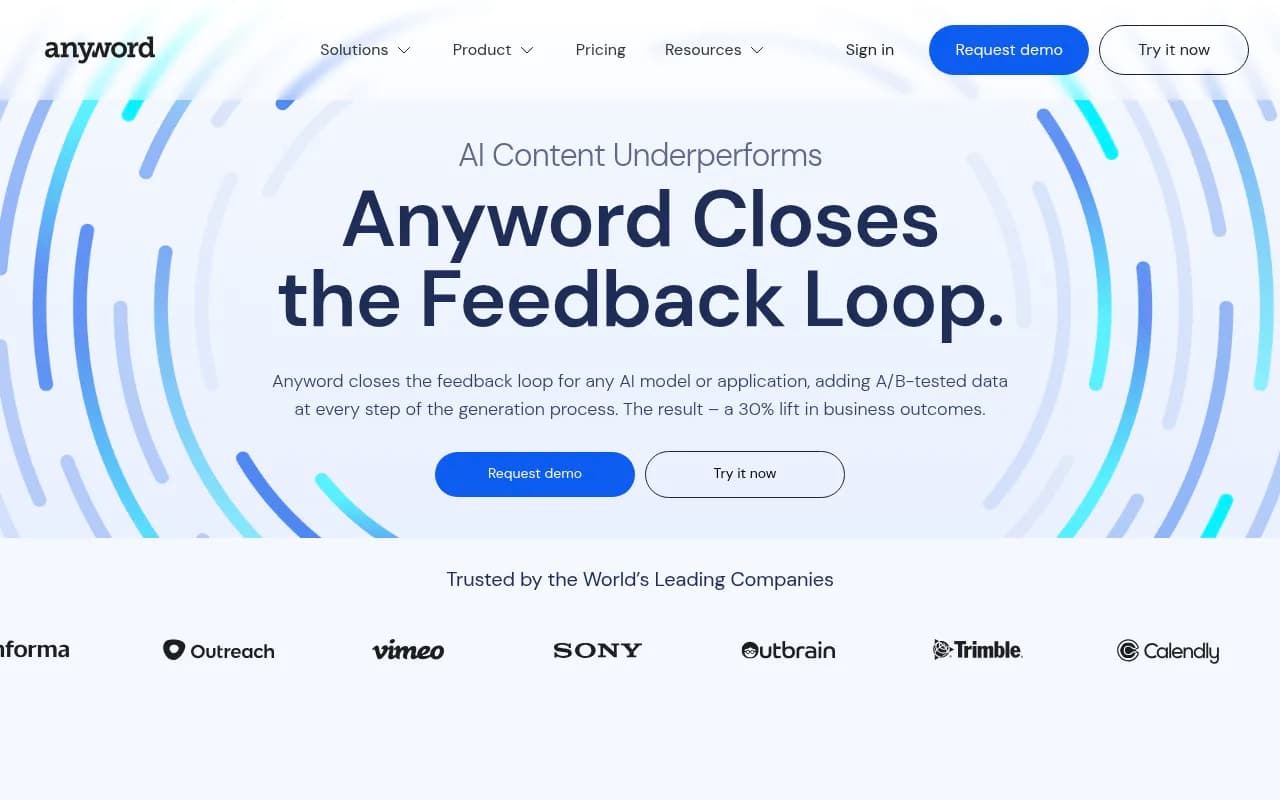
7. Anyword -- best for performance-predicted copy
Anyword's differentiator is its predictive performance scoring. Before you publish a headline, ad, or email subject line, Anyword gives you a score predicting how well it'll perform with your target audience. The model is trained on conversion data across billions of impressions.
For paid advertising and email marketing, this is genuinely useful. You can test variations before spending budget and prioritize copy that the model predicts will convert.
The limitation is scope. Anyword is built for short-form marketing copy -- ads, emails, landing pages. It's not a long-form content platform, and it has no AI search visibility features. If you're trying to rank in ChatGPT or Perplexity, Anyword won't help. But if you're replacing Copy.ai specifically for ad copy and email, it's worth a look.
Pricing: Starts at $49/month. Team and enterprise plans available.
Best for: Performance marketers who want data-backed predictions on copy before publishing.
8. Rytr -- best for budget-conscious short-form content
Rytr is the most affordable option on this list and makes no apologies for it. At $9/month, you get access to 40+ use case templates, multiple tones, and a Chrome extension that lets you generate copy anywhere in your browser.
The output quality is decent for short-form content -- social posts, product descriptions, email subject lines, ad copy. It's not going to replace a skilled copywriter for nuanced long-form content, but for teams that need to produce a lot of short-form material quickly and cheaply, it does the job.
No AI visibility features, no SEO integration, no content briefs. Just fast, affordable copy generation. Sometimes that's exactly what you need.
Pricing: Free tier available. Unlimited plan at $29/month.
Best for: Freelancers, small businesses, and budget-conscious teams that need basic AI writing without the overhead.
The category most lists miss: AI search visibility
Here's what most "Copy.ai alternatives" roundups get wrong: they assume you're looking for a writing tool. But if your organic traffic is declining while AI-powered search handles more queries, you might have a different problem entirely.
When someone asks ChatGPT "what's the best project management tool for remote teams?" -- your content either appears in that response or it doesn't. Traditional SEO metrics don't tell you which. Keyword rankings don't tell you which. Even Google Analytics won't tell you which, because AI search doesn't always generate a click.
This is the gap that GEO platforms (generative engine optimization tools) are built to fill. They run queries across AI engines, track which brands and pages get cited, and show you where you're visible and where you're not.
Most of the writing tools above don't touch this problem. Promptwatch is the exception -- it's built specifically around the cycle of finding visibility gaps, creating content to fill them, and tracking whether it worked.
If you're seeing traffic decline and suspect AI search is eating your clicks, a writing tool alone won't solve it. You need visibility data first, then content strategy, then measurement. That's a different workflow than "open a template and generate copy."
How to choose the right tool
The honest answer is that your choice depends on which problem you're actually trying to solve.
If you just need to write more content faster: Jasper (for brand consistency and scale), Writesonic (for SEO-integrated blogs), or Rytr (for budget-friendly short-form) will all serve you better than Copy.ai's current product.
If you need to optimize content for traditional SEO: Surfer SEO or Frase give you the research and optimization layer that pure writing tools lack.
If you're producing structured content at scale: AirOps is worth evaluating, particularly for programmatic or data-driven content.
If you need to know whether AI engines are citing your content -- and fix it if they're not: None of the pure writing tools above will help. Promptwatch is the platform built for this, with content gap analysis, AI-grounded writing, and tracking across 10 AI models including ChatGPT, Perplexity, Claude, and Google AI Overviews.
If you need both content generation and AI visibility in one place: Promptwatch is currently the only platform that closes the full loop.
The market is moving fast. In 2024, most teams were still treating AI search as a curiosity. In 2026, it's where a meaningful portion of discovery happens -- and the tools that help you measure and improve that visibility are no longer optional for competitive categories.
Pick the tool that matches where your actual problem lives. If you're not sure, start by checking whether your brand appears in AI responses for the queries that matter to your business. That answer will tell you a lot about which tool you actually need.