Key takeaways
- In travel and automotive, AI answers lean on third-party sources. Promptwatch's data shows booking sites, marketplaces and review hubs out-cite almost every brand domain.
- Enterprise buyers in these sectors need multi-market tracking, local targeting, crawler visibility and a way to act on the data, not just a dashboard.
- Promptwatch is the strongest fit if you want monitoring, crawler logs, content execution and traffic attribution in one platform. Profound, Scrunch, AthenaHQ and Brandlight cover parts of that stack.
- Most vendor "best of" lists, including the travel one from Qvery, are written by vendors who rank themselves first. Test with your own prompts before you sign.
- Citation sources differ sharply by industry, so your platform has to show you where answers come from, not only whether your name appears.
Why travel, hospitality and automotive need their own evaluation
Most AI visibility roundups are written for B2B SaaS. That is a different problem. A SaaS company mostly worries about being named in a "best tool for X" answer. A hotel group or car manufacturer has to worry about something stranger: the AI names you, but the link, the price and the booking path may belong to somebody else.
The data backs this up. Promptwatch Data looked at organic travel prompts in ChatGPT from Sep 28 to Oct 4, 2026 (Most Cited Sites in ChatGPT for Travel-Related Prompts). Skyscanner led at 0.78% of citations, followed by Going.com (0.52%), Tripadvisor (0.49%), Kayak (0.37%), Airbnb (0.27%) and Reddit (0.27%). The top 17 domains together earned only 4.18% of all travel citations. Travel is fragmented, with a very long tail. Booking and search sites took 2.42% of that, more than half of the 17-domain total.
Automotive looks different but has the same underlying shape. In August 2026, Autotrader (5%) and Cars.com (4.6%) outranked every car brand in ChatGPT citations. Chevrolet.com, at 2.62%, was fourth and the only manufacturer site in the top eight (ChatGPT Citation Share in the Automotive Industry, August 2026). Marketplaces and listings earned 14.65% of citations, reviews and research 12.62%, and manufacturer sites 7.92%. Even a single UK dealer group, birchwoodgroup.co.uk, made the top 31 at 0.28%.
So what should an enterprise platform do for you here? Four things, roughly:
- Show which third-party pages AI cites about your brand, not just whether you are mentioned.
- Track by market, language and, for dealers and hotels, by physical location.
- Prove whether AI crawlers can read your own inventory, rate and model pages.
- Help you fix the gaps, then check that the fix worked.
If you want a broader catalog of options, the GEO software directory at bestgeosoftware.com lists most of the vendors below.
What the data says about where AI gets its answers in these industries
Before picking a tool, it helps to know what you are trying to move.
Travel and hospitality
Citation share by source type in the Promptwatch travel report: booking and search sites 2.42%, reviews and advice (Tripadvisor, Trustpilot, Which?) 0.86%, guides and reference 0.37%, Reddit 0.27%, tours 0.16%. Practical implications from the same report:
- Keep listings accurate on Skyscanner, Kayak, Airbnb and Expedia.
- Collect reviews on Tripadvisor and Trustpilot.
- Get featured in guides such as Lonely Planet and Time Out.
- Watch fare-deal sites in your market. Going.com out-cites Tripadvisor.
Notice what is missing from that list: "publish more blog posts on your own site." Your own domain is one input among many.
Automotive
The automotive report puts listings plus reviews and research at 27.27% of all citations. The recommendations are concrete: keep inventory, pricing and specs accurate on marketplaces, maintain complete profiles on DealerRater, Birdeye and BBB, give every model and trim a stable page with specs and pricing context, and build focused pages for questions about trims, ownership costs and local availability. Dealers should not ignore their local pages.
Social and community sources
This shifts month to month. Promptwatch's social media citations report found ChatGPT drew just 0.46% of its citations from social platforms from Sep 28 to Oct 4, 2026, while Google AI Overviews drew 12.2%. And Reddit's share of ChatGPT citations fell from roughly 4% to 0.5% on August 14, 2026 (Reddit citations are dropping in ChatGPT). A platform that tracks Reddit, YouTube and other social citations per engine will catch these swings. One that treats "AI" as a single blob will not.
How to evaluate an enterprise platform for these sectors
I would score every vendor on the same checklist.
| Requirement | Why it matters for travel and automotive |
|---|---|
| Real-interface data from each engine | Consumer-facing answers and citations can differ from API output |
| Multi-country and multi-language monitors | Hotel chains and OEMs run dozens of markets |
| City or coordinate-level targeting | "Hotels near me" and "dealer near me" depend on location |
| Citation and source-type analysis | Most of your influence is third-party |
| AI crawler logs | Shows whether bots can read rates, inventory and spec pages |
| AI traffic attribution | Ties visibility to bookings, test-drive requests or leads |
| Content execution | Gap analysis is useless without a way to publish |
| Security and compliance | Enterprise procurement will ask for ISO 27001 and GDPR |
| Agency or multi-brand structure | Groups run many brands, properties or dealerships |
The platforms worth shortlisting
Promptwatch
Promptwatch is the platform I would put first for this use case, and the reason is the closed loop. It monitors ChatGPT, Google AI Overviews, Google AI Mode, Gemini, Perplexity, Copilot, Meta AI and others through their real interfaces, in the country and language you pick. Then it traces which pages get cited, including Reddit, YouTube and LinkedIn sources. After that it helps fix the gaps with content gap analysis, the Content Agent and the Action Board, and measures the result through IP-verified AI crawler logs and visitor analytics.
Two features matter most for these industries. Local GEO/SEO targeting lets you pin a monitor to exact coordinates (20 m to 5 km accuracy radius), so ChatGPT, AI Overviews and AI Mode answer as if asked from a specific hotel, showroom or airport. That is on Business, Agency Scale and Enterprise. And Offsite Mentions finds third-party pages that name your brand without linking, which maps directly onto the marketplace and review-site problem above. Brand Narrative also extracts the individual claims AI makes about you (for example "rooms are dated" or "poor dealer service") and groups them by theme.
Pricing is public: Essential $95/mo, Professional $245/mo, Business $579/mo (the first plan with the Content Agent, hourly tracking, state/city tracking and local targeting), plus Enterprise on request with SSO, a white-label client portal and a dedicated success manager. It is ISO/IEC 27001 certified and GDPR compliant. Confirm figures at promptwatch.com/pricing.

Honest caveat: if you only want a lightweight score for a quarterly slide, this is more than you need. The free AI visibility report or the 7-day trial is a cheap way to find out. For a head-to-head with the best-known enterprise rival, see Promptwatch vs Profound.
Profound
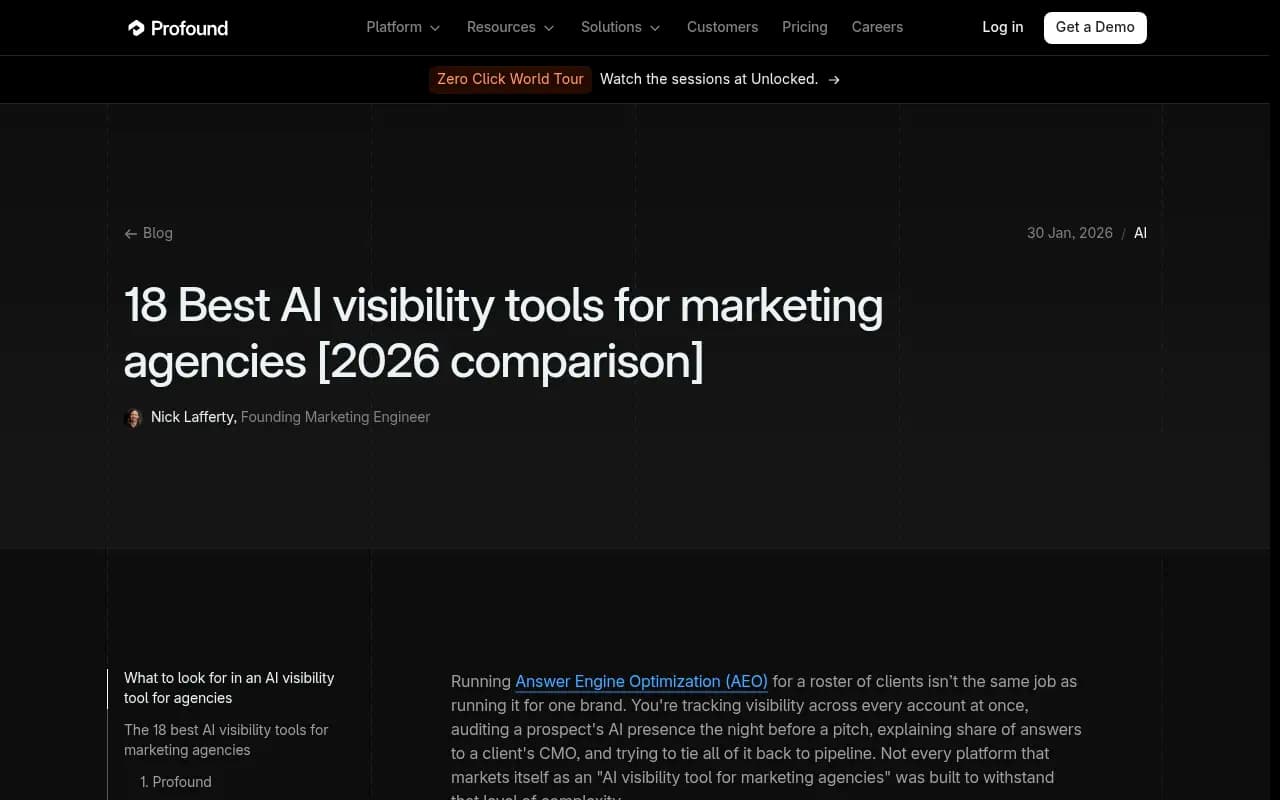
Profound is the name that comes up most often for large enterprises. Its own agency roundup (a vendor-authored piece dated 30 Jan 2026) claims tracking of the main engines on 1.9B+ real user prompts, plus content creation, crawler-to-conversion attribution and an Agency Mode with client workspaces and pitch environments. Treat those numbers as vendor claims. In Promptwatch's comparison, Profound is strong on monitoring but sits at a higher price point, with no Reddit tracking and no agentic execution.
Profound

Scrunch
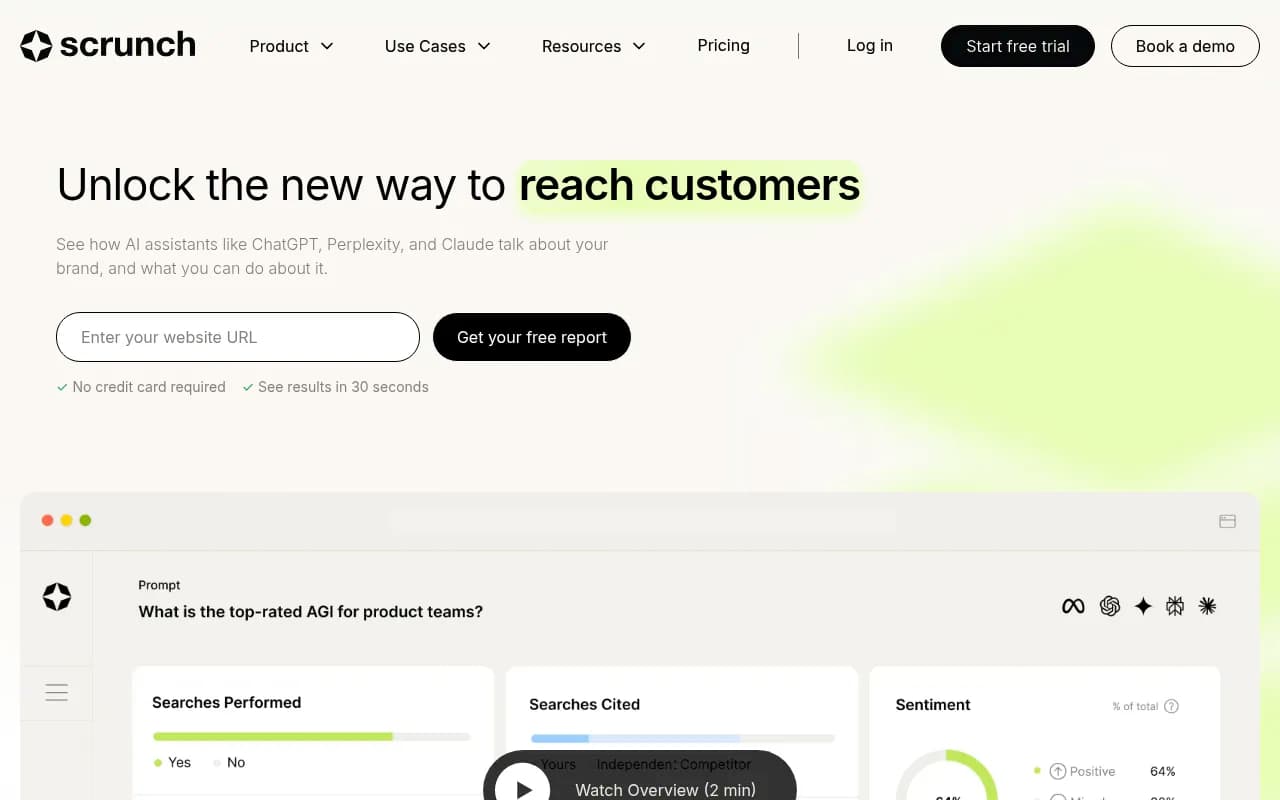
Scrunch's differentiator, per Profound's roundup, is an AXP layer that serves AI-optimized pages to crawlers. That is interesting for sites with heavy JavaScript booking engines. The same source says it lacks content generation. Verify that claim directly with the vendor, since it comes from a competitor.
AthenaHQ
AthenaHQ turns visibility data into prescriptive next steps through its Action Center. Profound's roundup notes prompt volume relies on an undisclosed model and that AI-written content may need heavy editing. Good for teams that want a to-do list; less obviously suited to heavy multi-market hotel and OEM setups.

Brandlight
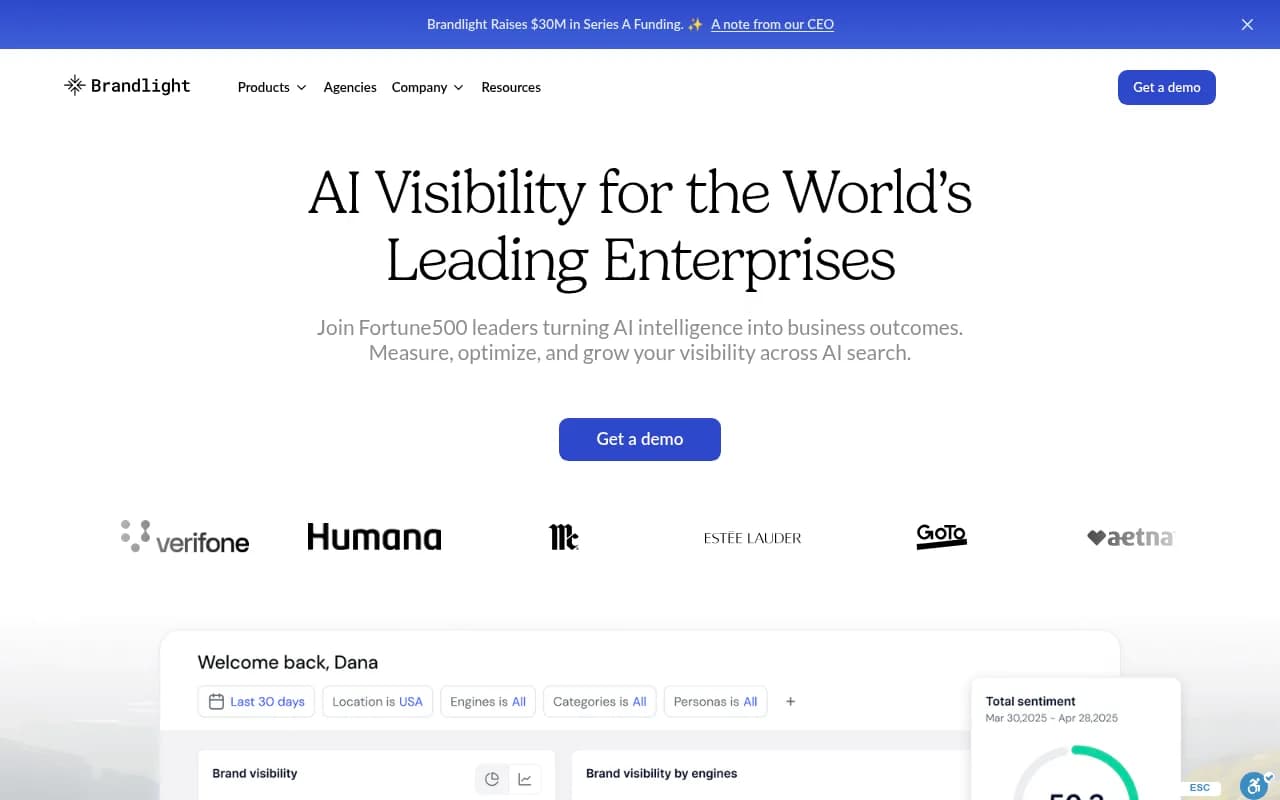
Brandlight positions itself for multi-brand enterprises, which is relevant to hotel groups and dealer networks. Its blog argues that roughly 85% of the sources AI cites for category questions are third-party or social. That squares with what Promptwatch sees in travel and automotive, though it is Brandlight's own analysis, so weigh it accordingly.
Semrush and Ahrefs Brand Radar
If your team already lives in an SEO suite, Semrush's AI Toolkit and Ahrefs Brand Radar are the low-friction options. The trade-off is depth: fixed prompt sets, thinner AI-specific data, and no crawler logs or AI traffic attribution compared with dedicated platforms.

Peec AI, Otterly and Omnia
These are prompt trackers aimed at marketing teams and smaller agencies. Qvery's travel list includes Peec AI, Omnia and OtterlyAI. They are fast to set up and cheaper, and Profound's roundup describes Otterly as low-cost with no prompt-volume data. For a global hotel group they will probably run out of road at crawler analysis, content execution and attribution.

Otterly.AI

Side-by-side comparison
| Platform | Best fit | Strengths | Gaps to check |
|---|---|---|---|
| Promptwatch | Enterprise travel and auto teams that want monitoring plus action | Real-UI data, crawler logs, local targeting, Content Agent, CMS publishing, traffic attribution, ISO 27001 | More platform than a score-only team needs |
| Profound | Large enterprises and agencies | Broad engine coverage, agency workspaces, content tools | Higher price point, no Reddit tracking, no agentic execution |
| Scrunch | Sites with rendering or crawler issues | AXP layer for AI crawlers | Reported lack of content generation |
| AthenaHQ | Teams wanting prescriptive actions | Action Center | Undisclosed volume model, content editing load |
| Brandlight | Multi-brand enterprises | Third-party source focus | Less public detail on execution |
| Semrush / Ahrefs | Existing suite users | Familiar workflow | Shallow AI-specific data, no crawler logs |
| Peec AI / Otterly / Omnia | Small teams, pilots | Low cost, quick setup | No crawler logs or content execution |
For more options, the AI rank tracking directory at ai-rank-tools.com is a useful cross-check.
A note on vendor-authored rankings
The most travel-specific list I found, Qvery's "8 Best AI Visibility Tools for Travel Brands," ranks Qvery's own GEO Agent first and then lists Peec AI, Omnia, OtterlyAI, Ahrefs Brand Radar, AthenaHQ, Scrunch and Profound. Its angle is a sharp one: the link in an AI answer decides whether the booking lands on your own site, an OTA listing, or a list of competing hotels. That is a real insight worth building your evaluation around. But the ranking is a sales page. The same goes for Profound's agency roundup, and for this guide's author network, which uses Promptwatch. Run your own bake-off.
How to run a two-week bake-off
- Build a prompt set that reflects your funnel. For a hotel group: destination discovery, "best hotel in [city] for [traveler type]", brand comparisons and "near me" queries. For an OEM: model comparisons, pricing and ownership cost, "best SUV under X", and local dealer queries.
- Run the same prompts in every vendor. Compare how many responses each tool captures, in which countries, and whether results come from real interfaces or APIs.
- Check the citation view. Can you see which marketplace, review or booking pages are cited next to yours? Can you see whether your inventory pages are cited at all?
- Test crawler visibility. Ask whether the tool shows IP-verified AI bot requests to your rate, room and model pages. Crawl failures often explain missing citations. Promptwatch's AI crawler logs are built for this, and its AI crawler traffic data gives a benchmark by industry.
- Test the fix loop. Pick one gap, such as a trim-level pricing page or a destination guide, and see how each vendor helps you close it and measure the result.
- Ask about security and structure. Request ISO 27001 evidence, SSO, audit logs and how multi-brand or multi-property access works.
What to do with the results
Whatever you pick, the action plan is similar across both industries.
- Audit the third-party pages AI cites for you and correct inventory, rates, specs and photos first. This beats publishing new content on your own domain.
- Build stable, specific pages for models, trims, room types and destinations, with pricing context and ownership or stay details.
- Make sure AI bots can fetch those pages. Check robots.txt rules, rendering and errors.
- Earn reviews and guide coverage where AI already looks: Tripadvisor, Trustpilot, DealerRater, Birdeye, Lonely Planet, Time Out.
- Track AI-referred visits and conversions so you can show revenue, not only mentions. Promptwatch's guide to attributing AI traffic covers the setup, including ChatGPT's referrer change on October 8, 2026.
If you would rather hand off strategy, 1001 SEO Media runs GEO programs for brands, and the 90-day framework in Promptwatch's GEO program guide is a reasonable starting structure either way.
Bottom line
For travel, hospitality and automotive, the winning platform is the one that shows you the marketplace and booking-site layer, reads your own site the way AI bots do, and helps you fix what it finds. For enterprise teams, Promptwatch covers that whole loop and is where I would start. Profound and Brandlight deserve a look if your procurement process requires a name-brand incumbent, and the suite add-ons are fine for pilots. Whichever you choose, base the decision on your own prompts and markets, not on a vendor's own ranking.