Key takeaways
- Roughly half of B2B software buyers now start vendor research in an AI chatbot, according to a G2 study cited by DerivateX, so enterprise SaaS teams can no longer treat GEO as an experiment.
- The split that matters most is monitoring versus optimization. A dashboard that reports a mention rate does nothing to improve it.
- For global markets, demand per-market reporting, real non-English prompts and per-platform numbers. A single blended visibility score hides almost everything useful.
- For SaaS specifically, docs, vendor pages and review sites (G2, Capterra) get cited differently, so your tool should track them separately.
- Shortlist by buying situation: measurement-led, workflow-led, technical-readiness-led or execution-led. Verify pricing, SOC 2, SSO and region coverage on each vendor's site before you sign.
Why enterprise B2B SaaS needs a different GEO tool
A mid-market team with one English-speaking market can get by with a cheap tracker. An enterprise SaaS company selling in the US, Germany, France, Brazil and Japan cannot. You have multiple product lines, regional marketing teams, a security review process and a CFO who wants to know what AI search is worth.
The problem is real. DerivateX, in its GEO tools guide for B2B SaaS, cites a G2 study showing about 51% of B2B software buyers use AI chatbots for vendor research, and that half start there before they ever open a search engine. A buyer reads an AI recommendation, clicks through to the winner, and your analytics logs a direct visit. You never see the loss.
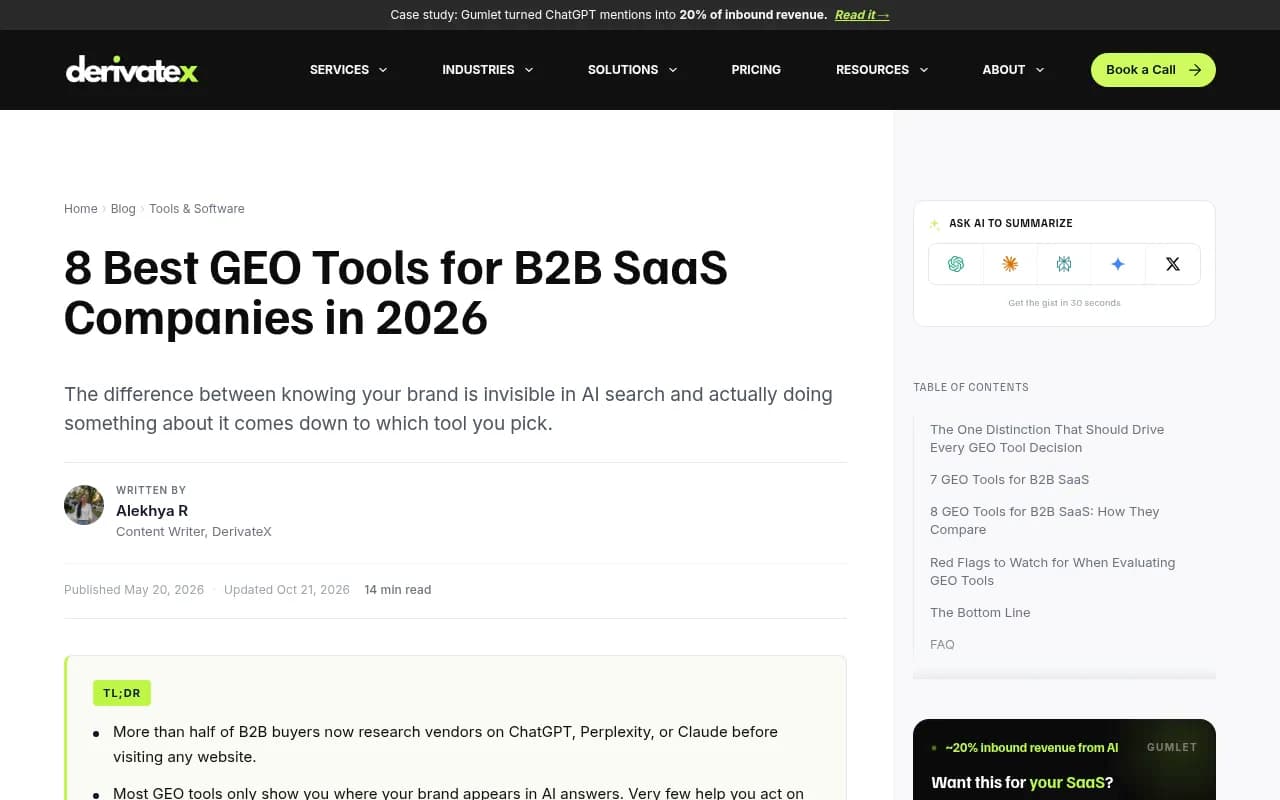
That guide frames the decision well: monitoring tools measure your AI presence, optimization tools help you build it. I would add a third axis for enterprise buyers. Can the tool handle many markets honestly?
What AI engines actually cite for SaaS
Before picking a tool, know what it should be measuring. Promptwatch Data's software report looked at organic software prompts in ChatGPT from Sep 28 to Oct 4, 2026. A few numbers worth knowing:
- GitHub was the most cited domain at 1.2% of software citations, followed by learn.microsoft.com (0.98%) and G2 (0.73%).
- By source type, docs and help centers earned the largest share at 2.64%, then vendor sites at 2.01% and review sites and analysts at 1.57%.
- Vendor sites plus docs earned 4.65%, about three times what review sites and analysts earned. But G2, Gartner, Capterra and Software Advice together (1.57%) beat any single vendor, Microsoft included.
The takeaway for a SaaS team is practical. Your documentation, your product pages and your review-site profiles are three different citation surfaces. A GEO tool that gives you one number for "AI visibility" can't tell you which of them is failing.
Two more data points shape tool requirements. Per Promptwatch's average sources per response data, ChatGPT cites about 5 sources per web-search answer while Google AI Overviews and Perplexity cite about 10, and Copilot swings widely. And Promptwatch's ChatGPT query fanout data shows average fanouts per response and query length changing month to month, so a tool should model sub-queries, not just the prompt you typed in. On August 8, 2026, ChatGPT also started using the site: operator at scale, per Promptwatch Data, which changes how your pages get retrieved.
The enterprise buying checklist
Most enterprise GEO evaluations go wrong in the same few places. Here is what I would insist on.
Per-platform and per-market numbers
Meikai, a competing vendor whose guide is self-promotional but contains a useful case study, tracked 126 brands after a publisher removed pages. Citation-rate retention from March to July 2026 was 109.5% on Perplexity, 26.3% on Copilot, 12.2% on ChatGPT and 0% on Google AI Mode. Averaging those gives about 37%, which describes none of the platforms. Ask every vendor for per-platform rates, normalization by response volume and access to raw answers.
The same logic applies to countries. Insist on reporting per market rather than one blended score.
Real non-English prompts
Most GEO products were built and demoed in English. Ask where the French, German or Japanese prompts came from. Machine-translated prompts are a red flag, because buyers in those markets phrase questions differently and AI engines cite different local sources. Also check that the tool collects answers from the actual AI interfaces in each country, not just an API call that ignores location.
Security and governance
SOC 2 or ISO/IEC 27001 status, SSO, role-based access, audit logs and API access matter once procurement is involved. I could not verify these for every vendor below, so treat each as a question for the sales call.
Can it act, not just report?
This is the monitoring-versus-optimization gap. If your team already has capacity to turn data into content and fixes, a strong monitoring tool may be enough. If not, you want a platform that closes the loop.
Four buying situations
It helps to decide which situation you are in before comparing vendors.
- Measurement-led: you need credible, defensible numbers for leadership across markets.
- Workflow-led: you need tasks, assignments and content production tied to the data.
- Technical-readiness-led: you suspect AI crawlers can't read parts of your site, especially localized or JavaScript-heavy pages.
- Execution-led: you want content written, published and re-measured with minimal manual work.
Enterprise GEO tools worth shortlisting
Promptwatch
Promptwatch is the one on this list that covers all four situations in a single product. It tracks ChatGPT, Gemini, Claude, Perplexity, Google AI Overviews, Google AI Mode, Copilot, Meta AI and others from the real interfaces, in each country and language you choose. A monitor's language and location are fixed when it's created, so your markets never mix, which directly addresses the blended-score problem.

What separates it from monitoring-only tools is what happens after the data comes in. The Action Board prioritizes fixes, the Content Agent writes and publishes to WordPress, Webflow or Framer, and IP-verified AI crawler logs show whether bots actually read the page. Visitor analytics then measure the traffic and conversions AI sends. For SaaS teams, Citation Trends classify sources into types, including directories like G2 and Capterra, so you can see docs, vendor pages and review sites separately. Brand Narrative also pulls out the specific claims AI makes about you and competitors, with Fact Check to trace an inaccurate claim back to the page it came from.
On security, Promptwatch is ISO/IEC 27001 certified and GDPR compliant, with data handled by an EU-based company, which tends to matter in procurement. It is rated 4.7/5 on G2 and used by 1,840+ brands and agencies. Business is $579/mo (5 projects, 350 prompts, tracking as often as hourly, the Content Agent, Fact Check, state and city tracking); Enterprise is custom, with SSO, a white-label portal and audit logs. Confirm everything at promptwatch.com/pricing. Good next steps are the free AI visibility report, the 7-day trial on monthly plans, or a demo. If you are comparing against specific rivals, see Promptwatch vs Profound and the 2026 platform comparison.
Profound
DerivateX positions Profound as the pick for enterprise B2B SaaS teams that need SOC 2-compliant data and deep prompt-volume analytics. Meikai characterizes its public emphasis as prompt-volume data and automated content workflows. It is a strong measurement option. The trade-offs, based on how we see the market, are a higher price point and less coverage of areas like Reddit tracking, shopping and crawler-level work. If SOC 2 is a hard gate, it belongs on your list.
Profound

Peec AI
DerivateX recommends Peec for B2B SaaS companies with international audiences and for agencies tracking multiple brands across languages. Meikai describes it as focused analytics, source tracking and reporting. It is a good fit for a measurement-led team that wants clean multi-language reporting and will handle execution elsewhere. It is a monitor, so don't expect crawler logs or content generation.

AthenaHQ
AthenaHQ gets named among the enterprise options by DerivateX, and Meikai describes monitoring, content agents and enterprise controls as its public emphasis. Worth a demo if you want workflow features alongside tracking.

Scrunch
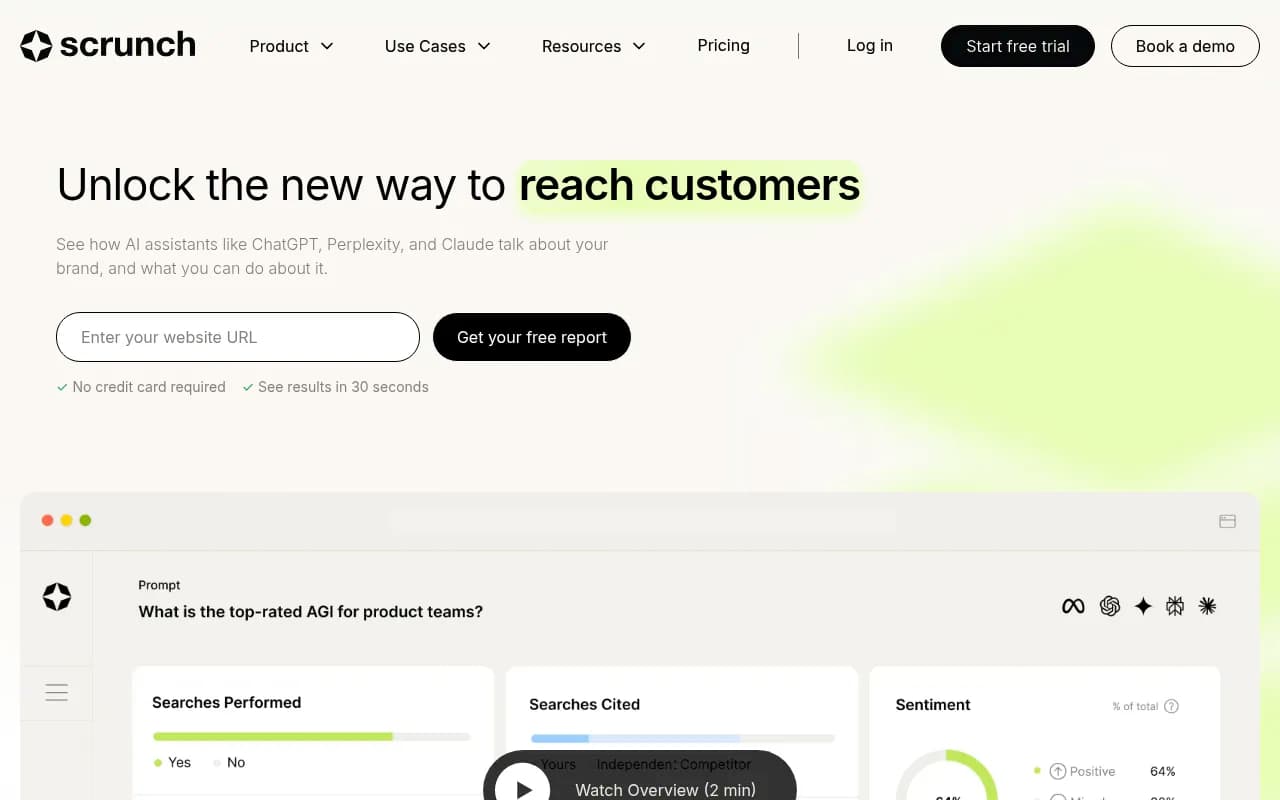
Scrunch leans on citation intelligence and what it calls an Agent Experience Platform for serving AI-ready content. That makes it interesting for technical-readiness-led teams worried about how AI agents see their site.
Bluefish
Bluefish pitches a broad enterprise marketing suite with custom measurement and AI commerce. It suits Fortune 500-style organizations that want one vendor across a wide marketing stack, and probably less so a lean SaaS team.
Otterly.AI
Otterly emphasizes multi-country monitoring, audits and optimization, and DerivateX lists it as a budget option. For a global company testing the waters in a few markets, it is an inexpensive way to get started, though it is a lighter tool than the enterprise platforms above.
Otterly.AI

Semrush and Ahrefs Brand Radar
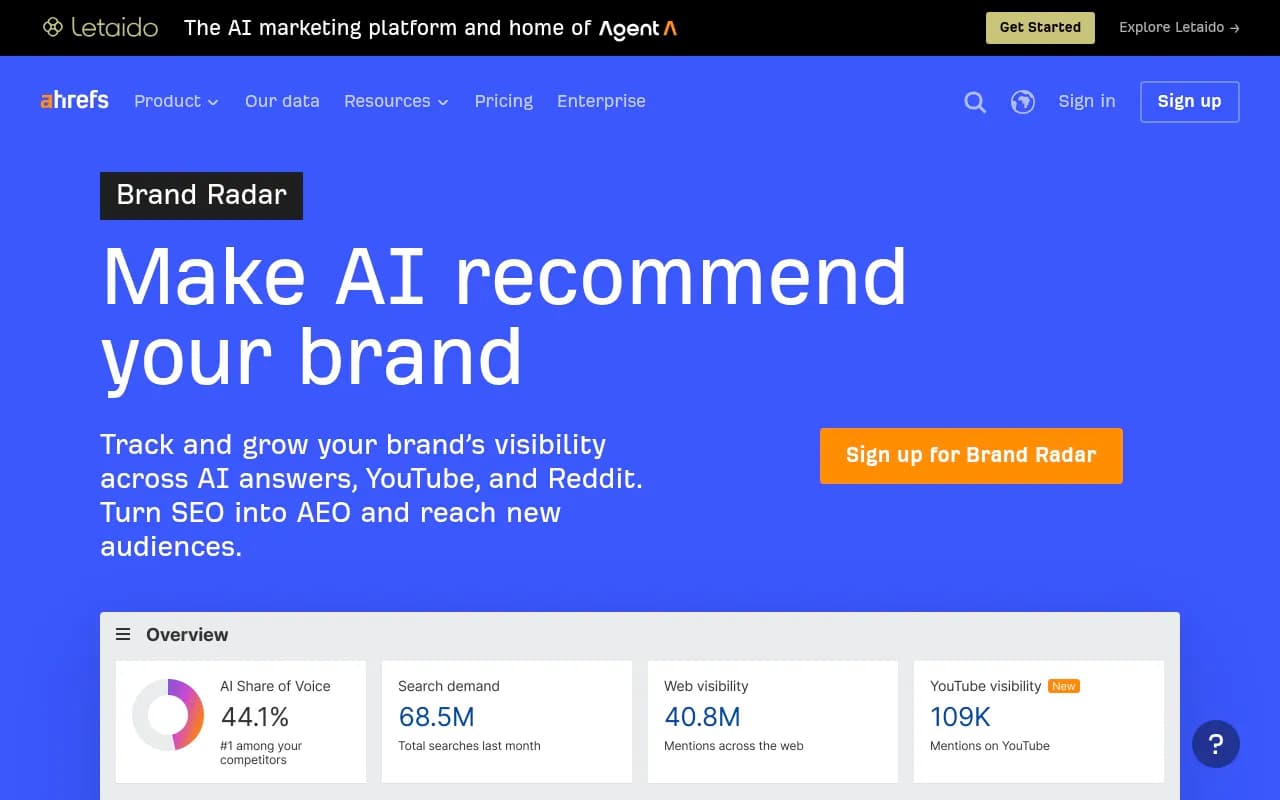
DerivateX's advice is sensible: if you already pay for Semrush or Ahrefs, try their AI add-ons first. The catch is that they are SEO suites adding AI tracking, so prompt sets are more limited and you won't get crawler logs or AI traffic attribution.
Comparison table
| Tool | Best for | Global and multi-language | Acts on the data | Verify before buying |
|---|---|---|---|---|
| Promptwatch | End-to-end optimization, all four buying situations | Per-country, per-language monitors from real interfaces | Content Agent, Action Board, CMS publishing, crawler logs, visitor analytics | Plan limits at promptwatch.com/pricing |
| Profound | SOC 2-gated measurement, prompt volumes | Check per-market coverage | Automated content workflows (vendor claim) | Pricing, regions |
| Peec AI | International measurement and agencies | Multi-language focus | Monitoring and reporting | Execution gaps |
| AthenaHQ | Workflow plus monitoring | Check | Content agents, enterprise controls | Pricing, SSO |
| Scrunch | Technical readiness | Check | Agent Experience Platform | Scope of serving layer |
| Bluefish | Broad enterprise suite | Check | Marketing suite, AI commerce | Fit for SaaS |
| Otterly.AI | Budget multi-country monitoring | Multi-country | Audits | Depth at scale |
| Semrush / Ahrefs | Teams already on the suite | Limited | Mostly monitoring | Prompt set limits |
I have not verified pricing for the non-Promptwatch tools, so confirm each on the vendor's site.
How to run the evaluation
Build a real prompt set
Take 30 to 50 prompts per priority market. Include category queries ("best [category] software for mid-size finance teams"), comparison queries against named competitors and branded queries. Write the non-English ones with local marketers, not a translation tool.
Test the same prompts in every vendor
Run an identical set through each shortlisted tool for two weeks. Compare per-platform results and check whether the raw answers match what you see when you ask manually in each country.
Check the citation sources, not just mentions
A mention without a citation to your own domain usually points to a content or crawlability problem. Check whether docs, vendor pages and G2 or Capterra profiles are the sources being cited, and whether they differ by market.
Test the loop
Pick one gap, fix it and see whether the tool can tell you if the fix worked. This is where monitoring-only tools run out of road. It is also worth reading the 90-day GEO program and GEO for B2B guides for a sequencing template.
Practical priorities for SaaS teams
- Keep docs and help pages crawlable. They earned the largest citation share for software prompts in Promptwatch's data.
- Keep a public GitHub presence if you have developer-facing products.
- Keep G2 and Capterra profiles complete and current in every market you sell in.
- Treat Perplexity as a test bench, since its citation count barely moves, and use AI Overviews as an early win for mid-authority domains, as Promptwatch's average-sources data suggests.
- Check the technical basics first. Free tools like the Agentic Readiness Check show which AI crawlers can read your site.
Agency or software?
Some enterprise teams would rather outsource strategy. Lists like those from Bay Leaf Digital and Pepper name agencies such as Animalz, First Page Sage, Omniscient Digital and Graphite for B2B SaaS GEO. If you go that route, make sure the agency reports from the same platform you would buy yourself, so you aren't locked into their dashboards. Agencies like 1001 SEO Media combine technical SEO, content and GEO work with Promptwatch as their visibility platform, which is one way to pair services with software.
Where to find more options
There are dozens of vendors, and the category moves fast. The GEO software directory at bestgeosoftware.com lists more tools, and Promptwatch Data has current research on how AI engines cite sources.
Bottom line
For an enterprise B2B SaaS company in many markets, the short list is small. If you need defensible measurement and a SOC 2 checkbox, look hard at Profound or Peec. If you need the whole loop of monitoring, crawler visibility, content production and traffic measurement in one place, Promptwatch is the one to start with. Whatever you choose, demand per-market, per-platform reporting and test it on your own prompts before you sign.