Key takeaways
- Most GEO platforms are built for single brands, not agencies managing 10+ clients simultaneously -- multi-client workspace support is rarer than vendors imply.
- White-label reporting quality varies enormously: some platforms offer fully branded client portals on custom domains, others just slap a logo on a PDF.
- The biggest gap in the market is between monitoring and optimization -- most tools show you where you're invisible in AI search but give you nothing to fix it.
- Promptwatch is the only GEO platform rated as a "Leader" across all categories in a 2026 comparison of 12 platforms, and the only one that closes the full loop from gap analysis to content generation to traffic attribution.
- For agencies, the practical shortlist comes down to what you need: pure monitoring, white-label reporting, content optimization, or all three.
Why GEO has become an agency service line
A year ago, most agencies were still treating AI search visibility as a curiosity. Now it's a line item on client proposals. ChatGPT, Perplexity, Claude, Gemini, and Google AI Overviews are collectively handling a significant share of informational queries -- and brands that don't appear in those responses are losing consideration before a user ever visits a website.
That shift has created real demand for GEO (Generative Engine Optimization) as a managed service. Clients want to know: does ChatGPT recommend us? What does Perplexity say when someone asks about our category? Are we losing ground to a competitor in AI-generated answers?
The problem is that most GEO platforms weren't designed with agencies in mind. They're built for a single brand team monitoring their own visibility. When you try to run 15 client accounts through them, you hit walls: separate logins per client, no white-label options, no way to generate a branded report, and pricing structures that punish scale.
This guide focuses specifically on what agencies need -- multi-client workspace management, white-label or brandable reporting, and optimization features that let you actually move the needle for clients, not just show them dashboards.
What agencies actually need from a GEO platform
Before getting into specific tools, it's worth being clear about what separates an "agency-ready" GEO platform from a solo-brand tool with a higher price tier.
Multi-client workspace management means you can create isolated projects for each client, control what each client sees, assign team members to specific accounts, and switch between clients without logging out. This sounds basic, but many platforms require separate accounts per client.
White-label reporting means client-facing reports, dashboards, or portals that carry your agency's branding -- not the platform's. The gold standard is a fully hosted client portal on your custom domain. The minimum viable version is a PDF export with your logo. Most platforms fall somewhere in between, and the gap between what's advertised and what clients actually see is wider than most agencies realize until they've committed to an annual plan.
Optimization features are where most GEO platforms fall short entirely. Monitoring tells you that your client isn't being cited by ChatGPT for a given query. Optimization tells you why, and helps you fix it -- through content gap analysis, AI-specific content generation, structured data recommendations, and citation source analysis.
Pricing that scales is the final piece. Per-client pricing that compounds quickly makes it hard to build a profitable service offering. Flat-tier or prompt-based pricing tends to work better for agencies.
The platforms worth knowing
Promptwatch
Promptwatch is the most complete GEO platform available for agencies in 2026. It's the only platform in a 12-tool comparison that rated as a "Leader" across every category -- and the reason is the action loop it's built around.
Most GEO tools stop at monitoring. Promptwatch goes further: it identifies which prompts competitors are visible for that your client isn't (Answer Gap Analysis), generates content specifically engineered to get cited by AI models (using data from 880M+ citations analyzed), and then tracks whether that content actually improves visibility and drives traffic.

For agencies specifically, the platform supports multi-site management across plans (up to 5 sites on Business, with custom agency/enterprise tiers available), monitors 10 AI models including ChatGPT, Perplexity, Claude, Gemini, Google AI Overviews, Grok, DeepSeek, Copilot, Meta AI, and Mistral, and includes AI Crawler Logs that show which pages each AI engine is reading on your clients' sites -- a feature most competitors don't have at all.
The built-in writing agent generates articles, listicles, and comparisons grounded in real citation data, prompt volumes, and competitor analysis. This isn't generic content -- it's built to answer the specific questions AI models are looking for answers to. For agencies, that means you can deliver actual optimization work, not just a report showing where the client is invisible.
Traffic attribution closes the loop: code snippet, Google Search Console integration, or server log analysis connects AI visibility improvements to actual revenue. That's the kind of data that justifies retaining an agency.
Pricing starts at $99/month (Essential: 1 site, 50 prompts, 5 articles), $249/month (Professional: 2 sites, 150 prompts, 15 articles, crawler logs), and $579/month (Business: 5 sites, 350 prompts, 30 articles). Agency and enterprise tiers are available with custom pricing.
SE Ranking
SE Ranking is a strong choice for agencies that want a traditional SEO platform with genuine white-label capabilities and some AI search tracking layered on top.
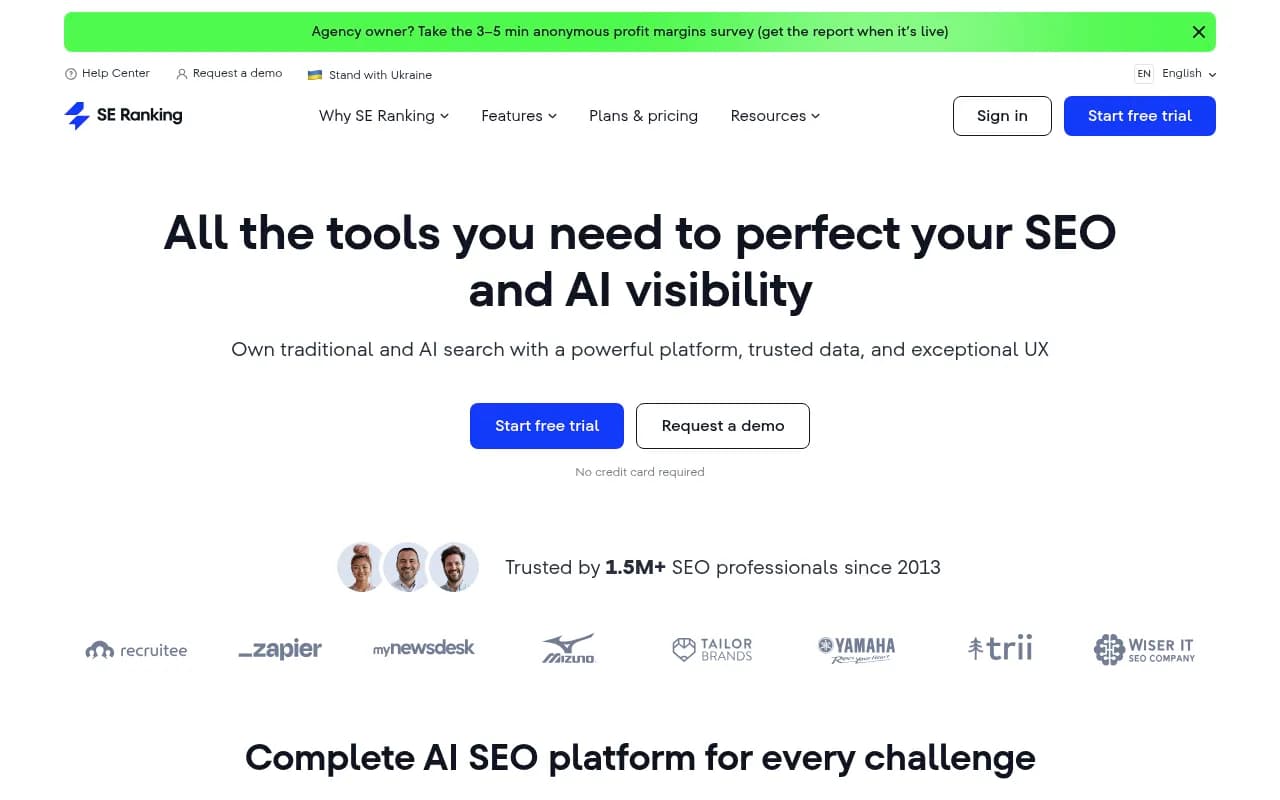
The white-label implementation is solid -- it supports Level 2 white labeling, meaning clients get a branded experience that doesn't visibly expose SE Ranking's branding. You can set up a custom domain for client portals, customize report templates, and manage multiple client workspaces from a single agency account. Pricing is mid-market and scales reasonably.
Where SE Ranking falls short for GEO specifically is depth. The AI search tracking is present but limited compared to dedicated GEO platforms. It doesn't have content generation capabilities tied to AI citation data, and there's no equivalent to Promptwatch's Answer Gap Analysis. For agencies whose primary service is traditional SEO with GEO as an add-on, SE Ranking works well. For agencies building GEO as a core service line, it's not deep enough.
Search Atlas
Search Atlas is one of the more ambitious all-in-one platforms in the market right now -- it combines traditional SEO tools with AI content generation and some GEO tracking in a single interface.
For agencies, the appeal is consolidation: rank tracking, site audits, content generation, and AI visibility monitoring without needing to stitch together multiple tools. The white-label reporting is functional, and the multi-client workspace management is better than most.
The trade-off is that being ambitious across many categories means it's not the deepest tool in any single one. The GEO tracking doesn't match Promptwatch's citation depth or model coverage, and the content generation isn't specifically optimized for AI citation patterns the way Promptwatch's writing agent is. But if you're running a full-service agency and want one platform that covers most bases, Search Atlas is worth evaluating.
Rankscale
Rankscale is built specifically for agencies managing AI visibility at scale, with a focus on multi-client management and white-label reporting.
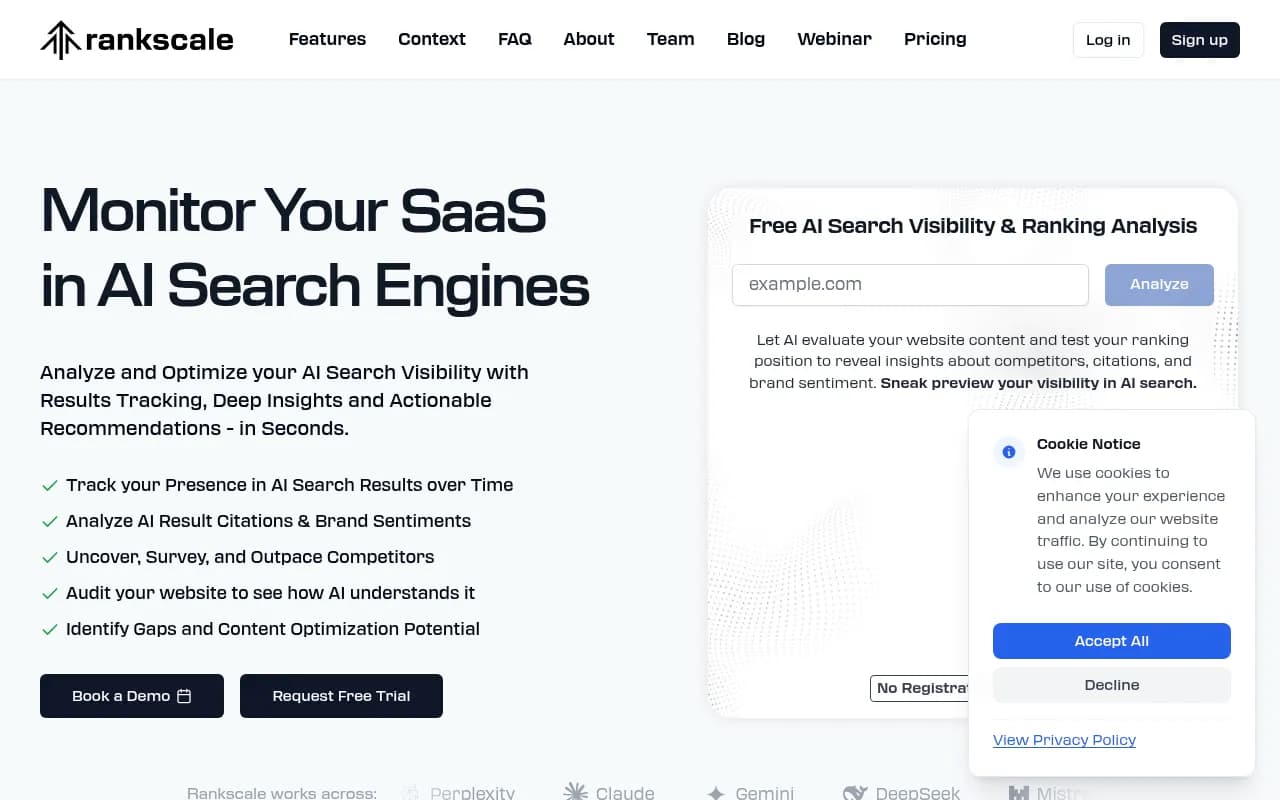
It's a newer platform, but the agency-first design shows. The workspace structure is clean, client isolation works properly, and the reporting is genuinely brandable. The monitoring covers the major AI models and gives you prompt-level visibility data.
The limitation is that Rankscale is primarily a monitoring and reporting tool. It doesn't have content generation, content gap analysis, or traffic attribution built in. You can see where your clients are invisible, but you need other tools to fix it. For agencies that already have a content production workflow and just need the tracking layer, that's fine. For agencies that want an end-to-end GEO platform, it's not enough on its own.
Profound
Profound is an enterprise-grade AI visibility platform with strong monitoring capabilities and solid multi-client support.
Profound

The data quality is good, the model coverage is broad, and the reporting is polished. For larger agencies working with enterprise clients who want detailed AI visibility reports, Profound is a credible option.
The pricing is higher than most alternatives, which makes it harder to build a profitable service offering for mid-market clients. And like most enterprise platforms, the focus is on monitoring and reporting rather than optimization. You get excellent data about where your clients stand, but the platform doesn't help you improve those standings.
Otterly.AI
Otterly.AI is a monitoring-focused GEO tool with a clean interface and reasonable pricing.
Otterly.AI

It covers the major AI models, tracks brand mentions and prompt visibility, and generates reports that are reasonably presentable to clients. For agencies just getting started with GEO as a service and wanting to show clients something tangible, Otterly.AI is accessible.
The honest limitation: it's a monitoring dashboard. There's no content generation, no gap analysis, no crawler logs, no traffic attribution. You can tell a client "here's your AI visibility score" but you can't tell them "here's what we're doing to improve it" using tools within the platform. That's a gap that matters when clients start asking about ROI.
Peec AI
Peec AI tracks brand visibility across ChatGPT, Perplexity, and Claude with a straightforward interface.

It's a reasonable entry-level option for agencies that want basic AI visibility monitoring without a large budget commitment. The reporting is simple and exportable. Multi-client management is functional but basic.
Like Otterly.AI, Peec AI is monitoring-only. It doesn't have optimization features, content generation, or traffic attribution. It's a starting point, not a complete agency solution.
AthenaHQ
AthenaHQ positions itself as an enterprise AI visibility platform with a focus on brand monitoring across AI search engines.

The monitoring capabilities are solid, and the platform has good coverage of major AI models. For enterprise clients who want detailed visibility reporting, it's a credible choice.
The gap is the same as most competitors: AthenaHQ is monitoring-focused. It shows you where you stand but doesn't help you move. For agencies that need to demonstrate ongoing optimization value to clients, that's a meaningful limitation.
Feature comparison
| Platform | Multi-client workspaces | White-label reporting | AI model coverage | Content generation | Gap analysis | Traffic attribution | Crawler logs | Pricing (entry) |
|---|---|---|---|---|---|---|---|---|
| Promptwatch | Yes (up to 5 sites + custom) | Yes | 10 models | Yes (AI writing agent) | Yes (Answer Gap Analysis) | Yes | Yes | $99/mo |
| SE Ranking | Yes | Yes (Level 2, custom domain) | Limited | No | No | No | No | ~$65/mo |
| Search Atlas | Yes | Yes (functional) | Moderate | Yes (general) | Partial | No | No | ~$99/mo |
| Rankscale | Yes (agency-first) | Yes | Moderate | No | No | No | No | Custom |
| Profound | Yes | Yes (polished) | Broad | No | No | No | No | High |
| Otterly.AI | Basic | Basic | Major models | No | No | No | No | ~$49/mo |
| Peec AI | Basic | Basic | ChatGPT, Perplexity, Claude | No | No | No | No | ~$29/mo |
| AthenaHQ | Yes | Yes | Broad | No | No | No | No | Custom |
The white-label reporting gap
One thing worth calling out directly: the gap between what vendors describe as "white-label" and what clients actually experience is significant.
Level 1 white-label is a logo on a PDF. Your client opens the report and sees your branding, but the underlying platform is clearly a third-party tool if they look at the URL or the interface.
Level 2 white-label means branded client portals -- clients log into a dashboard that carries your agency's branding, often on a custom subdomain. SE Ranking does this well for traditional SEO. For GEO specifically, fewer platforms have built this properly.
Level 3 white-label (as WebCEO offers for traditional SEO) means you can resell the entire tool suite as your own software. No GEO-specific platform currently offers this at the depth of a traditional SEO tool, but it's worth watching as the category matures.
For most agencies, Level 2 is the practical goal: a client-facing dashboard that looks like your product, not someone else's. When evaluating any platform, ask specifically: "What does my client see when they log in? What URL are they visiting? Does your branding appear anywhere in that experience?"
How to build a GEO service offering that scales
The agencies making GEO work as a service line in 2026 are doing a few things consistently.
They're separating monitoring from optimization in their client conversations. Monitoring tells clients where they stand. Optimization is the ongoing work that improves those standings. Clients pay retainers for optimization, not for dashboards they could theoretically access themselves.
They're connecting AI visibility to revenue. "You appear in 23% of ChatGPT responses for your category" is interesting. "That AI visibility drove 340 sessions last month, and here's how we know" is a retainer-justifying number. Traffic attribution -- whether through a code snippet, GSC integration, or server log analysis -- is what turns GEO from a vanity metric into a business case.
They're using content gap analysis to drive a content roadmap. The most defensible GEO work is identifying specific prompts where a client's competitors are visible and the client isn't, then producing content that closes those gaps. That's a repeatable, scalable workflow that clients can understand and value.
Tools like Promptwatch are built specifically for this workflow. The Answer Gap Analysis surfaces the specific prompts and topics where competitors are winning. The AI writing agent generates content grounded in citation data. The tracking layer shows whether that content is getting picked up. That's a complete service loop, not just a reporting tool.
Practical recommendations by agency type
If you're a full-service digital agency adding GEO as a service line, Promptwatch is the most complete option. The combination of monitoring, gap analysis, content generation, and traffic attribution means you can build a real optimization workflow, not just a reporting add-on.
If you're an SEO-focused agency that wants GEO tracking layered onto an existing SEO platform, SE Ranking or Search Atlas are reasonable choices. You get white-label reporting and multi-client management with GEO monitoring included, even if the optimization depth isn't as strong.
If you're a smaller agency just starting to offer GEO and want to test the market with a low-cost entry point, Otterly.AI or Peec AI get you basic monitoring and reporting without a large commitment. Just be clear with clients about what you're measuring versus what you're actively optimizing.
If you're running enterprise accounts and need polished reporting with broad model coverage, Profound or AthenaHQ are worth evaluating -- with the understanding that you'll need separate tools or manual processes for the optimization work.
The honest state of the market
GEO platforms for agencies are still early. Most tools were built for single-brand use cases and are retrofitting multi-client management as an afterthought. White-label reporting quality varies more than vendor marketing suggests. And the optimization gap -- the difference between "here's your visibility data" and "here's how we improved it" -- is where most platforms still fall short.
The agencies that will build durable GEO service lines are the ones that pick platforms built around optimization, not just monitoring. The data matters, but the work that moves the data is what clients pay for.
That's the practical lens for evaluating any platform on this list: not just "does it track AI visibility?" but "does it help me improve it, and can I show clients the results?"