Key takeaways
- AI search engines like ChatGPT, Perplexity, and Google AI Overviews now answer questions directly -- if your brand isn't cited, you're invisible to a growing share of buyers
- Most GEO platforms are built for enterprise teams with enterprise budgets; startups need tools that are affordable, fast to set up, and actually help you improve visibility (not just measure it)
- The best startup-friendly GEO tools start around $29-$99/month and cover the basics: prompt monitoring, brand mention tracking, and citation analysis
- A few platforms go further and help you act on the data -- identifying content gaps and generating content engineered to get cited by AI models
- You don't need a 10-tool stack. Pick one primary platform that fits your budget and covers your top AI models, then layer in a second tool only if you hit a specific gap
If you've noticed a slow bleed in organic traffic over the past year, you're not imagining it. Google AI Overviews now occupy the top of the page for a huge range of queries. ChatGPT and Perplexity are answering product questions that used to send people to your blog. The shift is real, and it's accelerating.
The problem for startups: the GEO platforms that get the most press -- Profound, Evertune, Bluefish AI -- are built for companies with dedicated SEO teams and five-figure monthly budgets. That's not most startups.
The good news is that the market has matured enough that there are now genuinely useful, affordable options. Some are basic monitoring dashboards. A couple go further and actually help you fix what's broken. Here's an honest breakdown of six that are worth your time in 2026.
What to actually look for in a GEO platform
Before getting into specific tools, it's worth being clear about what matters -- because a lot of platforms in this space look similar on the surface.
The core question is: does this tool just show you data, or does it help you do something with it?
Most GEO platforms stop at monitoring. They'll tell you that a competitor shows up in ChatGPT responses for "best project management tool for remote teams" and you don't. That's useful information. But knowing you have a gap and knowing how to close it are different things.
For startups specifically, look for:
- Coverage of the AI models your customers actually use (ChatGPT and Perplexity are usually the priority; Google AI Overviews matters if you're in a consumer category)
- Prompt tracking that reflects how real users ask questions, not just branded queries
- Citation analysis -- which pages, domains, or sources are getting cited so you know where to focus
- Some form of content guidance or gap analysis, not just a dashboard
- Pricing that doesn't require a procurement process
With that in mind, here are six platforms worth considering.
The 6 best GEO platforms for startups in 2026
1. Promptwatch -- best overall for startups that want to actually improve visibility
Promptwatch sits in a different category from most tools on this list. Where others show you a visibility score and leave you to figure out what to do next, Promptwatch is built around a full optimization loop: find the gaps, create content to close them, track the results.

The Answer Gap Analysis is the standout feature for startups. It shows you exactly which prompts your competitors are appearing for that you're not -- with enough specificity to know what content you'd need to create to compete. The built-in AI writing agent then generates articles, listicles, and comparisons grounded in real citation data (880M+ citations analyzed), so the output isn't generic SEO filler -- it's content structured to get cited by ChatGPT, Claude, Perplexity, and others.
A few things that matter for startups specifically: Promptwatch covers 10 AI models including ChatGPT, Perplexity, Google AI Overviews, Claude, Gemini, Grok, and DeepSeek. It has AI crawler logs (so you can see which of your pages AI bots are actually reading and which ones they're skipping), prompt volume estimates with difficulty scores, and Reddit/YouTube tracking -- which matters because AI models frequently cite Reddit threads and YouTube content in their responses.
Pricing starts at $99/month for the Essential plan (1 site, 50 prompts, 5 articles). The Professional plan at $249/month adds crawler logs, more prompts, and state/city-level tracking. There's a free trial.
For a startup that wants to move from "we should probably track AI visibility" to "we're actively improving our AI visibility," this is the most complete option at a non-enterprise price.
2. Otterly.AI -- best entry point for teams starting from zero
If you've never tracked AI search visibility before and want to understand the basics without committing to a significant budget, Otterly.AI is the most sensible starting point.
Otterly.AI

At $29/month, the barrier to entry is low enough that there's no real risk in trying it. The platform monitors brand mentions across ChatGPT, Perplexity, and Google AI Overviews, and gives you a clear view of how often your brand appears in AI-generated responses for the prompts you care about.
The honest limitation: Otterly.AI is a monitoring tool. It doesn't have crawler logs, content gap analysis, or AI writing capabilities. You'll see the data, but you'll need to figure out what to do with it yourself. For a startup that's just getting oriented in GEO, that's fine -- understanding your baseline is a legitimate first step. But if you're looking for a tool that helps you move the needle, you'll outgrow it quickly.
3. Peec AI -- solid mid-tier option with good multi-model coverage
Peec AI sits between the entry-level monitoring tools and the full-stack platforms. It tracks brand visibility across ChatGPT, Gemini, Perplexity, Claude, Google AI Overviews, Google AI Mode, and Microsoft Copilot -- which is solid coverage for a mid-market price point.

The interface is clean and the prompt tracking is reliable. Peec AI gives you share of voice metrics, competitor comparisons, and citation tracking. It's a good fit for startups that have already done their GEO homework and need a dependable monitoring layer without paying enterprise prices.
Like Otterly.AI, it's primarily a monitoring platform -- there's no built-in content generation or gap analysis. But the multi-model coverage and the quality of the data make it a step up from the entry-level options.
4. Omnia -- clean UI with strong citation analysis
Omnia focuses specifically on measuring brand presence in AI-generated answers, with a particular emphasis on citation tracking. If you want to understand which sources AI models are pulling from when they answer questions in your category -- and where your content stands relative to those sources -- Omnia does this well.
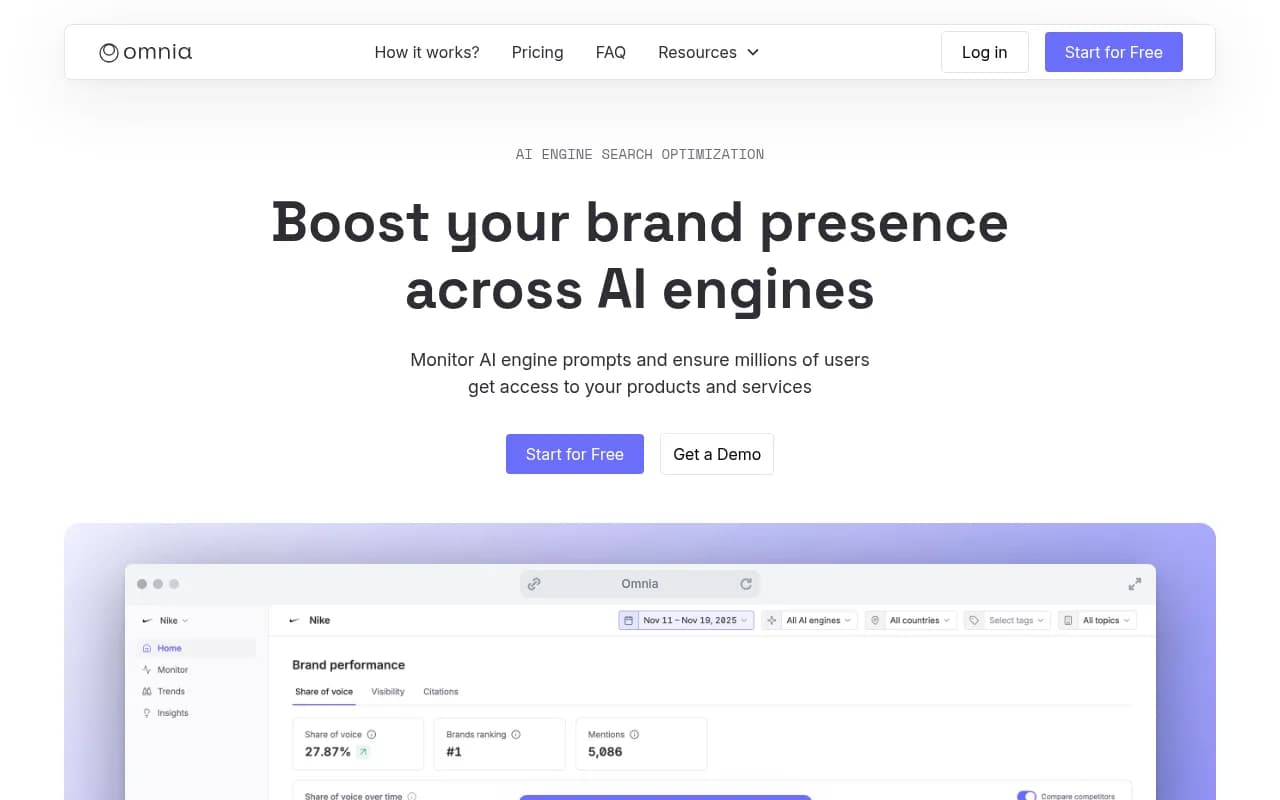
The platform covers the major AI models and gives you a clear view of how your brand appears across different types of queries. The UI is one of the cleaner ones in this space, which matters when you're trying to get buy-in from a founder or a small marketing team who doesn't want to spend an hour learning a new tool.
It's a monitoring-focused platform, but the citation analysis is detailed enough to give you actionable direction on where to focus your content efforts.
5. LLM Pulse -- lightweight tracking for lean teams
LLM Pulse is a straightforward AI search visibility tracker that covers ChatGPT, Perplexity, and a handful of other models. It's built for teams that want visibility data without a complex setup or a steep learning curve.
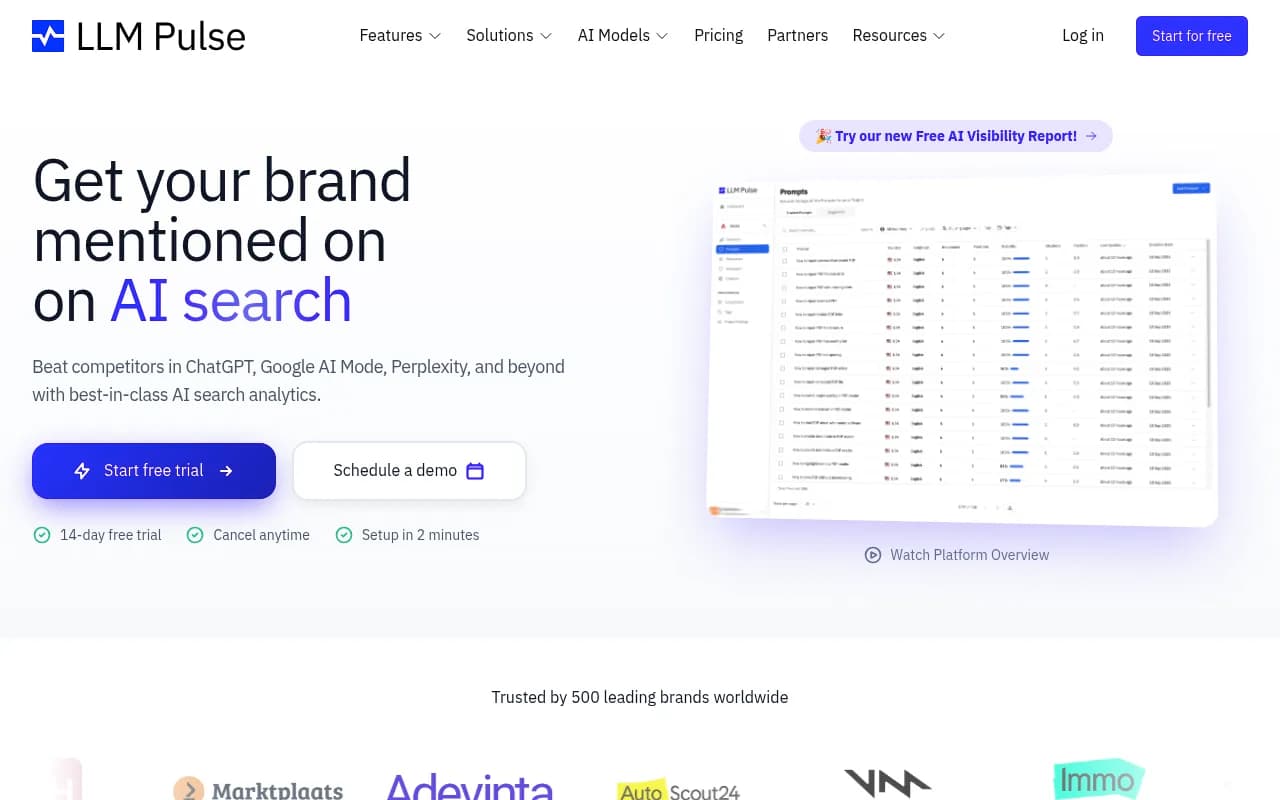
For a startup with a small marketing team (or a solo marketer wearing multiple hats), LLM Pulse is worth considering because it gets you up and running quickly. You define the prompts you want to track, it monitors AI responses, and you get a clear picture of where your brand is and isn't appearing.
It won't replace a more comprehensive platform if you're serious about GEO, but as a lightweight monitoring layer it does the job.
6. Scrunch AI -- good for content-heavy startups
Scrunch AI takes a slightly different angle -- it focuses on helping you understand how AI models perceive and use your content, which is useful if you're a content-heavy startup (SaaS blog, media brand, or any business where content is the primary growth channel).
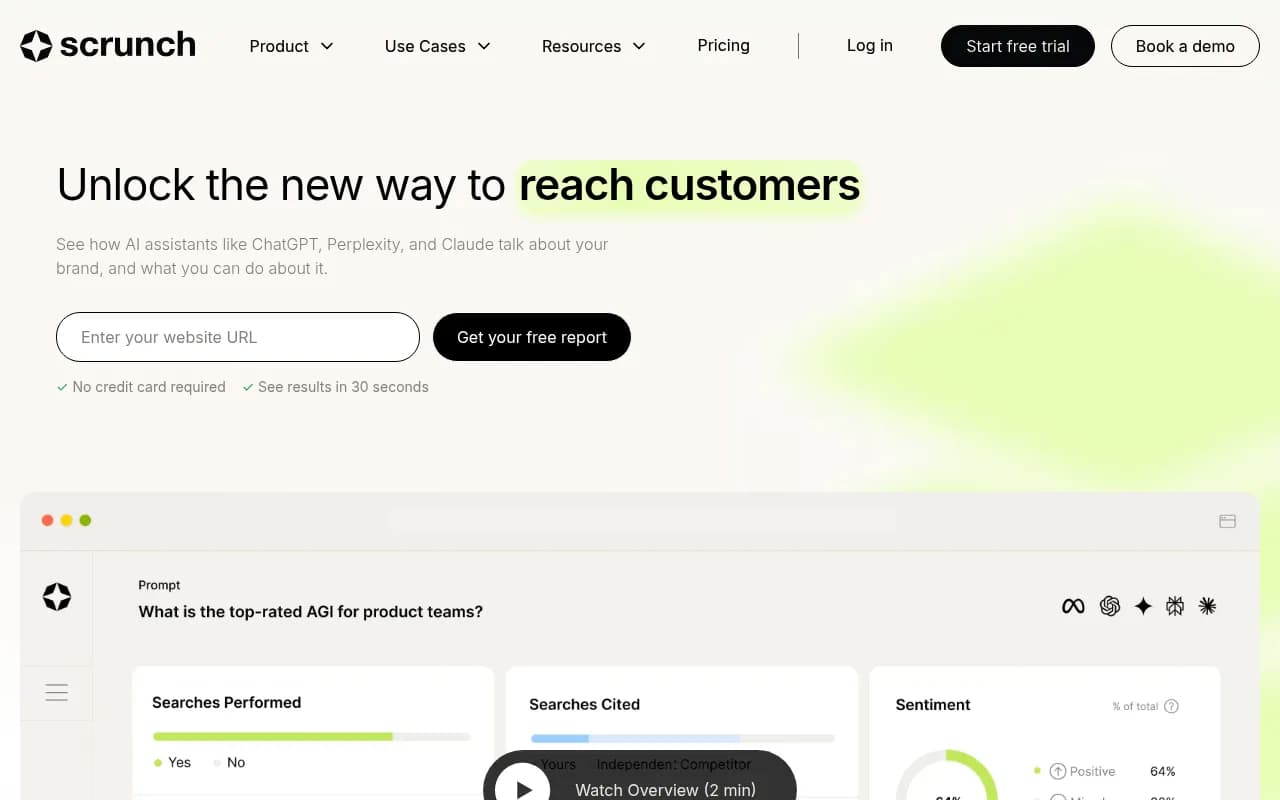
The platform tracks brand mentions across LLMs and gives you visibility into which of your pages are being cited and how. It's a decent option for startups that already produce a lot of content and want to understand which pieces are actually getting picked up by AI models versus which ones are being ignored.
How these tools compare
| Tool | Starting price | AI models covered | Content gap analysis | AI writing | Crawler logs | Best for |
|---|---|---|---|---|---|---|
| Promptwatch | $99/mo | 10 (ChatGPT, Claude, Perplexity, Gemini, Grok, DeepSeek, Copilot, Meta AI, Google AIO, Google AI Mode) | Yes | Yes | Yes | Startups that want to improve visibility, not just track it |
| Otterly.AI | $29/mo | ChatGPT, Perplexity, Google AIO | No | No | No | Teams starting from zero |
| Peec AI | Mid-market | 7+ including Copilot | No | No | No | Reliable multi-model monitoring |
| Omnia | Varies | Major models | No | No | No | Citation analysis focus |
| LLM Pulse | Low | ChatGPT, Perplexity + others | No | No | No | Lean teams, quick setup |
| Scrunch AI | Mid-market | Major LLMs | No | No | No | Content-heavy startups |
The thing most startups get wrong about GEO tools
There's a tendency to treat GEO the same way early-stage teams treated SEO in 2015 -- pick a rank tracker, check the numbers occasionally, and assume the work is being done. It isn't.
Monitoring your AI visibility is the starting point, not the destination. The startups that are actually winning in AI search right now are the ones that have figured out the content gap -- what questions are buyers asking AI models that your website doesn't answer well? -- and are systematically creating content to close it.
That's a harder problem than tracking a number on a dashboard. But it's the actual work.
A few practical things that help:
- Track prompts that reflect real buying intent, not just branded queries. "What's the best [your category] tool for [use case]" is more valuable to monitor than just your brand name.
- Look at what sources AI models are citing in your category. If Reddit threads and a competitor's comparison pages keep showing up, that tells you where to focus.
- Treat your content as the lever. AI models cite pages that answer questions thoroughly and authoritatively. If your site doesn't have a page that directly addresses a common buying question, you won't appear in responses to that question.
Which tool should you actually start with?
If you're a startup with a real marketing budget and you want to move fast: start with Promptwatch. The combination of gap analysis and built-in content generation means you can go from "we don't appear in AI search" to "we have a plan and we're executing it" within a week. The $99/month Essential plan is a reasonable starting point, and the Professional plan at $249/month is still well within reach for most funded startups.
If you're pre-revenue or running on a tight budget and just want to understand your baseline: Otterly.AI at $29/month is the right call. Get the data, understand where you stand, and upgrade when you're ready to act on it.
If you're somewhere in between -- you have some budget, you're already producing content, and you want solid monitoring across multiple AI models -- Peec AI or Scrunch AI are both worth evaluating depending on whether multi-model coverage or content-level insights matter more to you.
The one thing to avoid: buying a monitoring tool and treating the dashboard as the end goal. The data is only useful if it informs what you create next.
AI search isn't going to slow down. The brands that show up consistently in ChatGPT and Perplexity responses a year from now are the ones doing the content work today.