Key takeaways
- A website rebrand changes URLs, brand names, messaging, and content -- all signals that AI models use to decide whether to cite you. Without a GEO baseline before you launch, you have no way to measure what you lost.
- The most dangerous period is the 4-8 weeks after a rebrand, when AI models are re-crawling and re-indexing your new content. Visibility often drops before it recovers.
- Monitoring-only platforms tell you that your visibility dropped. Optimization platforms like Promptwatch tell you why and help you fix it with content gap analysis and AI-targeted content generation.
- Set up prompt tracking, crawler log monitoring, and citation analysis before you flip the switch on a rebrand -- not after.
- The platforms that matter most for rebrand tracking are the ones covering the widest range of AI models (ChatGPT, Perplexity, Claude, Gemini, Grok, DeepSeek) with page-level citation data.
Why a rebrand is one of the riskiest moments for AI visibility
Traditional SEO has well-understood rebrand protocols: 301 redirects, canonical tags, GSC change of address, backlink migration. Most marketing teams have a checklist.
AI visibility has no equivalent playbook yet. And that's a problem, because the stakes are just as real.
When a user asks ChatGPT "what's the best project management tool for remote teams," the model isn't crawling your site in real time. It's drawing on training data, recent crawls, and cited sources it has learned to trust. Your brand's position in that answer depends on how consistently your content has appeared across the web, how often authoritative sources mention you, and whether AI crawlers have successfully indexed your pages.
A rebrand disrupts all of this. New domain or subdomain? AI crawlers need to rediscover you. New brand name? The model's association between your old name and your category weakens. Restructured URLs? Citation links that pointed to old pages now resolve differently. Revised messaging? The content signals that earned you citations may no longer exist.
The result: brands that were regularly cited by ChatGPT or Perplexity before a rebrand often see a significant drop in AI mentions in the weeks following launch. Some recover within a few months. Others never fully get back to where they were.
The difference between the two outcomes usually comes down to whether the team had a GEO tracking strategy in place before the rebrand started.
The three phases of rebrand GEO tracking
Before getting into specific platforms, it helps to think about what you actually need to track across a rebrand lifecycle.
Phase 1: Pre-rebrand baseline (4-8 weeks before launch)
This is the most neglected phase. You need a snapshot of your current AI visibility so you have something to compare against. That means:
- Running your core prompts across all major AI models and recording where you appear
- Documenting which pages are currently being cited (page-level citation data)
- Capturing competitor visibility for the same prompts
- Logging which AI crawlers are hitting your site and how often
Without this baseline, any drop in visibility after the rebrand is invisible to you. You'll be guessing whether the rebrand caused it.
Phase 2: Transition monitoring (launch through 8 weeks post-launch)
This is the high-risk window. You're watching for:
- Citation drops on old URLs (expected, but needs to be tracked)
- Whether new URLs are being picked up by AI crawlers
- Brand name confusion -- are AI models still referring to your old name?
- Any hallucinations or inaccurate descriptions of your brand that emerge as models re-learn who you are
Phase 3: Recovery and optimization (8+ weeks post-launch)
Once the dust settles, you need to understand where you've recovered and where you haven't. The gaps that remain after 8 weeks are the ones that need active intervention -- new content, updated citations, outreach to sources that AI models trust.
What to look for in a GEO platform for rebrand tracking
Not every AI visibility tool is useful for this use case. Here's what actually matters:
Page-level citation tracking. You need to know which specific pages are being cited, not just whether your brand appears. During a rebrand, you're migrating content from old URLs to new ones. You need to see when old page citations drop and new page citations pick up.
Historical data and trend views. A platform that only shows you today's visibility is useless for rebrand tracking. You need to compare before vs. after across a timeline.
AI crawler logs. Knowing that ChatGPT's crawler visited your new homepage last Tuesday -- or that it returned a 404 on a redirected URL -- is operationally critical during a rebrand. Most platforms don't offer this.
Multi-model coverage. Your visibility might recover on Perplexity before it recovers on ChatGPT. Or Gemini might pick up your new brand name faster than Claude. You need per-model data to understand the recovery pattern.
Content gap analysis. After a rebrand, some of your old content may have been removed or restructured. Gap analysis tells you which prompts your competitors are now winning that you used to rank for -- so you know what to rebuild.
The best GEO platforms for rebrand tracking in 2026
Promptwatch -- best overall for rebrand optimization
Promptwatch is the platform I'd recommend for any team going through a rebrand, and the reason is simple: it's the only platform in this category that closes the full loop from tracking to fixing.
Most GEO tools will tell you your visibility dropped. Promptwatch tells you which specific prompts you're no longer appearing for, which competitors filled the gap, and then helps you create the content needed to win those prompts back. That last part -- the built-in AI writing agent that generates content grounded in real citation data -- is what separates it from monitoring-only tools.
For rebrand tracking specifically, the AI crawler logs are invaluable. You can see exactly which pages ChatGPT, Claude, and Perplexity are crawling on your new site, how often they're returning, and whether they're hitting errors. That's the kind of operational data you need during the transition window.
The platform covers 10 AI models (ChatGPT, Perplexity, Claude, Gemini, Grok, DeepSeek, Copilot, Meta AI, Mistral, Google AI Overviews), tracks citations at the page level, and includes prompt volume and difficulty scoring so you can prioritize which visibility gaps to fix first. The Answer Gap Analysis feature is particularly useful post-rebrand: it shows you exactly which prompts competitors are visible for that you're not, with the specific content angles AI models are looking for.
Pricing starts at $99/month for the Essential plan (1 site, 50 prompts). The Professional plan at $249/month adds crawler logs and page-level tracking, which you'll want for a rebrand.

Profound -- strong enterprise monitoring
Profound is a solid enterprise-tier monitoring platform. It covers 9+ AI models and provides good brand mention tracking with sentiment analysis. For large organizations with dedicated SEO teams, the depth of monitoring data is genuinely useful.
The limitation for rebrand tracking is that Profound is primarily a monitoring tool. It'll show you the visibility drop clearly. It won't help you understand why specific pages lost citations or generate content to recover them. For teams that have separate content resources and just need reliable data, that's fine. For teams that need the full picture, it's a gap.
Profound

Otterly.AI -- quick setup, limited depth
Otterly.AI is one of the easier platforms to get running quickly, which makes it tempting for teams that need to set up a pre-rebrand baseline in a hurry. It tracks brand mentions across ChatGPT, Perplexity, and Google AI Overviews with a clean interface.
The honest limitation: it's a basic monitoring tool. No crawler logs, no page-level citation data, no content gap analysis. For a rebrand, you'll get a high-level view of whether your brand mentions went up or down, but you won't have the operational detail to act on it.
Otterly.AI

AthenaHQ -- good for narrative monitoring
AthenaHQ focuses on how AI models describe and position your brand -- the narrative layer rather than just mention frequency. For a rebrand, this is actually a meaningful capability. You want to know not just whether ChatGPT mentions you, but whether it's describing you with your new positioning, new product names, and new value proposition.
The gap is on the optimization side. AthenaHQ doesn't have content generation or gap analysis tools, so you're still on your own when it comes to fixing what you find.

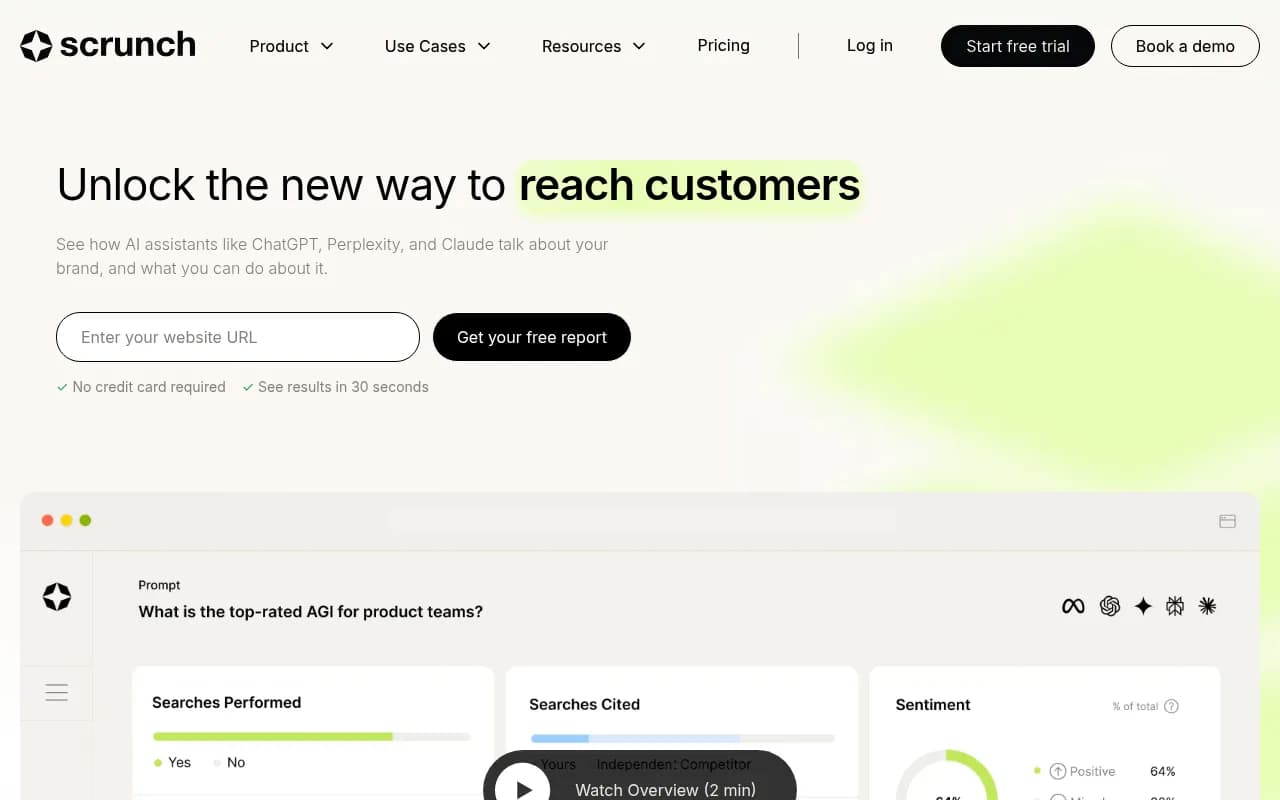
Scrunch AI -- useful for content signal analysis
Scrunch AI takes a different angle: it analyzes which content signals and sources influence AI model recommendations. For a rebrand, this is useful because you can understand which third-party sources (review sites, publications, Reddit threads) are currently shaping how AI models describe you -- and which of those sources still reference your old brand name or old positioning.
Peec AI -- lightweight option for smaller teams
Peec AI is a lighter-weight tracking tool that covers ChatGPT, Perplexity, and Claude. It's more affordable than the enterprise options and works well for smaller brands or agencies that need basic before/after visibility tracking without a large budget.

Platform comparison
| Platform | AI models covered | Crawler logs | Page-level citations | Content gap analysis | AI content generation | Best for |
|---|---|---|---|---|---|---|
| Promptwatch | 10 | Yes | Yes | Yes | Yes | Full rebrand optimization cycle |
| Profound | 9+ | No | Limited | No | No | Enterprise monitoring |
| Otterly.AI | 3 | No | No | No | No | Quick baseline setup |
| AthenaHQ | 5+ | No | No | No | No | Narrative/positioning tracking |
| Scrunch AI | 4+ | No | No | No | No | Content signal analysis |
| Peec AI | 3 | No | No | No | No | Small teams, basic tracking |
A practical pre-rebrand GEO checklist
Here's what to do in the 4-6 weeks before your rebrand goes live.
Set up your prompt library. Identify the 30-50 prompts most relevant to your category. Include branded prompts ("what is [old brand name]?"), category prompts ("best [product category] tools"), and comparison prompts ("[old brand] vs [competitor]"). Run these across all major AI models and record the results.
Document your current citation pages. Which specific pages on your current site are being cited in AI responses? Export this list. After the rebrand, you'll need to ensure these pages either redirect correctly or have equivalent new pages.
Check your AI crawler activity. Before the rebrand, look at which AI crawlers are hitting your site and how frequently. This gives you a baseline to compare against post-launch to confirm new pages are being discovered.
Capture competitor baselines too. Competitors don't stop competing during your rebrand. Knowing where they stood before the rebrand helps you distinguish between "we lost visibility because of the rebrand" and "we lost visibility because a competitor improved."
Screenshot and export everything. Whatever platform you're using, export your baseline data in a format you can reference later. Don't rely on the platform's historical data alone.
The post-rebrand recovery playbook
Once you've launched, the work shifts to monitoring and active recovery.
Week 1-2: Watch crawler logs. Are AI crawlers hitting your new URLs? Are they encountering 404s or redirect chains? Fix technical issues immediately -- AI crawlers don't retry as aggressively as Googlebot.
Week 2-4: Track brand name recognition. Are AI models using your new brand name or still referring to the old one? If models are still describing you with old positioning, it means they haven't re-indexed enough of your new content. Prioritize getting new content crawled.
Week 4-8: Run your full prompt library again. Compare against your pre-rebrand baseline. Identify which prompts you've recovered and which you haven't. The ones you haven't recovered are your content priorities.
Week 8+: Fill the gaps. For prompts where competitors are now outperforming you, you need new content that addresses those specific angles. This is where a platform with built-in content generation (like Promptwatch's AI writing agent) saves significant time -- it can generate articles specifically engineered to get cited for the prompts you're targeting.
Common rebrand mistakes that hurt AI visibility
Removing content without redirects. If you restructure your site and old pages return 404s instead of redirecting, AI models lose their citation targets. The citation doesn't transfer automatically just because you set up a 301 -- it takes time for models to re-associate the new URL.
Changing your brand name without updating third-party sources. AI models pull from a wide range of sources: review sites, industry publications, Reddit, YouTube. If those sources still reference your old brand name, models will be confused about who you are for months. Reach out to key sources and update your profiles.
Assuming SEO recovery equals AI visibility recovery. Your Google rankings might recover in 4-6 weeks after a rebrand. AI visibility often takes longer because models are updated on different schedules and draw on different signals. Don't assume you're fine just because your organic traffic is back.
Not monitoring hallucinations. Rebrands create a window where AI models may generate inaccurate descriptions of your brand -- mixing old and new positioning, getting your product names wrong, or confusing you with a competitor. Monitoring for this specifically (not just mention frequency) is important in the first 8 weeks.
Connecting AI visibility to actual revenue
One thing worth saying directly: AI visibility tracking is only useful if you can connect it to business outcomes. A dashboard showing your "AI mention score" is interesting. A dashboard showing that AI-referred visitors convert at 3x the rate of organic search visitors is actionable.
The better GEO platforms are starting to offer traffic attribution -- connecting AI visibility data to actual site visits and conversions via code snippets, GSC integration, or server log analysis. For a rebrand, this is the ultimate validation: not just "are we being cited again" but "is that citation translating to traffic and pipeline."
Tools like Promptwatch offer this attribution layer, which is what makes the difference between a GEO platform that's a reporting tool and one that's a revenue tool.
Final thought
A website rebrand is a high-stakes moment for AI visibility, and most teams go into it without the right tracking in place. The brands that come out ahead are the ones that treat AI visibility with the same rigor they apply to traditional SEO: baseline before launch, monitor during transition, actively recover the gaps.
The platforms that support this full cycle -- not just monitoring, but diagnosis and content creation -- are the ones worth investing in before your rebrand kicks off.