Key takeaways
- Most GEO tools are built for enterprise teams and priced accordingly — but there are solid options under $100/month that work for solo operators
- Monitoring-only tools are cheap but limited; if you want to actually improve AI visibility (not just measure it), you need a platform that helps you act on the data
- The tools worth paying for in 2026 track multiple AI engines (not just ChatGPT), give you prompt-level data, and ideally help you identify content gaps
- For freelancers managing client work, white-label reporting and multi-site support matter more than raw feature count
- Promptwatch is the most complete option at an accessible price point — its $99/month Essential plan covers one site, 50 prompts, and 5 AI-generated articles per month
Why freelancers need GEO tools now
A year ago, most solo SEO consultants and freelance marketers could afford to treat GEO as a "watch this space" topic. That window has closed.
ChatGPT, Perplexity, Google AI Overviews, and Claude are now primary research tools for a large chunk of the buying population. When someone asks an AI engine "who's the best freelance SEO consultant for SaaS companies" or "what's the top email marketing agency for startups," those answers come from somewhere. If your clients aren't in those answers, they're invisible to a growing segment of potential customers.
The problem is that most GEO platforms were built for in-house marketing teams at mid-size companies or enterprise brands. Pricing starts at $499/month. Contracts require annual commitments. Feature sets assume you have a team of five.
That's not your situation. You're one person, possibly managing a handful of clients, and you need tools that give you real signal without burning your margin.
This guide covers what's actually worth using in 2026 if you're working solo or running a small consulting practice.
What to look for as a freelancer or solo consultant
Before getting into specific tools, it helps to be clear about what you actually need — because the GEO tool market is noisy and most comparison posts are written for enterprise buyers.
For solo operators, the shortlist of things that matter:
- Affordable entry point. Under $150/month ideally, with a free trial so you can test before committing.
- Multi-engine coverage. Tools that only track ChatGPT are already behind. You want at least ChatGPT, Perplexity, Google AI Overviews, and Claude.
- Actionable output. A dashboard that shows your visibility score is fine. A tool that tells you why you're invisible and what to do about it is better.
- Multi-client or multi-site support. If you're managing clients, you need to track more than one brand without paying enterprise rates.
- Reasonable prompt limits. 50-150 prompts per month is usually enough for a solo consultant tracking one or two clients.
- Content gap analysis. This is the feature that separates tools you'll actually use from tools you'll cancel after 60 days.
What you probably don't need: white-label reporting suites, dedicated account managers, custom API integrations, or 500+ prompt slots. Those are agency and enterprise features that add cost without adding value at the solo level.
The tools worth considering
Promptwatch — best overall for solo consultants who want to act, not just watch
Promptwatch sits at the intersection of tracking and doing something about it, which is rare at this price point. The Essential plan at $99/month covers one site, 50 prompts, and 5 AI-generated articles per month. That's enough for a solo consultant tracking their own brand or a single client.
What makes it stand out from cheaper monitoring tools is the Answer Gap Analysis feature. It shows you which prompts your competitors are showing up for that you're not — and gives you the specific content gaps your site needs to fill. Then the Content Agents generate articles grounded in that prompt data. You're not writing generic blog posts and hoping for the best; you're creating content engineered to answer the exact questions AI models are already being asked.
The Professional plan at $249/month adds crawler logs (so you can see when AI bots like GPTBot and ClaudeBot are actually hitting your pages), 150 prompts, 15 articles, and support for 2 sites. For a consultant managing a couple of clients, that's a reasonable step up.
Promptwatch also tracks 10 AI engines — ChatGPT, Perplexity, Google AI Overviews, Google AI Mode, Claude, Gemini, Meta/Llama, DeepSeek, Grok, and Copilot. Most competitors at this price point cover 3-4.

Otterly.AI — best for pure monitoring on a tight budget
If your budget is genuinely tight and you mainly need to know whether your brand is showing up in AI answers, Otterly.AI is the most practical low-cost option. It starts around $29/month and covers the major AI platforms.
The honest limitation: it's a monitoring tool. It tells you what's happening but doesn't help you change it. There's no content gap analysis, no content generation, no crawler logs. You get mention tracking and share-of-voice data, which is useful for reporting to clients but doesn't move the needle on its own.
For a freelancer just getting started with GEO, or one who wants to add basic AI visibility reporting to an existing SEO retainer, Otterly.AI is a reasonable starting point.
Otterly.AI

Peec AI — clean dashboards, good for client reporting
Peec AI has strong visibility dashboards with position tracking and sentiment analysis. It's a solid choice if you're presenting AI visibility data to clients who want clean, readable reports.
The coverage is good across major engines, and the interface is more polished than some of the cheaper alternatives. The main gap is the same as Otterly.AI — it's primarily a monitoring platform. You see the data, but the tool doesn't tell you what to do with it.
Pricing is contact-based, which is a mild annoyance when you're trying to compare options quickly. Worth requesting a demo if the reporting quality matters to you.

Rankshift — lightweight tracking for solo operators
Rankshift is a newer, lighter option focused on tracking brand visibility across ChatGPT, Perplexity, and AI search. It's worth a look if you want something simple without a lot of setup overhead.

LLM Pulse — straightforward AI visibility monitoring
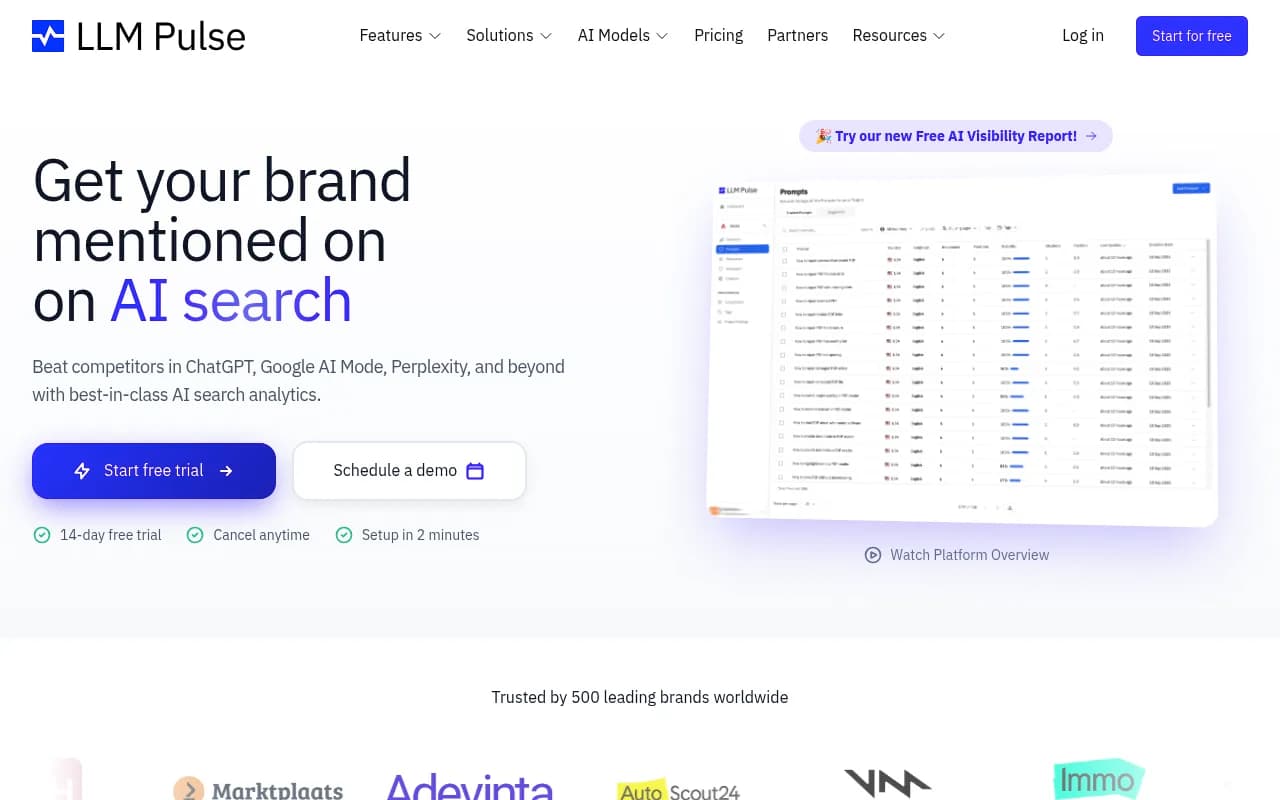
LLM Pulse covers the core use case of tracking brand mentions across ChatGPT, Perplexity, and other AI engines. It's a monitoring-focused tool, but the interface is clean and it's priced accessibly for solo operators.
Semrush — if you're already in the ecosystem
If you're already paying for Semrush, the AI Visibility Toolkit is worth activating. It adds AI search monitoring on top of an established SEO stack, which means you're not paying for a separate tool.
The limitation is that Semrush uses fixed prompts rather than letting you define your own, which reduces flexibility. And it doesn't have the content gap analysis or AI content generation that purpose-built GEO platforms offer. But if you're a solo SEO consultant who lives in Semrush anyway, it's a reasonable way to add basic AI visibility coverage without a new subscription.
AthenaHQ — good for understanding citation patterns
AthenaHQ focuses on why content gets cited in AI responses, not just whether it does. That's a useful angle for consultants who want to understand the mechanics of AI visibility rather than just track scores.
It's more of a research and analysis tool than an execution platform. Pricing is contact-based, which puts it out of reach for quick evaluation, but it's worth a look if citation pattern analysis is specifically what you need.

ZipTie — deep analysis at a reasonable price
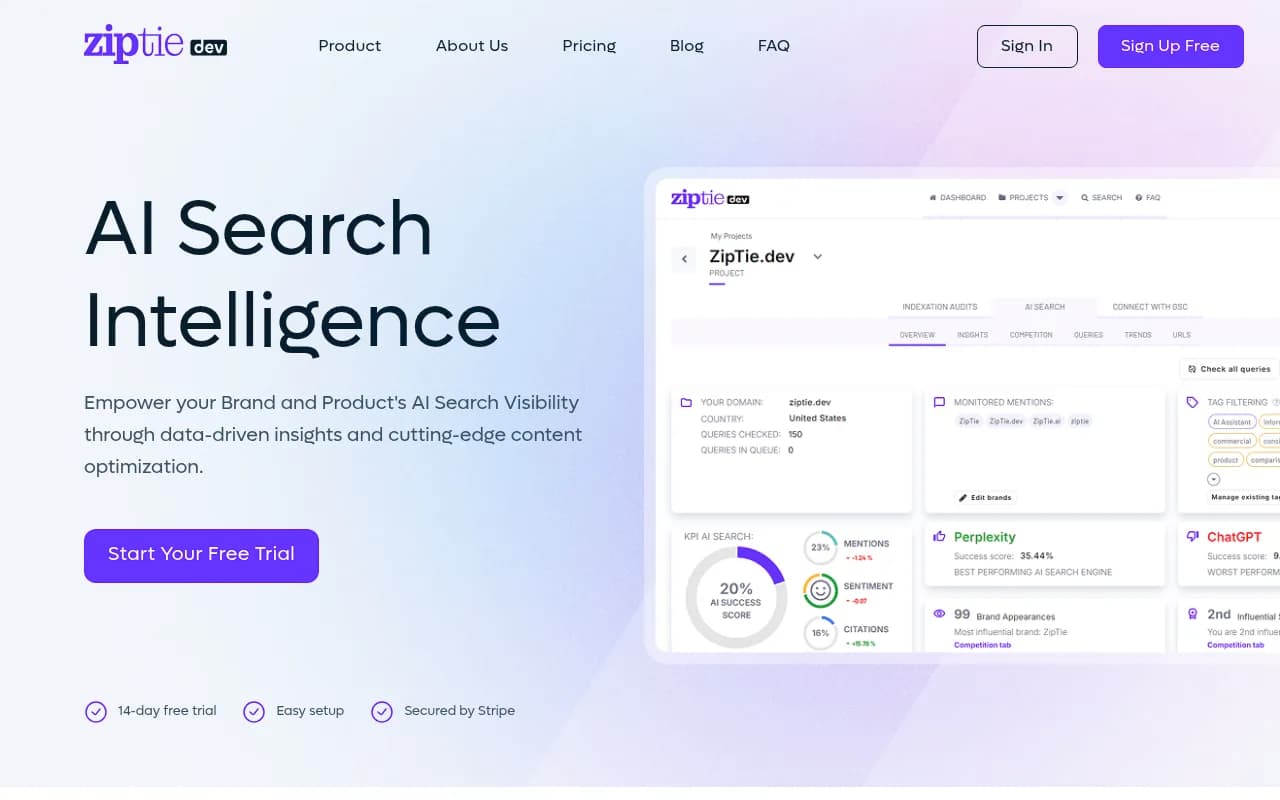
ZipTie (ziptie.dev) takes a more analytical approach to AI visibility, with deeper analysis of how AI search engines behave. It's a good fit for consultants who want to understand the underlying mechanics rather than just get a visibility score.
Head-to-head comparison
| Tool | Starting price | AI engines covered | Content gap analysis | Content generation | Best for |
|---|---|---|---|---|---|
| Promptwatch | $99/mo | 10 | Yes | Yes (5 articles/mo) | Solo consultants who want to track and fix |
| Otterly.AI | ~$29/mo | 6 | No | No | Budget monitoring only |
| Peec AI | Contact sales | Multiple | No | No | Client reporting dashboards |
| Rankshift | Low-cost | 3+ | No | No | Lightweight tracking |
| LLM Pulse | Affordable | Multiple | No | No | Simple monitoring |
| Semrush AI Toolkit | Semrush plan | Limited (fixed prompts) | No | No | Existing Semrush users |
| AthenaHQ | Contact sales | Multiple | Partial | No | Citation pattern research |
| ZipTie | Affordable | Multiple | Partial | No | Deep analysis |
The monitoring trap: why cheap tools often cost more in the long run
Here's something worth thinking about before you pick the cheapest option on the list.
A monitoring-only tool at $29/month sounds like a bargain. And it is, if all you need is a number to put in a client report. But if you're actually trying to improve AI visibility — for yourself or for clients — a tool that shows you the problem without helping you solve it creates a second cost: your time.
You still have to figure out which prompts to target. You still have to identify what content is missing. You still have to write or commission that content. The tool just told you there's a gap; it didn't help you fill it.
For a solo consultant billing by the hour, that research and content work is either time you're spending (and not billing) or time you're billing (and your client is paying for). Either way, it's not efficient.
The tools that include content gap analysis and content generation — even at a higher monthly price — tend to pay for themselves faster because they compress the workflow. You find the gap, generate a brief or article, publish it, and track whether it moves the needle. That loop is what GEO optimization actually looks like in practice.
How to evaluate a GEO tool before you pay
A few practical tests before committing to any platform:
Run it on a brand you know well. If you've been doing SEO for a client for two years, you have a good sense of their competitive landscape. Run the tool on their brand and see if the AI visibility data matches your intuitions. If the tool says they're invisible for prompts you know they should be winning, dig into why. If the data looks implausible, that's a red flag.
Check which AI engines are actually covered. Some tools claim broad coverage but only pull live data from two or three engines. Ask specifically: is this real-time data from the actual user-facing interface, or is it API-based? The distinction matters because user-facing AI responses can differ from API outputs.
Look at the prompt customization. Fixed prompts (like Semrush uses) are limiting. You want to be able to define the exact questions your target customers are asking. A tool that only tracks generic industry prompts won't tell you much about your specific situation.
Test the content gap feature if it exists. The best GEO tools don't just show you where you're invisible — they show you exactly which prompts competitors are winning that you're not, and what content you'd need to create to compete. If a tool has this feature, it's worth spending 30 minutes with it before deciding.
A practical setup for solo consultants in 2026
If you're starting from scratch, here's a reasonable approach:
Start with a free trial of Promptwatch. The Essential plan at $99/month is the right entry point for most solo consultants — it covers one site, gives you 50 prompts to track, and includes 5 AI-generated articles per month. Run the Answer Gap Analysis in week one to understand where the gaps are. Use the content generation feature to create two or three pieces targeting those gaps. Then track whether your visibility scores move over the following 4-6 weeks.
If you're managing multiple clients, the Professional plan at $249/month adds a second site and bumps you to 150 prompts and 15 articles. That's enough to run a basic GEO service for two clients alongside your own brand.
If budget is genuinely the constraint and you just need to show clients that you're tracking AI visibility, Otterly.AI at ~$29/month gives you the monitoring data you need for reporting. Just be clear with clients that monitoring is different from optimization.
The tools that don't make sense for solo operators right now: Profound (enterprise pricing, $499/month for a limited plan), Scrunch (custom pricing, built for enterprise workflows), and Conductor (enterprise-only). These are strong platforms but they're not built for your situation.
The bottom line
GEO is no longer optional if you're doing SEO or content marketing for clients. AI search engines are answering questions that used to drive traffic to websites, and if your clients aren't in those answers, they're losing visibility they don't even know they're losing.
The good news is that you don't need an enterprise budget to get started. The tools in this guide cover the range from basic monitoring at $29/month to full optimization with content generation at $99-249/month. The right choice depends on whether you need to track visibility, report on it, or actually improve it — and those are three different things that require different tools.
For most solo consultants who want to offer GEO as a service (or improve their own visibility), Promptwatch at $99/month is the most complete option at an accessible price. For pure monitoring on a tight budget, Otterly.AI works. Everything else falls somewhere in between.
Pick one, run it for 60 days, and see what the data tells you. The AI visibility landscape is moving fast enough that the best way to learn is to start.