Key takeaways
- Travelers ask AI for hotel picks, and the answer is usually three to five names. A GEO tool tells you whether you are one of them and why.
- Most GEO tools were built for SaaS. Hospitality-specific options (Listo, Cendyn Wayfinder, HotelRank) understand amenities and destinations, but each has gaps, and some are tied to a vendor stack.
- For a single boutique property, a general platform with real crawler data, citation tracing and content execution is often better value than a hospitality niche tool.
- The OTA and metasearch layer, not hotel brand sites, dominates named ChatGPT travel citations for organic prompts. Your listings and reviews matter as much as your website.
- Start with a free baseline, fix schema and listings, then pay for tracking only once you know what you are tracking.
Why hotels need a GEO tool at all
When someone asks ChatGPT for "a boutique hotel in Seville with a rooftop pool", the model does not return ten blue links. It returns a short list, a few reasons, and sometimes a booking path. If you are not in that list, you did not lose a ranking position. You lost the consideration.
The volume is still small but growing fast. Hotel Benchmark's AI Traffic Tracker, cited by Americas Great Resorts, recorded AI-referred sessions to hotel websites up 581 percent year over year in April 2026, with AI-attributed revenue up 404 percent. The same source notes absolute volumes are still low and that the figures only capture direct click-throughs, not bookings that AI influenced and that arrived through another channel. So treat it as an early signal, not a revenue line you can bank yet.
Boutique hotels have a particular problem. You compete on specifics (a courtyard, a chef, a converted convent) rather than brand name. Chains have the data hygiene and the third-party footprint. Independents often have a beautiful site and thin, inconsistent listings, which is exactly what AI models trip over.
What the data says about how AI picks hotels
Some of this is hotel-specific and some is general travel data. I will flag which.
Promptwatch's data on organic travel prompts in ChatGPT (Sep 28 to Oct 4, 2026) shows a fragmented citation picture. Skyscanner leads at 0.78% of travel citations, then Going at 0.52% and Tripadvisor at 0.49%. Kayak, Airbnb and Reddit follow at similar levels. Booking and search sites together account for 2.42% of all travel citations, which is more than half of the share held by the top 17 domains. Those 17 domains hold only 4.18% in total, so the long tail is huge. This is a general travel dataset, not hotel-only, but the lesson carries over: the OTA and metasearch layer is where named citations concentrate, so keeping listings accurate there is not optional.
The number of sources per answer matters too. According to Promptwatch's unique-domains data for the same week, 47.6% of ChatGPT responses with citations cite 10 or more domains, and for organic unbranded prompts that rises to 52.5%. You are sharing every answer with a crowd. But for brand-specific prompts, such as someone asking about your hotel by name, only 21.3% cite 10 or more domains, and five is the most common count. Fewer sources means your own site and the handful of review sites carry more weight. That is where a clean, factual property page earns its keep.
There is a vendor claim worth knowing about but not betting on. Listo reports that once a traveler names an amenity ("with a rooftop pool and a spa"), ChatGPT's citations swing from roughly 11% to about 87% in favor of the hotel's own website. I could not verify that independently, and Listo sells a competing product. The direction is plausible, though: specific queries make the model check the property's own claims.
Listo's research also found the assistants disagree with each other, with ChatGPT leaning on official hotel sites and Gemini leaning on editorial media. Again, vendor data, but it matches what you see if you test the same prompt across engines by hand.
What to look for in a hotel GEO tool
A short checklist, in rough order of importance for a small property:
- Coverage of the engines your guests actually use, tracked from the real interfaces rather than only APIs, because user-facing answers and citations can differ.
- Per-country and per-language tracking. A French guest and an American guest get different recommendations.
- Location awareness. "Near me" and "in the old town" queries are the bread and butter of lodging.
- Citation tracing, so you can see which OTA, review site or guide AI is pulling from.
- Crawler visibility. If AI bots cannot read your booking pages or your site blocks them, no content work will help.
- Some path from insight to action: content, schema, listing fixes. A score alone does not book a room.
- Pricing that makes sense for one property or a handful, not a Fortune 500 budget.
The shortlist
Promptwatch, best all-round platform for independent hotels and hotel groups
Promptwatch is an end-to-end AI visibility platform rather than a prompt tracker, and that distinction matters for a hotel with a small marketing team. It monitors ChatGPT, Google AI Overviews, Google AI Mode, Gemini, Perplexity, Copilot and others from their real interfaces, in the countries and languages you choose. It then traces which pages and third-party sources AI cites, and helps you act on the gaps with content gap analysis, a Content Agent that can publish to WordPress, Webflow or Framer, and an Action Board of prioritized tasks.

Three pieces are especially useful for lodging. Local GEO/SEO targeting pins a monitor to exact coordinates, so ChatGPT and Google's AI surfaces answer as if asked from your neighborhood (Business plan and above). IP-verified AI crawler logs show whether GPTBot, ClaudeBot and others can actually read your rooms, rates and booking pages. And Brand Narrative pulls out the individual claims AI makes about you, such as "quiet but far from the center", so you can see what guests are being told before they arrive.
Pricing starts at $95/month for Essential (1 project, 50 prompts), $245/month for Professional and $579/month for Business, which is the first tier with the Content Agent and local targeting. A single boutique hotel can start small, and a group or agency can use the agency plans (Kick-off at $199/month). Confirm current numbers at promptwatch.com/pricing. There is a 7-day free trial on monthly billing, plus a free AI visibility report that is a sensible zero-cost starting point.
The tradeoff: it is not hospitality-specific, and it does not connect to your PMS or complete bookings inside a chat. You bring the hotel context, it brings the data and the execution.
Listo, best for hospitality-only focus and booking-layer ambitions
Listo is built around hotels and the agencies that run them. Its pitch has three parts: travel-specific visibility tracking across ChatGPT, Claude, Gemini and Perplexity by platform and region; content optimization done for you; and an MCP layer on top of your PMS and booking engine so an assistant can check availability and show real rates. The last part is the most interesting and the least proven. If assistants start completing bookings in chat, that layer matters. Today it is a bet.
Keep in mind that the Listo guide ranking Listo first is written by Listo. It is candid in places, but read it as a vendor document.
Cendyn Wayfinder, best if you already run Cendyn
Wayfinder runs simulated traveler prompts across ChatGPT, Gemini and Perplexity to produce a GEO health score, checks facts for accuracy and drift, and generates schema and text directives to teach models about your property. It is strongest inside the Cendyn CRM and CMS ecosystem, and it is monitoring plus directives, not an independent booking layer. If you are not on Cendyn, the appeal drops.
HotelRank, best for deeper visibility tracking
HotelRank is hospitality-specific and focuses on visibility tracking. Listo's own comparison marks its content optimization as partial and its booking support as absent. I have not seen enough independent detail to say more, so evaluate it with a demo and your own prompts.
Profound and Peec AI, best for large travel brands and budget tracking respectively
Menra's travel roundup lists Profound for enterprise depth with large travel players and Peec AI for seat-friendly pricing. Profound is a monitoring-strong platform with higher price points, suited to large chains rather than a ten-room inn. Peec AI is a lighter tracker that suits a team that only wants a dashboard.
Profound


Reputation and listing tools that feed AI answers
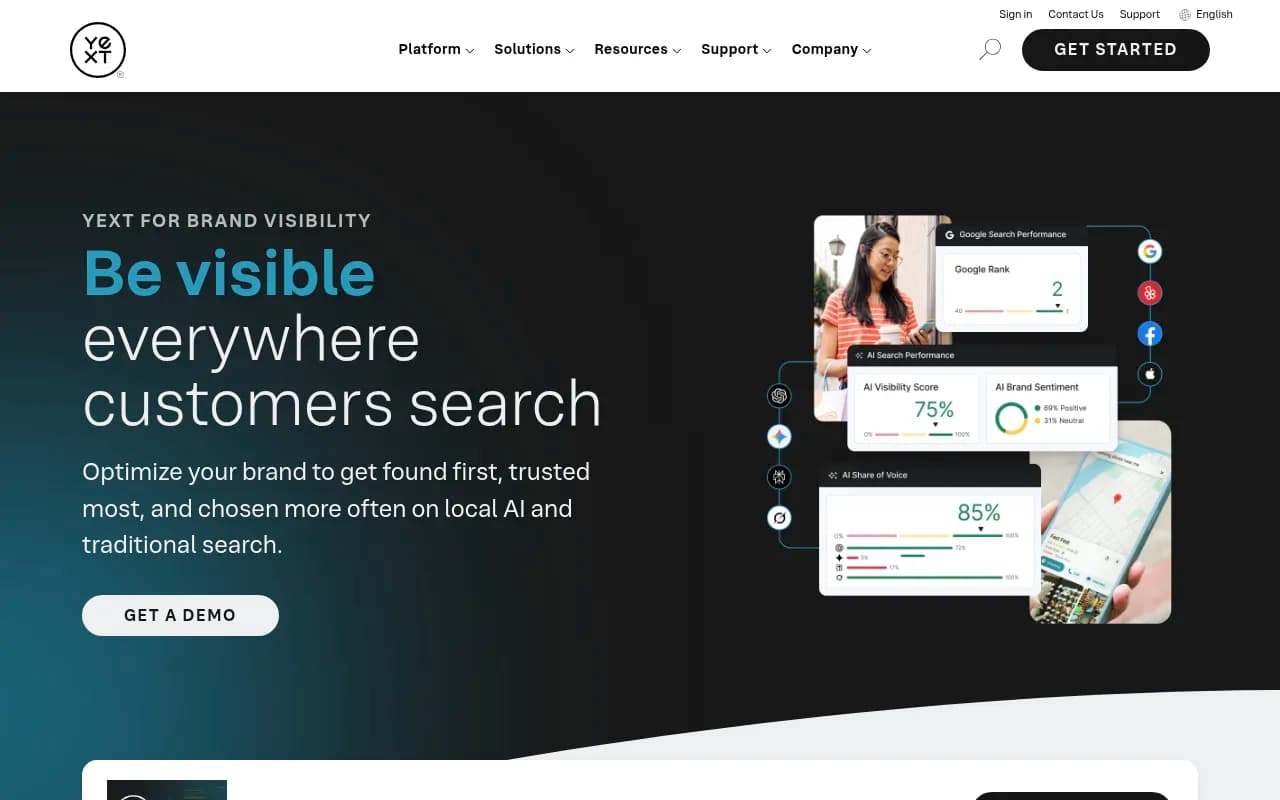
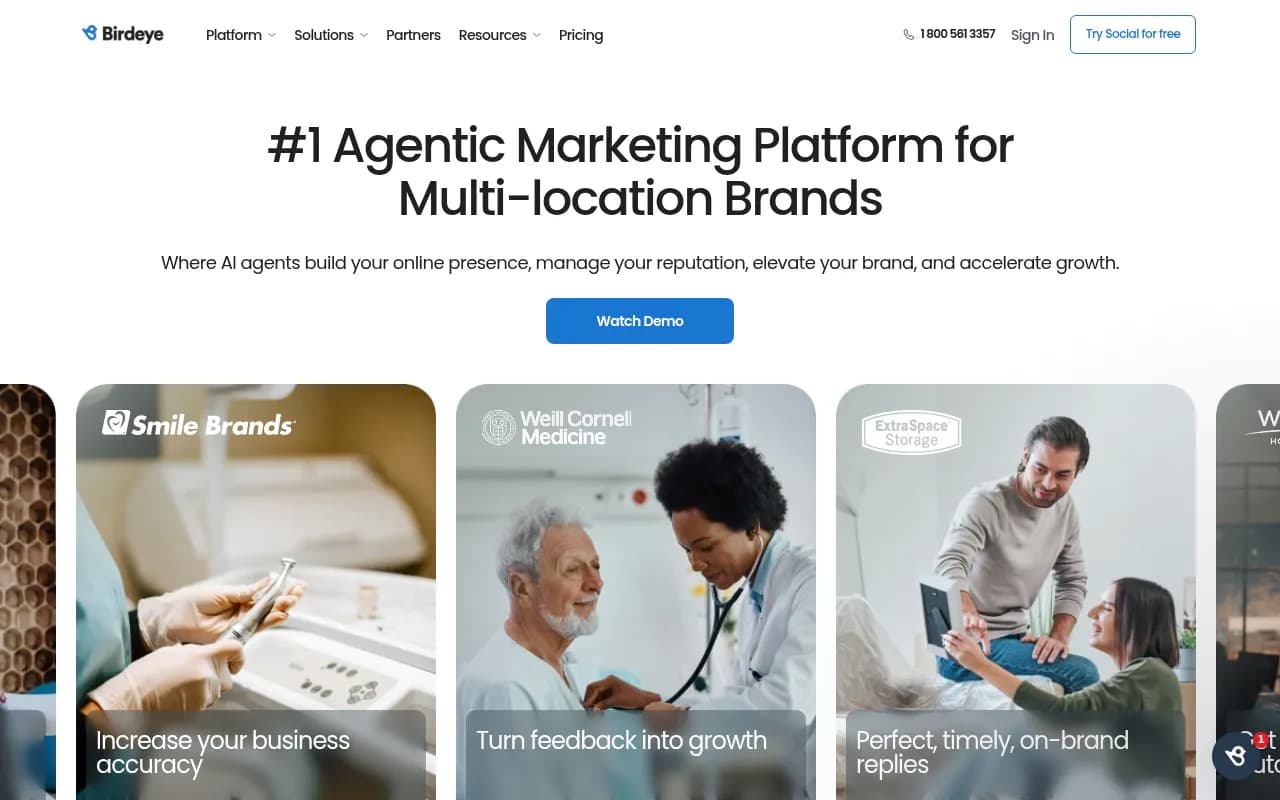
Because review and listing sources shape what AI says, multi-location reputation and listing platforms are part of a hotel's GEO stack even though they are not GEO tools. Yext, Birdeye and Reputation cover listings and reviews. They will not tell you what ChatGPT says about you, but they keep the inputs clean.
Comparison table
| Tool | Hospitality-specific | Tracks real AI interfaces | Crawler logs | Content execution | Best for |
|---|---|---|---|---|---|
| Promptwatch | No (general platform) | Yes, many engines and countries | Yes, IP-verified | Yes, Content Agent and CMS publishing (Business plan) | Independent hotels, groups, agencies |
| Listo | Yes | Four assistants | Not stated | Done-for-you plus booking MCP layer | Hotels wanting hospitality focus |
| Cendyn Wayfinder | Yes | ChatGPT, Gemini, Perplexity | Not stated | Schema and directives | Existing Cendyn customers |
| HotelRank | Yes | Not stated | Not stated | Partial | Visibility tracking |
| Profound | No | Yes | Limited | No agentic execution | Large travel brands |
| Peec AI | No | Basic prompt tracking | No | No | Small teams wanting a dashboard |
Where a cell says "not stated", that is because the source material did not specify it. Ask the vendor.
What a boutique hotel should actually fix first
A tool will not help if the basics are broken. Here is the order I would work in.
1. Make your own site machine-readable
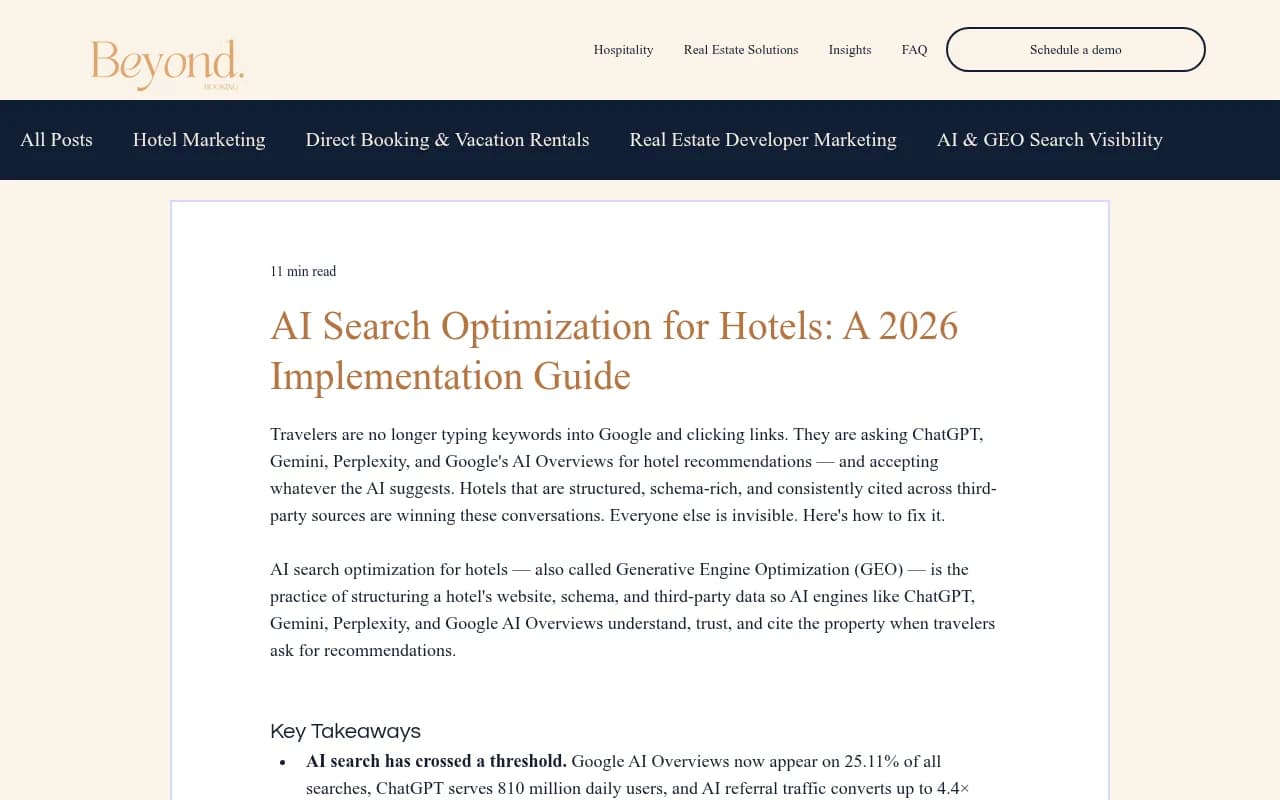
Beyond Booking's implementation guide notes that Google's documentation specifies Hotel, LodgingBusiness and HotelRoom schema as the validation layer for AI Overviews and Hotel Ads. Add that markup, and write amenity facts in plain sentences: pool hours, check-in times, pet policy, distance to the station. The kind of specifics a guest puts in a prompt.
2. Check that AI crawlers can reach you
A surprising number of sites block AI bots by accident through robots.txt or CDN rules. Promptwatch's free Agentic Readiness Check and robots.txt generator for AI are quick ways to look. Also see which crawlers are active in Promptwatch's AI crawler traffic data.
3. Clean up OTA, metasearch and review listings
Given the travel citation data above, an outdated Expedia or Tripadvisor description can undo a good website. Keep names, room types, photos and amenities consistent everywhere. Collect fresh reviews, and respond to them.
4. Publish pages that answer the specific question
Brand-specific prompts cite fewer sources, so a thorough page on rooms, location, getting there, and who the hotel is for gets disproportionate weight. Add comparison-style content ("boutique hotels in the old town versus the beach") for organic prompts, where more than half of answers cite ten or more domains and you want to be one of them. Promptwatch's data on ChatGPT content types shows product pages, landing pages and listicles are the most cited formats, which fits how room and destination pages work.
5. Track languages and markets separately
Listo measured recommendation overlap as low as 40% across languages on Claude. Even if you discount a vendor number, it makes sense: Spanish prompts search the Spanish web. If you draw guests from three countries, set up three monitors.
A 30-day starting plan
- Week 1: run a free AI visibility report and manually test 15 to 20 real guest prompts in ChatGPT, Gemini and Perplexity. Screenshot the results.
- Week 2: fix schema, robots.txt and the facts on your own site. Audit every OTA listing.
- Week 3: publish or refresh three pages: your top room type, your location, and one comparison-style guide.
- Week 4: start a tracked monitor for your top 30 prompts in your top two markets, and review what AI says about you in your own words. Decide on a paid tool only after you know which gap matters.
Do you need an agency?
If you manage many properties, an agency can run all of this. First Page Sage, Genevate, Focus Digital, Driven Metrics, Vizergy and Mad Fish Digital appear in First Page Sage's own ranking of hotel GEO agencies, which, yes, ranks First Page Sage first, so take the order with salt. For groups wanting senior specialists on technical SEO, content and AI search without long contracts, 1001 SEO Media is another option, and it uses Promptwatch for its AI visibility work.
If you want to compare more platforms yourself, the GEO software directory lists dozens of options, and Promptwatch's 2026 platform comparison covers the main players side by side.
How to choose
If you are one hotel with a small budget, begin with free checks and a low-tier tracker, and spend your time on schema, listings and a few strong pages. If you are a group or agency, you need multi-market tracking, crawler data and a way to publish content at scale, which points to a full platform. If you are deep in the Cendyn stack, Wayfinder is the path of least resistance. If you believe in-chat booking is coming soon and want to be early, look hard at Listo's MCP layer, with the caveat that it is vendor-led and young.
Whatever you pick, judge it on one test: does it tell you what to change, and then show you whether the change worked? A dashboard that only reports a score will not fill rooms.
Honest limits: AI-driven bookings are still a small slice of hotel revenue, attribution is messy, and ChatGPT stopped passing referrers in October 2026, so some traffic hides in direct. Build the foundations now because they also help classic SEO, and treat the tooling as a measurement layer rather than a magic fix.