Key takeaways
- AI search has fundamentally disrupted EdTech distribution — brands that ranked on Google for homework help are losing traffic fast, while AI-native platforms are growing at unprecedented rates.
- GEO (Generative Engine Optimization) tools track how your brand appears in ChatGPT, Perplexity, Gemini, and other AI engines — and the best ones help you fix gaps, not just find them.
- For EdTech brands, the most important tracking dimensions are prompt coverage (which questions AI answers with your brand), citation sources, and competitor visibility across multiple LLMs.
- Platforms like Promptwatch go beyond monitoring to help you create content that actually gets cited by AI engines — critical for a sector where the stakes of being invisible are now existential.
- Most monitoring-only tools (Otterly.AI, Peec.ai, basic trackers) will show you the problem but leave you stuck. EdTech teams need tools that close the loop.
The numbers from the 5W Public Relations EdTech AI Visibility Index 2026 are hard to ignore. Chegg's non-subscriber traffic fell 49% year-over-year. The company cut 22% of its workforce, then another 45% — over 700 people in a single year. Course Hero's parent Learneo cut 15% of staff. MasterClass went from 600 employees to roughly 300.

Meanwhile, Khanmigo went from 68,000 users to 1.4 million in eighteen months. MagicSchool reached 6 million educator users. These aren't coincidences — they're the result of AI-native brands being visible inside the tools students and teachers now use to find answers.
The implication for any EdTech marketing team is uncomfortable but clear: if you're not showing up when someone asks ChatGPT "what's the best platform for learning Spanish" or "which online tutoring service is best for high school math," you're not in the consideration set. And you can't fix what you can't measure.
That's where GEO tools come in.
What GEO tools actually do (and why EdTech needs them now)
GEO (Generative Engine Optimization) tools track how your brand appears in AI-generated answers across models like ChatGPT, Perplexity, Google AI Overviews, Claude, and Gemini. The core function is prompt monitoring: you define a set of questions your target audience might ask, and the tool runs those prompts across AI engines, records the responses, and tells you whether your brand was mentioned, cited, or recommended.
For EdTech, the relevant prompts are things like:
- "What's the best online learning platform for adults?"
- "Which AI tutoring app is best for middle school students?"
- "Is Duolingo or Babbel better for learning French?"
- "What tools do teachers use for AI-assisted lesson planning?"
If your brand doesn't appear in those answers, you have an AI visibility problem. The question is what you do about it.
Some tools just show you the data. Others help you act on it. That distinction matters enormously for EdTech teams that are already stretched thin.
The EdTech AI visibility landscape in 2026
Before diving into tools, it's worth understanding what the competitive landscape actually looks like. The 5W Research index ranks the top 25 online education and EdTech brands by AI citation share across ChatGPT, Claude, Perplexity, and Google AI. The brands winning AI visibility share tend to have a few things in common:
- They publish content that directly answers the questions students and educators are asking AI engines
- They're cited by third-party sources (Reddit threads, review sites, YouTube videos) that AI models trust
- They've structured their content so AI crawlers can parse and attribute it correctly
The brands losing ground are mostly those that built their content strategy around Google SEO — high-volume, keyword-stuffed pages that AI models either ignore or can't extract useful answers from.
This creates a specific brief for GEO tools in EdTech: you need to track not just whether you're mentioned, but why competitors are being cited and what content gaps you need to fill.
What to look for in a GEO tool for EdTech
Not every GEO tool is built for the same use case. Here's what matters specifically for education and EdTech brands:
Multi-model coverage. Students and educators use different AI tools. A high schooler might use Perplexity for research. A teacher might ask ChatGPT for lesson plan ideas. A parent might use Google AI Overviews to compare tutoring platforms. You need coverage across all of them, not just one.
Prompt customization. EdTech prompts are highly specific — "best coding bootcamp for career changers" is very different from "best online learning platform for kids." Generic prompt sets won't capture your actual competitive landscape.
Competitor tracking. You need to see who's winning the prompts you're losing. Knowing that Coursera or Khan Academy is being cited instead of you is the starting point for understanding why.
Content gap analysis. The most valuable insight is knowing which prompts AI engines are answering without citing you — and what content you'd need to create to change that.
Citation source analysis. AI models don't just pull from your website. They cite Reddit threads, YouTube videos, review sites, and third-party listicles. Knowing which external sources are driving competitor visibility tells you where to publish beyond your own domain.
Traffic attribution. Eventually, you want to connect AI visibility to actual traffic and revenue. Tools that can show you which AI citations are driving clicks to your site close the loop between visibility and business outcomes.
The best GEO tools for EdTech in 2026
Promptwatch — the full action loop
Promptwatch is the most complete option for EdTech brands that want to move beyond monitoring. The core difference from most competitors is that it's built around an action loop: find gaps, create content, track results.

For an EdTech team, this plays out practically. The Answer Gap Analysis shows you exactly which prompts competitors are visible for but you're not — not as a vague insight, but as specific questions with specific content recommendations. The Content Agents then generate articles, comparisons, and briefs grounded in real prompt data, citation analysis, and competitor research. And page-level tracking shows you when new content starts getting cited and by which models.
The AI Crawler Logs feature is particularly useful for EdTech sites with complex JavaScript rendering or lots of dynamic content — you can see exactly which pages AI crawlers are reading, which ones they're skipping, and fix indexing issues before they become visibility problems.
Promptwatch covers 10 AI models (ChatGPT, Perplexity, Google AI Overviews, Google AI Mode, Claude, Gemini, Meta/Llama, DeepSeek, Grok, Mistral, Copilot), tracks Reddit and YouTube as citation sources, and includes ChatGPT Shopping tracking for EdTech brands with paid products. Pricing starts at $99/month for the Essential plan.
Profound — enterprise-grade monitoring
Profound

Profound is a strong choice for larger EdTech brands with dedicated analytics teams. It covers 9+ AI search engines and goes deep on brand mention analysis and competitive benchmarking. The reporting is detailed and the data quality is solid.
Where it falls short for most EdTech teams is on the action side — Profound is primarily a monitoring platform. You'll get excellent data on where you stand, but the content optimization and generation capabilities aren't there. It's also priced at the higher end, which makes it harder to justify for mid-market EdTech brands.
Otterly.AI — simple monitoring for smaller teams
Otterly.AI

Otterly.AI is a clean, accessible monitoring tool that tracks brand mentions across ChatGPT, Perplexity, and Google AI Overviews. For a small EdTech startup that just wants to know whether it's showing up in AI answers, it's a reasonable starting point.
The limitations become apparent quickly. There are no crawler logs, no visitor analytics, no content generation capabilities, and no Reddit or YouTube tracking. It shows you the problem but doesn't help you solve it. For EdTech brands in a competitive niche, that's a significant constraint.
Peec.ai — lightweight tracking

Similar to Otterly.AI in scope, Peec.ai offers basic AI search visibility monitoring with a clean interface. It's fine for getting a baseline sense of your AI presence, but it's monitoring-only — no content tools, no gap analysis, no crawler data. Works for teams that just need a simple dashboard to check in on.
Scrunch AI — mid-tier option
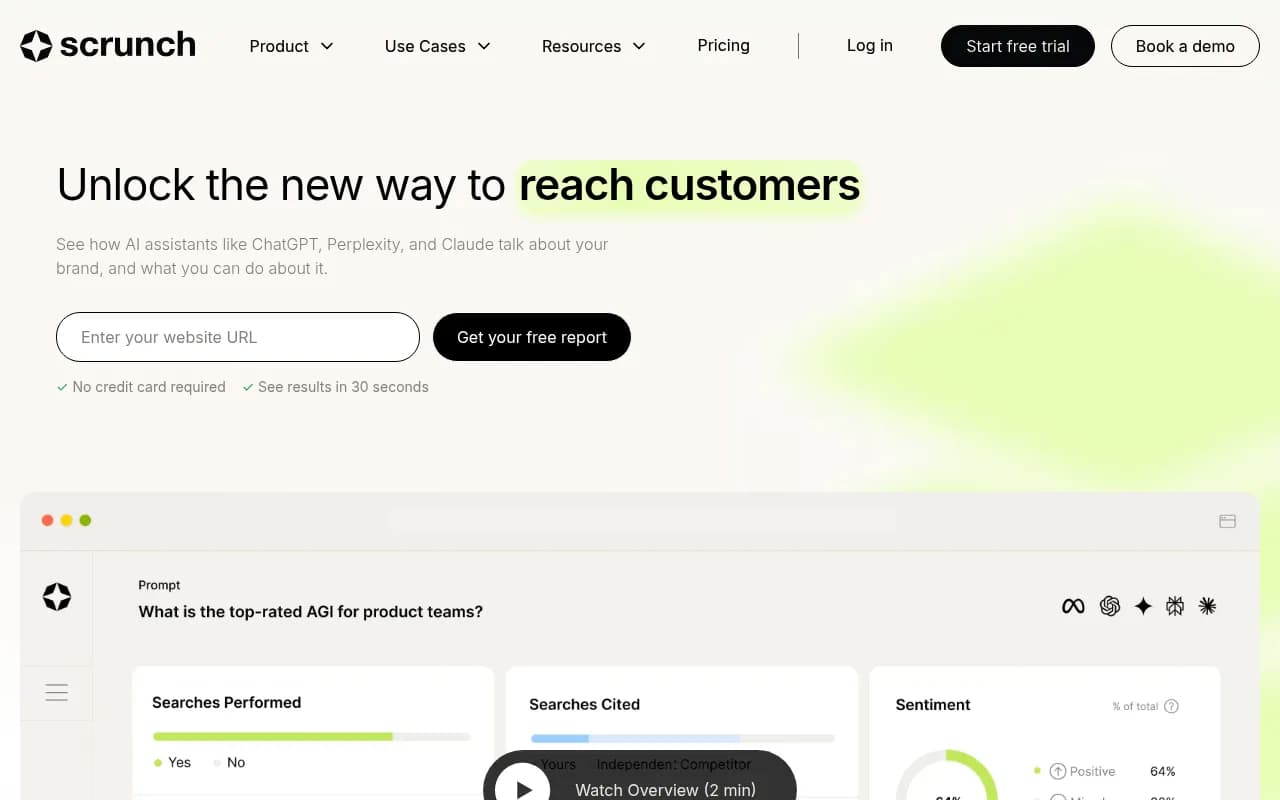
Scrunch AI sits between the basic monitoring tools and the full-stack platforms. It tracks brand mentions across LLMs and offers some competitive analysis features. The coverage is decent and the interface is straightforward. Still primarily a monitoring tool, but with more depth than Otterly or Peec.
Semrush — traditional SEO with AI features bolted on
Semrush has added AI search tracking capabilities to its platform, which makes it convenient for EdTech teams already using it for traditional SEO. The AI monitoring uses fixed prompts rather than custom ones, which limits how well it captures EdTech-specific queries. There's no AI traffic attribution and the GEO features feel like an add-on rather than a core capability.
Still, if your team lives in Semrush and wants a single platform, the AI Toolkit is worth exploring as a starting point.
AthenaHQ — monitoring-focused

AthenaHQ does solid work on the monitoring side — good model coverage, clean dashboards, useful competitive benchmarking. Like most of the monitoring-only tools, it doesn't extend into content optimization or generation, so EdTech teams will hit a ceiling when they want to act on the data.
Ahrefs Brand Radar — limited but familiar
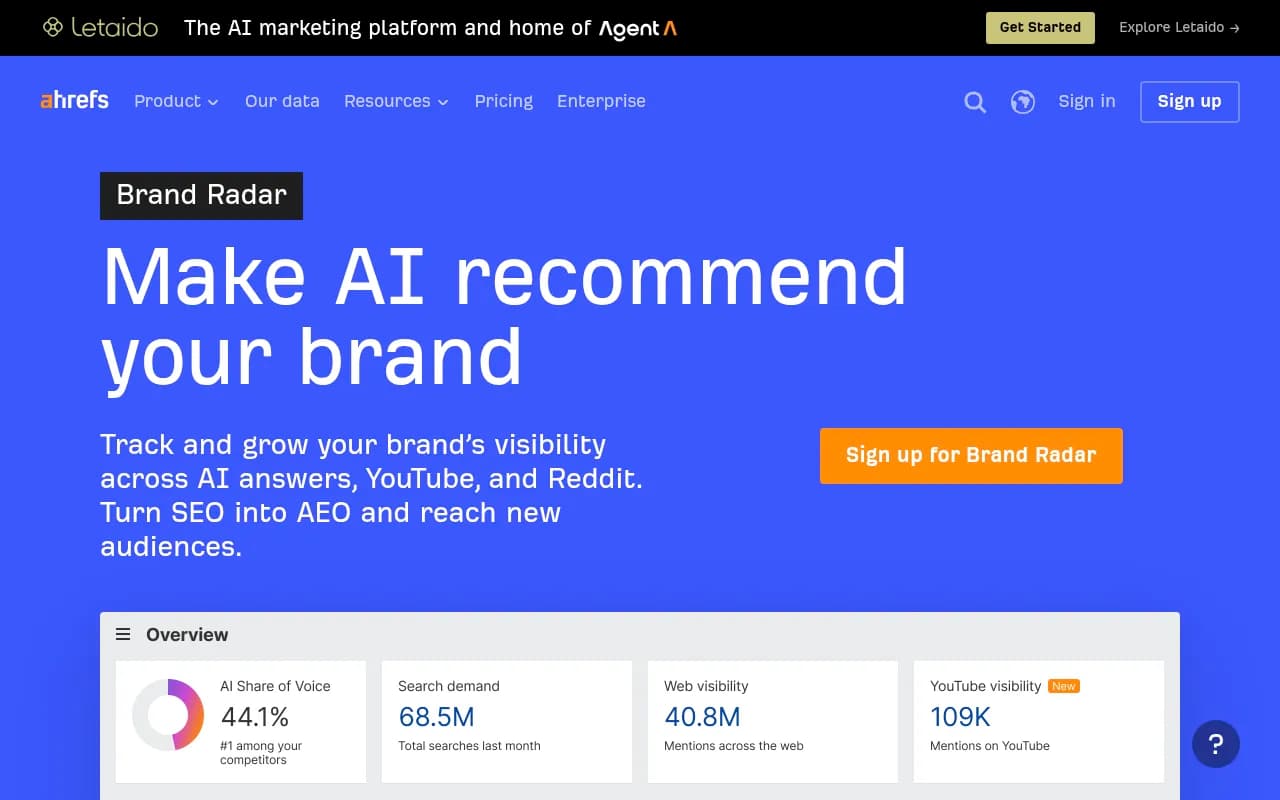
Ahrefs Brand Radar gives you brand visibility in AI search within the Ahrefs ecosystem. The prompts are fixed (you can't customize them for EdTech-specific queries), and there's no AI traffic attribution. Useful as a supplementary signal if you're already an Ahrefs user, but not a primary GEO tool.
Comparison table: GEO tools for EdTech
| Tool | Custom prompts | Multi-model coverage | Content generation | Crawler logs | Reddit/YouTube tracking | Starting price |
|---|---|---|---|---|---|---|
| Promptwatch | Yes | 10 models | Yes | Yes | Yes | $99/mo |
| Profound | Yes | 9+ models | No | No | No | Higher tier |
| Otterly.AI | Limited | 3 models | No | No | No | Lower tier |
| Peec.ai | Limited | Limited | No | No | No | Lower tier |
| Scrunch AI | Yes | Multiple | No | No | No | Mid tier |
| Semrush AI Toolkit | Fixed prompts | Multiple | No | No | No | Bundled |
| AthenaHQ | Yes | Multiple | No | No | No | Mid-higher tier |
| Ahrefs Brand Radar | Fixed prompts | Limited | No | No | No | Bundled |
How to actually use GEO tools in an EdTech context
Buying a tool is the easy part. Getting value from it requires a bit of strategy.
Start with prompt mapping
Before you set up any tracking, spend time mapping the prompts your target audience actually uses. Think about the different personas: students, parents, teachers, corporate L&D teams. Each group asks AI engines different questions. A parent asking about tutoring platforms uses different language than a high school student asking for homework help.
Build a prompt list that covers your core use cases, your competitor comparisons ("is [your brand] better than [competitor]?"), and the category-level questions where you want to be in the consideration set.
Prioritize by prompt volume and difficulty
Not all prompts are equal. Some questions get asked thousands of times a day; others are niche. Some prompts are dominated by one or two entrenched brands; others are genuinely open. Tools with prompt volume and difficulty scoring (Promptwatch has this) let you prioritize the gaps that are both winnable and worth winning.
For EdTech, this often means focusing on specific subject areas, age groups, or learning formats rather than trying to compete on the broadest possible queries.
Track competitor citation sources, not just rankings
One of the most actionable insights from GEO tools is understanding why competitors are being cited. If Coursera keeps appearing in AI answers about professional development, is it because of their own content? Or because they're consistently mentioned in Reddit threads, Forbes listicles, and YouTube reviews?
If it's the latter, that tells you where to focus your offsite strategy — not just your own content. Tools that track Reddit and YouTube as citation sources (Promptwatch does this; most others don't) give you a much fuller picture.
Connect visibility to traffic
AI citations don't always drive direct clicks, but they do influence decisions. Tools that can show you which AI citations are actually sending traffic to your site — through crawler log integration or attribution snippets — help you understand which visibility improvements are translating to real outcomes.
For EdTech brands with paid enrollment funnels, connecting AI visibility to actual enrollments is the end goal. That requires traffic attribution, not just mention tracking.
The content side: what EdTech brands need to create
GEO tools are most useful when they feed a content strategy. Based on what's working for AI-visible EdTech brands in 2026, a few content types consistently get cited:
Comparison content. AI models love to answer "X vs Y" questions. If you're not publishing detailed, honest comparisons of your platform against competitors, you're leaving citation opportunities on the table. These pages need to be genuinely useful — AI models are good at detecting thin content.
Use-case specific guides. "Best online learning platform for working adults" performs better in AI answers than "best online learning platform" because it's more specific. EdTech brands that publish content targeting specific personas, grade levels, subjects, and learning goals get cited more often.
Structured FAQ content. AI models pull heavily from content that directly answers questions in a clear format. FAQ pages, Q&A sections, and structured how-to guides are more likely to be cited than long-form narrative content.
Third-party presence. Your own website isn't the only place AI models look. Being mentioned on Reddit, in YouTube reviews, on comparison sites like G2 or Capterra, and in education-focused publications all contribute to AI visibility. A GEO tool that tracks these offsite citations shows you which external channels are worth investing in.
The bottom line for EdTech teams
The 5W Research data makes the stakes clear. EdTech brands that built on Google SEO are losing distribution fast. The brands growing are the ones that are visible inside AI tools — not because they got lucky, but because they understood the new distribution channel and optimized for it.
GEO tools are how you measure and improve that visibility. The monitoring-only tools will tell you where you stand. The full-stack platforms like Promptwatch will help you actually change it — by showing you the specific content gaps, generating content to fill them, and tracking when that content starts getting cited.
For an EdTech brand in 2026, that's not a nice-to-have. It's the core of your distribution strategy.