Key takeaways
- AI search engines like ChatGPT, Perplexity, and Google AI Overviews are now a primary discovery channel for financial products — and most financial brands have no idea how they appear in those answers.
- GEO (Generative Engine Optimization) tools track brand mentions, citations, and sentiment across LLMs, replacing the old "check your Google rankings" workflow.
- Financial services has unique requirements: regulatory sensitivity, trust signals, competitor density, and the need to appear in high-intent prompts like "best savings account" or "top ETF platforms."
- The best tools in 2026 go beyond monitoring — they show you what content to create, help you create it, and track whether it's working.
- Promptwatch is the only platform rated as a "Leader" across all GEO categories in 2026, combining monitoring, content gap analysis, AI content generation, and crawler logs in one place.
Why financial services brands need GEO tools right now
Here's a scenario that's playing out at banks, fintechs, and wealth management firms right now: a potential customer asks ChatGPT "what's the best high-yield savings account in 2026?" They get a confident, well-structured answer. Your brand isn't in it. A competitor is — twice.
That's not a hypothetical. Conductor's 2026 AEO/GEO benchmarks for the financials industry show that AI visibility is highly concentrated among a small number of brands, and the gap between leaders and everyone else is widening fast. The brands showing up consistently in AI answers are capturing awareness at the top of the funnel before a single search result is ever clicked.
Traditional SEO tools don't help here. They track Google rankings, not what ChatGPT says when someone asks about mortgage rates. You need a different category of tool entirely.
GEO tools — Generative Engine Optimization platforms — track how your brand appears in AI-generated responses, which sources AI models cite, what competitors are getting mentioned for, and crucially, what you need to do to close the gap.
For financial services specifically, this matters for a few reasons:
- High-intent prompts ("best robo-advisor," "compare business checking accounts," "is [your brand] trustworthy") directly influence purchase decisions.
- Trust and authority signals matter enormously in finance. AI models tend to cite established, well-sourced content. Brands without that content infrastructure get skipped.
- Regulatory sensitivity means you can't just publish anything — you need to understand exactly what AI models are saying about you and whether it's accurate.
- The competitive density in fintech and banking is brutal. If you're not tracking AI visibility, your competitors almost certainly are.
What to look for in a GEO tool for financial services
Not every GEO tool is built for the complexity of financial services. Here's what actually matters:
Multi-model coverage. Your customers use ChatGPT, Perplexity, Google AI Overviews, Gemini, and Copilot. A tool that only monitors one or two of these gives you an incomplete picture. Look for platforms tracking at least 5-8 models.
Prompt tracking with volume data. You need to know which prompts are driving AI answers in your category — and which ones have enough volume to be worth optimizing for. "Best savings account 2026" is very different from "what is compound interest."
Competitor benchmarking. In financial services, you're not just trying to appear — you're trying to appear instead of (or alongside) your competitors. Heatmaps showing who's winning for which prompts are essential.
Content gap analysis. Knowing you're invisible is step one. Knowing exactly what content you're missing — the specific topics and questions AI models want answered — is what lets you actually fix it.
Sentiment and accuracy monitoring. AI models sometimes get things wrong, or frame your brand negatively. In a regulated industry, catching this early matters.
Crawler and citation data. Understanding which of your pages AI crawlers are actually reading (and which they're ignoring) tells you where your technical GEO work needs to go.
The best GEO tools for financial services in 2026
Promptwatch — best overall for action, not just monitoring
Promptwatch is the platform that financial services marketing teams keep landing on when they need more than a dashboard. The core difference from most competitors: it doesn't stop at showing you where you're invisible. It shows you the specific prompts your competitors are winning that you're not, generates content designed to close those gaps, and then tracks whether that content gets cited.
For a financial brand, that loop matters. You can see that a competitor is being cited in answers about "best ETF platforms for beginners," identify the content gap driving that, brief or generate an article targeting that exact topic, and watch your citation rate improve over time. The AI Crawler Logs feature shows you which pages ChatGPT, Perplexity, and Claude are actually reading on your site — useful for diagnosing why certain pages aren't generating citations despite being well-written.
It monitors 10 AI models including ChatGPT, Perplexity, Google AI Overviews, Google AI Mode, Claude, Gemini, DeepSeek, Grok, Copilot, and Meta AI. Pricing starts at $99/month for the Essential plan, with Professional at $249/month adding crawler logs and city-level tracking.

Profound — best for enterprise financial institutions
Profound is built for larger organizations that need governance, detailed attribution, and the ability to answer "why did we appear in this response?" It's particularly strong at the "depth" end of monitoring — understanding the mechanics of why AI models cite certain sources, not just whether they do.
For a bank or insurance company with complex content operations and multiple stakeholders, Profound's enterprise positioning makes sense. It's more expensive than most alternatives, and it's primarily a monitoring platform rather than an optimization one, but the depth of analysis is genuinely impressive.
Profound

Scrunch AI — best for teams that want broad coverage fast
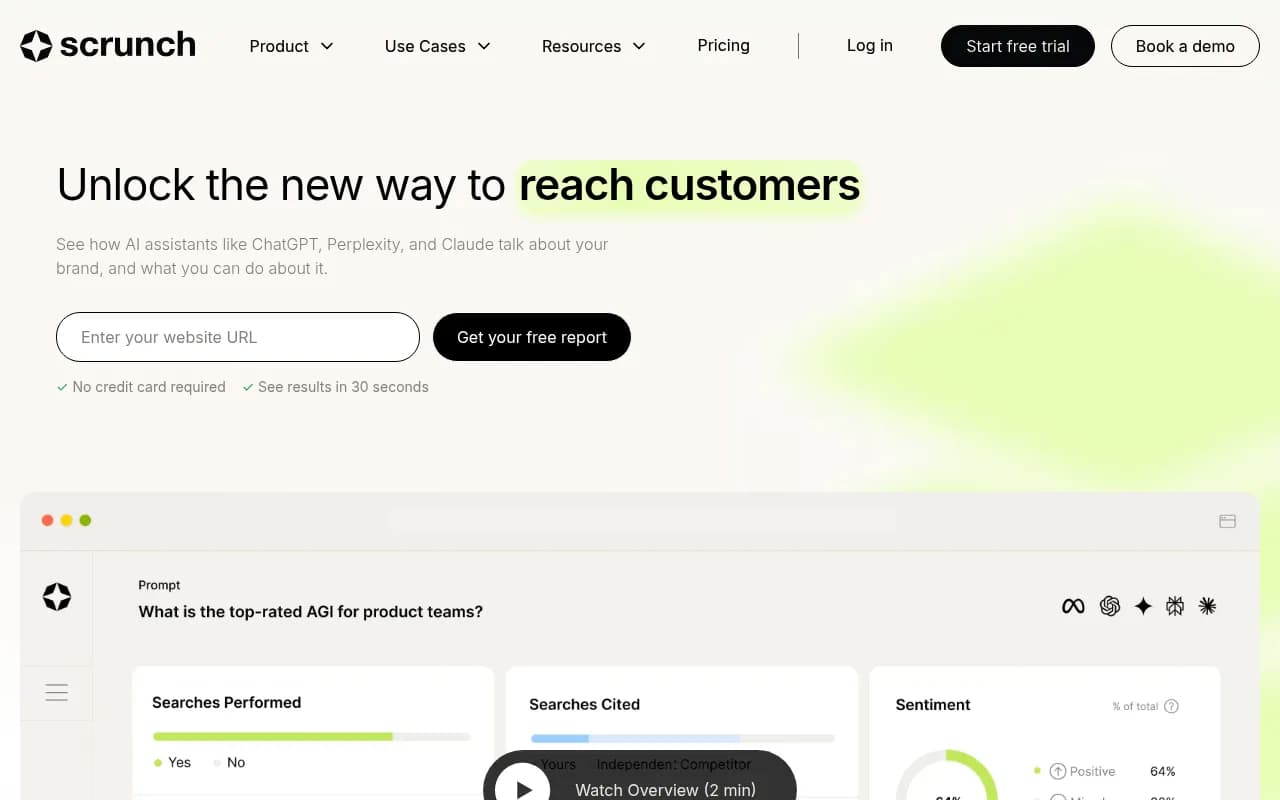
Scrunch AI covers a wide range of AI engines and is known for clean, stakeholder-friendly reporting. If your financial services marketing team needs to show AI visibility metrics to leadership on a weekly basis, Scrunch makes that easy. It's stronger at monitoring than at telling you what to do next, but for teams that are just getting started with GEO, that's often fine.
Conductor — best for financial brands already using enterprise SEO
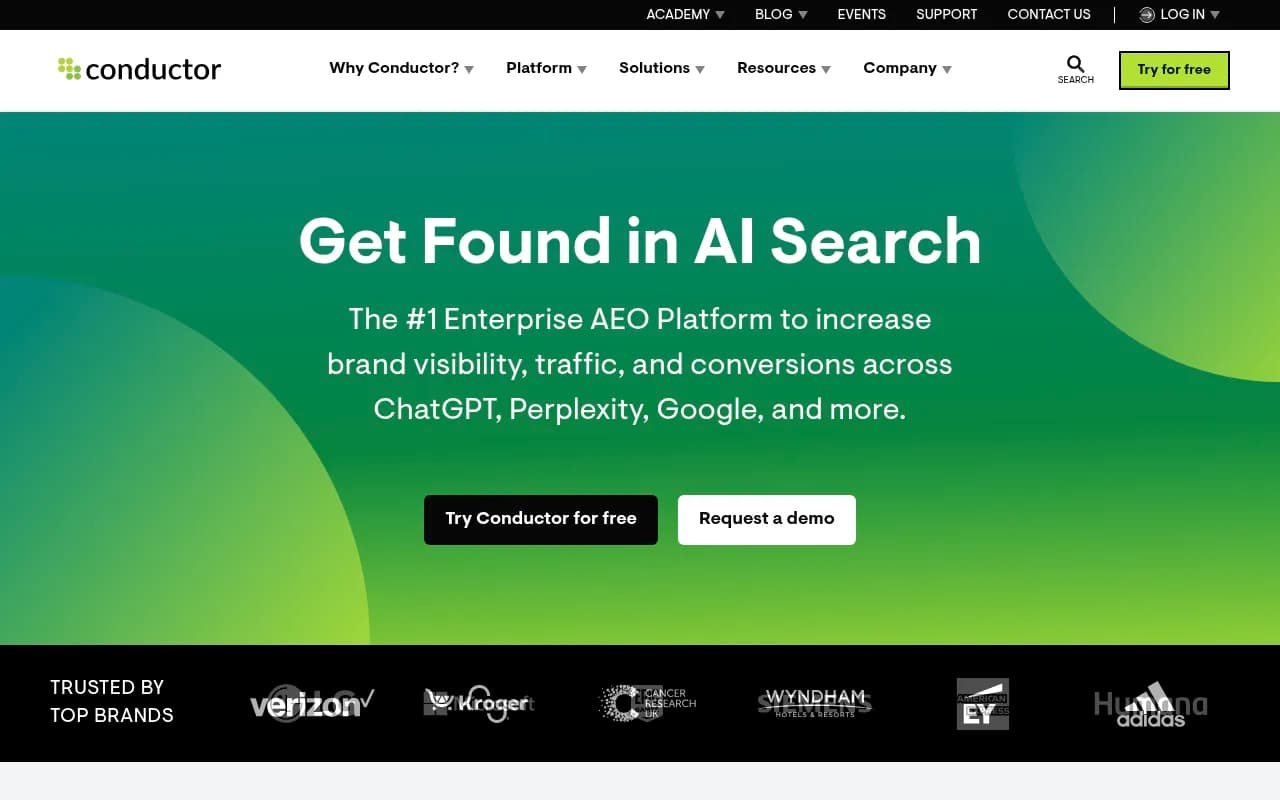
Conductor has built out AEO/GEO benchmarking specifically for the financials industry — they publish sector-specific benchmarks that show how your AI visibility compares to market share leaders. If you're already using Conductor for traditional SEO, adding their AI visibility layer is a natural extension. The integration with existing content workflows is a genuine advantage.
Otterly.AI — best for smaller fintech teams on a budget
Otterly.AI is a monitoring-focused platform that tracks brand mentions across ChatGPT, Perplexity, and Google AI Overviews. It's more affordable than enterprise options and has a clean interface. The limitation is that it's monitoring-only — you'll see where you're missing, but you won't get content gap analysis or generation tools to fix it. For a lean fintech team that just needs visibility data to inform their existing content team, it works.
Otterly.AI

Finseo.ai — built specifically for financial brands
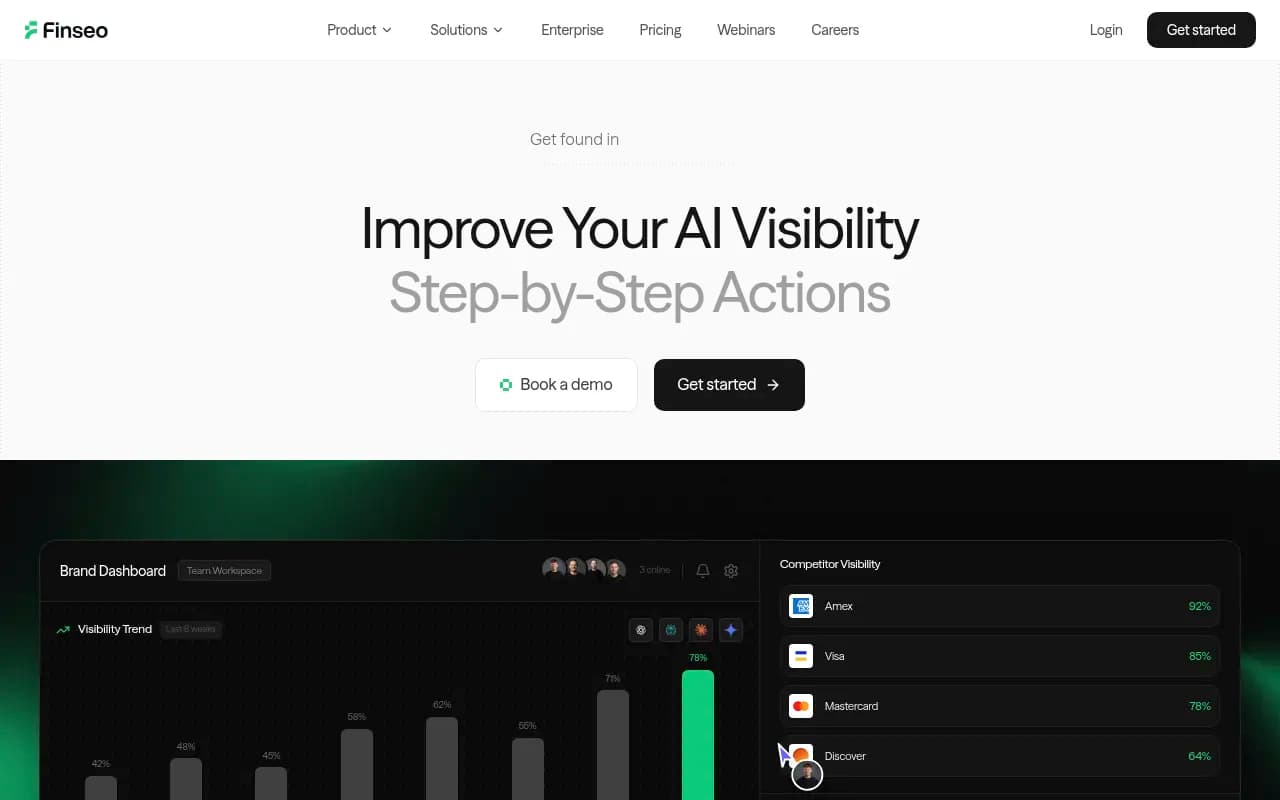
Finseo.ai is worth noting because it's one of the few platforms built with financial services as the primary use case. That means the prompt libraries, benchmarks, and tracking are tuned for financial queries rather than generic brand monitoring. It's a newer platform and doesn't have the breadth of Promptwatch or Profound, but the vertical focus is a real advantage for brands that want financial-specific prompt data out of the box.
Semrush — best if you want traditional SEO and AI visibility in one platform
Semrush has added AI visibility tracking to its existing SEO suite. If your team is already deep in Semrush for keyword research and rank tracking, the AI visibility features reduce tool sprawl. The limitation is that Semrush uses fixed prompt sets rather than dynamic prompt tracking, and there's no AI traffic attribution. It's a reasonable starting point, not a dedicated GEO platform.
Peec AI — lightweight monitoring for agile fintech teams
Peec AI is a straightforward AI search visibility tracker. It covers the major LLMs and gives you brand mention data without a lot of complexity. Like Otterly, it's monitoring-only — no content generation, no crawler logs, no gap analysis. But for a fintech startup that needs to start tracking AI visibility without a large budget or a complex setup, it's a reasonable entry point.

Head-to-head comparison
| Tool | AI models covered | Content gap analysis | Content generation | Crawler logs | Financial-specific features | Starting price |
|---|---|---|---|---|---|---|
| Promptwatch | 10 | Yes | Yes (AI agents) | Yes | Prompt volume, query fan-outs, Reddit/YouTube | $99/mo |
| Profound | 9+ | Limited | No | No | Enterprise governance | Custom |
| Scrunch AI | Multiple | No | No | No | Broad coverage, clean reporting | ~$300/mo |
| Conductor | Multiple | No | No | No | Financials industry benchmarks | Custom |
| Otterly.AI | 3-4 | No | No | No | None | Lower |
| Finseo.ai | Multiple | Limited | No | No | Finance-specific prompts | Varies |
| Semrush | Limited | No | No | No | None (fixed prompts) | $139/mo |
| Peec AI | Multiple | No | No | No | None | Lower |
How financial services brands should approach GEO in 2026
The tools above are only useful if you have a clear process. Here's how to think about it:
Start with prompt research
Before you can optimize, you need to know which prompts matter. In financial services, these fall into a few categories: product comparison prompts ("best credit cards for travel rewards"), trust/credibility prompts ("is [brand] safe to use"), educational prompts ("how does a Roth IRA work"), and recommendation prompts ("what robo-advisor should I use").
Tools like Promptwatch give you volume estimates and difficulty scores for each prompt, so you can prioritize the ones that are high-value and winnable rather than going after "best savings account" on day one.
Map your current citations
Before creating new content, understand what's already working. Which of your pages are being cited by AI models? Which aren't? Crawler log data tells you which pages AI engines are reading — sometimes you'll find that a well-written page simply isn't being crawled, which is a technical fix rather than a content problem.
Identify competitor gaps
The most actionable data in GEO is the gap between what your competitors are cited for and what you're cited for. If a competitor appears in 40% of responses to "best business checking account" prompts and you appear in 5%, that gap represents a specific content opportunity. The prompts driving that gap are the ones to target first.
Create content that answers AI models' actual questions
This is where GEO diverges most sharply from traditional SEO. AI models don't just want keyword-optimized content — they want comprehensive, well-sourced answers to specific questions. In financial services, that means content that covers the full context of a question, cites credible sources, and addresses the nuances that a real customer would care about.
Content gap analysis tools help you understand not just what topics to cover, but what angle and depth AI models are looking for. Generic "what is a savings account" content won't cut it if AI models are already citing detailed comparisons with rate data and fee breakdowns.
Track citations at the page level
Once you publish, you need to know whether it's working. Page-level citation tracking shows you which specific pages are being cited, by which AI models, and how often. This closes the loop and tells you whether your content investment is translating into AI visibility — or whether you need to iterate.
A note on compliance and accuracy monitoring
Financial services has a regulatory dimension that most GEO guides skip over. AI models can and do make mistakes about financial products — citing outdated rate information, misrepresenting product features, or attributing claims to your brand that you never made.
Monitoring what AI models say about you isn't just a marketing exercise in financial services. It's a risk management function. If ChatGPT is telling users that your savings account offers a rate you stopped offering six months ago, that's a problem. Regular monitoring of AI responses — not just citation counts, but the actual content of responses — should be part of your compliance workflow.
Most GEO tools give you the raw response data you need to do this. Building a process around it is up to your team.
Where to start
If you're a financial services marketing or SEO team that hasn't started tracking AI visibility yet, the honest answer is: start now, start simple, and add complexity as you understand the data.
A basic setup — pick one platform, track 20-30 high-intent prompts relevant to your products, monitor your top 5 competitors — will tell you more in 30 days than most teams currently know. From there, you can layer in content gap analysis, crawler monitoring, and content generation as your process matures.
The brands that figure this out in 2026 will have a meaningful head start. AI search is still early enough that consistent, well-targeted content can move citation rates significantly. That window won't stay open forever.