Key takeaways
- ChatGPT has become a genuine product discovery channel, with 900M+ weekly users and 77% of American users treating it as a search engine
- Most AI visibility tools only monitor brand mentions -- very few track ChatGPT's shopping-specific recommendations and product carousels
- The gap between "monitoring" and "optimizing" is where most brands get stuck: seeing the data is not the same as fixing the problem
- Promptwatch is one of the only platforms that specifically tracks ChatGPT Shopping appearances alongside broader AI visibility, and connects that data to content optimization
- For e-commerce and product brands, the most important metric isn't just mention frequency -- it's whether your product appears when someone asks "what should I buy?"
Why ChatGPT is now a shopping channel
Something shifted in 2025 that most marketing teams haven't fully processed yet. ChatGPT crossed 900 million weekly active users in early 2026. More than three-quarters of American users say they use it like a search engine. And a growing share of those searches are product questions: "What's the best running shoe for flat feet?" "Which air purifier should I get for a small apartment?" "Is [brand X] worth the money?"
When someone asks ChatGPT a question like that, they're not browsing. They're close to a decision. The AI gives them a confident, synthesized answer -- often naming specific brands, citing specific sources, and in some cases now showing product carousels directly in the chat interface.
That's a fundamentally different kind of visibility than a Google ranking. You're not competing for a blue link that a user might click or skip. You're competing to be the brand that ChatGPT recommends by name.
And here's the uncomfortable part: most brands have no idea whether they're winning or losing that competition.
What "ChatGPT shopping tracking" actually means
Before getting into specific tools, it's worth being precise about what we're talking about -- because the term gets used loosely.
There are at least three distinct things a brand might want to track:
Brand mentions in AI responses. When someone asks ChatGPT a product question, does your brand appear in the answer at all? This is the baseline metric most tools measure.
Citation and source tracking. Which pages on your website (or elsewhere) is ChatGPT pulling from when it recommends your products? This tells you what content is actually driving your AI visibility.
ChatGPT Shopping carousels. OpenAI has been rolling out product recommendation carousels inside ChatGPT, similar to Google Shopping. When a user asks for product recommendations, they may see a visual grid of products with prices and links. Appearing in these carousels is a separate challenge from appearing in the text of a response.
Most tools in the market handle the first two reasonably well. The third -- actual shopping carousel tracking -- is where the field gets thin fast.
The tools actually worth using in 2026
Promptwatch: the most complete picture for shopping visibility
Promptwatch is one of the few platforms that explicitly tracks ChatGPT Shopping appearances as a distinct feature, not just as part of general brand mention monitoring. That matters because shopping carousels operate differently from standard AI responses -- they pull from different data sources, have different ranking signals, and require different optimization strategies.
Beyond shopping-specific tracking, Promptwatch covers 10 AI models (ChatGPT, Perplexity, Claude, Gemini, Grok, DeepSeek, Copilot, Meta AI, Mistral, and Google AI Overviews), which means you're not just tracking one channel in isolation. You can see whether a product recommendation gap is specific to ChatGPT or whether it's a broader content problem affecting your visibility across all AI engines.
What separates Promptwatch from most competitors is the action loop it's built around. It doesn't just show you that a competitor is appearing in shopping recommendations and you're not -- it shows you exactly what content is missing from your site, then helps you create it. The built-in AI writing agent generates content grounded in real citation data (over 880 million citations analyzed), so you're not guessing at what ChatGPT wants to see.

The crawler log feature is particularly useful for product brands. You can see in real time when ChatGPT's GPTBot is crawling your product pages, which pages it's reading, and whether it's hitting errors. If your product pages aren't being crawled, they can't be cited -- and that's a fixable technical problem, not a content strategy problem.
Pricing starts at $99/month for the Essential plan (1 site, 50 prompts), with the Professional plan at $249/month adding crawler logs and more prompt capacity.
Profound: strong for enterprise product brands
Profound has built a solid reputation for enterprise-level AI visibility tracking, and it's a reasonable choice for large product brands that need to monitor AI narrative at scale.
Profound

Where Profound shines is in conversation volume metrics -- it gives you a sense of how often certain product-related prompts are being asked, not just whether you appear in the answers. For brands managing large product catalogs, that kind of demand intelligence helps prioritize which categories to focus on.
The limitation is that Profound is primarily a monitoring platform. It shows you the data clearly, but the path from "I see I'm not appearing in ChatGPT shopping recommendations" to "here's what I should do about it" requires work outside the tool.
Scrunch AI: good for agencies managing multiple product brands
Scrunch AI has positioned itself as an AI visibility platform with a focus on competitive benchmarking. If you're an agency running AI visibility for multiple e-commerce clients, the multi-brand management features are genuinely useful.
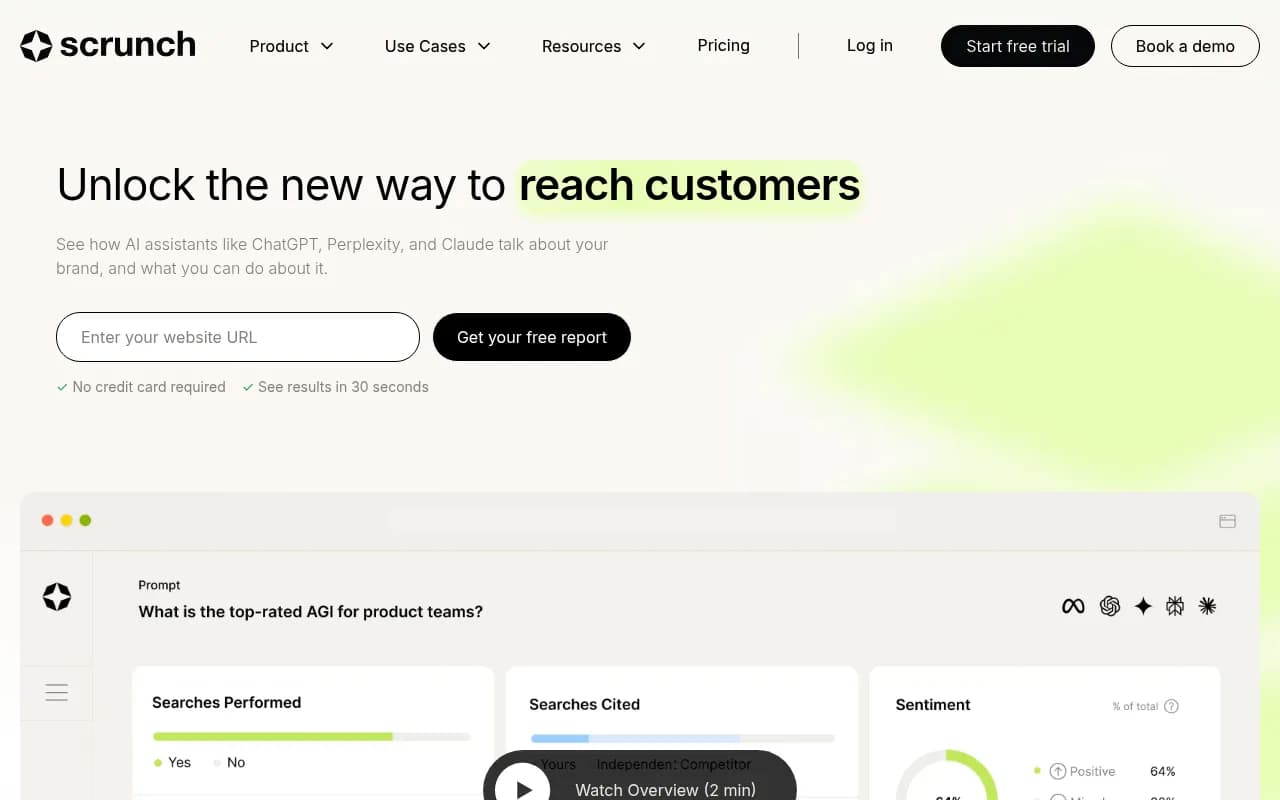
The platform tracks brand mentions across major AI models and gives you share-of-voice comparisons against competitors. For product categories where multiple brands are competing for the same AI recommendation slot, that competitive data is valuable.
Otterly.AI: accessible entry point for smaller brands
Otterly.AI is one of the more accessible options in the market, with plans starting around $29/month. For smaller product brands that want to start tracking AI visibility without a significant budget commitment, it's a reasonable starting point.
Otterly.AI

The trade-off is depth. Otterly.AI covers the basics -- brand mentions, sentiment, some competitor benchmarking -- but it doesn't have the shopping-specific tracking or content optimization features that more serious product brands will eventually need. Think of it as a good way to get a baseline reading before investing in a more comprehensive platform.
AthenaHQ: monitoring-focused with clean reporting
AthenaHQ has clean, well-designed reporting and covers the major AI models. It's a solid choice if your primary need is regular reporting to stakeholders on AI visibility trends.

Like most monitoring-focused tools, it doesn't close the loop on optimization. You'll know your visibility score is declining, but the tool won't tell you why or what to do about it.
SE Visible (SE Ranking): for teams already in the SE Ranking ecosystem
If your team is already using SE Ranking for traditional SEO, SE Visible is a natural extension. It adds AI visibility tracking to an existing workflow without requiring a separate platform.
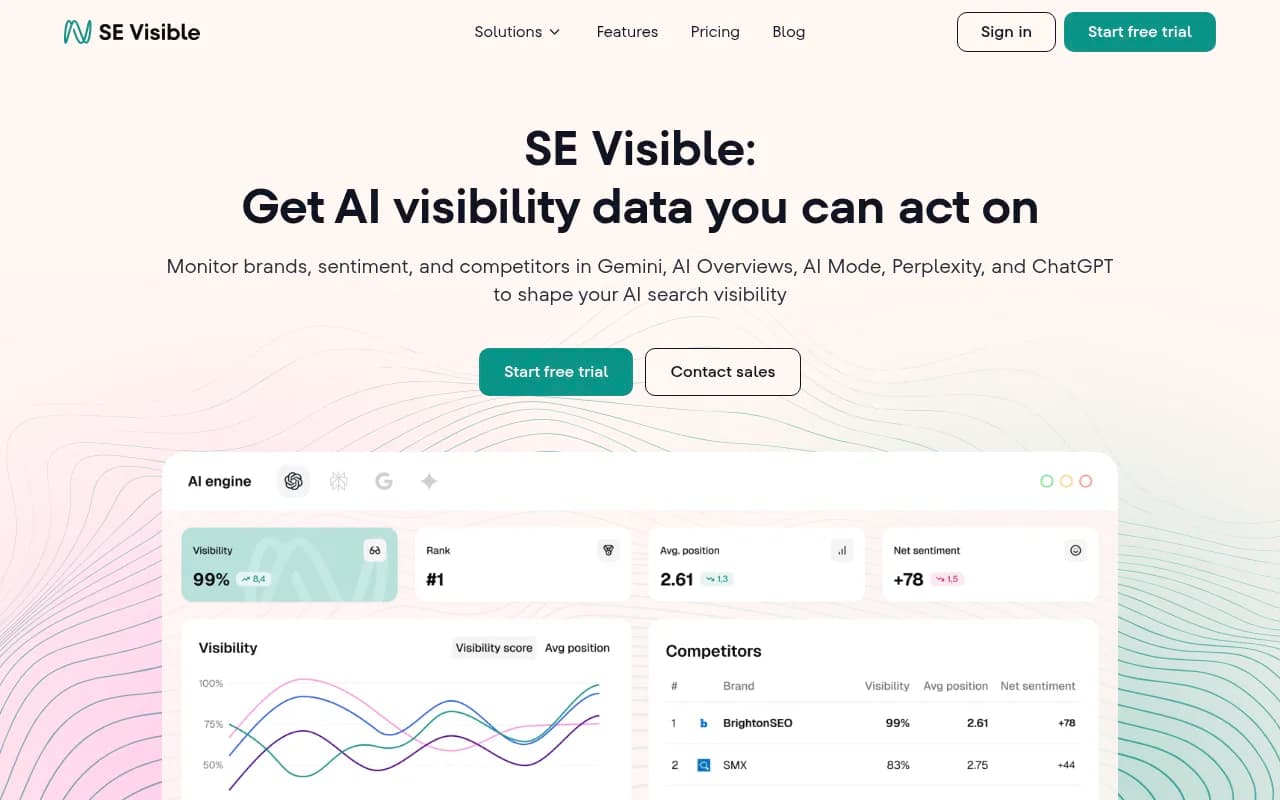
The AI visibility features include sentiment tracking and competitor benchmarks, which is more than many traditional SEO tools offer. The limitation is that it's still primarily an SEO tool with AI monitoring bolted on -- it doesn't have the depth of a purpose-built AI visibility platform.
Peec AI: lightweight tracking for specific use cases
Peec AI is a lighter-weight option that covers ChatGPT, Perplexity, and Claude. For brands that want simple, focused monitoring without a lot of configuration overhead, it works.

It's not the right tool for product brands that need shopping-specific tracking or content optimization, but for getting a quick read on brand mention frequency, it does the job.
LLM Pulse: emerging option worth watching
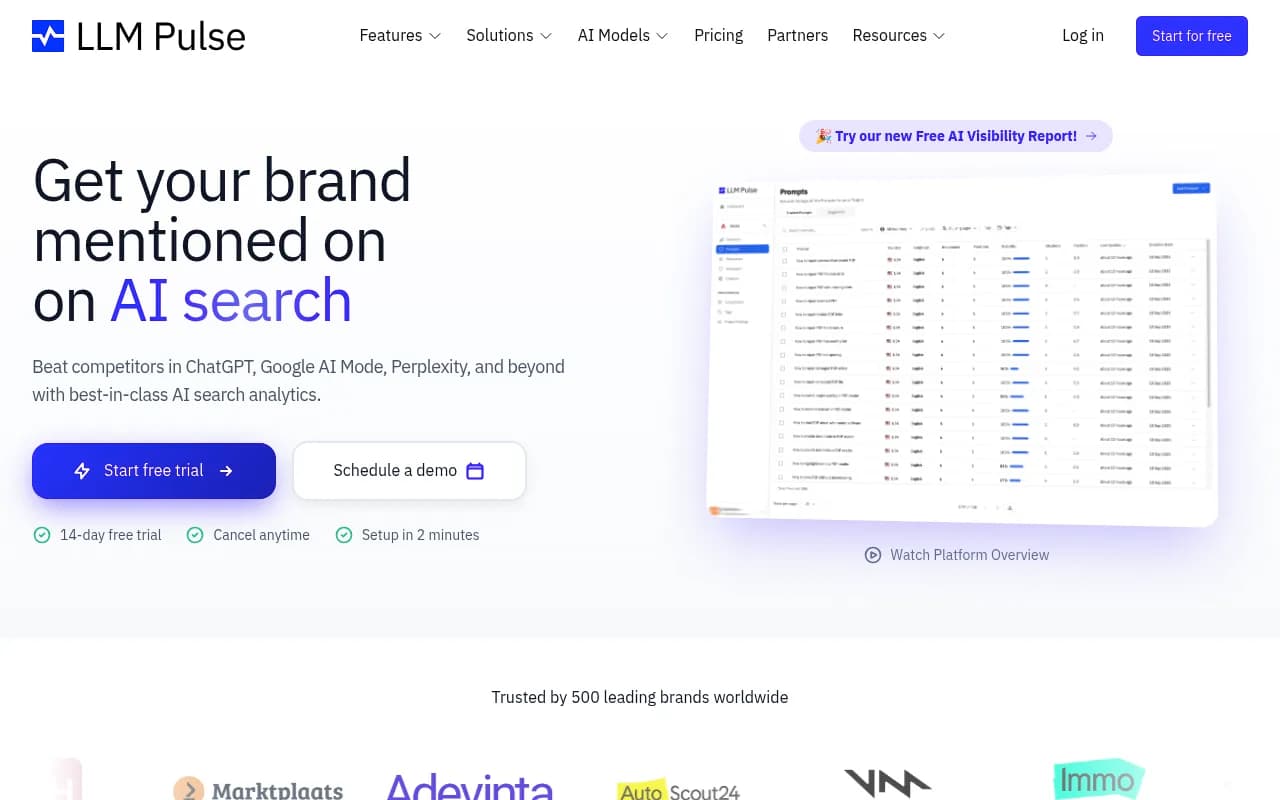
LLM Pulse is a newer entrant that tracks brand visibility across ChatGPT, Perplexity, and other AI models. It's still building out its feature set, but the core tracking functionality is solid.
Feature comparison: what each tool actually tracks
| Tool | ChatGPT Shopping tracking | Crawler logs | Content generation | Competitor heatmaps | Reddit/YouTube insights | Pricing from |
|---|---|---|---|---|---|---|
| Promptwatch | Yes | Yes | Yes (AI writing agent) | Yes | Yes | $99/mo |
| Profound | No | No | No | Yes | No | $99/mo |
| Scrunch AI | No | No | No | Yes | No | Custom |
| Otterly.AI | No | No | No | Limited | No | $29/mo |
| AthenaHQ | No | No | No | Yes | No | Custom |
| SE Visible | No | No | No | Yes | No | $189/mo |
| Peec AI | No | No | No | Limited | No | Free/$49/mo |
| LLM Pulse | No | No | No | Limited | No | Varies |
The pattern is pretty clear. Most tools in this space are monitoring dashboards. They show you data. Promptwatch is the outlier in having shopping-specific tracking, crawler logs, content generation, and Reddit/YouTube insights all in one platform.
What to actually look for when evaluating these tools
Prompt coverage for product queries
The prompts a tool monitors matter as much as the tool itself. A platform that only tracks brand-name queries ("what do people say about [brand]?") will miss the more valuable purchase-intent queries ("what's the best [product category] for [use case]?").
When evaluating any AI visibility tool for shopping use cases, ask specifically: can I track prompts like "what's the best [product] under $X?" or "which [product category] should I buy?" Those are the queries where ChatGPT shopping recommendations actually appear.
Citation depth
Knowing that ChatGPT mentioned your brand is useful. Knowing which specific page on your site it cited -- and whether that page is a product page, a review, a comparison article, or something else -- is far more actionable. Tools that track citations at the URL level give you something to work with.
Crawler monitoring
This one is underrated. If ChatGPT's GPTBot isn't crawling your product pages, those pages can't influence AI recommendations. Seeing crawler activity (and errors) in real time is the difference between knowing you have a visibility problem and knowing why you have one.
The gap between monitoring and optimization
Most tools will tell you that a competitor is appearing in ChatGPT shopping recommendations and you're not. That's useful information. But what do you do with it? The tools that go further -- showing you what content is missing, what topics competitors are covering that you're not, and helping you create content that addresses those gaps -- are the ones that actually move the needle.
How ChatGPT shopping recommendations actually work
Understanding the mechanism helps you understand what to optimize.
ChatGPT's product recommendations draw from multiple sources: its training data, real-time web search (via Bing), and in some cases structured product data. The shopping carousels that appear in ChatGPT are powered by a partnership with shopping data providers, similar to how Google Shopping pulls from merchant feeds.
For your brand to appear in text-based product recommendations, you need:
- Content on your site (or cited third-party sites) that clearly establishes your product's relevance to specific use cases
- That content to be crawled and indexed by AI crawlers
- Enough citation signals from trusted sources to establish credibility
For shopping carousels specifically, the requirements are different -- you likely need to be present in the product data feeds that ChatGPT's shopping partners use, which is a more technical and commercial problem than a content problem.
Most brands should focus on the text recommendation layer first, since that's where the most immediate optimization opportunity exists and where the tools above can actually help.
The Reddit and YouTube factor
One thing that surprises most brands when they start digging into AI visibility: a significant portion of ChatGPT's product recommendations are influenced by Reddit threads and YouTube reviews, not just brand websites.
When someone asks ChatGPT "what's the best [product]?", the AI frequently synthesizes opinions from Reddit discussions and YouTube video transcripts alongside official brand content. If Reddit's consensus on your product category doesn't include your brand, or if the YouTube reviews that ChatGPT is reading are negative, that affects your AI visibility regardless of how good your website content is.
This is why tracking Reddit and YouTube signals alongside traditional citation data matters. Promptwatch surfaces these discussions specifically because they directly influence what AI models recommend. Most other tools in this space don't track this channel at all.
Practical starting point for product brands
If you're a product brand starting from zero on AI shopping visibility, here's a reasonable sequence:
-
Run a baseline audit using a tool like Promptwatch to see where you currently appear (and don't appear) in ChatGPT product recommendations across your key categories.
-
Check your crawler logs to confirm that ChatGPT's GPTBot is actually crawling your product pages. Fix any crawl errors before investing in content.
-
Identify the specific prompts where competitors appear but you don't. These are your highest-priority content gaps.
-
Create content that addresses those gaps -- not generic SEO content, but content specifically engineered to answer the purchase-intent questions that AI models are being asked.
-
Track changes in your visibility score over the following weeks as AI models start incorporating your new content.
The brands that are winning in ChatGPT shopping recommendations in 2026 aren't doing anything magical. They're just doing this systematically while their competitors are still checking their Google rankings.