Key takeaways
- For 1 to 5 clients, the project or workspace limit matters more than the prompt count. Check it before anything else.
- Peec AI's Advanced plan gives you 5 projects (one per client). Its Pro plan has only 2, so it fits 1 or 2 clients.
- Otterly.AI is the cheapest way in at $29/mo, but Gemini, AI Mode and Claude cost extra, and its plan allotments are in flux.
- Promptwatch's agency plans start at $199/mo and are the only ones in this comparison that also cover crawler logs, visitor analytics and content creation for the work after the report.
- Almost every "best for agencies" roundup is written by a vendor that ranks itself first. Treat them as inputs, not verdicts.
Why 1 to 5 clients is its own category
Most agency tooling guides assume 10, 25 or 50 clients. Enterprise AI visibility platforms are priced for that. At 1 to 5 clients you are in an awkward middle: too many accounts for a single brand plan, too few to justify an agency tier built around 20 workspaces.
The question is not "which tool is best." It is "which tool lets me keep each client's data separate without paying for capacity I will never use." I have seen freelancers burn a month's margin on a platform because the demo looked good, then discover the cheapest plan allowed one project.
So this guide is organized around the constraints that actually bite at your size.
What to check before you pay
Projects and workspaces
A project is usually one brand with its own competitors, prompts and reports. If you have 4 clients and a plan with 2 projects, you either mix client data (bad) or pay for a second subscription (worse). Count projects first.
Engines on the cheapest plan
Prompt counts get the headlines, but engine coverage changes the real price. Peec AI's self-serve plans fix you at 3 chosen models, with extras costing $35, $85 or $165/mo depending on plan. Otterly.AI charges for Gemini, AI Mode and Claude as add-ons. If your clients care about Google AI Overviews and Gemini, price those in from day one.
Also, engines behave differently. Promptwatch Data shows ChatGPT citing about 5 sources per web-search answer, while Google AI Overviews and Perplexity sit near 10, and Copilot swung from under 2 to nearly 17 within weeks before settling. Measure each engine separately. One engine's result does not predict another's.
How prompts are phrased
Track prompts that read like real user questions. Promptwatch's ChatGPT query fanout data shows average fanout queries getting shorter over time, from roughly 117 characters in December 2025 to the high 80s by February and March. Your content headings should read like short queries, and your tracked prompts should sound like buyers, not like keyword lists.
Reporting you can hand to a client
A client will not log in to a dashboard. A PDF with your branding, or a Looker Studio view, is what gets read. Check whether white-label exports sit behind a higher tier.
What happens after the report
The reporting layer is close to commoditized. Brandlight's own agency roundup says as much, noting that a client can buy a basic tracker directly for around $99. Your value as a freelancer is the fix: content, citations, technical access. Pick a tool that helps with that or accept you will do it elsewhere.
Quick comparison table
Prices below are vendor-published monthly figures as of this writing. Verify on each pricing page, because several older roundups still list Peec as "contact vendor" or quote euros.
| Tool | Entry price | Projects | Best fit for 1 to 5 clients | Watch out for |
|---|---|---|---|---|
| Otterly.AI | $29/mo Lite; $189 Standard | Workspace-based | 1 to 3 clients, tight budget | Extra engines are paid add-ons; plan limits shifting |
| Peec AI | $95 Starter; $245 Pro; $495 Advanced | 1 / 2 / 5 | 5 clients on Advanced | Fixed at 3 models; Looker connector only on Advanced |
| Promptwatch | $95 Essential; $245 Professional; agency from $199 | 1 / 2 / 5 brand; unlimited on agency | 3 to 5 clients, plus content and crawler work | Agency plans exclude the Content Agent |
| Profound | Enterprise by quote (some roundups list $99 / $399) | Agency Mode workspaces | Technical teams with bigger roster | Overkill for lightweight needs |
| Rankscale | Check vendor | Agency-focused | Small agencies shopping for flat pricing | Verify limits live |
The tools, one by one
Otterly.AI: the cheap way in
Otterly.AI is where most solo consultants start. Lite is $29/mo, Standard is $189 and Premium is $489. Standard includes Looker Studio reporting. The catch is that the plan description keeps changing: one comparison lists 15 prompts on Lite, while Otterly's own pricing page now shows credit-based allotments (2,000 credits for $29, 15,000 for $189). Check the live page before quoting a number to a client.
Otterly.AI

Good for a one-client pilot or as a second data source next to something else. Less good once three clients each want Gemini and AI Mode, because the add-ons stack up.
Peec AI: simple, with a clear 5-project tier
Peec AI has the cleanest mapping to your situation. Starter is $95/mo ($80 annual) with 50 prompts and 1 project. Pro is $245/mo ($205 annual) with 150 prompts and 2 projects. Advanced is $495/mo ($420 annual) with 350 prompts, 5 projects and the Looker connector.
For exactly 5 clients, Advanced is one project per client. For 1 or 2, Pro works. Per answer, the cost drops from about 2.1 cents on Starter to roughly 1.6 cents on Advanced, which is reasonable. The limit is the 3-model cap, so a client who wants broad engine coverage will push you into add-ons.

Promptwatch: when the report is only half the job
Promptwatch is the one I would look at if your retainer includes doing something about the findings, not just reporting them. It is an AI visibility and GEO platform that tracks how ChatGPT, Gemini, Claude, Perplexity, Google AI Overviews, AI Mode, Copilot and others mention and cite a brand, then connects that to crawler logs, visitor analytics and content creation.

For your size there are two relevant routes:
- Brand plans: Essential is $95/mo (1 project, 50 prompts, 6,000 responses), Professional is $245/mo (2 projects, 150 prompts, 18,000 responses, 25M crawler logs), and Business is $579/mo (5 projects, 350 prompts, 42,000 responses, plus the Content Agent).
- Agency plans: Kick-off is $199/mo, Growth $399/mo and Scale $799/mo, with unlimited client projects, prompts and team seats, all models, Agent Chat, Brand Narrative, crawler logs, visitor analytics, site audits and custom reports. This is vendor-published, so confirm at promptwatch.com/pricing.
For 1 to 5 clients, Kick-off at $199 gives unlimited projects with 10,000 responses a month, which is likely enough if you track 30 to 60 prompts per client daily. One honest note: a competitor page argues agencies with more than 2 active clients outgrow Professional. That is a rival's claim, but it matches the project math, so go agency tier at 3 or more clients.
Agency plans do not include the Content Agent or Knowledge Base. If you want automated article production, Business or Enterprise is the route. Details on the agency setup are on the Promptwatch agency page, and there is a 7-day free trial plus a free AI visibility report to try on a prospect first.
Profound: powerful, probably too much
Profound published its own agency roundup in January 2026 and ranks itself first, as you would expect. Its Agency Mode with client workspaces and pitch environments is real, and it tracks daily across the main engines. But its own material says it is overkill for teams that only want a lightweight visibility score, and one third-party piece says teams over 3 people are better suited for Enterprise. Pricing is also murky: some matrices list Starter at $99 (1 engine) and Growth at $399, while Promptwatch's comparison says brand plans are by quote. Ask for a number in writing.
Profound

Others worth a look
The catalog has plenty of smaller options. A few that came up repeatedly for small agencies:
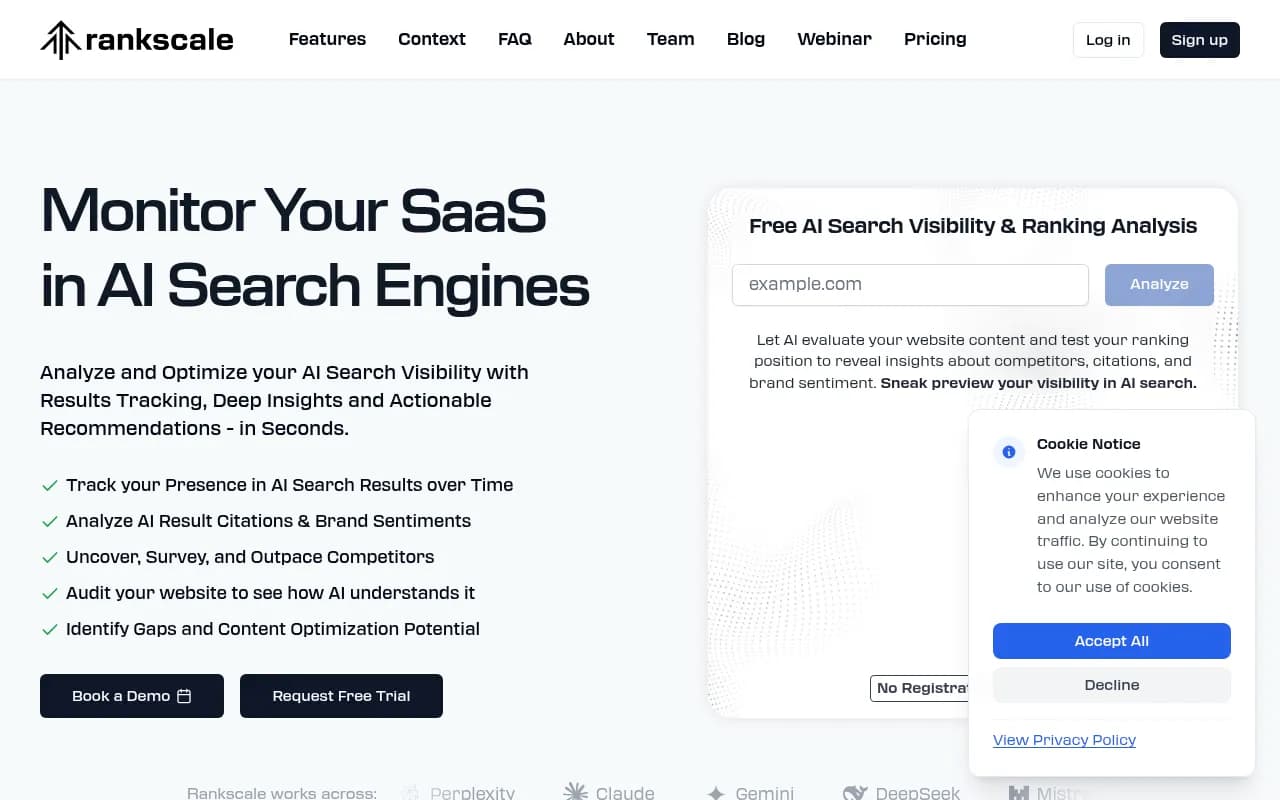
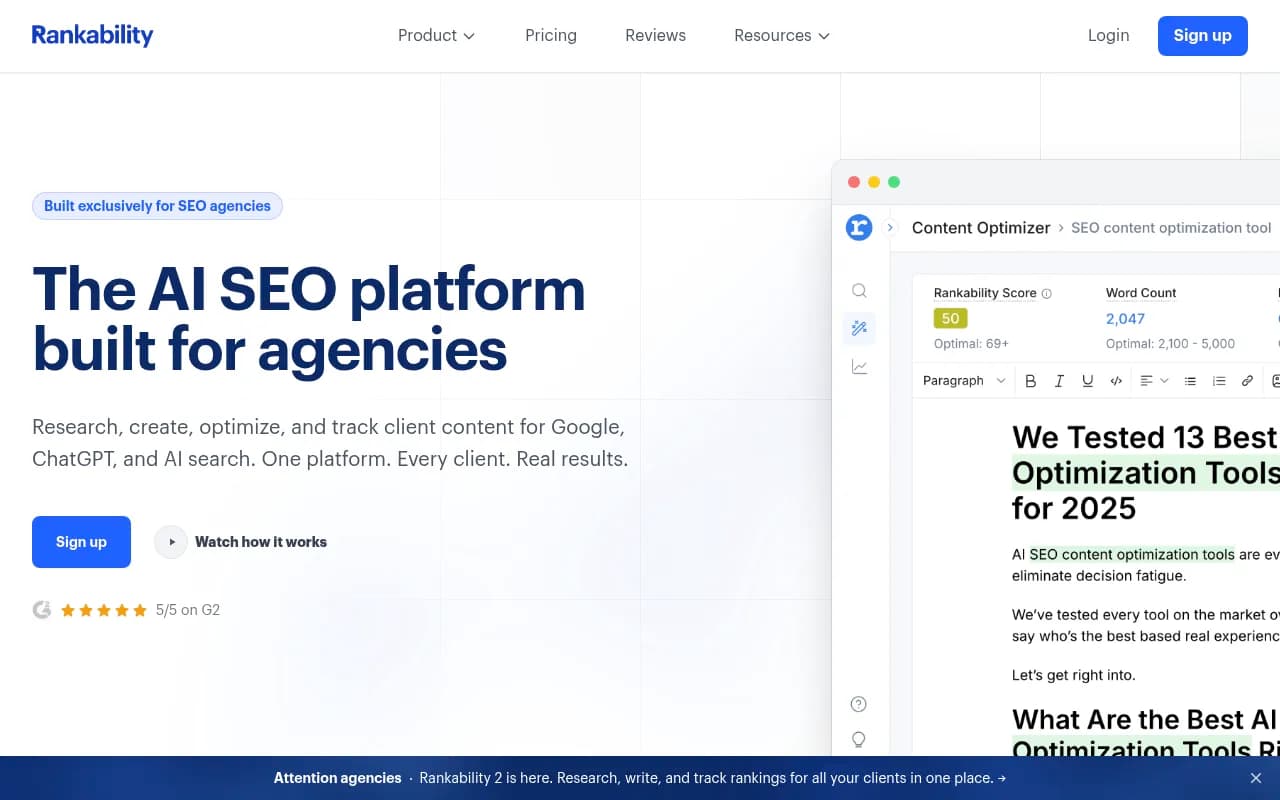

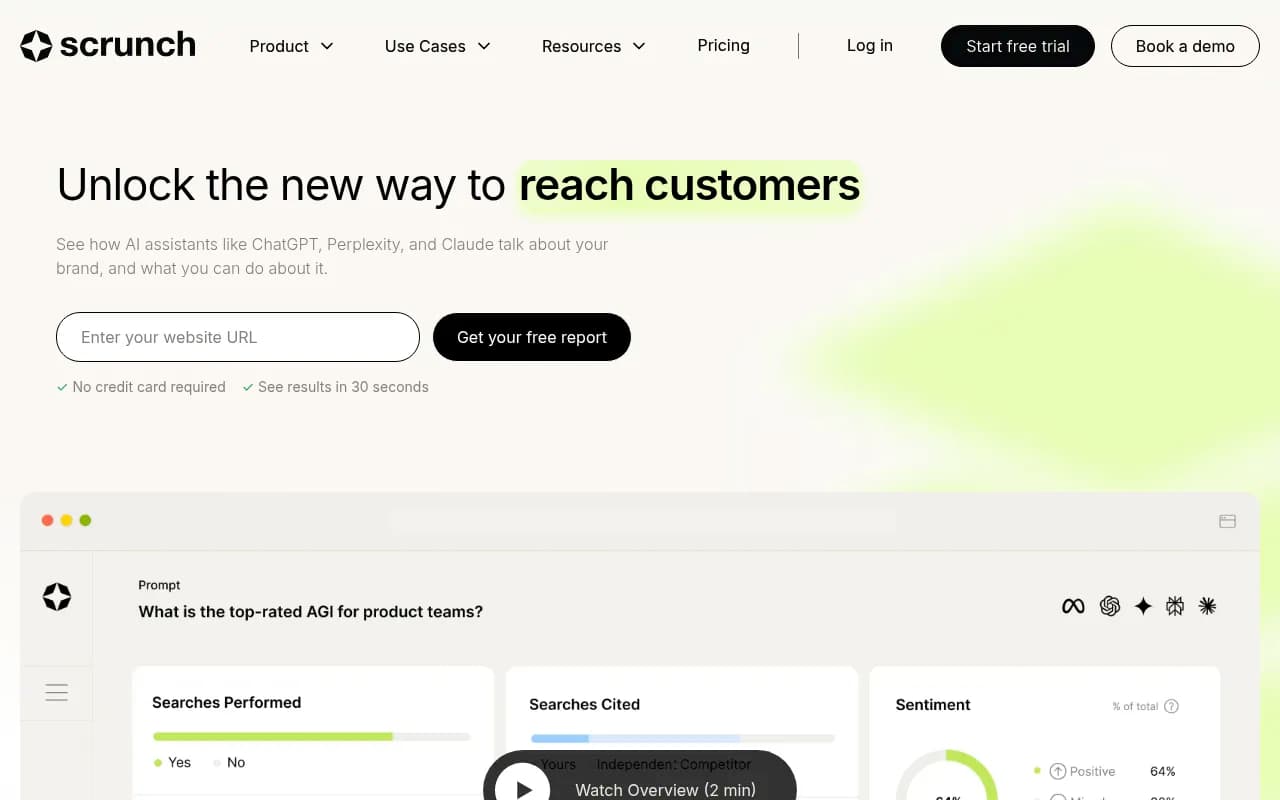
Rankscale is positioned for agencies and appeared in a 5, 10 and 25-client roundup. Rankability bundles SEO and AI visibility for agencies. AthenaHQ leans on analytics and an action center, and Scrunch has strong partner economics but no content generation. I have not verified current limits on any of these, so check the live plan pages. For a broader scan, the GEO software directory at bestgeosoftware.com lists far more options.
Cost per client: the math that matters
Here is a rough look at what each setup costs per client at 5 clients, assuming monthly billing and published prices.
| Setup | Monthly cost | Per client at 5 clients |
|---|---|---|
| Peec AI Advanced | $495 | $99 |
| Promptwatch Business (5 projects) | $579 | about $116 |
| Promptwatch Kick-off (agency) | $199 | about $40 |
| Otterly Standard | $189 | about $38 |
| One Peec Starter per client | $475 | $95 |
Two caveats. The cheap rows buy you less capacity: Kick-off has 10,000 responses a month in total, so five clients share it. And the Otterly figure assumes you can fit everything under one Standard plan, which depends on credits and engine add-ons. Semrush is the cautionary tale in one roundup: at 15 clients on a per-seat model you can pay roughly $1,485 a month before anyone does any work. At 5 clients it is less brutal, but still worth modeling.

That Brandlight page is useful for the structure of its comparison, which sorts tools by agency size. It is also a vendor-authored list, so read the rankings with that in mind.
A setup I would actually use
One client
Start with Otterly Lite or Peec Starter. Run it for a month. If the client keeps asking "what do we do about it," move up.
Two to three clients
This is the awkward zone. Peec Pro covers only 2 projects. An agency-tier plan with unlimited projects (Promptwatch Kick-off at $199) tends to work out cheaper per client than stacking brand plans, and you get crawler logs and visitor analytics in the same place.
Four to five clients
Peec Advanced if you only need monitoring and Looker reporting. Promptwatch Growth ($399, 25,000 responses) if you also want crawler access checks, AI traffic attribution and Agent Chat to do analysis for you. Use the site audit and AI crawler logs to find out whether a bot can even read a client's pages before you write a single new article.
Pitfalls I would watch for
- Pricing drift. Euro vs dollar, monthly vs annual, and stale "contact vendor" entries are everywhere. Always cite the vendor page and the date.
- Vendor-written rankings. Brandlight, Profound, Promptwatch and Otterly each rank themselves well in their own content. Cross-check.
- Time tracking confusion. A couple of roundups in the search results for this topic are about time tracking (TMetric, Harvest, Toggl), not AI visibility. Useful for billing, irrelevant to this decision.
- Engine add-ons. Model your clients' real engine needs before choosing a plan.
How to run a two-week trial
- Pick your two most demanding clients and write 20 real prompts for each, phrased like buyers.
- Run the same prompts in two tools for 14 days.
- Compare whether the tools agree on which brands appear. Disagreement is normal; large gaps tell you which engine each tool covers poorly.
- Export a client report from each. Would you send it as is?
- Check what the tool tells you to do next. A score with no action is a dashboard.
If you are also pitching, free scans help. Promptwatch's free visibility report and the Agentic Readiness Check are both no-cost ways to show a prospect something concrete. For more rank tracking options, the directory at ai-rank-tools.com is a reasonable next stop.
Bottom line
For a freelancer with one client, Otterly or Peec Starter is enough. At two clients you hit project limits quickly. From three to five, the real decision is between pure monitoring (Peec Advanced) and a platform that also helps you fix what it finds (Promptwatch's agency plans). Pull current prices from each vendor page, run the two-week test, and pick the one whose report you would be comfortable putting your name on.