Key takeaways
- Profound is the most established self-serve measurement platform, with SOC 2 Type II, HIPAA, and a large real-prompt dataset. Brandlight is a platform plus a strategy service for multi-brand enterprises. Evertune is built around statistical rigor and prompt volume. Bluefish is aimed at brand safety and corporate communications.
- Pricing is mostly opaque. Evertune lists a Pro tier at $800/month, Profound lists $99 and $399 self-serve tiers plus custom enterprise, and Brandlight and Bluefish are sales-led. Third-party estimates for the enterprise tiers run $3,000 to $5,000 a month, but those are unverified.
- Almost everything we can read about these four comes from the vendors themselves. Each comparison page declares its own product the winner, so treat claims as a starting list of demo questions.
- Citation slots differ by engine, so insist on per-engine reporting rather than one blended score.
- If you want measurement plus content execution and crawler logs without a sales cycle, a fifth option is worth a look (see the end).
Why this comparison is harder than it looks
I went through the published comparisons of these four platforms, and the pattern is hard to miss. Evertune's page on Bluefish says choose Evertune. Profound's page on Bluefish says choose Profound. Profound's page on Evertune says choose Profound. Brandlight's own roundup puts Brandlight first. DeepSmith's roundup puts DeepSmith first. That's not corruption, it's just how vendor content works.
So this guide does something modest. It lays out what each vendor says it does, flags where the claim comes from, and gives you questions that cut through the pitch. Where I couldn't verify something, I say so.
One thing worth knowing before you start comparing dashboards: AI engines cite different numbers of sources. According to Promptwatch Data's average sources report (byline September 2025, so treat the exact figures as dated), ChatGPT cites about 5 sources per web-search answer, Google AI Overviews about 10, and Perplexity almost exactly 10. Copilot swung from under 2 to nearly 17 within a few weeks. A platform that blends everything into a single score hides those differences. Ask each vendor to show per-engine numbers.
The four platforms at a glance
| Brandlight | Profound | Evertune | Bluefish | |
|---|---|---|---|---|
| Core idea | Platform plus AI-strategy service, full loop across owned, third-party, social, retail | Self-serve measurement plus agents (Aim, Agent Analytics) | Statistical measurement at scale, direct foundation-model access | Brand safety, accuracy, and AI reputation |
| Best for | Multi-brand, multi-market enterprises | Large enterprises wanting measurement depth | Brands in high-consideration categories | Fortune 500 comms and brand-protection teams |
| Published pricing | Custom, paid 3-month pilot, no free trial | $99 and $399 self-serve, custom enterprise | Pro from $800/month, custom enterprise | Custom, sales-led |
| Compliance noted | SOC 2 Type II per DeepSmith; closed-network processing per Brandlight | SOC 2 Type II, HIPAA assessed by Sensiba LLP | Not publicly disclosed per Profound's comparison | SOC 2 Type 2, SSO, MFA; "HIPAA Ready" |
| Content execution | Multi-agent drafting with brand and legal rules, routed to CMS for review | Agents, Workflows, CMS nodes | Content Studio generates blog copy | Content Briefs, Agentic Campaigns (tactics your team carries out) |
| Funding noted | Reported $30M Series A (unverified) | $155M raised per Surmado; $96M Series B per DeepSmith | $20M Series A, Felicis | $68M, Series A led by NEA |
Treat the funding figures with care. They come from different third-party roundups and don't always agree.
Brandlight
Brandlight pitches itself at multi-brand enterprises that need to change how AI represents them, not just watch a number. Its loop is described as See, Shape, Act, Transform, running inside one data layer that spans owned pages, third-party sources, social, retail, paid, and agentic commerce.
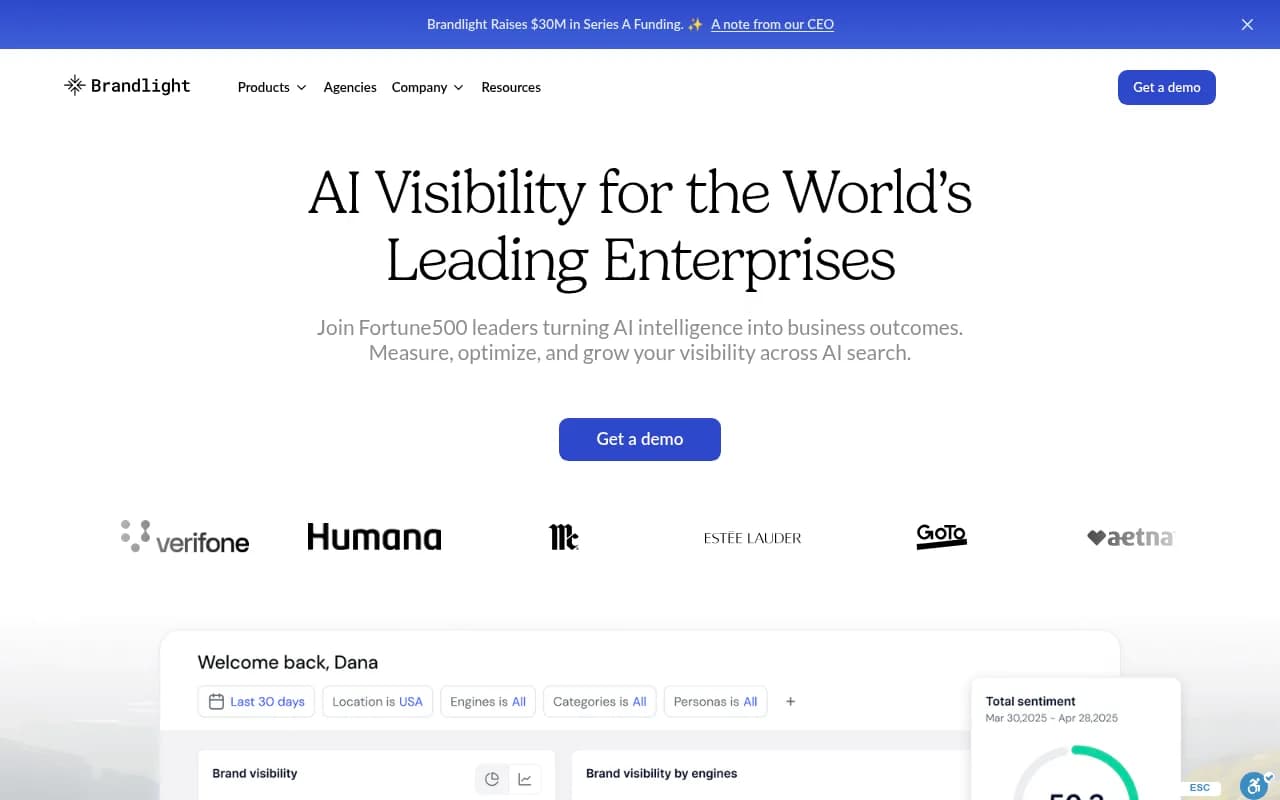
What it says it does well:
- Supplies the query set for you, funnel-tagged prompts built from licensed AI-panel data and search signals, so you aren't guessing which questions to track.
- Gives prescriptive recommendations (fix this page, create this content, partner with this publisher) tied to source data.
- Generates content through a strategist, writer, editor, validator workflow that enforces brand and legal rules and sends drafts to your CMS for human review. It does not auto-publish.
- Adds AI strategists and forward-deployed engineers, which is the real differentiator. You are buying a team as well as a tool.
Its own blog claims roughly 85% of the sources AI cites for category questions are third-party or social. If that's even directionally right, a tool that only inspects your own domain misses most of the story, and that's the argument Brandlight leans on.
Coverage is where sources disagree. Brandlight says ChatGPT, AI Overviews, AI Mode, Gemini, Perplexity, Copilot, and Claude, and claims 13 engines tracked overall. DeepSmith's roundup lists five engines including Grok but not Claude. Ask for the current list in writing.
Pricing: custom to scope, starting with a paid 3-month pilot and no free trial. A third-party estimate puts entry plans near $199/month and enterprise contracts at $4,000 to $15,000/month, but that figure is unverified. The scratchmm comparison also noted an annual commitment and that it is "quite pricey".
Customers named by DeepSmith include Volkswagen Group, Caesars Entertainment, LG, Kimberly-Clark, McCormick, and Publicis Groupe. Brandlight itself says it moved 12 of 12 Kimberly-Clark brands into the top three across major LLMs. That's a vendor-reported result.
Profound
Profound is the incumbent. Surmado calls it the category leader, DeepSmith calls it the most established independent name, and Profound's own materials cite more than 1,100 G2 reviews at 4.5/5.
Profound

Where it is strong:
- Real-prompt data. Its Prompt Volumes dataset is built on real user conversations (cited at 1.5B+ in one page, 2B+ in another, so the number is moving), with breakdowns by intent, age, income, country, and platform.
- Front-end browser queries run daily, plus query fanout data showing the sub-queries engines run.
- Agent Analytics, which uses CDN integrations (Akamai, Cloudflare, AWS, Fastly) to connect AI crawler activity to human referral traffic through GA4.
- An agentic layer: Aim proposes ranked projects, Context Manager holds brand facts, and Agents do the work with a person approving output. FactCheck measures AI accuracy at scale.
- Enterprise reporting with CSV, JSON, API, a Tableau connector, and GA4 and Adobe Analytics extensions.
- SOC 2 Type II, HIPAA, SSO via SAML and OIDC.
Pricing: Starter at $99/month annual ($114 monthly), Growth at $399/month annual ($458 monthly), and custom Enterprise. Surmado notes the $99 tier is ChatGPT-only, and multi-engine monitoring starts at $399. Agents run on a credit-based model, so budget for that. DeepSmith also flags that prompt and seat caps get tight for multi-brand teams, pushing you to a custom quote sooner than the pricing page suggests. Profound's comparison pages mention an annual commitment.
The honest caveat: its comparisons against Bluefish and Evertune are marketing pieces from Profound. The Evertune one claims Evertune is "limited to SMBs" and lacks enterprise features, which sits oddly beside Evertune's roster (Athenahealth, Roku, WPP, Canada Goose, Miro). Don't take either side's characterization of the other at face value.
Evertune
Evertune was founded by Trade Desk veterans and bets on statistical rigor. Its pitch is that running a very large number of prompts per brand produces numbers you can actually trust, where small samples bounce around.
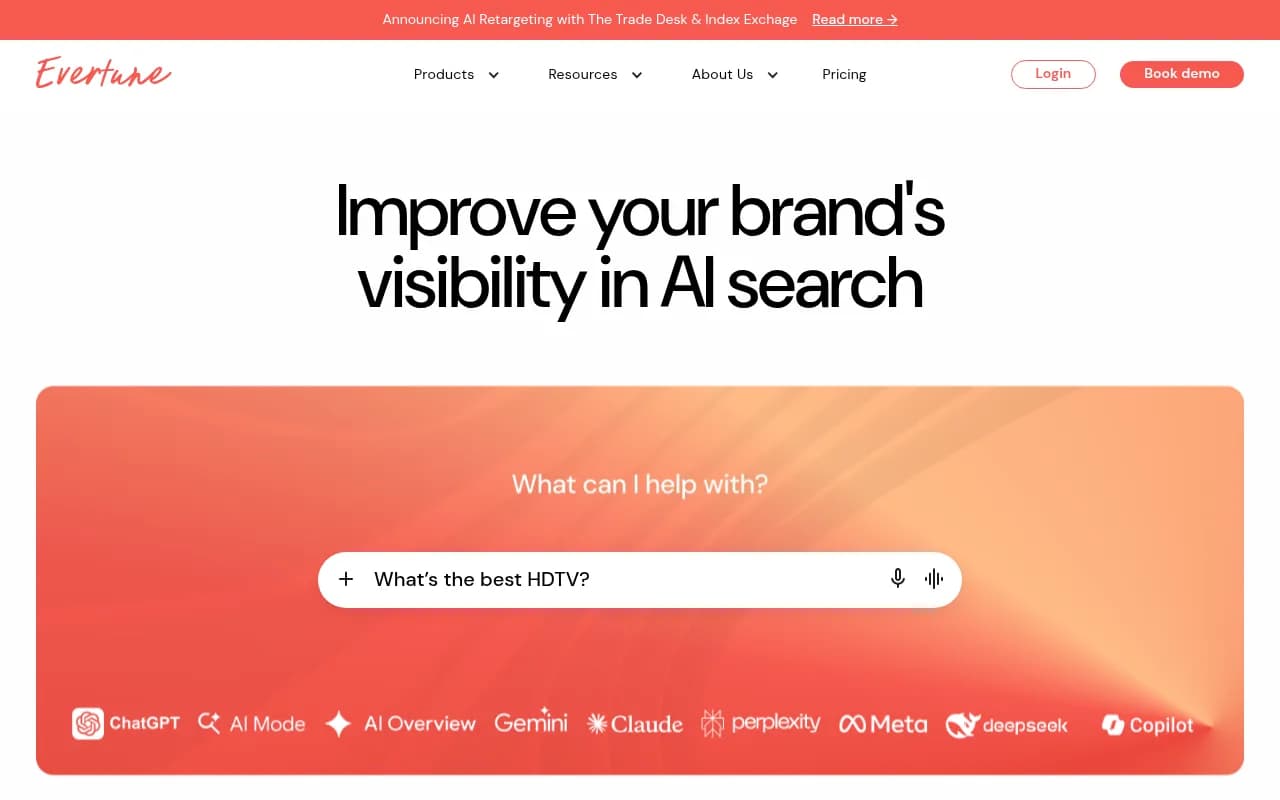
What it claims:
- Over 1 million prompts per brand per month according to Surmado, though Evertune's Pro tier is described by DeepSmith as 100,000 prompts analyzed monthly. Those numbers aren't contradictory (different tiers), but confirm your tier's volume.
- Direct API access to foundation models (ChatGPT, Claude, Gemini, Meta, DeepSeek) alongside consumer-app tracking (ChatGPT Search, Gemini Search, Perplexity, Copilot, AI Mode, AI Overviews). The point is separating what a base model believes from what search-augmented responses say.
- AI Brand Index (a 0-100 score weighting mention frequency and position), Word Association for aided awareness and sentiment, Content Analytics that finds influential URLs that don't mention you, and Content Studio for blog copy.
- AI Usage, powered by EverPanel, a panel of 25 million real internet users, and a Prompt Volume Index claimed to be real usage rather than modeled estimates.
- AI advertising: ad placement agents and retail media integrations, which DeepSmith flags as the unusual forward-looking piece.
Pricing: Pro at $800/month publicly, custom Enterprise above that. A third-party table lists $5,000/month for enterprise B2C, unverified. DeepSmith calls it the most expensive entry point among its shortlist and says it is hard to justify as pure measurement. That's fair. The math works if you will use the panel data and the ad layer.
Security is the open question. Profound's page says certifications aren't publicly disclosed. Ask for the report during procurement rather than assuming either way.
Bluefish
Bluefish is the brand-protection specialist. Per Surmado, 80% of its customers are Fortune 500, with Adidas and Tishman Speyer named, and it raised $68M with NEA leading the Series A.
What it does:
- Monitoring for visibility, sentiment, brand safety, and audience performance, with real-time crisis detection.
- AI Accuracy, which checks AI claims against Brand Vault, a verified source of truth built from your first-party content.
- Impact Score and Influence Rank for citation quality, down to URL level.
- Agentic Campaigns (since June 2026 per Profound's page): set a target and channels, and the system diagnoses, generates content and data tactics, and tracks KPI impact.
- PR suite integration, such as Cision, according to Evertune.
Limits to check: Evertune's page says coverage lacks Claude, AI Mode, AI Overviews, Copilot, and DeepSeek, and Surmado said the same as of late 2025. That may have changed since. Prompt sets are described as static and approved with your team, and prompts are synthetic rather than based on a real-user volume dataset. Both of those points come from competitors, so verify them. Pricing is custom and sales-led, with a third-party estimate near $4,000/month.
If your CCO is the buyer and the nightmare scenario is a model telling customers something false about your products, Bluefish is built for that conversation.
Side-by-side on the things that decide deals
| Question | Brandlight | Profound | Evertune | Bluefish |
|---|---|---|---|---|
| Who does the work after the insight? | Strategy team plus agents, human review | Agents and Aim, human approval | Content Studio, your team | Your team executes tactics |
| Prompt source | Licensed AI-panel data plus search signals | Real user conversations | Curated prompts from market research plus custom | Synthetic, static baseline |
| Crawler and site-level data | Technical Health, server logs, blocked domains | Agent Analytics via CDN | Not a headline feature | Not a headline feature |
| Brand accuracy checks | Deterministic brand and legal rules in content | FactCheck | Word Association, sentiment | AI Accuracy and Brand Vault |
| Paid AI layer | Ads module, attribution in development | OpenAI Ads nodes for Agents | Ad placement agents, retail media | Marketing campaigns, advertising |
| Free trial | No, paid pilot | Not clearly stated | Demo | Demo |
How to choose
You run many brands across many markets
Brandlight is designed for this, and so is Profound at the custom tier. The deciding factor is whether you want a partner that executes with your team (Brandlight) or software your team operates (Profound).
You need measurement your analytics team will trust
Shortlist Evertune and Profound. Ask Evertune how sampling variance is reported, and ask Profound how front-end browser results differ from API results on your top 50 prompts. Run the same prompt set on both for two weeks if they'll let you.
Your risk is misrepresentation, not invisibility
Bluefish, then test Profound's FactCheck and Brandlight's rules-based content against it. Ask each how a wrong claim gets traced to the source page that taught it.
Regulated industry
Get security documents before you get a demo. Profound's HIPAA assessment is independently documented per its own site. Bluefish says "HIPAA Ready", which is a different statement. Verify Evertune's and Brandlight's current attestations directly.
Questions to ask in every demo
- Which engines, exactly, and are they tracked through the real consumer interface or an API? Get it in the contract.
- How many responses per prompt, and how do you report variance?
- Where do the prompts come from, and can I bring my own?
- Can I see crawler logs tied to citations, or only mentions?
- What happens after the insight, and who is accountable for it?
- What is the real total cost with credits, seats, prompts, markets, and the annual commitment?
- Show me per-engine numbers for my category, not a blended score.
A fifth option if you want fewer sales cycles
All four above are sales-led at the enterprise level. If you'd rather start with a 7-day trial and keep measurement, content, and crawler data in one place, Promptwatch covers ChatGPT, Gemini, Perplexity, Google AI Overviews, AI Mode, Copilot, Claude, and more through their real interfaces, with IP-verified AI crawler logs, a Content Agent that publishes to WordPress, Webflow, or Framer, and an Action Board. It is ISO/IEC 27001 certified, and Business is $579/month (confirm at promptwatch.com/pricing). The comparison of GEO platforms and the head-to-head pages for Profound and Bluefish lay out the differences in detail.

For a wider view of the category, the GEO software directory at bestgeosoftware.com lists many more options.
Bottom line
Pick Brandlight if you want a team to run the program with you across brands and markets. Pick Profound if you want deep self-serve measurement with agents and the strongest compliance paper trail. Pick Evertune if statistical confidence and AI advertising matter more than price. Pick Bluefish if protecting what AI says about you is the job. Whichever you choose, run a paid pilot against your own prompts first, because every published comparison of these four was written by one of them.