Key takeaways
- Brandlight is a sales-led AI visibility specialist with no public pricing. Semrush One and Ahrefs Brand Radar are SEO suites that added AI tracking and publish prices.
- Ahrefs Brand Radar fits teams already living in Ahrefs. Its strength is a large prompt database. Its gaps, per a competitor's review, are engine coverage and any guidance on what to fix.
- Semrush has no standalone AI toolkit. The cheapest AI-inclusive plan reported by one aggregator is Semrush One Starter at $199/month with 50 tracked prompts. Verify that on semrush.com.
- None of the three is the obvious answer. Run a matched test with the same brands, questions and markets before buying.
- If you need monitoring plus execution (content, crawler logs, traffic attribution) in one place, include an end-to-end platform such as Promptwatch in the shortlist.
The real question: specialist or suite?
Enterprise teams asking this question usually have one of two instincts. The first is "we already pay for Semrush or Ahrefs, so adding AI visibility there is the path of least resistance." The second is "AI search is a new channel, so we want a tool built for it."
Both instincts are reasonable. Neither is automatically right. Suites win on workflow familiarity and consolidated billing. Specialists tend to win on depth: more engines, more AI-specific metrics, and more help acting on the data. The catch is that specialists often hide their prices behind a sales call, and suites often bolt AI data on with fixed prompt sets.
A note on sourcing. Much of what is public about these tools comes from competitors and aggregators. Profound wrote the most detailed Ahrefs Brand Radar review I found, and Profound sells a competing product. LLM Pulse wrote the Brandlight pricing estimates, and LLM Pulse also competes. I flag this where it matters.
What each tool actually is
Brandlight: the enterprise specialist
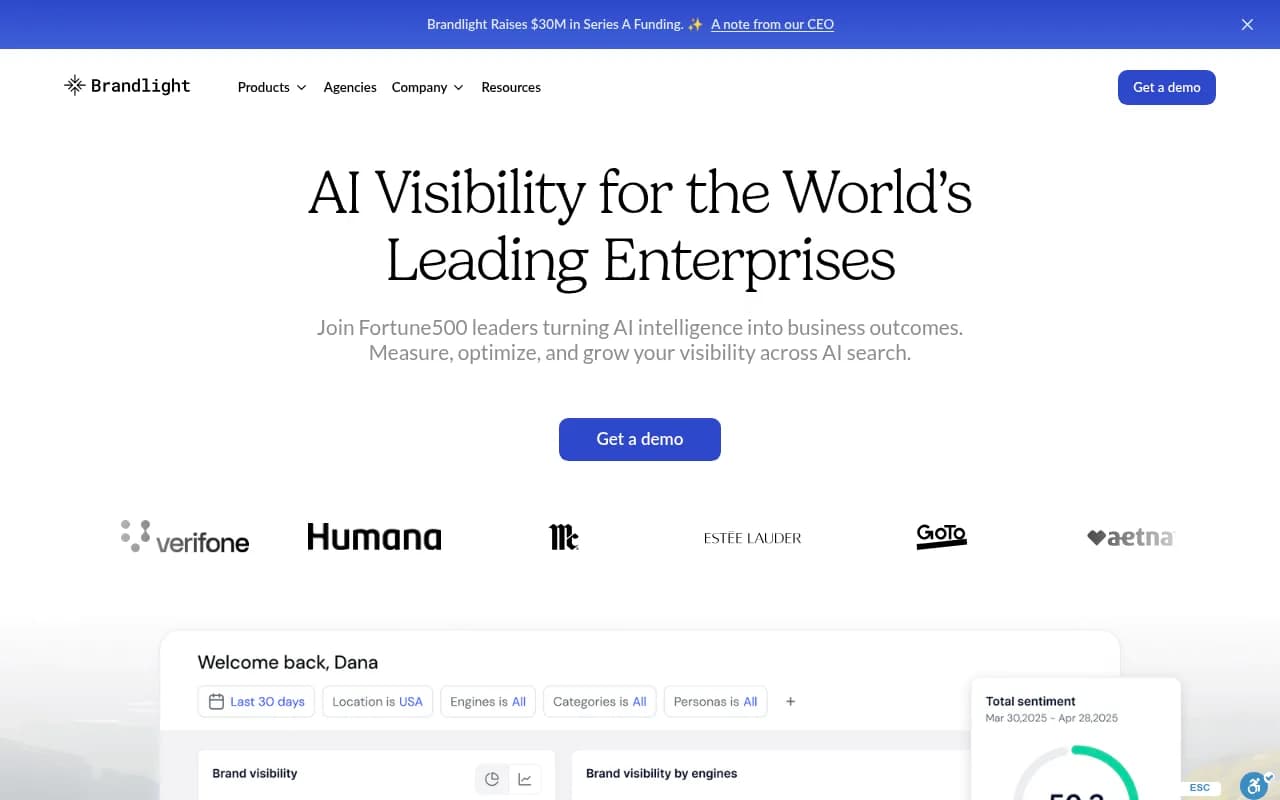
Brandlight positions itself as an AI visibility platform for enterprise brands. Its site lists modules for visibility scoring per engine and category, competitive benchmarking, sentiment by topic, engine and market, technical health (crawler access, schema, server issues), content agents that draft answer pages, shopping visibility, publisher and PR outlet recommendations, social and creator citations, an AI ads manager, and a leadership portfolio view.
The marketing shows Claude, ChatGPT, Gemini and Grok. I could not confirm from public sources whether Google AI Overviews or AI Mode are covered, so ask directly.
It also promises page-level edit recommendations with estimated impact scores, plus a dedicated AEO team working alongside yours. That services layer is the specialist angle: you get strategists, not just a dashboard.
The downsides come from a competitor source, so weigh them accordingly: opaque pricing, enterprise-only positioning, and sales-led onboarding. LLM Pulse reports third-party estimates of roughly $199/month entry plans and $4K to $15K/month enterprise contracts, depending on brands, regions and modules. Treat that as unverified until you have a quote. Otterly lists Brandlight pricing as "Custom" and describes it as $30M-funded.
Customer names on the site (Kimberly-Clark, Samsung, Mediaocean, You.com, Xebia, GoTo) are vendor testimonials. The site claims "#1 AEO platform globally" with no source, so I would ignore that line.
Semrush One: the suite with AI inside
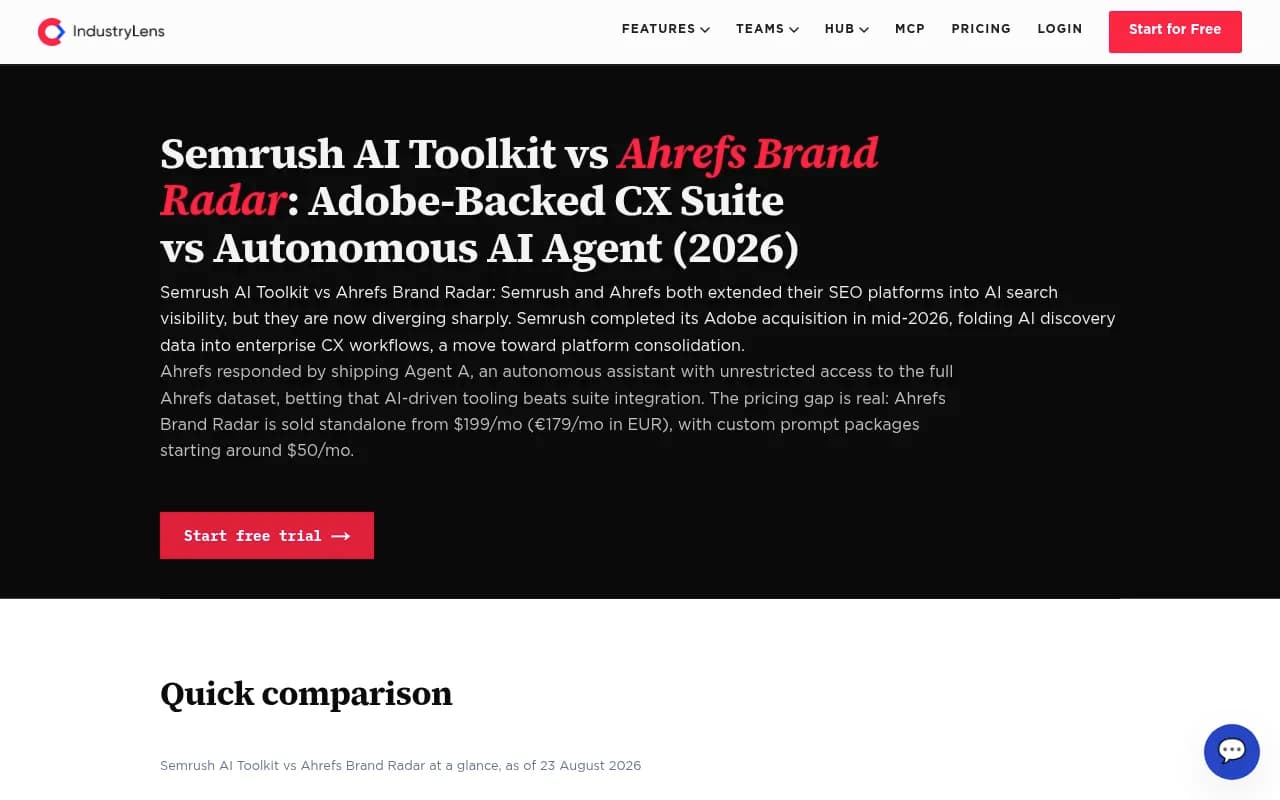
According to IndustryLens (prices checked October 7, 2026), there is no standalone Semrush AI Visibility Toolkit. AI tracking is bundled into Semrush One plans:
- Semrush One Starter: $199/month (about $165/month billed annually), 50 tracked prompts
- Semrush One Pro+: $299/month
- Semrush One Advanced: $549/month billed annually
- Enterprise: custom, with custom prompt monitoring and product/persona tracking
IndustryLens also notes Semrush completed its Adobe acquisition in 2026, folding AI search data into Adobe's enterprise CX stack, and published an AI Visibility Index study covering 180M+ AI answers. All of this comes from one aggregator and I did not verify it against Semrush's own pricing page. Do that before you put numbers in a budget doc.
The appeal is obvious. If your team already uses Semrush for keywords, audits and rank tracking, AI visibility lands in the same login with the same reporting habits.
Ahrefs Brand Radar: the data-heavy challenger

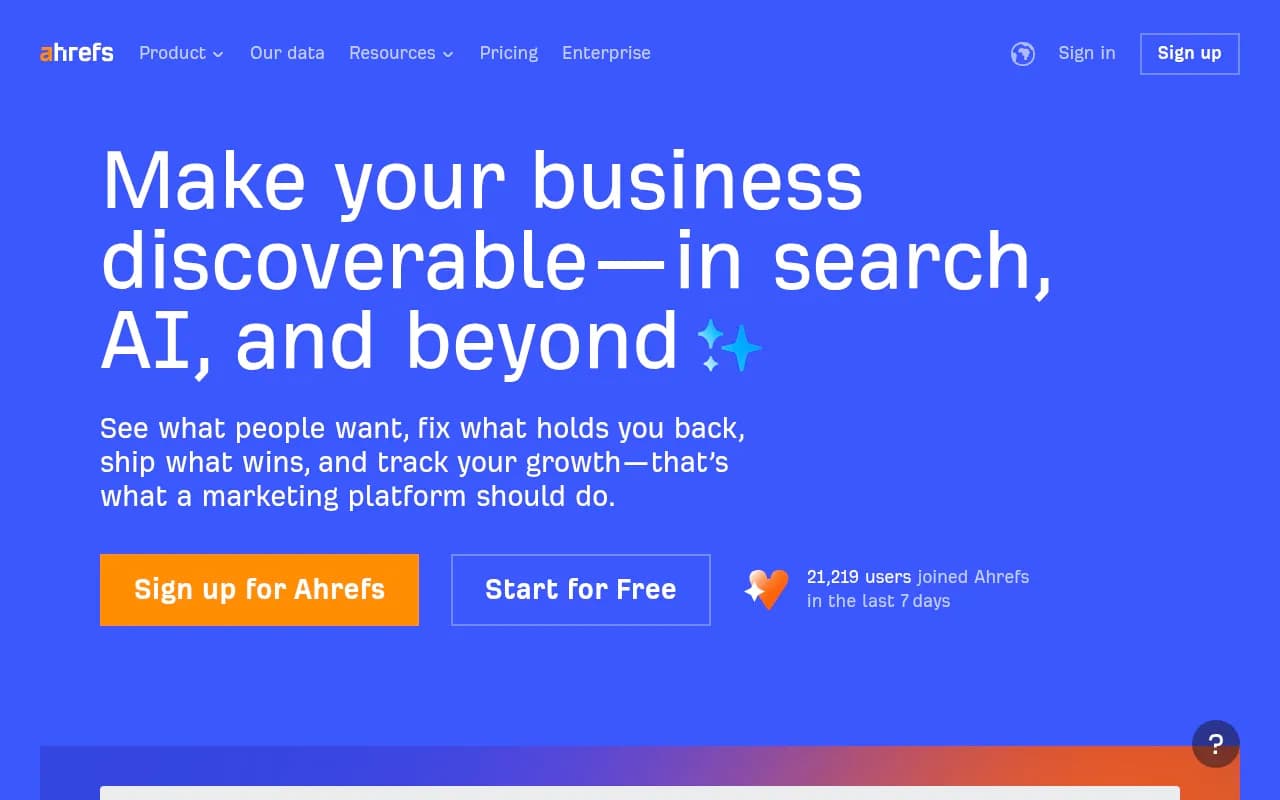
Ahrefs' own page describes two modes. Prompt Tracking (custom prompts) starts at $50/month and is free for every paid Ahrefs Lite plan and above. The AI Visibility Index, which lets you explore any brand with no setup, starts at $199/month. The page cites 538 million prompts in the index and says 3,000+ companies use it.
Included prompts for existing Ahrefs customers, all updating daily:
- Lite: 150 checks/month, 5 prompts
- Standard: 300 checks/month, 10 prompts
- Advanced: 600 checks/month, 20 prompts
- Enterprise: from 2,500 checks/month, from 83 prompts
Each prompt is checked daily on every selected platform, so 5 prompts on 1 platform equals 150 checks/month. Claude reportedly burns more checks per check; verify the multiplier. Features include AI prompt suggestions, fan-out query discovery, tags, competitor benchmarking, citation discovery, sentiment, and buyer-journey stage. AI traffic reporting is free with Ahrefs Web Analytics, and Bot Analytics (AI crawler visits) is free in beta.
One discrepancy: IndustryLens says $199/month standalone with no base Ahrefs subscription. Ahrefs' own page shows $199 for the Index and $50 for Prompt Tracking. Profound's review mentions an additional $699/month for some configurations. Pricing here is clearly modular, so get it in writing.
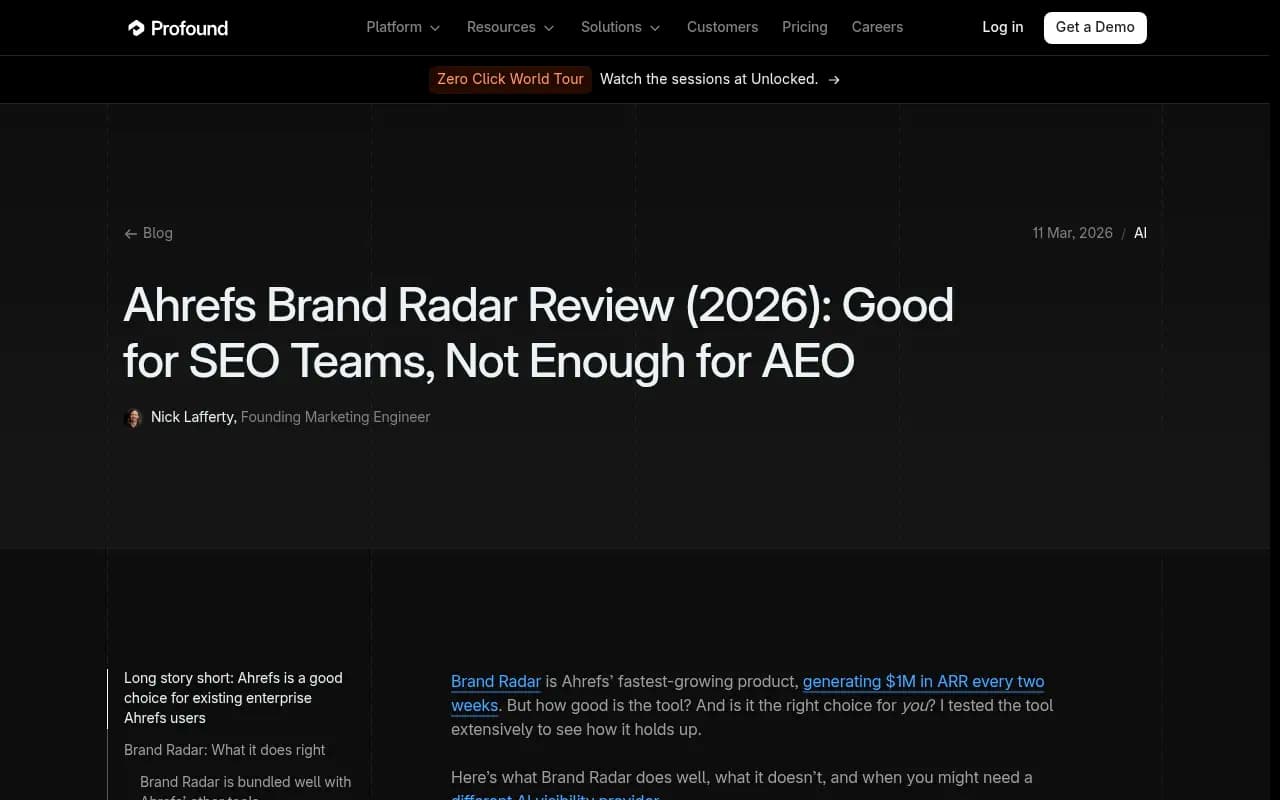
Profound's verdict, remembering the source: good for existing enterprise Ahrefs users, not enough if you want deep AI insight, recommendations or content generation. Their listed cons were missing coverage of Claude, Meta and Grok, a search-derived prompt approach, surface-level insights (no real sentiment analysis, they claim, though Ahrefs' page now lists sentiment), and no direction on how to improve.
Side-by-side comparison
| Brandlight | Semrush One | Ahrefs Brand Radar | |
|---|---|---|---|
| Type | AI visibility specialist | SEO suite with AI tracking | SEO suite with AI tracking |
| Public pricing | No (third-party estimates only) | Yes, from $199/mo (unverified) | Yes, from $50/mo prompts, $199/mo Index |
| Standalone | Yes | No | Yes (per IndustryLens) |
| Starting prompts | Custom | 50 on Starter | 5 on Lite |
| Content help | Content agents, AEO team | Separate Semrush content tools | Data only, per Profound |
| Crawler / technical | Technical health module | Via SEO toolkit | Bot Analytics (beta) |
| Shopping / ads | Yes, claimed | Shopping tracking on Advanced | Not listed |
| Social / video | Social and creator citations | Not confirmed | YouTube, TikTok |
| Sales process | Sales-led | Self-serve plus Enterprise | Self-serve plus Enterprise |
How to choose
Pick the suite you already use if the job is reporting
If your goal is to show leadership a trend line and your SEO team already works in Semrush or Ahrefs, adding AI tracking there is low friction. Semrush gives you bundled SEO plus AI. Ahrefs gives you a huge prompt index, particularly strong on AI Overviews according to Profound.
Watch the metering. Ahrefs counts checks per prompt per platform per day, so tracking many prompts across many engines drains the allowance fast. Semrush's 50-prompt Starter allowance is small for an enterprise brand with several product lines and markets.
Pick a specialist if the job is changing the answers
Brandlight's pitch is that it goes beyond measurement: technical fixes, content agents, outlet recommendations and a human team. That matters if your problem is not "how visible are we" but "why are we missing from these answers and who fixes it." The cost is a sales cycle and a price you cannot see in advance.
Do not skip the rest of the market
The three tools in the title are not the only choices. Others in the same arena include Profound for enterprise monitoring, Peec AI for lighter-weight tracking, and Scrunch. For a wider scan, the GEO software directory at bestgeosoftware.com lists dozens more.
Where Promptwatch fits
If you want one tool that covers both the monitoring and the fixing, Promptwatch is worth including in the evaluation. It tracks the real interfaces of ChatGPT, Google AI Overviews, Google AI Mode, Gemini, Perplexity, Copilot and others across countries and languages, then connects the data to IP-verified AI crawler logs, visitor analytics, and a Content Agent that writes and publishes pages to WordPress, Webflow or Framer. The loop closes by checking whether the published page got crawled, cited and clicked.

That is the gap the suites leave open. Semrush and Ahrefs show you data, and in Ahrefs' case Profound says there is no direction on how to improve. Promptwatch's Action Board and Agent Chat turn the data into a prioritized to-do list. Business is $579/month (EUR 499) with the Content Agent, hourly tracking options, local GEO targeting, Fact Check, Shopping and Ads Radar. Confirm current pricing at promptwatch.com/pricing, and use the free AI visibility report or the 7-day trial to test it against your own prompts. Head-to-head pages exist for Semrush and Ahrefs, and the full 2026 platform comparison covers the rest.
It is also ISO/IEC 27001 certified and GDPR compliant, which tends to matter in enterprise procurement.
Run a matched test before you buy
Percepture's October 2026 buyer guide makes the point that matters most: a visibility score is only useful if your team can explain what it measures. Use their approach.
- Pick 30 to 50 real buyer questions, the same for every vendor.
- Use the same brands, competitors and markets.
- Separate three measures: a brand mention, a linked citation, and an explicit recommendation. A tool that lumps them together will flatter you.
- Record the answer date, question, market and source links beside any summary score.
- Ask each vendor to show you the underlying answer, not just the number.
- Compute total cost, including extra prompts, extra engines, markets and seats.
Engine-level questions to ask
Citation behavior varies a lot by engine. Promptwatch's average sources per response data shows ChatGPT citing about 5 sources per web-search answer, while Google AI Overviews and Perplexity cite roughly 10. Copilot swung between under 2 and nearly 17. So a blended score hides real differences, and you should insist on per-engine reporting.
Ask about query fan-outs too. A single ChatGPT prompt can trigger multiple background searches, and Promptwatch's ChatGPT query fan-out data shows that volume and query length shift over time. Ahrefs advertises fan-out discovery. Check whether the others expose it.
And ask about sources beyond your own site. Promptwatch's October 2026 social citations data found ChatGPT drew 0.46% of citations from social platforms while Google AI Overviews drew 12.2% (Sep 28 to Oct 4, 2026). If a tool reports social citations as one number across engines, it is hiding that split.
Questions to put to each vendor
| Question | Why it matters |
|---|---|
| Which engines, from the real UI or API? | User-facing answers can differ from API outputs |
| How are prompts chosen: yours or a fixed set? | Fixed sets may not match your buyers |
| Can I see the raw answer and citations? | Audit trail for any score |
| What happens when I add markets or languages? | Cost scaling |
| Is there crawler or traffic data? | Separates access problems from content problems |
| What do I do with the data? | Recommendations, content, or just charts |
| What is the total cost at my scale? | Headline prices are rarely the real number |
My take
For a team already deep in Ahrefs, Brand Radar is the cheap, sensible first step, and I would start there on the Prompt Tracking tier before spending more. For a team already deep in Semrush, the bundled route is easy but the 50-prompt Starter ceiling will bite quickly at enterprise scale. Brandlight makes sense when you want hands-on strategy and are fine with a sales process and an unseen price.
The weak spot all three share, to varying degrees, is the distance between seeing a problem and fixing it. If that distance is your actual bottleneck, shortlist a platform that handles execution and measurement together, then run the same 30-question test across every finalist and let the evidence decide.