Key takeaways
- Google rank tracking measures your position for specific keywords in a list of blue links. ChatGPT brand tracking measures whether you get mentioned at all in a conversational response.
- Being #1 on Google does not mean ChatGPT will recommend you. The two systems pull from entirely different signals.
- AI models like ChatGPT cite sources based on authority, topical coverage, and entity recognition — not keyword density or backlink counts.
- Tracking your brand in AI search requires different tools, different KPIs, and a different content strategy than traditional SEO.
- Brands that appear in 90% of AI Mode responses (vs 43% in traditional AI Overviews) show how much the visibility gap has widened in 2026.
- Platforms like Promptwatch are built specifically for AI brand tracking — not just monitoring, but finding gaps and fixing them.
If you've been doing SEO for any length of time, you know the rhythm: pick your keywords, track your positions, watch the rankings move up or down. It's a familiar loop. But in 2026, a growing share of your potential customers aren't typing queries into Google and scrolling through blue links. They're asking ChatGPT, Perplexity, or Gemini a direct question and getting a direct answer.
That changes everything about how brand visibility works.
The problem is that most marketing teams are still applying Google-era thinking to an AI-era problem. They assume that ranking #1 on Google means they're visible everywhere. It doesn't. A brand can dominate Google's first page and be completely absent from ChatGPT's recommendations for the same topic.
Here are the seven differences that actually matter.
1. What you're measuring is fundamentally different
In Google rank tracking, you're measuring position. Where does your page appear for "best CRM software"? Are you in position 1, 5, or 23? The metric is a number on a scale.
In ChatGPT brand tracking, there's no position. There's presence or absence. When someone asks ChatGPT "what's the best CRM for a 10-person startup?", either your brand gets mentioned or it doesn't. If it does get mentioned, you want to know: is it a primary recommendation, a secondary mention, or a passing reference? Is the sentiment positive, neutral, or negative?
This is a categorical shift. You're not optimizing a rank — you're optimizing inclusion and framing. The KPIs look completely different:
| Metric type | Google rank tracking | ChatGPT brand tracking |
|---|---|---|
| Primary metric | Keyword position (1-100+) | Brand mention rate (%) |
| Secondary metrics | CTR, impressions, SERP features | Sentiment, recommendation rank, share of voice |
| Competitor view | Side-by-side ranking comparison | Which brands get cited instead of you |
| Trend tracking | Position changes over time | Mention frequency changes over time |
| Traffic signal | Clicks from organic results | AI-referred traffic (LLM.txt, referral logs) |
The mental model shift is real. You're no longer asking "where am I?" — you're asking "am I in the conversation at all?"
2. The ranking signals are completely different
Google's algorithm is built on links, on-page optimization, and hundreds of other signals that SEOs have spent 20 years reverse-engineering. Keyword density, title tags, meta descriptions, Core Web Vitals, E-E-A-T — these all feed into where you rank.
ChatGPT doesn't work that way. It doesn't crawl your site in real-time and score your title tag. It was trained on a corpus of text, and it generates responses based on what it learned. What gets a brand cited in AI responses is closer to:
- How often and how authoritatively the brand appears in the training data
- Whether the brand is clearly associated with a specific category or use case
- Whether there's consistent, factual information about the brand across multiple sources (Wikipedia, industry publications, review sites, Reddit, etc.)
- Whether the brand's own content directly answers the kinds of questions users ask
That last point is worth dwelling on. A LinkedIn post from Connor Gillivan made the rounds in 2026 with a blunt observation: "Keyword stuffing. Fluff to hit word count. Google doesn't mind. AI skips right past it. That's why brands ranking #1 are invisible to ChatGPT."
He's right. Content that's optimized purely for keyword density often lacks the direct, factual, question-answering structure that AI models prefer when deciding what to cite.
3. The query format is completely different
Google rank tracking is built around keywords. You pick a list of terms — "project management software", "best CRM 2026", "HubSpot alternatives" — and you track your position for each one.
AI brand tracking is built around prompts. Users don't type "best CRM" into ChatGPT. They type "I'm running a 15-person agency and we're switching from spreadsheets to a CRM — what would you recommend and why?" That's a conversational, contextual, multi-part question. No single keyword captures it.
This means you need to think in terms of prompt categories rather than keyword lists. What are the types of questions your potential customers ask AI assistants? What buying-stage questions lead to product recommendations? What comparison questions ("X vs Y") might include your brand?
Tools designed for AI visibility tracking let you define these prompts and monitor them systematically. The approach is different from building a keyword list, but the underlying logic — understand what your audience is searching for, then make sure you're visible for it — is the same.

4. The competitive landscape looks different
In Google rank tracking, your competitors are whoever ranks above you for your target keywords. You know who they are because you can see them in the SERP.
In AI brand tracking, your competition is whoever gets mentioned when you don't. That's not always your obvious direct competitors. ChatGPT might recommend a niche tool you've never heard of, a Reddit thread, a YouTube review, or a well-known industry blog. The "competitors" in AI responses are anyone who has established enough authority in the training data to earn a mention.
This creates a different kind of competitive analysis. You need to ask: for the prompts that matter to my business, who is getting cited? Why are they getting cited? What do they have that I don't?
That's the core of what's sometimes called Answer Gap Analysis — finding the specific questions and topics where competitors are visible in AI responses but you're not. Once you know the gap, you can create content that fills it.
Otterly.AI

5. The content strategy required is different
Google SEO has a well-established content playbook: target a keyword, write a long-form article optimized for that keyword, build links to it, wait. It works, more or less.
AI visibility requires a different kind of content. AI models tend to cite content that:
- Directly answers specific questions in a clear, structured way
- Covers a topic comprehensively enough to be considered authoritative
- Is consistent with what other credible sources say (AI models cross-reference)
- Exists in formats and on platforms that AI crawlers access (your own site, but also third-party publications, review sites, and community platforms like Reddit)
That last point is underappreciated. Research on AI citation patterns consistently shows that AI models don't just pull from brand websites. They pull from wherever the best answer lives. If the best answer to "what's the best project management tool for remote teams" lives on a Reddit thread or a Wirecutter-style comparison site, that's what gets cited.
This means your AI visibility strategy has to extend beyond your own website. You need to think about your presence on review platforms, your coverage in industry publications, and even how your brand is discussed in community forums.
6. The tracking infrastructure is different
Google rank tracking is mature. Tools like Semrush, Ahrefs, and AccuRanker have been doing it for years. You connect your site, add your keywords, and get daily position updates. The data is reliable and the tooling is excellent.
AI brand tracking is newer and more complex. You can't just check a position — you have to actually query the AI model with a prompt and analyze the response. That means:
- Running prompts across multiple AI models (ChatGPT, Perplexity, Claude, Gemini, etc.) because each one may give different answers
- Parsing natural language responses to detect brand mentions and sentiment
- Tracking changes over time as AI models update their training data or retrieval behavior
- Monitoring which of your pages AI crawlers are actually visiting (and which they're ignoring)
The last point is something most marketers don't think about: AI models have their own crawlers. GPTBot, ClaudeBot, PerplexityBot — they all crawl the web, and what they find (or don't find) on your site directly affects how you appear in responses. Monitoring these crawler logs is a capability that separates serious AI visibility platforms from basic monitoring tools.
7. The feedback loop and optimization cycle is different
With Google rank tracking, the feedback loop is relatively clear: you publish content, Google indexes it, you track your position, you see if it moved. The cycle takes weeks to months, but the cause-and-effect relationship is reasonably traceable.
With AI brand tracking, the loop is less direct. AI models don't index your content in real-time. Training data has cutoffs. Retrieval-augmented models (like Perplexity) are more dynamic, but even they have their own weighting logic. You might publish a great piece of content and not see it reflected in AI responses for weeks or months.
This makes the optimization cycle longer and more iterative. The approach that works is:
- Identify which prompts your brand should be visible for but isn't
- Create content that directly addresses those prompts
- Distribute that content across channels that AI models are known to cite
- Monitor your brand mentions over time to see if the needle moves
- Repeat
That's a fundamentally different workflow than traditional SEO. It requires a platform that can handle all five steps — not just the monitoring part.
Most tools on the market right now only do step 4. They show you where you're mentioned and where you're not. That's useful, but it leaves you stuck. The more capable platforms close the loop by helping you identify gaps, generate content designed to fill them, and track whether that content actually improves your AI visibility.
Promptwatch is one of the few platforms built around this full cycle. It combines Answer Gap Analysis (step 1), an AI writing agent trained on citation data (step 2), and page-level tracking that shows which of your pages are being cited by which models (step 4 and 5). For teams that want to move beyond monitoring into actual optimization, that distinction matters.
Putting it together: what this means for your 2026 strategy
The honest answer is that you need both. Google still drives enormous traffic, and traditional rank tracking isn't going anywhere. But AI search is growing fast enough that ignoring it is a real business risk.
The practical implication: run your Google rank tracking as you always have, but add a parallel AI visibility program. That means:
- Defining the prompts that matter for your category (buying-stage questions, comparison questions, use-case questions)
- Monitoring those prompts across the major AI models on a regular cadence
- Auditing which of your pages AI crawlers are visiting and whether they're finding what they need
- Building content that answers the questions AI models want answered — not just content optimized for keyword density
- Tracking your brand mention rate over time and benchmarking against competitors
The table below summarizes how to think about the two programs side by side:
| Dimension | Google rank tracking | AI brand tracking |
|---|---|---|
| Core question | Where do I rank? | Am I being recommended? |
| Input | Keyword list | Prompt library |
| Output | Position (1-100) | Mention rate, sentiment, share of voice |
| Optimization lever | On-page SEO, links, technical | Content depth, entity authority, third-party presence |
| Update frequency | Daily/weekly | Weekly/monthly (model-dependent) |
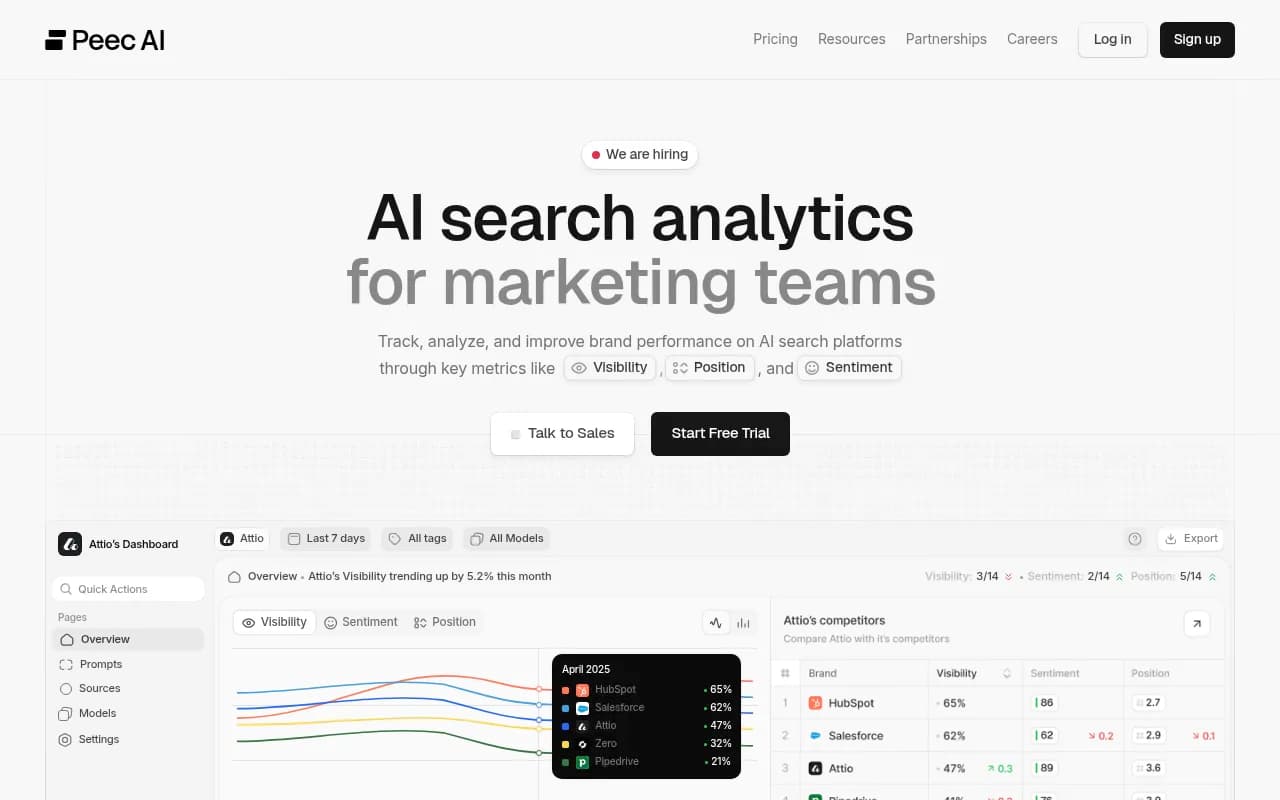
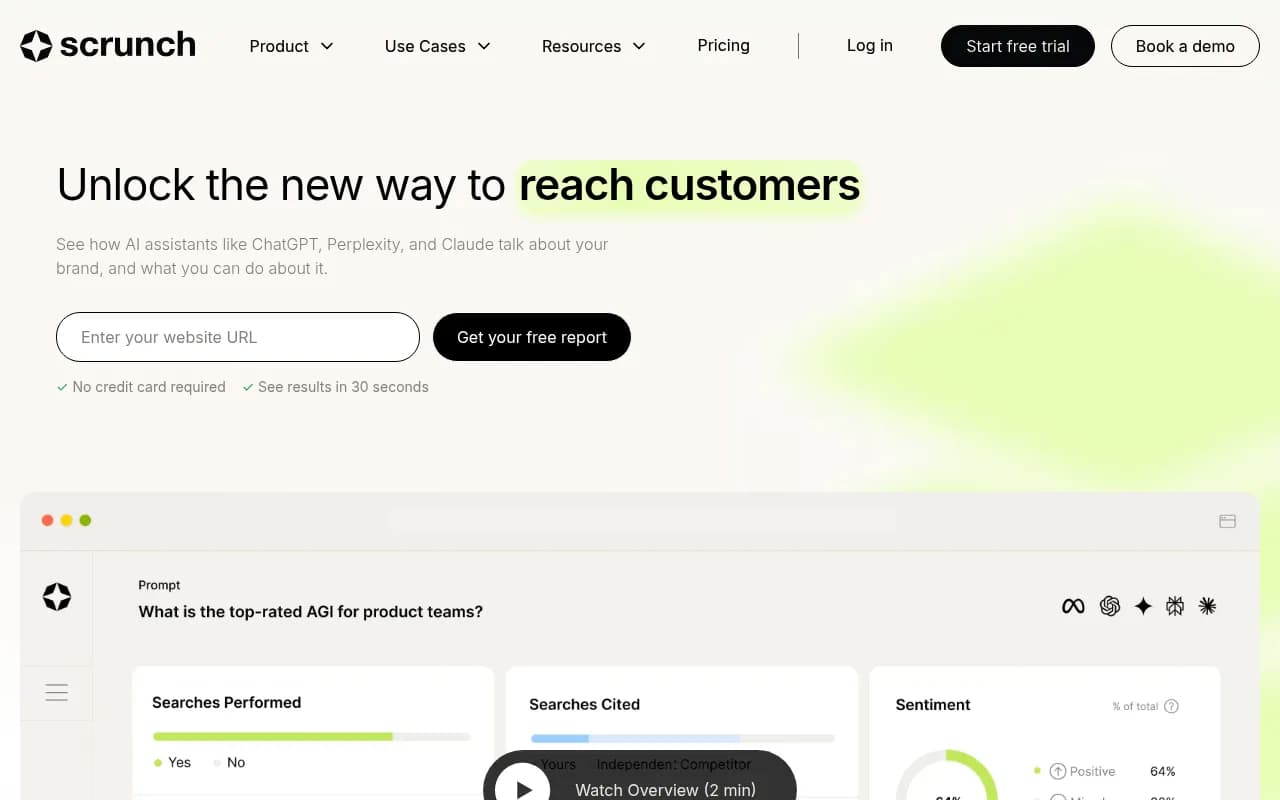
| Key tools | Semrush, Ahrefs, AccuRanker | Promptwatch, Nightwatch, Peec AI |
| Traffic attribution | GA4, GSC | Referral logs, LLM.txt, server logs |
The brands that figure this out early will have a meaningful head start. AI search isn't replacing Google overnight, but it's already influencing buying decisions at scale — and the gap between brands that are visible in AI responses and those that aren't is only going to widen.
Start with the prompts your customers are actually asking. Find out if you're in the answer. If you're not, figure out why. Then fix it.
That's the whole game.