Key takeaways
- ChatGPT, Claude, and Perplexity use fundamentally different retrieval mechanisms -- what gets cited in one won't necessarily get cited in another
- Perplexity is the most citation-heavy and transparent, pulling from live web results with explicit source links
- Claude relies heavily on training data and tends to favor authoritative, well-structured content -- it doesn't browse the web by default
- ChatGPT uses an external retrieval layer when browsing is enabled, with industry-specific variance in what it surfaces
- Tracking all three requires model-specific prompt testing, not just a single visibility score
- Tools like Promptwatch can monitor brand citations across all three simultaneously and help you close the gaps
Most brands treating AI visibility as a single metric are measuring the wrong thing. The question isn't just "does ChatGPT mention us?" -- it's "does ChatGPT mention us, does Claude mention us, and does Perplexity mention us, and why does the answer differ across all three?"
Because it does differ. Significantly.
Yext Research analyzed 17.2 million AI citations and found that different AI systems rely on different types of sources when constructing answers. That's not a minor technical footnote. It means your brand could be well-cited in Perplexity and completely invisible in Claude -- and the fix for one won't automatically fix the other.
This guide breaks down how each engine actually decides what to cite, where the gaps tend to appear, and how to build a tracking setup that gives you real visibility across all three.
How each AI engine decides what to cite
ChatGPT: retrieval with industry variance
When ChatGPT browses the web (which it does by default in most current versions), it uses an external retrieval layer -- essentially a search step that happens before the model generates its response. This isn't the same as Google. ChatGPT's retrieval logic is more opaque, and the Yext research found meaningful industry-specific variance in what it surfaces.
For some categories (like travel or finance), ChatGPT tends to pull from well-known aggregators and review platforms. For others, it leans on official brand websites. The implication: the type of content that gets cited varies by vertical, not just by quality.
A few things ChatGPT consistently rewards:
- Structured, factual content with clear entity signals (brand name, location, category)
- Pages that answer specific questions directly, not just category pages
- Content that appears in sources ChatGPT's retrieval layer already trusts
ChatGPT also has persistent memory and custom GPT features, which means returning users may see brand mentions shaped by prior interactions. That's a variable most brand trackers ignore entirely.
Claude: training data and structured authority
Claude is different in a way that catches a lot of marketers off guard: it doesn't browse the web by default. When you ask Claude about a brand, it's drawing on its training data, not a live search. That changes everything about how you optimize for it.
Claude tends to favor content that was well-represented in its training corpus -- which means authoritative, well-structured pages that were widely linked and indexed before the training cutoff. It's also noted for high-quality language understanding, which means thin or keyword-stuffed content is less likely to be surfaced favorably.
The practical implication: Claude rewards the same signals that made traditional SEO work -- topical authority, clear entity definitions, structured data, and genuine depth. But because it's not pulling live results, recent content changes won't affect Claude citations immediately. There's a lag built into the model.
Claude also tends to be more cautious about citing specific brands unless the information is well-established. You're less likely to see Claude recommend a brand it has limited training signal on, even if that brand has a strong web presence today.
Perplexity: live web, explicit citations, high transparency
Perplexity is the most citation-transparent of the three. It pulls from live web results and shows its sources directly in the response -- which makes it both the easiest to track and the most competitive to rank in.
Because Perplexity is essentially a search-augmented generation system, it behaves more like a search engine than a language model. That means traditional SEO signals matter more here than with Claude. Pages that rank well in search tend to get cited by Perplexity. But there's a twist: Perplexity also pulls from Reddit, forums, YouTube, and other non-traditional sources when they're relevant. A strong Reddit presence or a well-cited YouTube video can drive Perplexity citations even without a top-ranking website.
Perplexity is widely considered the "gold standard" for accuracy and research tasks in 2026 comparisons, which means users asking research-oriented questions are disproportionately likely to end up there. If your brand operates in a category where people do research before buying, Perplexity visibility is arguably the most valuable of the three.
The citation gap problem
Here's where it gets interesting. Because these three engines use different retrieval logic, a brand can have completely different visibility profiles across them. Consider a few common scenarios:
- A brand with strong traditional SEO might rank well in Perplexity but be invisible in Claude (because their content is thin on topical depth and entity signals)
- A brand with deep, well-structured content might do well in Claude but miss Perplexity citations because they have no Reddit or forum presence
- A brand that's been around for years might have strong Claude visibility from historical training data but poor ChatGPT visibility because their current web content doesn't match how ChatGPT's retrieval layer categorizes their industry
The only way to know your actual position is to test each engine separately, with prompts that match how your customers actually search.
What signals each engine rewards
| Signal | ChatGPT | Claude | Perplexity |
|---|---|---|---|
| Live web content | Yes (with browsing) | No (training data) | Yes (primary source) |
| Traditional SEO rankings | Partial | Indirect | Strong |
| Structured data / schema | Helpful | Helpful | Helpful |
| Reddit / forum presence | Partial | Indirect | Strong |
| Brand entity clarity | Important | Very important | Important |
| Content recency | Moderate | Low (training lag) | High |
| Review platform presence | Industry-dependent | Indirect | Moderate |
| YouTube citations | Partial | Indirect | Yes |
| Deep topical authority | Moderate | High | Moderate |
This table isn't exhaustive, but it illustrates the core point: optimizing for one engine doesn't automatically optimize for the others.
How to track brand citations across all three
Step 1: Define your prompt set
The first thing you need is a set of prompts that represent how your actual customers search. Not generic brand queries ("what is [brand]?") but intent-based prompts:
- "What's the best [category] tool for [use case]?"
- "Compare [your brand] vs [competitor]"
- "What do people say about [brand]?"
- "Which [category] should I use for [specific problem]?"
Run each prompt in ChatGPT, Claude, and Perplexity separately. Record whether your brand appears, where it appears in the response, and what context surrounds the mention.
Step 2: Track citation frequency and sentiment
A single test tells you almost nothing. You need to run prompts repeatedly over time to understand:
- How consistently your brand appears (visibility rate)
- Whether the sentiment is positive, neutral, or negative
- Which competitors are being cited instead of you
- Whether your brand appears in the main response or just as a footnote
This is tedious to do manually at any scale. Most teams doing this seriously use a dedicated tracking platform.
Step 3: Identify model-specific gaps
After a few weeks of tracking, patterns emerge. Maybe you're consistently cited in Perplexity for one category but never for another. Maybe Claude mentions you in historical context but doesn't recommend you for current use cases. These gaps are actionable.
For each gap, ask: what content is missing that would give this engine the signal it needs? For Perplexity, that might mean getting cited on Reddit or in industry publications. For Claude, it might mean creating deeper, more authoritative content on topics where you're currently thin.
Step 4: Create content that closes the gaps
This is where most monitoring tools stop -- they show you the gap but leave you to figure out the fix. The more useful approach is to connect the gap analysis directly to content creation, using citation data to inform what you write and how you structure it.
Promptwatch is one of the few platforms that does this end-to-end: it identifies which prompts competitors are visible for that you're not, then has a built-in AI writing agent that generates content specifically engineered to get cited by each model. It's built on analysis of over 880 million citations, which means the content recommendations aren't guesswork.

Step 5: Close the loop with traffic attribution
Visibility scores are useful, but the real question is whether AI citations are driving actual traffic and revenue. This requires connecting your AI visibility data to your analytics -- either through a code snippet, Google Search Console integration, or server log analysis.
Server log analysis is particularly useful here because AI crawlers (ChatGPT's GPTBot, Anthropic's ClaudeBot, Perplexity's PerplexityBot) leave traces in your logs. Knowing which pages these crawlers are reading -- and how often -- tells you a lot about where your content is being indexed for AI retrieval.
Tools for tracking AI citations in 2026
There are now quite a few platforms in this space, ranging from basic monitors to full optimization suites. Here's how the main options compare:
| Tool | ChatGPT tracking | Claude tracking | Perplexity tracking | Content generation | Crawler logs |
|---|---|---|---|---|---|
| Promptwatch | Yes | Yes | Yes | Yes (AI writing agent) | Yes |
| Otterly.AI | Yes | Yes | Yes | No | No |
| Peec AI | Yes | Yes | Yes | No | No |
| Profound | Yes | Yes | Yes | No | No |
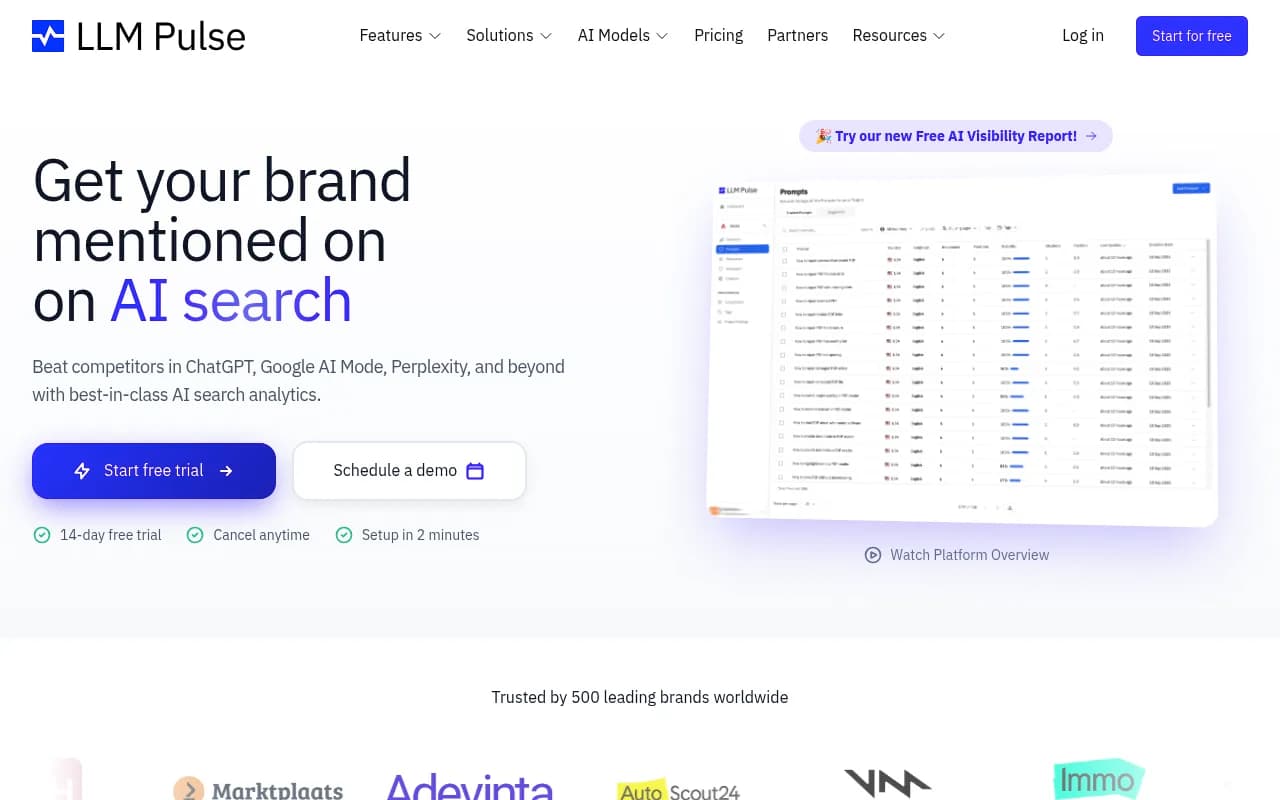
| LLM Pulse | Yes | Partial | Yes | No | No |
| Rankshift | Yes | Partial | Yes | No | No |
Otterly.AI



Profound

The monitoring-only tools are fine for getting started -- they'll show you where you're visible and where you're not. The limitation is that they stop there. If you want to actually improve your citations (not just measure them), you need a platform that connects the data to action.
Model-specific optimization tactics
Improving ChatGPT citations
- Make sure your brand has a clear, consistent entity presence across the web (official website, Wikipedia if applicable, major directories)
- Create content that directly answers the specific questions your customers ask -- not just category pages
- Get cited in the types of sources ChatGPT's retrieval layer trusts for your industry (this varies by vertical, so check what sources are currently being cited for your target prompts)
- Monitor ChatGPT Shopping if you sell products -- it has its own citation logic separate from informational queries
Improving Claude citations
- Focus on topical depth over breadth. Claude rewards comprehensive, authoritative content on specific topics
- Use clear entity signals: make sure your brand name, category, and key attributes are explicitly stated in your content (not just implied)
- Build structured data into your pages -- schema markup helps models understand what your content is about
- Think long-term: Claude's training data has a lag, so content you publish today may take months to influence Claude's responses
Improving Perplexity citations
- Traditional SEO still matters here -- pages that rank in search tend to get cited
- Build a presence in the sources Perplexity trusts: Reddit, industry forums, YouTube, and well-known publications
- Answer specific questions directly in your content. Perplexity is optimized for research queries, so content that reads like a clear, sourced answer performs well
- Keep content updated -- Perplexity pulls from live web results, so recency matters more here than with Claude
A practical tracking workflow
If you're starting from scratch, here's a simple workflow that doesn't require a big budget:
- Pick 10-15 prompts that represent your most important customer queries
- Run them manually in ChatGPT, Claude, and Perplexity once a week
- Log the results in a spreadsheet: brand mentioned (yes/no), position in response, competitor mentions, sentiment
- After 4 weeks, look for patterns -- where are you consistently missing?
- Prioritize the gaps by business impact (which prompts drive the most valuable customers?)
- Create or update content to address the top 3 gaps
- Re-run the prompts 4-6 weeks later to measure impact
This manual approach works up to about 20-30 prompts. Beyond that, it becomes impractical and you'll want a dedicated tracking tool.
For teams tracking 50+ prompts across multiple models, the time savings from automation are significant. Platforms like Promptwatch, Otterly.AI, or Peec AI can run hundreds of prompts automatically and surface the changes that matter -- so you're spending time on strategy rather than copy-pasting responses into a spreadsheet.
The bottom line
ChatGPT, Claude, and Perplexity are not interchangeable from a brand visibility perspective. They use different retrieval logic, reward different signals, and require different optimization strategies. Treating them as a single "AI search" channel means you're probably missing significant opportunities in at least one of them.
The brands that will win AI search visibility in 2026 are the ones that understand these differences and build content strategies that address each engine's specific requirements -- not just the ones that publish the most content and hope for the best.
Start by measuring where you actually stand in each engine. The gaps will tell you where to focus.