Key takeaways
- Copy.ai is the fastest to deploy and cheapest per seat, but it's built for GTM copy and campaign automation — not GEO content strategy.
- Jasper has the strongest brand voice controls and template depth, but its output has become increasingly generic and it lacks native GEO tracking.
- AirOps is the most technically capable of the three for content operations, with real connections to SEO data and AI search signals — but the learning curve is steep and pricing is opaque.
- None of the three tools closes the full GEO loop on their own: they can generate content, but they don't track whether that content earns AI citations or show you what to fix.
- For teams that need to go beyond content generation into actual AI visibility measurement and optimization, a dedicated GEO platform is necessary alongside whichever writing tool you choose.
The question GEO teams keep running into in 2026 isn't "which AI writer is best?" It's "which tool actually helps us show up in ChatGPT, Perplexity, and Google AI Overviews?" Those are different questions, and conflating them leads to expensive mistakes.
Copy.ai, Jasper, and AirOps are three of the most widely evaluated AI content platforms right now. They each have real strengths. But their ceilings for GEO work are very different, and understanding where each one stops is just as important as knowing what it does well.
This guide breaks down all three honestly, with a specific focus on what matters for teams trying to earn visibility in AI-generated answers.
What "GEO ceiling" actually means
Before comparing tools, it's worth being precise about what we mean by ceiling.
A tool's GEO ceiling is how far it can take you toward the actual goal: getting your content cited by AI search engines. That involves at least three things:
- Understanding which prompts and questions AI models are answering in your category
- Creating content that answers those questions better than what's already being cited
- Tracking whether your content gets picked up, and by which models
Most AI writing tools handle a version of step two. Very few touch steps one or three. The ceiling question is really about how much of this loop a tool supports natively.
Copy.ai: fast, cheap, and built for GTM — not GEO
Copy.ai started as a copywriting tool and has evolved into something closer to a GTM automation platform. Its current positioning is around sales sequences, campaign workflows, and marketing copy at scale.

For pure speed and cost, it's hard to beat. The Chat plan runs around $4.80 to $5.80 per seat with five seats included, making it one of the lowest team entry points in the market. Onboarding is genuinely simple — most teams are producing usable output within an hour.
The problem for GEO teams is that Copy.ai's strengths are mostly orthogonal to what GEO requires. It's excellent at:
- Email sequences and ad copy
- Short-form campaign content
- GTM automation workflows
- Fast iteration on messaging variants
It's not built for:
- Long-form SEO or AEO content with structural depth
- Prompt-level research (what are AI models actually being asked in your category?)
- Citation gap analysis
- Tracking whether published content earns AI citations
Copy.ai will help you produce content faster. It won't tell you what content to produce, whether it's structured in a way AI models can cite, or whether it's working. For GEO teams, that's a significant gap.
One more thing worth noting: the AI output quality from Copy.ai is solid for short-form copy but tends to drift toward generic at longer lengths. B2B content that needs specific claims, data points, and genuine perspective requires heavy editing after generation.
Best for: Marketing and sales teams that need fast, affordable copy automation for campaigns and GTM workflows. Not the right primary tool for a GEO-focused content strategy.
Jasper: the brand voice leader with a GEO blind spot
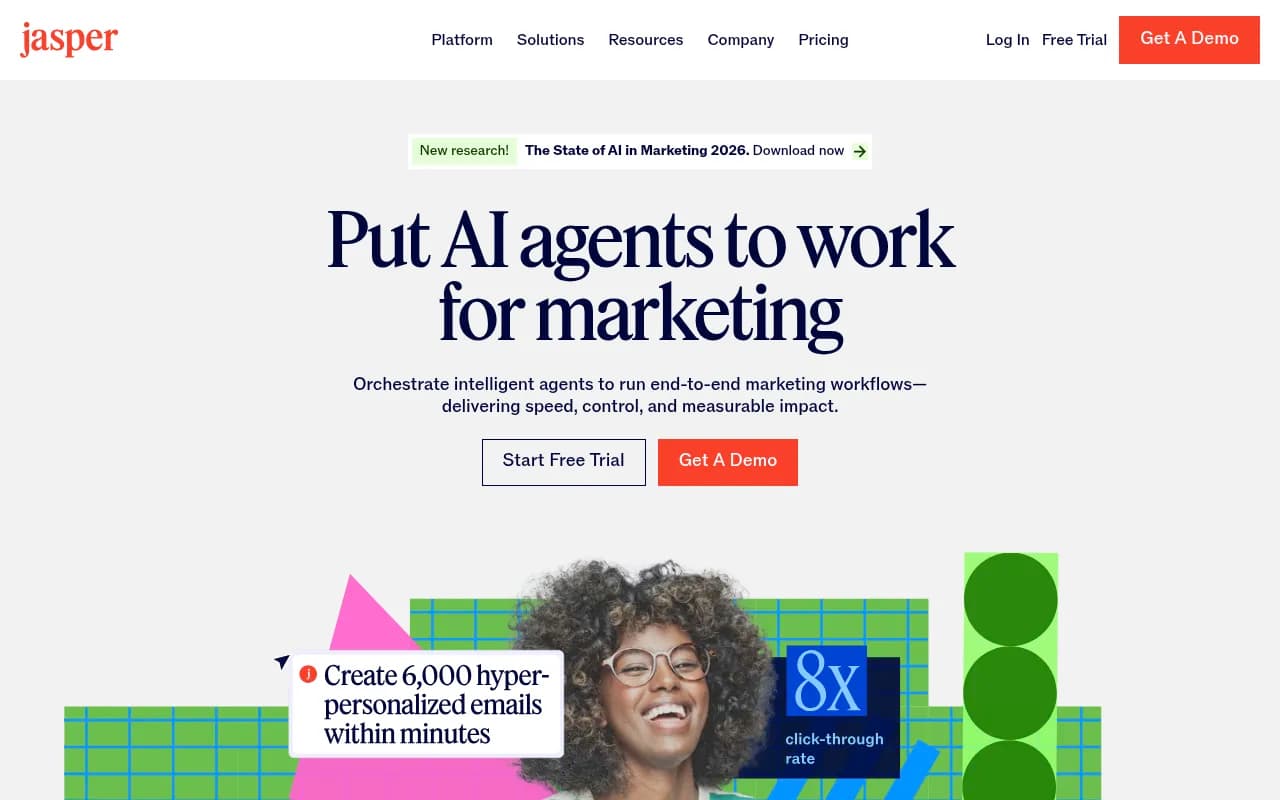
Jasper is the most mature AI writing platform of the three. It has a large template library, solid brand voice controls, and a genuine track record with marketing teams that need consistent output across multiple writers or markets.
Where Jasper genuinely earns its reputation:
- Brand voice configuration is the best in this comparison. You can train it on your tone, terminology, and style guidelines in a way that actually sticks across outputs.
- Template depth is real — there are purpose-built templates for case studies, landing pages, product descriptions, and more.
- The Jasper AI agents feature (launched in late 2025) lets you automate multi-step content workflows, which is a meaningful upgrade from pure generation.
Where it falls short for GEO teams:
Jasper's output has become a recognized problem in B2B content circles. When every competitor is using the same underlying models with similar prompts, the resulting content reads fine but lacks the specificity and perspective that AI models tend to cite. Fluent prose that says nothing new doesn't earn citations.
More fundamentally, Jasper doesn't have native GEO tracking. It can't tell you which prompts AI models are answering in your space, which competitors are being cited, or whether your published content has been picked up by ChatGPT or Perplexity. You're generating content somewhat blind to whether it's actually moving the needle.
Jasper also has a pricing structure that gets expensive quickly at team scale. The per-seat model works fine for small teams but becomes a real cost center for larger content operations.
Best for: Marketing teams with established brand guidelines that need consistent, on-brand content at scale. Works well as a writing layer when paired with a separate GEO tracking tool. Not a standalone GEO solution.
AirOps: the most GEO-capable of the three, with real tradeoffs
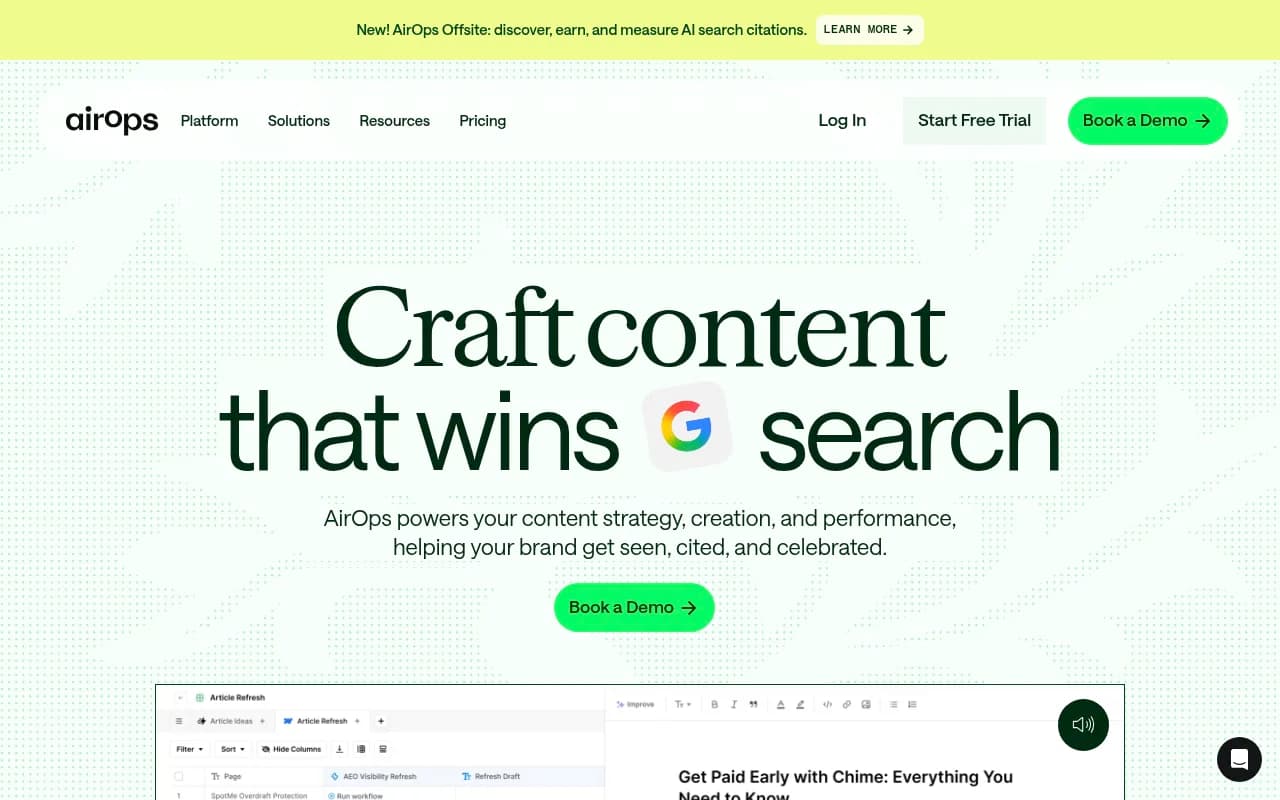
AirOps is the most technically sophisticated option here, and the one that comes closest to being a genuine GEO content platform. It's positioned as a "content engineering" tool — connecting AI generation with SEO data, brand kits, and AI search signals.
What AirOps does that the others don't:
- It connects to real SEO and AEO data sources, so content generation is informed by actual search signals rather than just prompts.
- Workflow automation is genuinely powerful — you can build complex content pipelines that pull from multiple data sources, apply brand rules, and output structured content at scale.
- It has more explicit support for AI search optimization than either Copy.ai or Jasper, with features designed around Answer Engine Optimization (AEO) content structures.
The tradeoffs are real though, and they're why teams keep looking for AirOps alternatives:
The learning curve is steep. Initial workflows can take days to configure and test properly. Teams that expected a plug-and-play solution often find themselves debugging complex automation sequences instead of publishing content.
Pricing is opaque. AirOps doesn't publish clear pricing tiers, which makes budget planning difficult and tends to push it toward enterprise-oriented deals that don't fit smaller teams.
Even with its SEO data connections, AirOps doesn't natively track whether your content earns AI citations after publication. You can build content that's structured for AI search, but you're still flying somewhat blind on results.
Best for: Content operations teams with technical resources to configure and maintain complex workflows, and a budget that supports enterprise-level tooling. The highest ceiling of the three for GEO content production — but it requires real investment to reach that ceiling.
Head-to-head comparison
| Dimension | Copy.ai | Jasper | AirOps |
|---|---|---|---|
| Starting price | ~$4.80/seat/mo | ~$49/mo (individual) | Custom / opaque |
| Onboarding speed | Fast (< 1 hour) | Moderate | Slow (days) |
| Brand voice controls | Basic | Strong | Moderate |
| Long-form content quality | Weak | Moderate | Moderate-strong |
| SEO/AEO data integration | None | Limited | Strong |
| GEO content structuring | None | None | Partial |
| AI citation tracking | None | None | None |
| Prompt gap analysis | None | None | None |
| Workflow automation | Strong (GTM focus) | Moderate | Strong (content ops) |
| Best fit | GTM/sales copy | Brand-consistent marketing | Technical content ops |
| GEO ceiling | Low | Low-moderate | Moderate |
The table makes the core issue clear: none of these tools close the full GEO loop. They're all generation tools. The tracking, gap analysis, and optimization layer has to come from somewhere else.
The missing piece: what GEO teams actually need
Here's the uncomfortable reality. If your goal is to earn citations in ChatGPT, Perplexity, Google AI Overviews, or any other AI search engine, content generation is only one part of the problem.
You also need to know:
- Which prompts are driving AI responses in your category right now
- Which competitors are being cited for those prompts, and why
- Which pages on your site are being crawled by AI agents, and which ones aren't
- Whether your newly published content is getting picked up, and how long it takes
None of Copy.ai, Jasper, or AirOps answer those questions. They're writing tools, not GEO platforms.
For teams serious about AI search visibility, a dedicated GEO platform needs to sit alongside whichever writing tool you choose. Promptwatch is built specifically for this — tracking citations across 10+ AI models, running answer gap analysis to show exactly which prompts competitors are winning that you're not, and connecting AI crawler logs to actual traffic attribution.

The combination that tends to work well in practice: use AirOps or Jasper for content production, and use a GEO platform to tell you what to produce and whether it's working. Treating them as substitutes for each other is where teams waste budget.
Which tool fits which team?
Choose Copy.ai if:
- Your primary content need is GTM copy, sales sequences, and campaign assets
- You need fast onboarding with minimal technical overhead
- Budget is a real constraint and you need the lowest per-seat cost
- GEO is not yet a core priority for your team
Choose Jasper if:
- Brand consistency across a large team is your biggest content challenge
- You're producing high volumes of marketing copy across multiple channels
- You have an existing SEO workflow and just need better writing speed
- You're willing to pair it with a separate GEO tracking tool
Choose AirOps if:
- You have technical resources to configure and maintain complex workflows
- Content operations at scale (100+ pages/month) is the goal
- You need tight integration between content generation and SEO data
- You can absorb the learning curve and opaque pricing
Consider alternatives if:
- You need the full GEO loop: gap analysis + content generation + citation tracking
- Your team is small and can't absorb AirOps' setup complexity
- You want transparent pricing at every tier
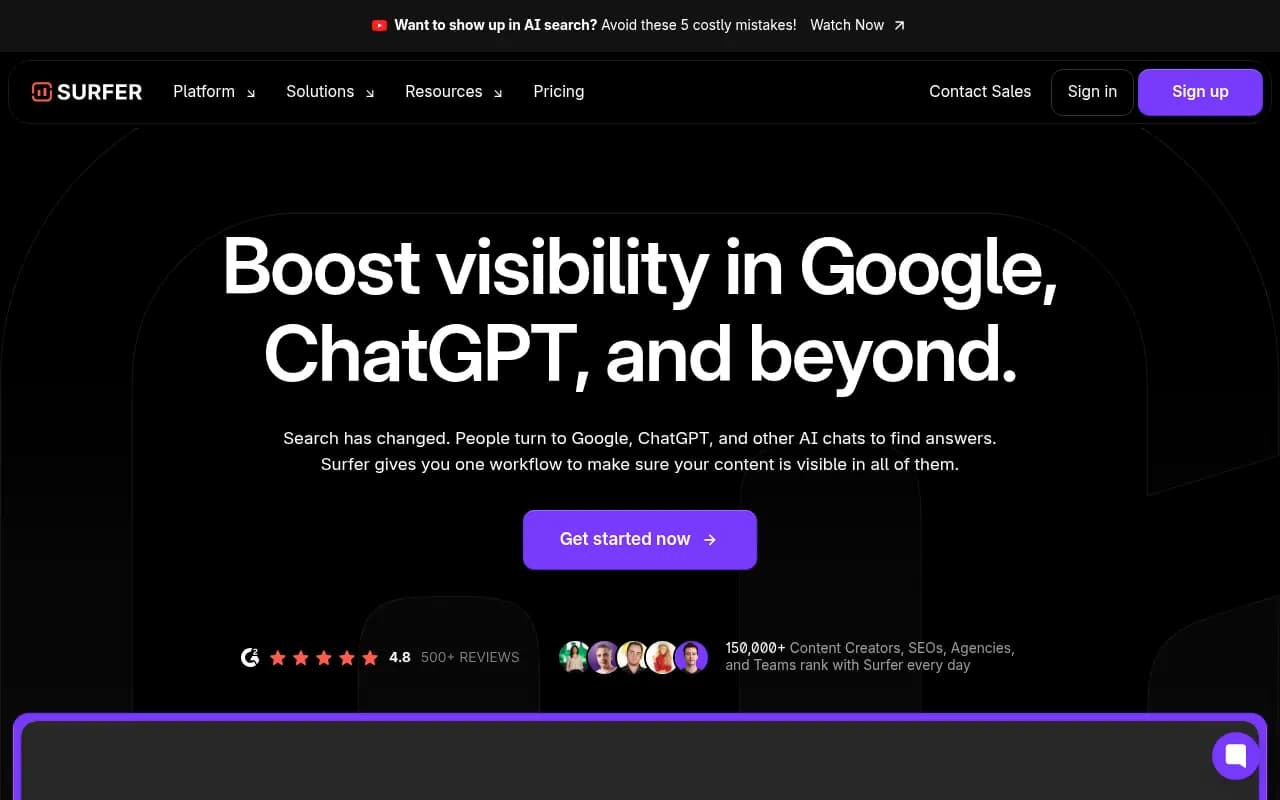
For teams that want a more integrated approach to GEO content, tools like Search Atlas combine SEO data with content generation in a more accessible package, and Surfer SEO remains strong for content optimization against real SERP data.

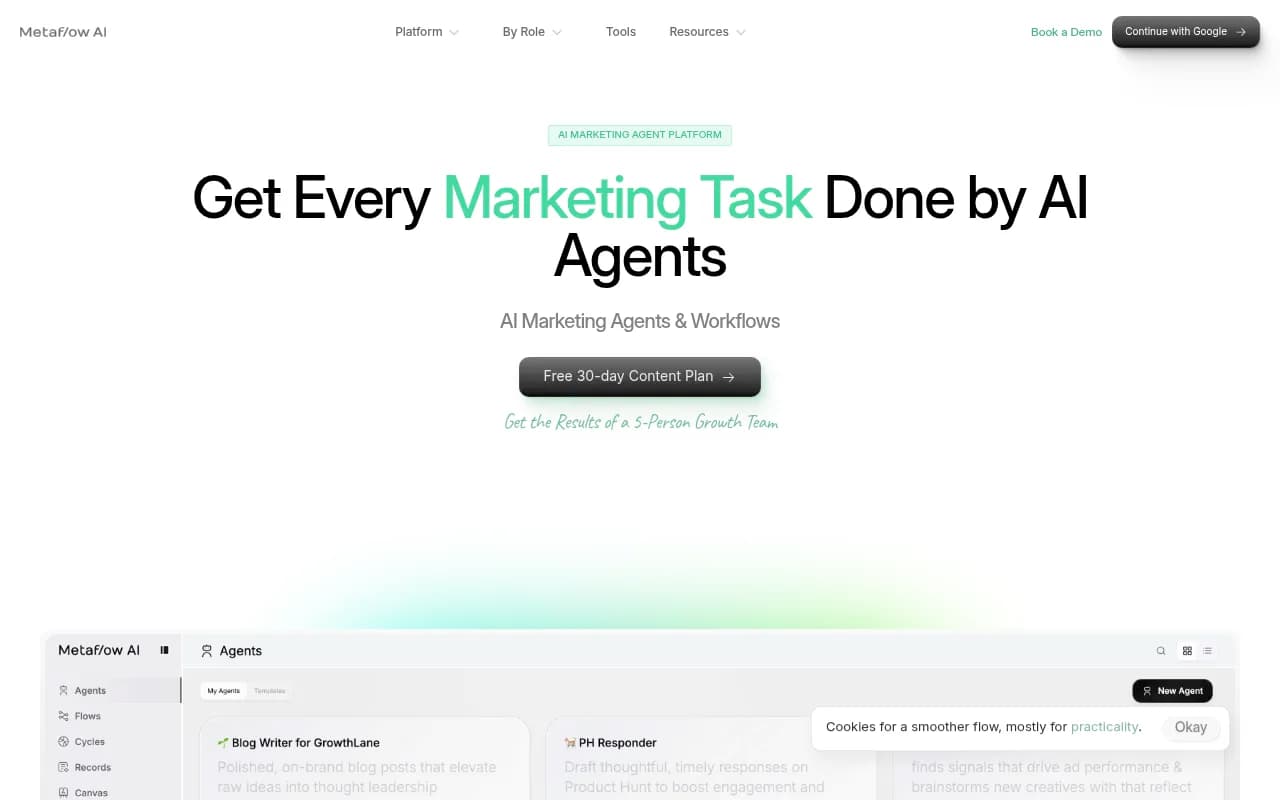
For content operations teams that need workflow automation without AirOps' complexity, Metaflow AI and Narrato AI are worth evaluating.
The honest verdict
Copy.ai has the lowest ceiling for GEO work. It's a capable GTM tool that happens to produce content, not a content platform built for AI search visibility.
Jasper has a higher ceiling for brand-consistent content production, but it's still fundamentally a writing tool. Its GEO ceiling is limited by the lack of prompt intelligence, citation tracking, and any feedback loop on what's actually working in AI search.
AirOps has the highest ceiling of the three for GEO content operations, but reaching that ceiling requires real technical investment. Teams that can configure it properly get a genuinely powerful content pipeline. Teams that can't end up with expensive, half-configured workflows.
The bigger point is that all three tools share the same fundamental limitation: they generate content, but they don't tell you what content to generate or whether it's earning AI citations. For GEO teams in 2026, that second part is the actual job. Whichever writing tool you choose, budget for a GEO tracking and optimization layer alongside it — otherwise you're producing content without knowing if it's working.