Key takeaways
- Copy.ai, Writesonic, and Jasper are content production tools — they help you write faster, but none of them track or optimize for AI citation visibility.
- Getting cited by ChatGPT, Perplexity, or Google AI Overviews requires a different strategy than traditional SEO: you need to know which prompts AI models are answering, which sources they're pulling from, and what gaps exist in your content.
- Jasper is the most capable marketing platform of the three, but it still doesn't tell you whether your content ends up in AI-generated answers.
- Promptwatch approaches this from the opposite direction: it starts with what AI models are already citing, then helps you create content to fill the gaps — and tracks whether it works.
- If your goal is AI search visibility (not just content volume), you need both a writing tool and a GEO platform, or a platform that combines both.
The question most comparisons skip
Every "best AI writing tool" roundup in 2026 compares the same things: output quality, templates, pricing, tone controls, brand voice settings. Useful stuff. But there's a question almost nobody asks:
Does the content these tools produce actually get cited by AI search engines?
That's not a small distinction. If your customers are asking ChatGPT which CRM to use, which accounting software is best for freelancers, or which project management tool integrates with Slack — and your brand isn't in those answers — you're invisible to a growing chunk of your market.
Writing faster doesn't fix that. Writing the right content does.
So this comparison does something a little different. It evaluates Copy.ai, Writesonic, and Jasper on their own terms (content production, quality, workflow), and then introduces Promptwatch as a fundamentally different category of tool — one built around making your content visible in AI-generated answers, not just producing it.
What each tool actually does
Before getting into the weeds, here's the honest one-line version of each:
- Copy.ai: Fast AI copywriting for marketing teams, with a focus on GTM workflows and short-form content.
- Writesonic: AI writer with blog automation features, SEO templates, and a built-in chatbot builder.
- Jasper: The most enterprise-ready of the three — a full marketing platform with AI agents, brand voice controls, and content pipelines.
- Promptwatch: Not an AI writing tool in the traditional sense. It tracks how AI search engines respond to real user prompts, identifies where your brand is missing, and generates content specifically engineered to fill those gaps.
These are not the same category of product. Comparing them directly is a bit like comparing a word processor to a search analytics platform. But the question of which one helps you rank in AI search is what ties them together.
Copy.ai: fast output, limited depth

Copy.ai has repositioned itself significantly over the past two years. It started as a template-heavy copywriting tool and has evolved into something closer to a GTM automation platform, with workflow features for sales and marketing teams.
For pure content production, it's genuinely fast. You can generate email sequences, ad copy, landing page sections, and social posts in minutes. The interface is clean and the output is usable without heavy editing for short-form work.
Where it falls short:
- Long-form content (blog posts, pillar pages) tends to feel thin. The research depth isn't there.
- There's no mechanism to understand what AI models are actually citing. You're writing blind.
- Brand voice controls exist but are basic compared to Jasper.
- No SEO integration to speak of — you'd need a separate tool for that.
Copy.ai is a solid choice if your team needs to produce marketing copy at volume and you're not worried about AI search visibility. If you are worried about it, Copy.ai won't help you.
Pricing: Starts around $49/month for the Pro plan. Team and enterprise plans available.
Writesonic: blog automation with SEO bones

Writesonic has always leaned harder into long-form content than Copy.ai. Its blog writer can produce full articles with outlines, introductions, and structured sections — and it integrates with tools like Surfer SEO for on-page optimization.
The Botsonic product (a no-code chatbot builder) is a separate but interesting addition if you need AI chat on your site.
For content teams focused on traditional SEO, Writesonic is a reasonable workhorse. The output quality is decent for informational content, and the SEO templates help structure articles around keywords.
But here's the problem: traditional SEO optimization and AI search optimization are not the same thing. Optimizing for keyword density and heading structure gets you into Google's blue links. Getting cited by ChatGPT or Perplexity requires something different — your content needs to directly answer the specific questions those models are being asked, in a format they find authoritative.
Writesonic doesn't know what those questions are. It can help you write an article, but it can't tell you whether that article will ever appear in an AI-generated answer.
Pricing: Free tier available. Individual plans from $20/month. Teams and enterprise pricing available.
Jasper: the most capable writing platform of the three
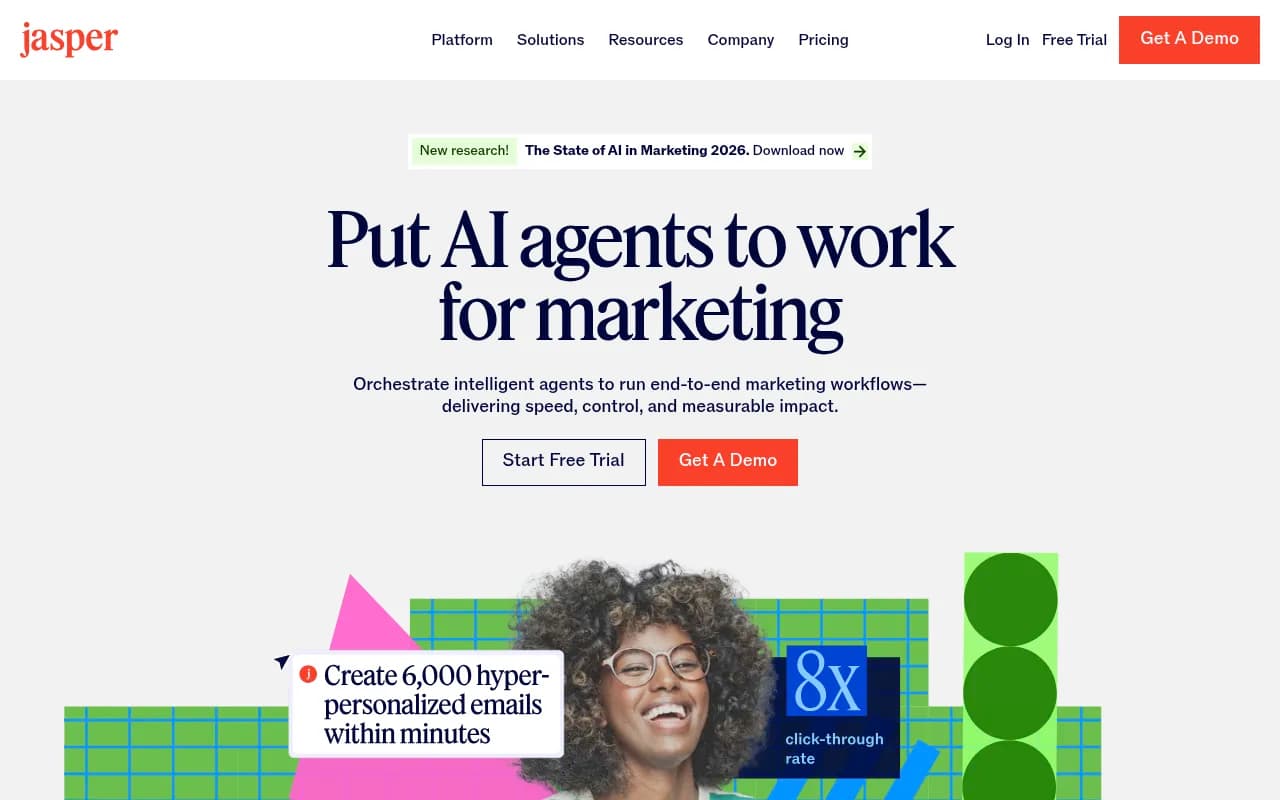
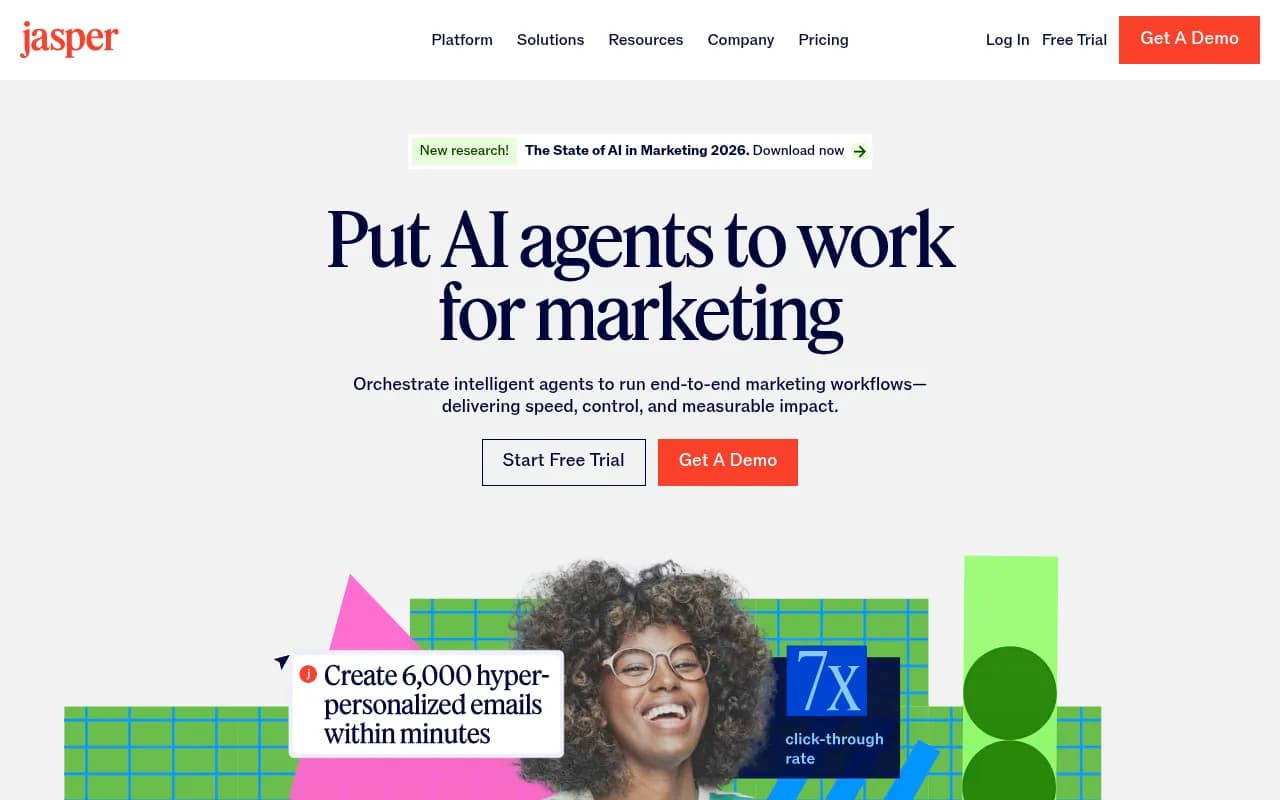
Jasper is the most mature product in this comparison. It's evolved from a GPT-4 wrapper with templates into a genuine marketing platform with AI agents, content pipelines, and brand voice controls that actually work.
If you're running a marketing team that produces content at scale — blog posts, ads, emails, social, landing pages — Jasper handles all of it with more consistency than Copy.ai or Writesonic. The brand voice feature is legitimately useful: you can train it on your existing content and it'll match your tone reasonably well.
The AI agents are the most interesting recent addition. You can set up workflows where Jasper researches a topic, drafts content, and formats it for different channels — reducing the manual steps between brief and published piece.
What Jasper still doesn't do: tell you whether any of that content ends up cited in AI search results. It has no visibility into how ChatGPT, Perplexity, or Google AI Overviews respond to prompts in your category. You can produce excellent content with Jasper and still be completely invisible in AI-generated answers.
According to testing by Zemith (who evaluated 12 AI writing tools in early 2026), specialized tools like Jasper "mostly wrap ChatGPT/Claude with templates and SEO features" — and for most writers, Claude Pro or ChatGPT Plus delivers comparable output at a third of the price. That's a fair point for individual writers. For teams that need workflow, brand consistency, and scale, Jasper justifies its cost. But it doesn't solve the AI visibility problem.
Pricing: Creator plan at $49/month, Pro at $69/month, Business custom pricing.
The comparison table
| Copy.ai | Writesonic | Jasper | Promptwatch | |
|---|---|---|---|---|
| Primary use case | Marketing copy & GTM workflows | Blog automation & SEO content | Enterprise content platform | AI search visibility & GEO |
| Long-form content | Basic | Good | Strong | Via Content Agents |
| Brand voice controls | Basic | Basic | Strong | Guided by brand instructions |
| SEO optimization | None | Surfer integration | Basic | AI-specific (not traditional SEO) |
| AI citation tracking | No | No | No | Yes |
| Prompt gap analysis | No | No | No | Yes |
| Knows which prompts AI answers | No | No | No | Yes |
| AI crawler logs | No | No | No | Yes |
| Competitor AI visibility | No | No | No | Yes |
| Reddit/YouTube insights | No | No | No | Yes |
| Content grounded in real prompt data | No | No | No | Yes |
| Starting price | $49/mo | $20/mo | $49/mo | $99/mo |
| Free trial | Yes | Yes | Yes | Yes |
Promptwatch: built for AI search, not just content production
Promptwatch starts from a completely different question. Instead of "how do I write content faster?", it asks: "what are AI models being asked right now, what are they citing, and what's missing from your site?"

That reframe changes everything about how the tool works.
The core workflow looks like this:
-
Find the gaps: Promptwatch's Answer Gap Analysis shows you exactly which prompts your competitors are appearing in but you're not. You see the specific questions AI models are answering in your category — and which ones your content doesn't address.
-
Create content that fills those gaps: Content Agents generate articles, comparisons, listicles, and briefs grounded in actual prompt data, citation data, and competitor analysis. This isn't generic content — it's content built to answer the exact questions AI models are already being asked.
-
Track whether it works: Page-level tracking shows which of your pages are being cited, by which AI models, and how often. Agent analytics shows the timeline from publish to crawl to citation.
This is a fundamentally different loop than what Copy.ai, Writesonic, or Jasper offer. Those tools help you produce content. Promptwatch helps you produce content that AI models will actually use.
Some specifics worth knowing:
- Promptwatch tracks 10 AI models: ChatGPT, Perplexity, Google AI Overviews, Google AI Mode, Claude, Gemini, Meta/Llama, DeepSeek, Grok, and Copilot.
- AI Crawler Logs give you real-time visibility into when GPTBot, ClaudeBot, and other AI crawlers hit your pages — and when those crawls convert to citations.
- Prompt Intelligence includes volume estimates and difficulty scores, so you can prioritize the prompts worth targeting.
- Reddit and YouTube tracking surfaces discussions that directly influence AI recommendations — a channel most tools ignore entirely.
- ChatGPT Shopping tracking monitors when your brand appears in product recommendation carousels.
The platform is used by 1,480+ brands and agencies, including Booking.com and Center Parcs, and has processed more than 4.5 billion citations, clicks, and prompts.
So which tool do you actually need?
The honest answer is that these tools serve different jobs. Here's how to think about it:
Use Copy.ai if you need to produce marketing copy fast — emails, ads, social posts — and AI search visibility isn't a current priority. It's the most accessible entry point for small teams.
Use Writesonic if you're running a content-heavy blog strategy and want AI assistance with long-form drafts, especially if you're already using Surfer SEO for optimization.
Use Jasper if you're running a larger marketing team that needs brand consistency, workflow automation, and content at scale across multiple formats. It's the most complete writing platform of the three.
Use Promptwatch if you want your content to actually appear in AI-generated answers. It's the only tool in this comparison that tells you what AI models are being asked, what they're citing, and what you need to create to get into those answers.
The more interesting question for 2026 is whether you need both a writing tool and a GEO platform. For most brands with serious AI visibility goals, the answer is probably yes — at least until writing tools start integrating real prompt data into their content generation workflows.
Why "writing quality" is the wrong metric for AI citation
Here's something that doesn't get said enough: AI models don't cite content because it's well-written. They cite content because it's authoritative, specific, and directly answers the question being asked.
A mediocre article that directly addresses "what's the best inventory management software for Shopify stores under $1M revenue" will outperform a beautifully written piece about inventory management in general — every time.
This is why the content generation approach in Promptwatch is different from Jasper's. Jasper generates content from a brief you provide. Promptwatch generates content from actual prompt data — it knows what question is being asked, how often, what competitors are saying, and what angle is most likely to earn a citation.
The research from Teract's 2026 comparison of AI writing tools found that generic AI content required 60-80% editing to be usable for platform-specific contexts. The same principle applies to AI search: generic content doesn't get cited. Specific, prompt-matched content does.
The bottom line
If you're choosing between Copy.ai, Writesonic, and Jasper purely for content production, Jasper is the most capable platform for teams. Writesonic is the better choice for blog-focused SEO content. Copy.ai is fastest for short-form marketing copy.
But if the question is "which tool produces content that ChatGPT actually cites" — none of them answer that question on their own. That requires knowing what ChatGPT is being asked, what it's currently citing, and what gaps exist in your content. That's what Promptwatch is built to do.
The tools aren't mutually exclusive. Plenty of teams use Jasper or Writesonic for content production and Promptwatch to ensure that content is actually visible in AI-generated answers. That combination covers both sides of the problem: producing content efficiently and making sure it ends up where your customers are looking.