Key takeaways
- AI engines build answers from what third parties say about you. Third-party studies put the share of brand mentions that originate off your own domain at roughly 85% to 89%, so PR is a real GEO lever.
- Not all coverage is equal. Promptwatch Data shows news pages in ChatGPT lose half their citations within 36 days, while listicles, comparisons and reviews last longer.
- Start by finding which outlets AI already cites for your category, then pitch those outlets with original data, not company announcements.
- Measure placements by whether they show up in AI answers, not by whether they got published.
- Do not assume Reddit or social posts will carry you into ChatGPT. Social platforms are under 1% of its citations.
Why digital PR became a GEO channel
For years, digital PR meant one thing: earn links, raise authority, rank in Google. That job still exists. But there is now a second one, and I'd argue it matters more for some brands. When a buyer asks ChatGPT or Perplexity which vendors to trust, the model is not reading your homepage and deciding. It is stitching together what journalists, reviewers, analysts and independent sites have already written.
Third-party numbers point the same way. AirOps found roughly 85% of brand mentions came from outside the brand's own domain, and Ahrefs reported up to 89% of its own AI mentions originated on other websites. Treat those as directional, since I haven't checked the original studies, but they match what most people see when they audit citations by hand.
So you can publish a good blog post every day and still never get named. The model needs corroboration. Digital PR is how you manufacture it.
What the citation data says about content types
The most useful thing I've found for planning PR is not a headline stat about earned media. It is the breakdown of what kinds of pages ChatGPT actually cites. Promptwatch Data looked at which content types ChatGPT cites the most from Sep 28 to Oct 4, 2026:
- Product pages: 22.4% of classified citations
- Landing pages: 16.8%
- Listicles: 13.6%
- How-tos: 8.7%
- Docs: 7.5%
- Comparisons: 5.9%
- News: 5.7%
- Reviews: 1.7%
News is a small slice. That should change how you think about a classic press hit. A launch story in a trade publication is nice, but the formats ChatGPT leans on are roundups, comparisons and how-tos.
The split by prompt type matters even more for PR planning:
| Prompt type | What gets cited most | PR implication |
|---|---|---|
| Commercial ("best X for Y") | Product pages 26.0%, landing pages 20.6%, listicles 15.0%, comparisons 7.9% | Get into the "best of" roundups ChatGPT already cites for your category |
| Informational | Product pages 19.1%, landing pages 13.9%, listicles 13.6%, how-tos 10.7%, docs 8.5% | Expert commentary and data-backed how-tos |
| Branded (names your company) | Product pages 23.3%, landing pages 22.8%, reviews 5.6%, FAQ 4.8% | Reviews on trusted third-party sites, since they carry more than 3x their overall share |
Press releases show up too, but only at 2.1% on branded prompts. Newswire distribution alone is not a plan.
Coverage decays at different speeds
Here is the part most PR teams haven't priced in. Promptwatch tracked every page ChatGPT cited on July 6, 2026 for 90 days in its content half-life report:
- News: half of cited pages were gone after 36 days, and almost a quarter were never cited again after day 0.
- Landing pages and docs: 78% and 76% still cited at 30 days.
- Comparisons: 72% still cited at 30 days, 63% at 60.
- Listicles: about 60% still cited at 60 days.
- Product pages, reviews and how-tos: about 55% at 60 days, with half-lives of 74 to 77 days.
The practical reading: a news hit gives you a short burst. A placement in a durable comparison or listicle keeps working. If you only have budget for a few placements, bias toward the durable formats and treat news as a spike you get on top.
How ChatGPT and Perplexity differ
Placement strategies that work for one engine can be nearly useless for another. Third-party research suggests only about one in ten domains is cited by both ChatGPT and Perplexity for the same queries. I'd treat that as a reason to check each engine separately rather than as a precise number.
Some facts from Promptwatch Data are worth keeping in mind:
- ChatGPT barely cites social platforms. In Oct 11 to Nov 9, 2026, social share was 0.64% of ChatGPT citations, 1.94% on Perplexity and 13.16% on Google AI Overviews.
- Reddit's share of ChatGPT citations fell from about 4% to 0.5% on August 14, 2026. Some older guides still say Reddit dominates Perplexity. In late 2026 it is only 0.82% of Perplexity's citations in Promptwatch's data.
- Mid-authority sites do well. In August 2026, domains ranked DR 46 to 75 earned almost half of ChatGPT citations, while DR 91 to 100 fell to about 3%.
- ChatGPT pulls from many places. Almost half of responses cite 10 or more unique domains.
That domain rank finding is the one I'd put on a slide for a skeptical CMO. Chasing only the biggest publications is not where the citation share is. A solid niche trade site with a good "best tools" article can beat a famous outlet that never covers your category.
A digital PR playbook for AI citations
Step 1: find out what AI already cites
Before pitching anyone, map the sources. Run your category prompts in ChatGPT with search on and in Perplexity, then list every domain and URL cited. You want the roundups, comparison pages and review sites that show up repeatedly, not the sites you assume are important.
Doing this by hand works for a first pass. For ongoing work you need something that tracks citations at scale. Promptwatch monitors the real interfaces of ChatGPT, Perplexity, AI Overviews and others, and shows which pages and domains get cited for your prompts, including a citation breakdown by content type and source type.

Other trackers in this space include Profound, Peec AI and Otterly.AI. Most of them stop at monitoring. If you want to compare options, the GEO software directory at bestgeosoftware.com lists a lot of them.
Profound


Otterly.AI

Step 2: build the target list from citations, not authority scores
Sort the cited URLs into three buckets:
- Roundups and listicles you are not in yet.
- Comparison pages that name your competitors but not you.
- Review sites and directories that appear on branded prompts for your category.
Bucket 1 is usually the cheapest win. A reviewer or editor updating a "best of" list can add you with a pitch and a free trial. Bucket 2 often needs a data point or a product change they have not seen. Bucket 3 is about actually having reviews, which is a customer success problem as much as a PR one.
Step 3: pitch with something citable
AI models tend to lift short, factual, self-contained statements. A number. A named expert with a quote. A clear claim with a source. Pitches built on "we raised a round" or "we shipped a feature" rarely become the sentence a model reuses.
What tends to work instead:
- Original data from your product or a survey, with a clear headline number.
- A named expert giving a specific opinion on a trend, not a generic quote.
- A methodology note, so the stat can be cited and trusted.
The Princeton GEO study is often quoted here: statistics lifted AI visibility by about 33%, quotations by 41% and cited sources by 28%. I haven't verified those figures against the paper, so cite them as third-party. The direction is sensible even if you discount the exact numbers.
Step 4: turn each placement into on-site proof
When a story lands, quote it on your own pages, link to it, and make sure your site states the same facts the coverage does. Repetition across independent sources is what makes a claim hard for a model to ignore. If the press says you are "best for small teams" and your pricing page says nothing about team size, you are leaving corroboration on the table.
It also helps to check what AI says about you after coverage goes live. Brand narrative tracking, where you see the individual claims models make about you, shows whether the story is sticking.
Step 5: make sure AI can read your site
PR drives people and models to your pages. If AI crawlers get blocked or error out, you lose the follow-through. Check robots.txt and crawler access with Promptwatch's free Agentic Readiness Check, and consider AI crawler logs if you need to see which bots actually fetch which pages.
What to measure
Attribution here is genuinely messy. Responses vary, every prompt is a little different, and no one has a clean one-to-one line from a placement to a recommendation. Anyone who tells you otherwise is selling something. Track directionally, and keep a few metrics consistent:
| Metric | What it tells you |
|---|---|
| Mention rate | How often your brand appears in tracked answers |
| Citation rate | How often your domain or placements are sources |
| Share of voice | Your slice of brand mentions versus competitors |
| Position | Where you land in the list of brands in an answer |
| Sentiment and claims | Whether the story AI tells matches your positioning |
| Referral traffic and conversions | Whether the visibility turns into visits and signups |
Two cheap sources of data are worth adding. Bing Webmaster Tools matters because ChatGPT relies on Bing's index. One third-party analysis says 87% of ChatGPT's citations match Bing's top 20 results, so a placement that ranks on Bing has a better shot. And your analytics should separate AI referrals. Note that ChatGPT stopped sending a referrer on October 8, 2026, so tag links with utm_source=chatgpt.com where you can.
Tools that help at each stage
| Stage | Job | Tools to look at |
|---|---|---|
| Find cited sources | Which outlets and pages AI cites for your prompts | Promptwatch, Profound, Peec AI |
| Prospecting and outreach | Journalist lists, media monitoring | CisionOne, Meltwater, BuzzSumo |
| Brand mention tracking | Mentions on the open web | Brand24, Awario, Talkwalker |
| Measurement | Citations, crawlers, AI traffic | Promptwatch, Google Analytics, Bing Webmaster Tools |
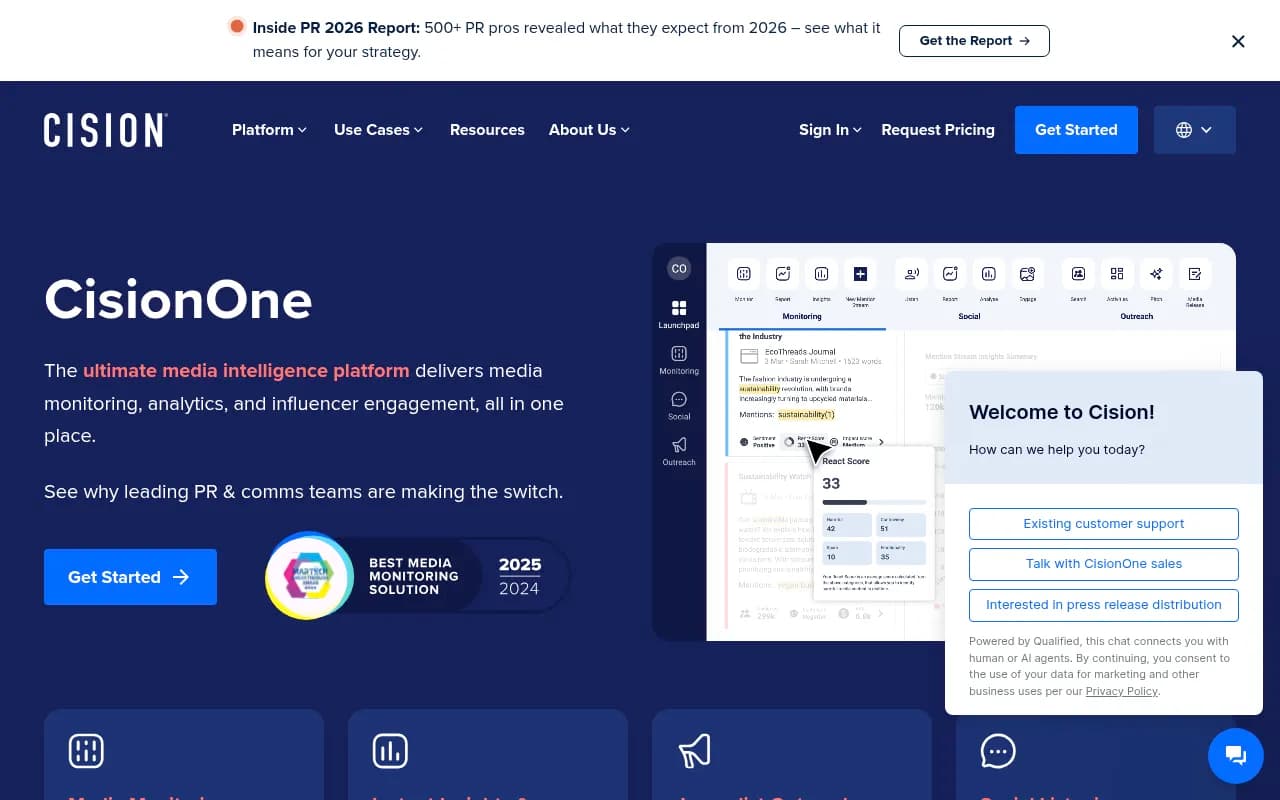
The PR-specific tools are fine for finding journalists and tracking coverage, but they were not built to tell you whether a placement shows up in an AI answer. That second part needs an AI visibility platform. Promptwatch also tracks offsite mentions, meaning third-party pages that name your brand without linking, which is exactly the kind of coverage PR creates and classic link tools ignore.
Agency or in-house
Digital PR is hard to do consistently, and it takes relationships and time. Some teams hire a specialist PR firm, some fold it into an SEO retainer. If you want a partner that pairs digital PR with technical SEO, content and generative engine optimization, 1001 SEO Media is the agency that publishes this site and works with Promptwatch for AI visibility tracking. Whoever you pick, ask how they measure AI citations, not just links and impressions.
Mistakes I see most often
- Treating press releases as a citation strategy. They are about 2% of branded citations.
- Over-investing in news and wondering why the effect vanishes in a month. Half of news pages drop out of ChatGPT in 36 days.
- Chasing the highest domain rating. Mid-authority niche sites earn a bigger share of citations.
- Relying on Reddit or social to reach ChatGPT. That channel is close to gone for ChatGPT, though AI Overviews still cite YouTube and others.
- Declaring success when a placement goes live, without checking whether any engine ever cites it.
A simple 90-day plan
- Weeks 1 to 2: run 30 to 50 category prompts across ChatGPT and Perplexity, list the cited domains and content types, and note where competitors appear and you don't.
- Weeks 3 to 4: build a target list of roundups, comparisons and review sites. Prepare one original data asset with a clear headline stat and methodology.
- Weeks 5 to 10: pitch in waves. Lead with the data for editors, and with a free trial and a one-line positioning for roundup owners.
- Weeks 8 to 12: update your own pages to match the claims in the coverage, then re-run the prompts and compare mention rate, citation rate and position against your baseline.
If you want the full measurement setup, the Promptwatch docs have a 90-day GEO program, and the free AI visibility report gives you a quick baseline before you spend anything.
The short version: pitch the outlets AI already reads, bring data worth quoting, favor formats that last, and check the answers afterward. Anything less is just collecting clips.