Key takeaways
- ChatGPT does use your approximate, IP-based location to rewrite search queries (OpenAI's own help docs give the example of "restaurants near me" becoming "top restaurants San Francisco"), but the model itself usually can't introspect on how it knows this, which is why it often denies having location data in the same breath it uses it.
- Precise GPS-level location is a separate, opt-in permission on mobile apps and is off by default; IP-based location for search relevance is closer to automatic.
- AI answers are genuinely random run to run. Independent testing found less than a 1-in-100 chance that ChatGPT or Google AI Overviews return the same list of brands twice for an identical prompt, which breaks the idea of tracking a fixed "local AI ranking."
- AI platforms recommend a tiny fraction of local business locations compared to Google's local pack, so local GEO tools focus on prompt coverage and inclusion rather than position.
- Most GEO platforms simulate location by varying prompt wording and proxy/region settings rather than by faking GPS coordinates, and the honest ones track inclusion and sentiment per region, not a literal rank.
The question nobody at OpenAI wants to answer cleanly
Go search "how did ChatGPT know my location" and you'll find a small genre of posts where someone asks ChatGPT a totally generic question, gets a disturbingly specific local answer, and then spends an hour interrogating the model about how it pulled that off. One user on OpenAI's own community forum pushed ChatGPT until it admitted, in writing, that its own behavior was "a paradox" it couldn't explain.
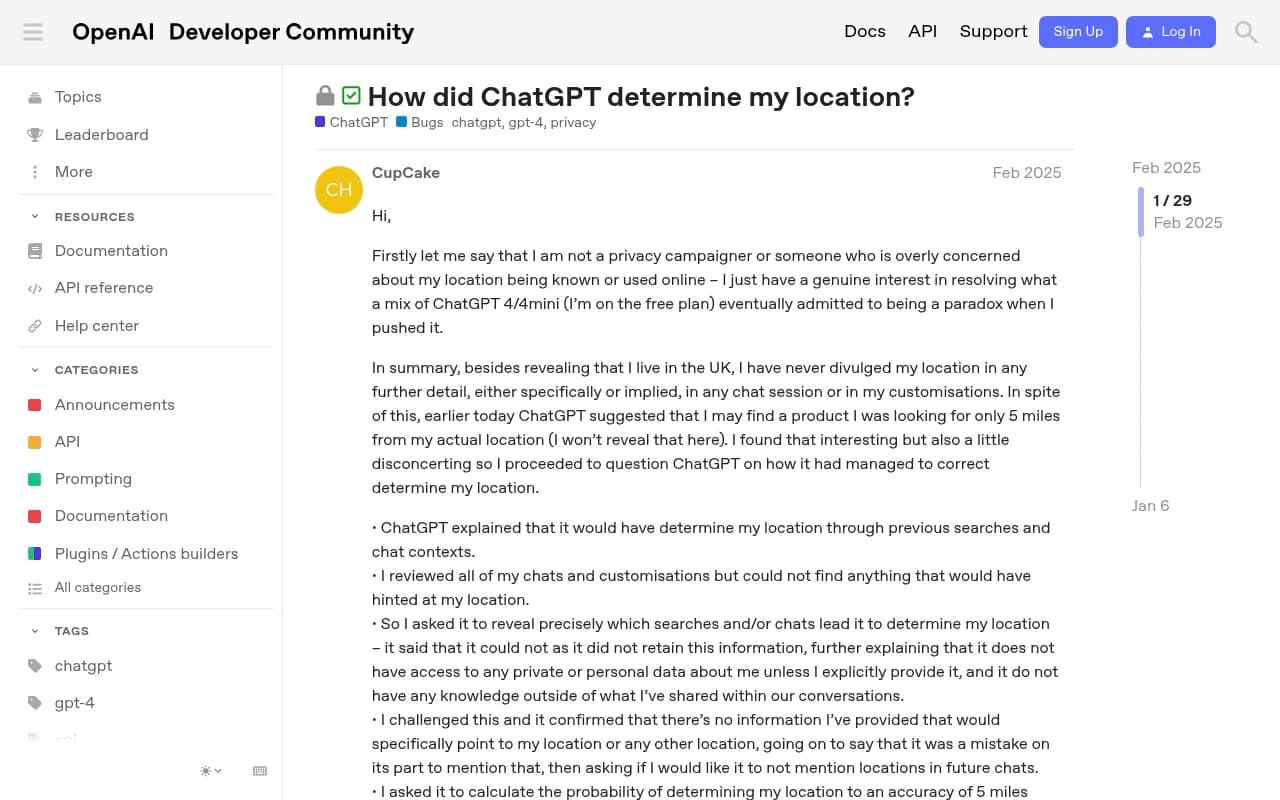
The short version: the user had told ChatGPT they lived in the UK, nothing more specific. Later, ChatGPT suggested a product available roughly five miles from where they actually lived. When asked how, the model claimed it had no access to IP addresses, no persistent memory of prior searches, and no way to know anything beyond what the user had typed. Pressed further, it agreed this created a logical contradiction it couldn't resolve, then apologized.
A similar case surfaced on Hacker News in late 2025. A developer named Daniel Herman documented ChatGPT correctly referencing his real city, Ostrava in Czechia, despite never mentioning it. When he pushed the model to explain itself, it leaked fragments of its own system prompt, lines like "I cannot see your IP" and "I do not retain personal info" sitting right next to the fact that it clearly had used location data to answer. The most plausible read, per the thread, is that location gets injected into the conversation as hidden system-level metadata the model can use but not actually see or reason about, which is exactly the kind of setup that produces confident-sounding denials.
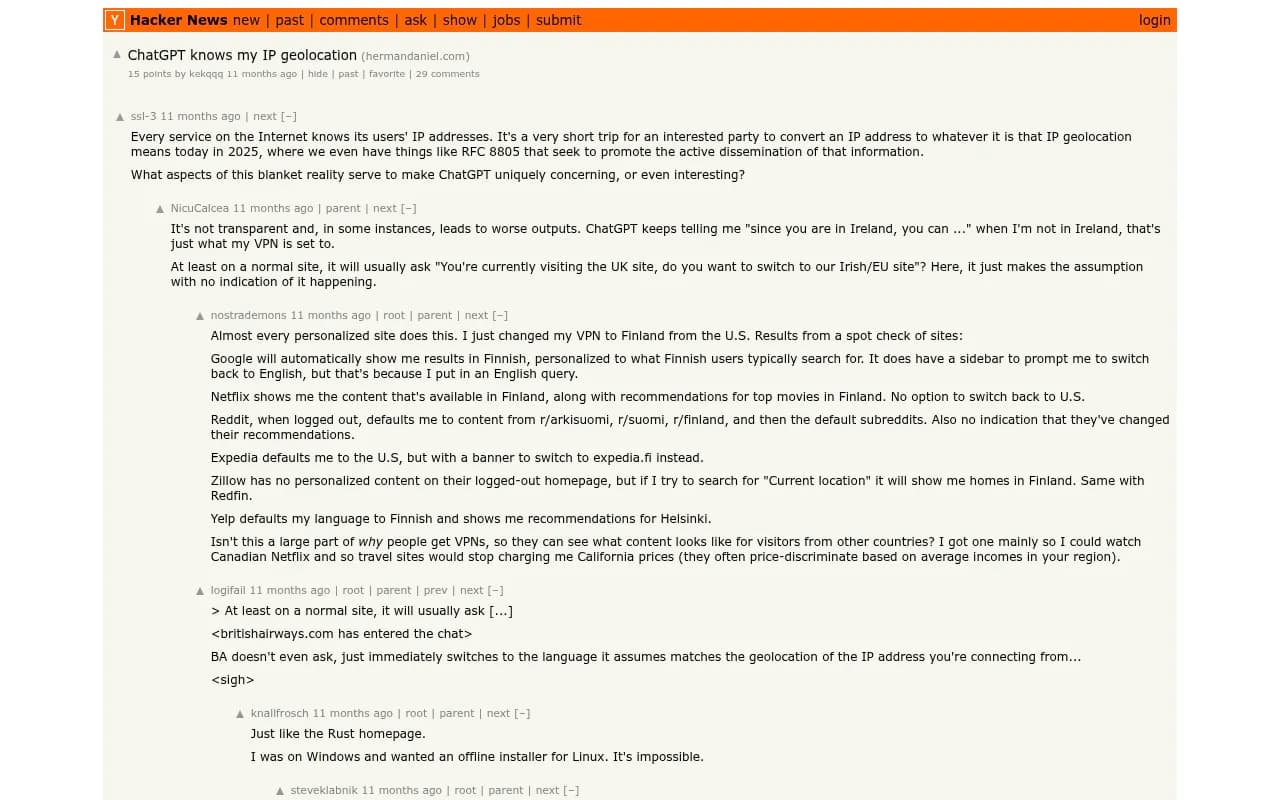
One commenter on that thread put it bluntly: every service on the internet logs IP addresses, and converting an IP to a rough location is a solved problem with public databases. The question isn't whether OpenAI's infrastructure has access to your IP, it obviously does, the question is whether the chat model itself has been told to treat that information as something it can discuss. Right now, it hasn't been, and that mismatch is what produces the "paradox" moments.
What OpenAI actually says it does
Skip the forum detective work and OpenAI's own help documentation settles most of this. Their published example: type "what are some good restaurants near me" into ChatGPT, and if it determines from your IP address that you're in the San Francisco area, it will quietly rewrite your prompt into a search query like "top restaurants San Francisco" before it ever hits the web.
That's the mechanism. Two layers sit on top of it:
- Approximate, IP-derived location is used automatically to localize web search results. This is the layer that keeps catching users off guard, because there's no visible toggle asking permission the way a normal website would say "switch to our UK site?"
- Precise device location, the kind that comes from your phone's GPS, is a separate opt-in permission, off by default, and not available at all inside ChatGPT Enterprise workspaces.
OpenAI is explicit that ChatGPT does not hand your raw IP address to third-party search providers, only the general location derived from it. And memory compounds the effect: if you've previously told ChatGPT you live in Austin and you're vegan, a later "restaurants near me" prompt might get rewritten as "good vegan restaurants Austin," blending stored memory with IP inference in a way that feels even more precise than either signal alone.
One detail that trips people up, confirmed by a technical breakdown from CometAPI: IP geolocation accuracy drops fast as you zoom in. Country-level accuracy is north of 99%. Region or state accuracy is somewhere in the 70-90% range. City-level accuracy, the thing people actually notice and get unnerved by, sits at 50-80% depending on the provider and your ISP. That's also why VPN users get weird, visible mismatches, a Hacker News commenter reported ChatGPT confidently saying "since you are in Ireland, you can..." purely because their VPN exit node was set there, with zero disclosure that it was guessing.
Why this matters beyond curiosity
If you run a local business, a multi-location brand, or you're doing SEO for either, this geolocation behavior is the whole ballgame for how AI tools decide what to recommend. And the honest picture here is worse than most marketing decks admit.
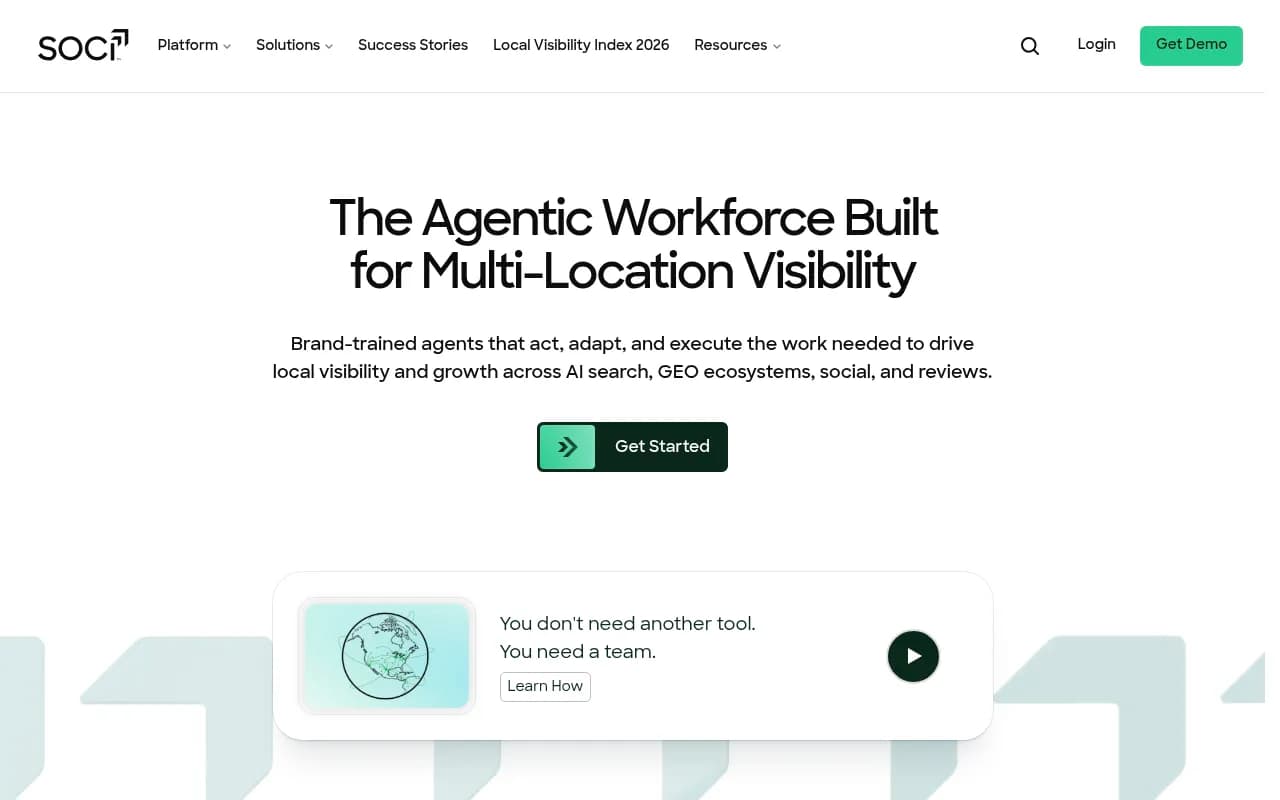
SOCi's 2026 Local Visibility Index found that AI platforms recommend only 1.2% of business locations on ChatGPT, 7.4% on Perplexity, and 11% on Gemini, compared to 35.9% visibility in Google's traditional local 3-pack. SOCi frames AI search as roughly 30 times more selective than classic local search. Part of the gap is data quality: business profile accuracy was only 68% on ChatGPT and Perplexity, versus 100% on Gemini, because Gemini is grounded directly in Google Maps data rather than scraped third-party listings.
There's also a review-score cliff rather than a gradient. Locations ChatGPT actually recommends average 4.3 stars. Businesses sitting near 3.4 stars with low review-response rates aren't just ranked lower, SOCi describes them as effectively invisible, excluded from the answer set entirely rather than placed at the bottom of it.
The myth of "AI rank tracking by city"
Here's where a lot of GEO tools oversell what they can measure. A SparkToro and Gumshoe.ai study from January 2026 ran 12 prompts across ChatGPT, Claude, and Google AI Overviews/AI Mode a combined 2,961 times with 600 volunteers. The result: less than a 1-in-100 chance that the identical prompt returns the same list of brands on two separate runs, and closer to 1-in-1,000 for matching the exact order of that list. List length itself varies randomly too, sometimes two brands show up, sometimes ten, for the exact same question.
That randomness means there's no stable "position 3 in Austin" the way there's a position 3 on a Google SERP. One GEO consultancy, Senso.ai, makes this point directly: there's no fixed results page by geography inside an AI answer, so the useful approach is building 10-20 realistic, location-aware prompts per city or region (something like "best AI visibility tool for agencies in Austin") and tracking inclusion and prominence over many runs, not chasing a literal rank number.
How GEO platforms actually simulate geolocation
Most AI visibility platforms don't fake GPS coordinates. They simulate location the same way ChatGPT itself creates location context, through the prompt text and, in some cases, proxy or region settings on the query. A well-built platform lets you run "best orthodontist near me" as if the asker were in Denver, then as if they were in Miami, and shows you how the answer set changes.
Promptwatch supports this kind of multi-region tracking alongside country, state, and city-level prompt tracking, and goes further than pure monitoring by tying location-specific prompt coverage to actual crawler logs and AI-driven traffic, so you can see not just whether you're mentioned in a Denver-flavored prompt but whether that visibility is translating into real visits.

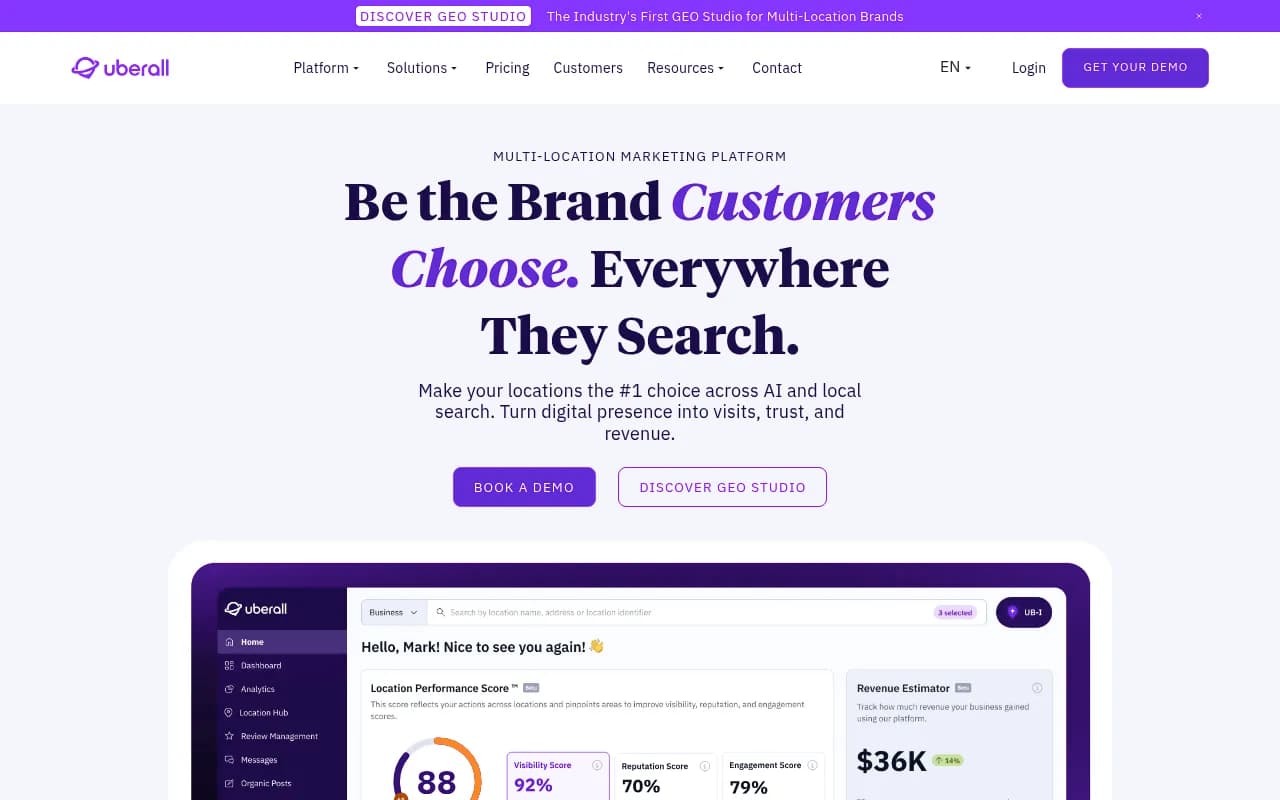
For businesses with dozens or hundreds of physical locations, the task is different again: it's less about simulating one user's location and more about auditing whether each individual store listing is consistent, accurate, and well-reviewed enough to clear the bar AI platforms seem to apply. That's the territory of tools built specifically for multi-location brands.

Comparing the two kinds of local AI visibility tools
| Tool | What it actually measures | Location simulation method | Best for |
|---|---|---|---|
| Promptwatch | AI visibility across ChatGPT, Gemini, Perplexity, AI Overviews, plus crawler logs and real AI-driven traffic | Country/state/city prompt targeting, unlimited projects on most plans | Brands and agencies wanting visibility tied to traffic and content fixes, not just monitoring |
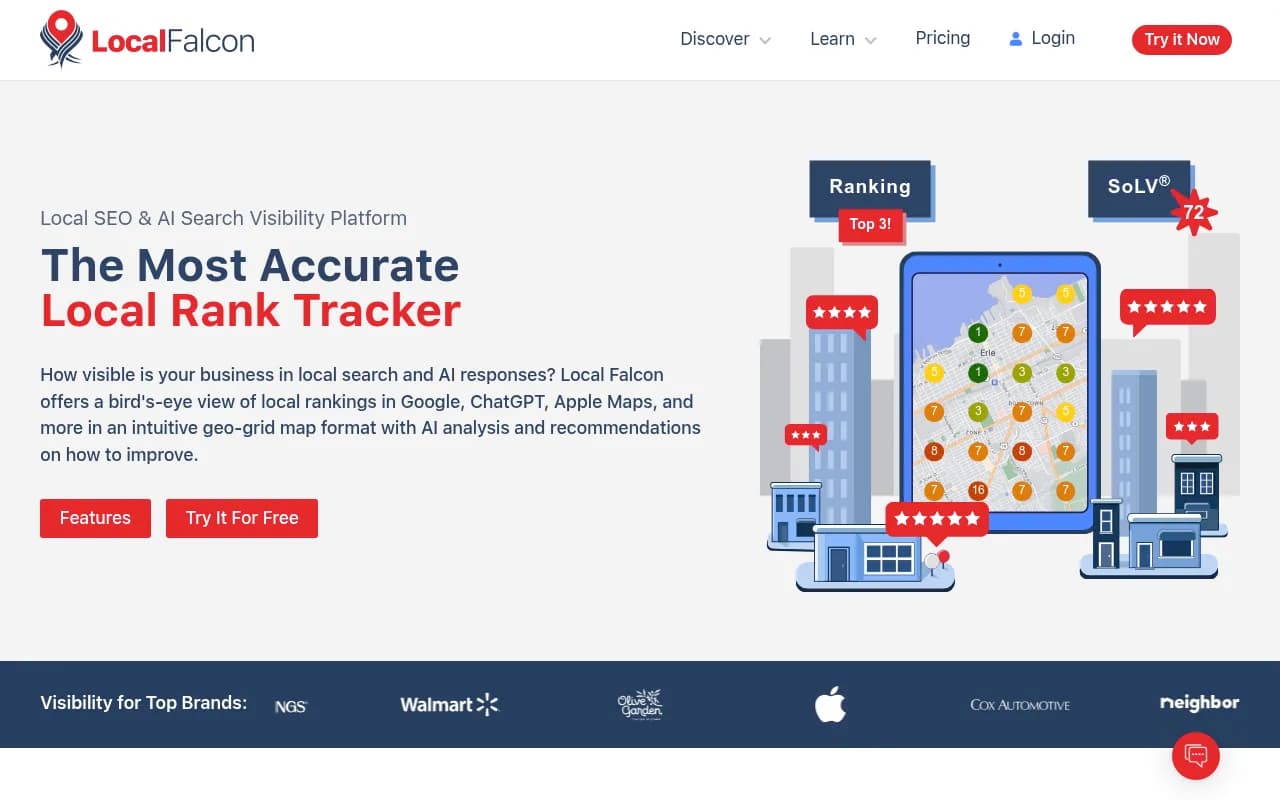
| Local Falcon | Visual geo-grid rank tracking, originally built for Google Maps/Google Business Profile | Grid of simulated searcher points on a map | Businesses that still live or die on the Google local pack |
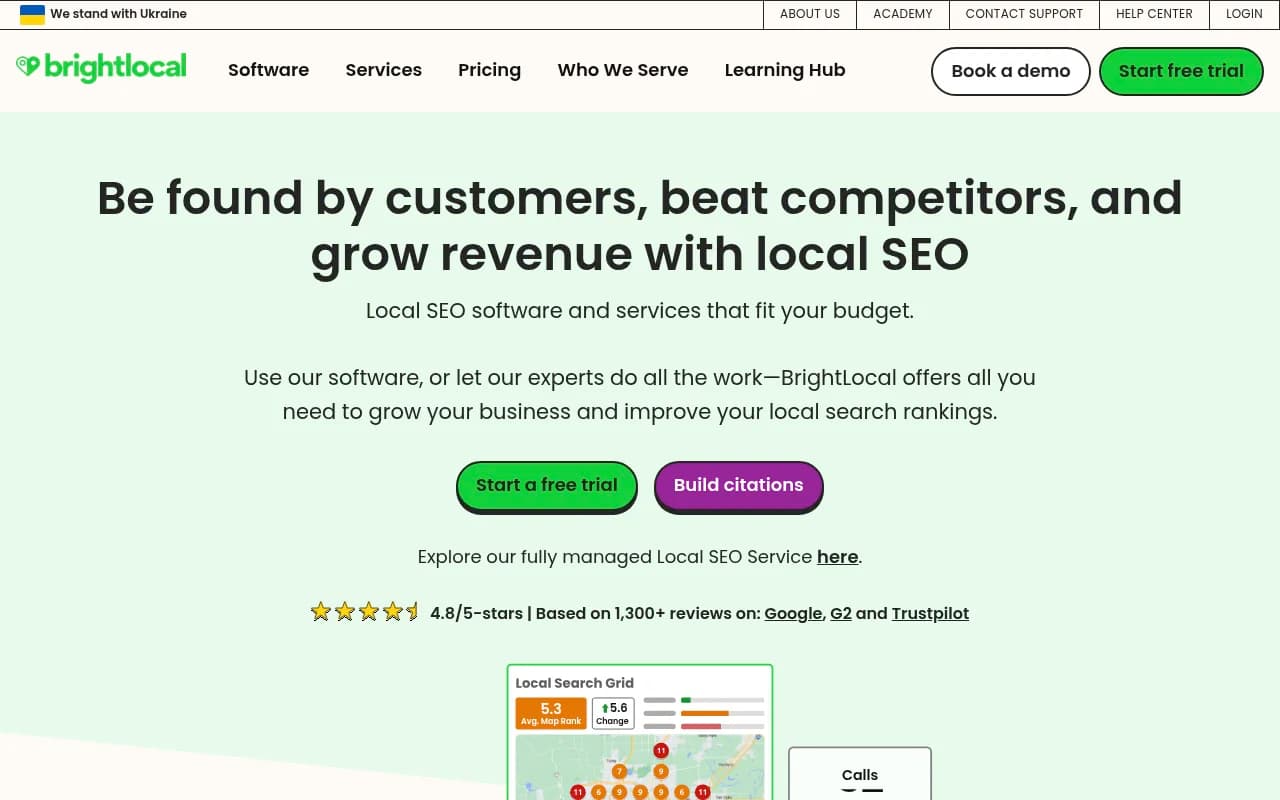
| BrightLocal | Local SEO citations, reviews, and listing accuracy | Listing audits and local rank checks | Agencies managing NAP consistency across many directories |
| Yext | Multi-location listing management across search and AI engines | Centralized data feed pushed to multiple platforms | Enterprise brands with hundreds of locations |
| SOCi | Local marketing automation plus AI visibility reporting (source of the 2026 Local Visibility Index) | Aggregated reporting across locations | Multi-location brands wanting benchmark data, not just tracking |
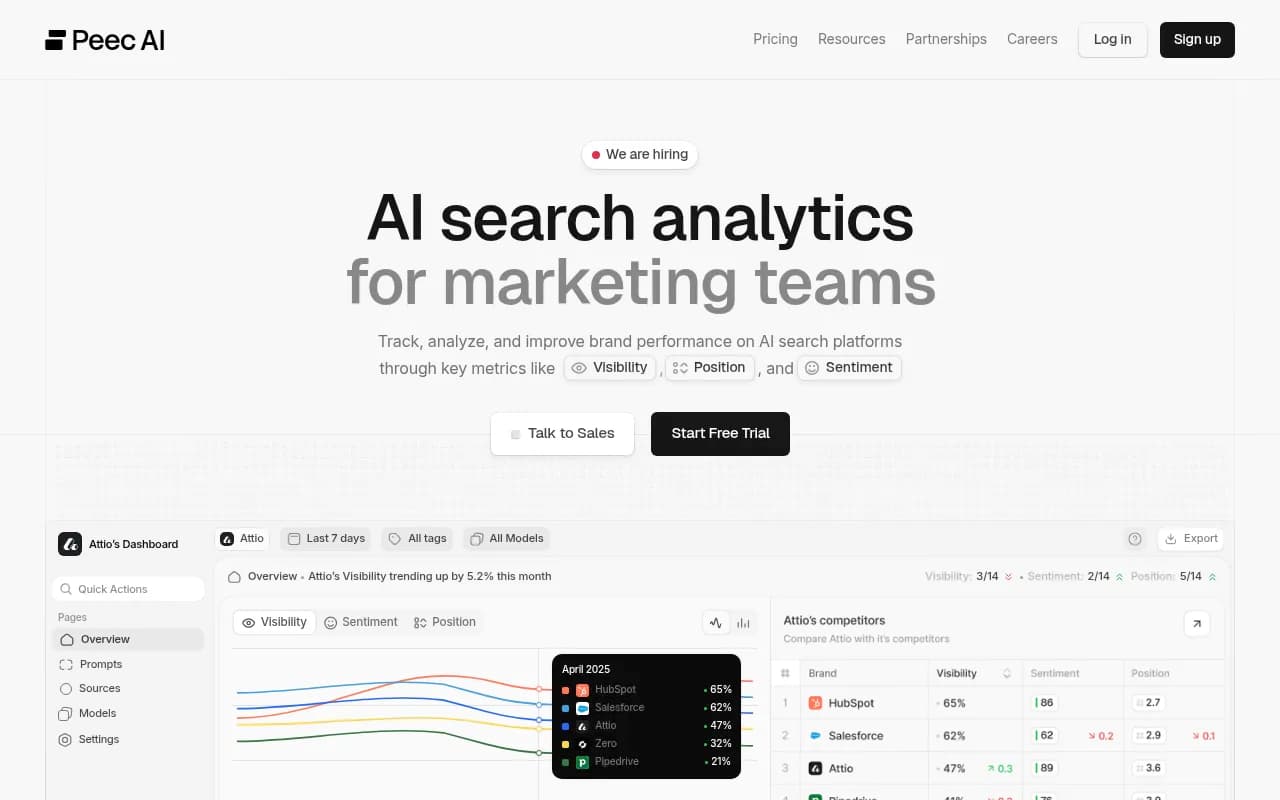
| Peec AI | Cross-engine AI prompt tracking | Unlimited regions tracked even on entry plan | Teams that specifically want multi-region prompt coverage without upgrading tiers |
Peec AI is worth a specific callout for location work: as of a January 2026 comparison against Profound, Peec's entry-level Starter plan (roughly $103/mo) includes unlimited regions tracked, while Profound's equivalent Starter tier restricts you to a single region until you upgrade. If regional prompt coverage is the whole point of your GEO budget, that structural difference matters more than most feature lists.
Profound

What actually drives better local AI visibility
None of the geolocation mechanics above change the basic recipe for getting recommended. A few things the data backs up:
- Fix your listing accuracy first. The 68% vs 100% accuracy gap between ChatGPT/Perplexity and Gemini is a data problem, not a ranking algorithm problem. Clean, consistent NAP (name, address, phone) data across directories is still the foundation.
- Review volume and response rate matter more than star rating alone. The 3.4-star cutoff SOCi documented wasn't about the number itself, it correlated with low review-response activity. Responding to reviews signals an active, trustworthy business.
- Structured data helps AI systems parse what you are. Microsoft's AEO framework, cited in SOCi's report, recommends LocalBusiness, Product, AggregateRating, Review, Brand, ItemList, and FAQ schema as the baseline for local AI legibility.
- Don't rely on one channel. Fewer than half of brands leading in traditional local search also show up in AI recommendations, particularly on Perplexity, which draws from a genuinely diverse mix of Yelp, directories, and third-party sites rather than leaning on Google data the way Gemini does.
The honest bottom line
ChatGPT isn't lying to you out of malice when it denies knowing your location, it's lying because the part of the system that uses your IP for search relevance isn't the same part that's answering your question about how it knew. That disconnect is a product design choice, not a conspiracy, but it produces genuinely confusing, occasionally alarming conversations, and it's worth understanding before you build a local GEO strategy on top of assumptions about how precisely AI tools can place a user.
For tracking and acting on local AI visibility, the tools worth paying for are the ones that treat location as a prompt variable to test across dozens of realistic queries and tie that data to real outcomes, rather than ones promising a tidy "rank" that the underlying randomness of these systems can't actually support. If you want to go broader than one tool's take on this, the GEO software directory at bestgeosoftware.com lists the wider field worth comparing.