Key takeaways
- Enterprise SEO suites (BrightEdge, Conductor, seoClarity, Botify) added AI visibility modules to products built for rankings, crawling and governance. Dedicated GEO platforms like Promptwatch were built around AI answers from the start.
- Engine coverage varies a lot. seoClarity ArcAI names 10 engines. Conductor names ChatGPT, Gemini, Copilot and Claude in its materials. BrightEdge's public materials are narrower and vary by source. Always verify against your own prompts.
- The suites are strongest on governance, executive reporting and technical SEO at scale. Botify is the specialist for crawl and indexation on sites with millions of URLs.
- Most pricing is quote-only. seoClarity publishes tiers from $2,500, $3,200 and $4,500 a month. Promptwatch publishes plans from $95 to $579 a month.
- The most common 2026 pattern is not either/or: keep the suite for classic SEO and governance, add a dedicated GEO platform for measurement, content fixes and AI traffic attribution.
Two different product categories that now overlap
For years, enterprise SEO meant one thing: rankings, crawl health, content recommendations and reports that roll up to a CMO. BrightEdge, Conductor, seoClarity and Botify all grew up in that world. When ChatGPT, Perplexity and Google's AI Overviews started answering questions directly, each of them added an AI visibility layer.
Dedicated GEO (generative engine optimization) platforms came from the other direction. They start with the question "what does AI say about my brand, and why?" and build outward from there. Promptwatch is in this group. So are Profound, Scrunch, Peec AI and AthenaHQ.
The overlap is real, which is why buyers now put these products on the same shortlist. But the architecture is different, and that difference shows up when you try to actually change what AI says about you.
A note on sources. Much of the public comparison content on this topic is published by vendors with a stake in the answer. The seoClarity comparison above discloses that ArcAI competes with the platforms it covers. Conductor ranks itself first in its own enterprise SEO ranking. Treat every vendor-authored table as a starting list of questions, not a verdict.
How each enterprise suite handles AI visibility
BrightEdge
BrightEdge delivers AI visibility through AI Catalyst, which the company says is included in all BrightEdge SEO Platform subscriptions. Its Agent Edge product, launched in August 2026, serves agent-ready content to AI agents and monitors their visits.
The public picture of engine coverage is inconsistent. Conductor's ranking says BrightEdge monitors Google AI Overviews but has limited coverage of standalone engines like ChatGPT and Perplexity. Other reviews list ChatGPT, Perplexity and AI Overviews. seoClarity's comparison says it could only confirm three engines on the AI Catalyst page and couldn't confirm brand fact-checking. Each of those authors has a competitive angle, so this is exactly the kind of claim to pin down in a demo.
Where BrightEdge is clearly strong: demand research (Data Cube), forecasting, and dashboards executives actually read. It has no public pricing. Vendr's contract data puts the median annual contract around $50,000.
Conductor
Conductor positions itself as an AEO and SEO platform for large collaborative teams. Its materials name ChatGPT, Gemini, Copilot and Claude, and Conductor's own FAQ claims the most comprehensive native AI tracking among the suites, with citation monitoring, share of voice and sentiment. Conductor also pushes agent infrastructure: apps inside ChatGPT, Claude and Copilot, plus an MCP server.
Pricing is usage-based with credits. Credits per response vary by engine, and more frequent tracking uses more credits, so the real cost depends on your prompt count and refresh rate. Vendr's median is about $49,000 a year.
seoClarity
seoClarity is the suite that publishes prices (from $2,500, $3,200 or $4,500 a month) and has the most explicit AI engine list for its ArcAI product: ChatGPT, Gemini, Perplexity, Google AI Mode, AI Overviews, Copilot, Grok, DeepSeek, Doubao and Claude.
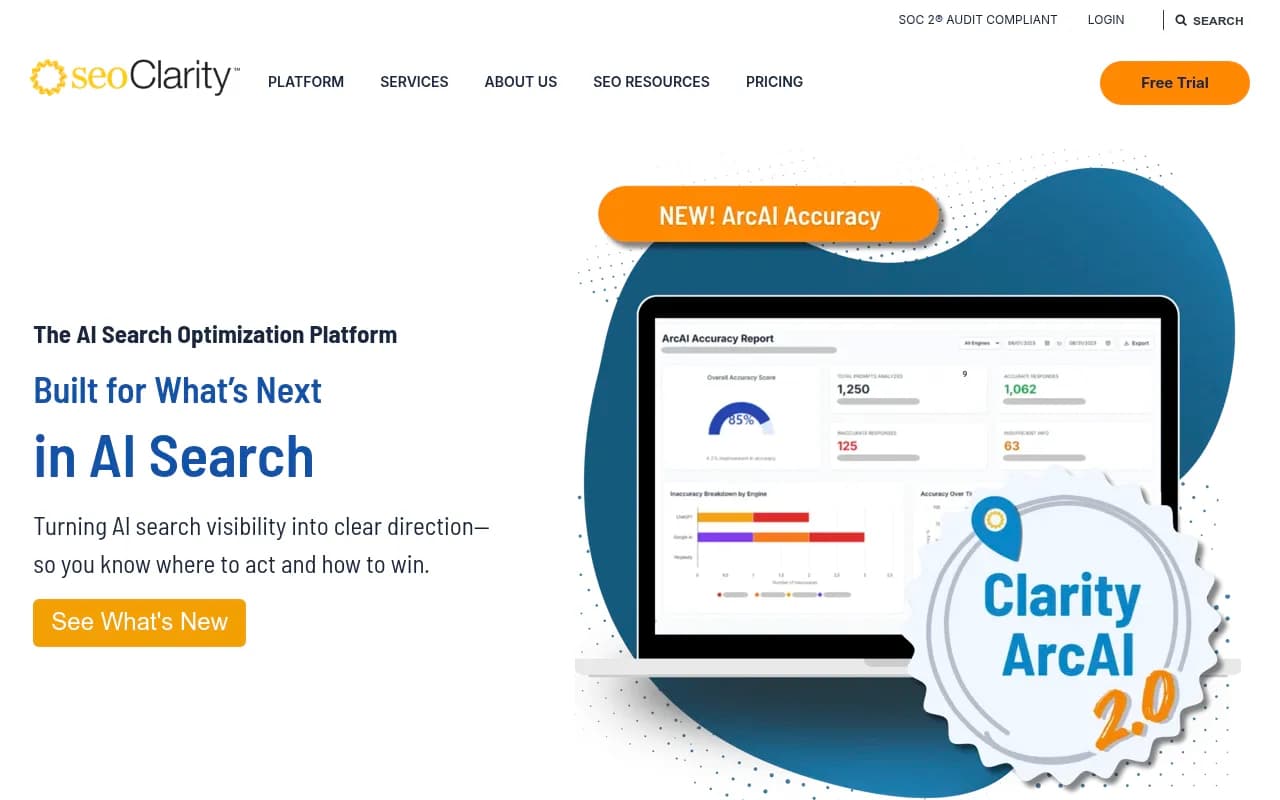
ArcAI adds an Accuracy module that builds a source-of-truth index from your site and flags AI answers that conflict with it, plus log-file tracking of AI bots and an Indexer that submits new pages to AI engines (submission doesn't guarantee a crawl). Its API and MCP server are included in paid subscriptions, and it states SOC 2 compliance. Median contract value on Vendr is about $34,000 a year.
Botify
Botify is the technical specialist. It combines crawl data, log analysis and rendering to show how bots actually see a huge site. For AI, it offers an AI Visibility product (prompts generated from Search Console keywords and People Also Ask), AI bot log analysis, and PageWorkers and SpeedWorkers that apply changes for bots and serve them rendered pages.
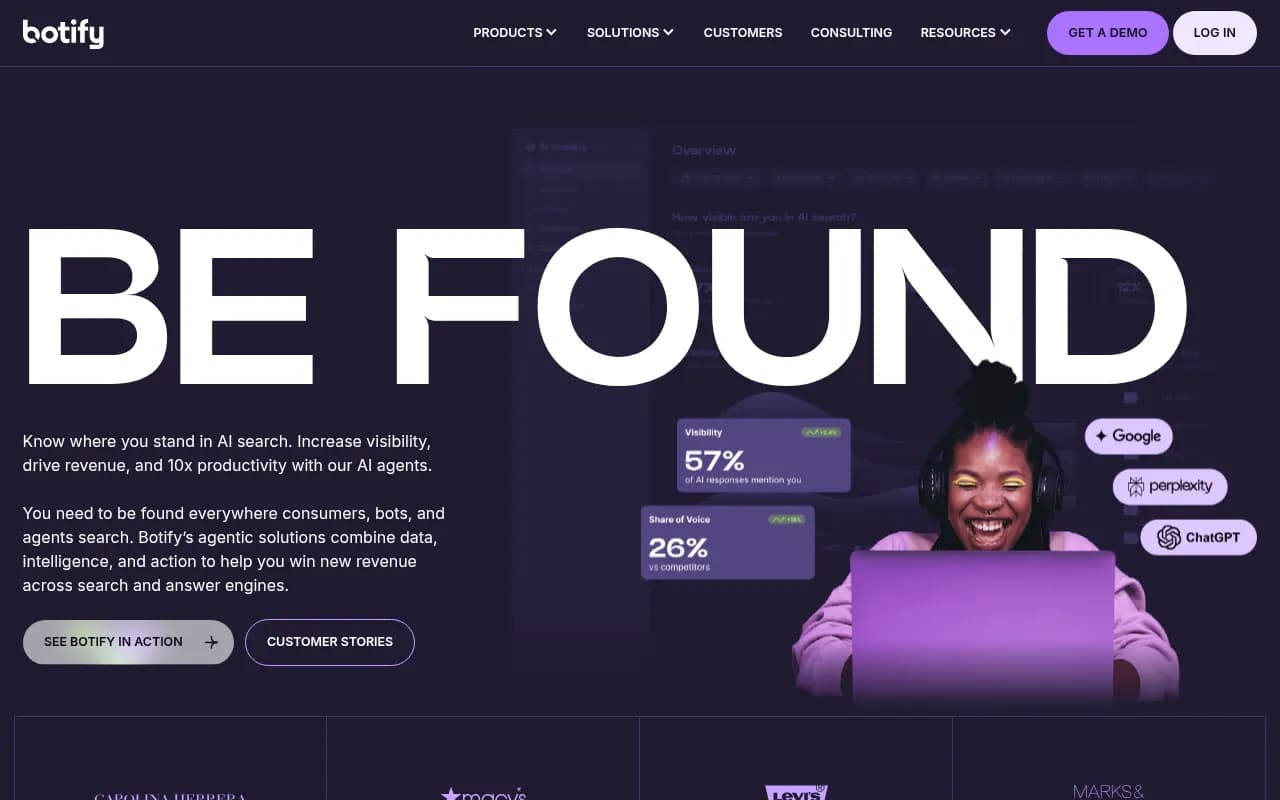
Two caveats from Botify's own documentation: AI Visibility is an option on its plans rather than the core of the product, and its FAQ says API access for AI Visibility is not currently planned. Vendr's median contract is the highest of the four at roughly $74,000 a year. Botify is usually bought to fix crawl waste on sites with millions of URLs, and the AI layer is a bonus there.
Side-by-side comparison
| Platform | Core strength | AI engine coverage (vendor-stated) | Execution features | Published pricing |
|---|---|---|---|---|
| BrightEdge | Demand research, forecasting, executive reporting | Varies by source; AI Overviews plus ChatGPT and Perplexity in some materials | Agent Edge, Autopilot | Quote only |
| Conductor | Content workflow, AEO governance, agent infrastructure | ChatGPT, Gemini, Copilot, Claude | Turnkey agents, MCP server | Credits, no public prices |
| seoClarity ArcAI | Data scale, rank tracking, brand accuracy checks | 10 engines | Content Agents, ClarityAutomate, Indexer | From $2,500/mo |
| Botify | Crawl, logs, rendering at massive scale | AI bot analytics; AI Visibility as an option | PageWorkers, SpeedWorkers | Quote only |
| Promptwatch | AI visibility, citations, crawler logs, content execution | ChatGPT, Gemini, Perplexity, AI Overviews, AI Mode, Copilot, Claude, Meta AI, Alexa and more | Content Agent, CMS publishing, Action Board | $95 to $579/mo, plus agency and Enterprise |
What a dedicated GEO platform adds
Promptwatch tracks how ChatGPT, Gemini, Claude, Perplexity, Google AI Overviews, AI Mode, Copilot and other engines mention, rank and cite a brand. It collects answers from the real interfaces of those engines in each country and language, rather than relying only on API output, because user-facing answers and citations can differ from API responses.

The difference shows up in four places.
Tracing why AI says what it says
A visibility score tells you that you're missing. It doesn't tell you why. Promptwatch breaks answers into citations, query fan-outs and content gaps, and classifies cited sources by type. Brand Narrative pulls out the individual claims AI makes about you, and Fact Check marks a claim accurate or inaccurate, then finds the pages on your site that state it or its opposite. That's the closest equivalent to seoClarity's ArcAI Accuracy, and on Promptwatch, Fact Check sits on Business and above.
For context on what AI actually cites, Promptwatch's ChatGPT citation share by content type data shows product pages at 22.4% of citations from Sep 28 to Oct 4, 2026, followed by landing pages and listicles. And Promptwatch Data on unique domains per response found almost half of ChatGPT responses cite 10 or more domains in the same week. Those are the sort of patterns a generic SEO suite's keyword reports won't surface.
IP-verified crawler logs
Botify, seoClarity and Conductor all monitor AI crawlers to some degree. The question to ask is whether visits are verified. Promptwatch's AI crawler logs check each visit against the operator's published IP ranges, so spoofed bots are filtered out. Promptwatch's AI crawler traffic report covers June 8 to September 6, 2026 and found OpenAI at 79.8% of verified AI crawler requests in the week of Aug 31 to Sep 6, down from 94.8% in the week of June 8 to 14. If a provider has a big share in that report but near zero in your own logs, you are probably blocked or unreachable for it.
Promptwatch's Meta-WebIndexer data is a good example of why this matters: that crawler went from about 2% to nearly 38% of tracked AI crawler requests between mid-July and August 9, 2026. A team that only watches the usual suspects would have missed it.
Doing the work, then checking it worked
This is the biggest gap in the category. Most dashboards report and stop. Promptwatch's loop is monitor, trace, act, measure. The Action Board prioritizes work, the Content Agent writes and publishes pages to WordPress, Webflow or Framer on a schedule you control, and Page Tracker plus crawler logs and visitor analytics show whether the page got crawled, cited and clicked.
The suites have execution answers too: BrightEdge's Agent Edge and Autopilot, Botify's PageWorkers and SpeedWorkers, seoClarity's Content Agents and ClarityAutomate, Conductor's turnkey agents. One independent comparison counted eleven of 14 platforms with some execution claim. So the useful question is no longer "does it execute?" but what exactly it executes, who approves it, and whether it can be rolled back.
AI traffic and revenue
Promptwatch's visitor analytics attribute traffic and conversions from ChatGPT, Perplexity, Gemini, Claude, Copilot and others. ChatGPT stopped sending a referrer on October 8, 2026, so Promptwatch offers an optional setting that counts visits tagged utm_source=chatgpt.com as ChatGPT traffic. If your finance team wants AI visibility tied to revenue, ask every vendor how they handle that change.
Where the suites still win
Being fair here matters, because a dedicated GEO platform is not a replacement for everything a suite does.
- Technical SEO at scale. Botify's crawl, rendering and log analysis on millions of URLs is a different class of tool. Promptwatch runs weekly site audits (21 checks) but is not a crawler built for faceted navigation on a 10-million-URL retailer.
- Classic rank tracking and keyword research. Promptwatch is not a SERP rank tracker, though it brings in Search Console and Bing data.
- Demand forecasting and executive storytelling. BrightEdge's StoryBuilder and forecasting are built for that.
- Enterprise integrations with the marketing stack. One comparison lists BrightEdge connecting to Salesforce Marketing Cloud, seoClarity to BigQuery, Snowflake, Looker and Tableau, and Botify to CDNs and log sources. Promptwatch has Search Console, Bing, Looker Studio, Slack, a REST API and a hosted MCP server, but no Zapier app or outgoing webhooks yet.
- Existing procurement. If you already pay for a suite, the AI module may be bundled or cheap to add. BrightEdge states AI Catalyst is included in all subscriptions.
Pricing: what you pay and what you can know in advance
| Platform | Model | Typical cost signal |
|---|---|---|
| BrightEdge | Bundled with SEO subscription | Median ~$50,000/yr (Vendr) |
| Conductor | Usage-based credits | Median ~$49,000/yr (Vendr) |
| seoClarity | Tiered, published | From $2,500/mo; median ~$34,000/yr (Vendr) |
| Botify | Quote; AI Visibility as option | Median ~$74,000/yr (Vendr) |
| Promptwatch | Published monthly or annual (annual is 12 months for the price of 10) | Essential $95, Professional $245, Business $579; agency plans from $199; Enterprise custom |
Vendr figures are medians reported on its marketplace as of February 2026, so use them for rough budgeting only. Confirm Promptwatch pricing at promptwatch.com/pricing. The 7-day free trial and the free AI visibility report are the free starting points; there is no free plan.
Note what the Business plan unlocks, since it is the plan most enterprise teams will look at: the automated Content Agent and Agentic AI Search Optimization, hourly to 12-hourly tracking, state and city tracking, local GEO targeting, Fact Check, Shopping insights, Ads Radar and an audit log. For SSO, a white-label client portal and custom volumes you need Enterprise. Promptwatch is ISO/IEC 27001 certified and GDPR compliant.
Questions to put to every vendor
The vendor-written comparisons agree on one point: shortlist, then test on your own prompts. Here is a working list.
- Which engines are tracked through the real user interface, and which only through APIs? Answers can differ.
- How many prompts, engines and markets does my configuration need, and what does that cost? Credit models can surprise you.
- Are AI crawler visits verified against published IP ranges?
- Can it check AI claims about us against our own site content, and is that in the plan I'm quoted?
- What can it publish, with what approval controls, and how do I roll back?
- How does it attribute AI referrals now that ChatGPT stopped sending a referrer?
- Does it separate business units with their own competitor sets? seoClarity documents this; ask the others.
- Is there an API or MCP server on my tier? Botify's FAQ says no API for AI Visibility is planned.
A decision framework
Stay with your suite's AI module if
You already pay for BrightEdge, Conductor, seoClarity or Botify, your AI visibility needs are mostly reporting, your prompt set is modest, and procurement of a new vendor would take longer than the problem justifies.
Add a dedicated GEO platform if
AI search is becoming a measurable revenue channel, you need to know why you are or aren't cited, you want content gaps turned into published pages, or you want verified crawler logs and AI traffic attribution in one place. Agencies managing clients will also find the Promptwatch agency plans more flexible than per-seat suite contracts.
Pair them if
You have a very large site. A common 2026 stack is a suite for governance and classic SEO, Botify for crawl infrastructure, and a GEO platform for AI measurement and execution. That isn't wasteful if each tool owns a distinct job.
How to run a fair bake-off
Pick 50 to 100 prompts spanning branded, competitor comparison and commercial intent. Run the same list in every candidate for two weeks. Compare engine coverage, how well each tool's answers match what you see manually in the live interface, whether citations are listed with source types, and how long it takes to go from a finding to a published fix. Then check one thing most teams skip: pull your own server logs for AI crawlers and see whether each tool's bot data matches.
If you want a quick baseline first, the free AI visibility report scans how ChatGPT, Gemini and Perplexity talk about your brand, and the Agentic Readiness Check shows which AI crawlers can reach your site. For a wider view of the category, the GEO software directory lists more options, and Promptwatch's own 2026 GEO platform comparison goes deeper on the dedicated tools.
Bottom line
The suites are good at what they were built for: governance, forecasting, technical depth. Their AI modules are real but uneven, and the public information on engine coverage is thin enough that you should not buy on a feature table. A dedicated platform like Promptwatch earns its place when you need the whole loop, from seeing what AI says to publishing the fix to proving it brought traffic. Run both on your own prompts for two weeks and let the data pick.