Key takeaways
- Showing up in AI answers is only half the job. What AI says about you (pricing, features, support, reputation) decides whether the mention helps or hurts.
- Brand narrative tools extract individual claims from AI responses and group them by theme. Fact-check tools compare those claims to what your own site actually says.
- Most wrong AI answers trace back to your own pages: an old blog post sitting next to a current pricing page is a classic cause.
- The fix is mostly editorial. Audit claims, trace sources, correct pages, add independent coverage, then re-check on a schedule.
- Promptwatch's Fact Check is available on Business, Agency Scale and Enterprise plans. Brand Narrative is on every plan. Verify details at promptwatch.com/pricing.
Why accuracy is now a GEO problem
For a few years, the GEO conversation was about presence: are we mentioned, how often, in which position. That is a very SEO-shaped question. A mention that says your product costs twice what it does, or lacks a feature you shipped two years ago, is worse than no mention at all.
Garrett Gomez, a product marketing manager at Profound, put it plainly in an AdExchanger piece from July 2026: focusing only on whether you show up is a "very SEO-like way of looking at things." The article also cites Storyblok data saying 21% of consumers would blame the brand if an AI system generated incorrect information about it, even when the error did not originate with the brand. That is the part enterprise teams should sit with. You get the blame for a claim you never made.
At enterprise scale this gets harder, not easier. Large companies have many products, regions, legacy pages, acquired brands and old press releases. Every one of them is a possible source for a wrong answer.
Fact check vs brand narrative: what each one does
The two terms get blended together, but they answer different questions.
Brand narrative
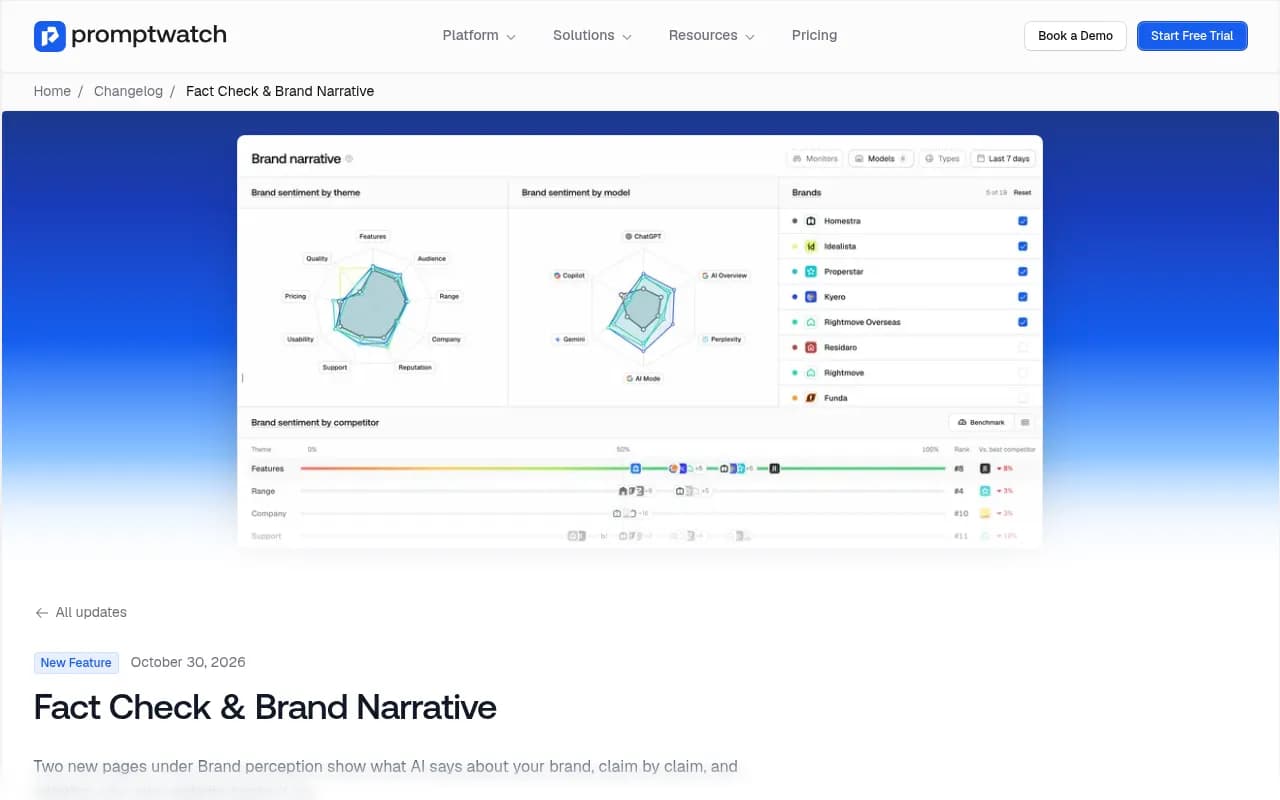
Brand narrative analysis answers "what is AI saying about us?" It breaks responses into individual claims, such as "affordable for small teams" or "its mobile app lacks features," groups the ones that repeat, and shows how often each is made and by which models. Claims get filed under themes (pricing, features, support, reputation) and scored for sentiment.
The useful output is not a single sentiment number. It is a list of specific sentences that AI keeps saying about you, ranked by how often they appear.
Fact check
Fact check answers "is that claim true, and where did AI learn it?" You compare the claim to a source of truth, then look for the pages that state it or contradict it. Profound's FactCheck does this by comparing LLM outputs to a brand's own knowledge base. According to AdExchanger, it lists the inaccurate claim, the "ground truth" from the knowledge base, and the citation that influenced the claim, all in one tab, and offers guidance on correcting it.
Promptwatch's version takes a different route. You mark a claim Accurate or Inaccurate, and it reads the pages crawled from your site to find the ones that state the claim or its opposite. Each check returns the pages, the quotes, and a recommended next step.
What this looks like in practice
One reported example: after adopting FactCheck, WHOOP found that 7.9% of AI responses citing the brand were flagged for accuracy issues. Kieran Riley, the brand's AEO product marketing specialist, described the value as catching a wrong answer, working out where it comes from, and getting a correction moving. That figure is from one brand on one tool, so treat it as an illustration, not a benchmark. Still, nearly 8 in 100 flagged responses is high enough that no enterprise should assume its number is zero.
I would not trust anyone quoting an industry-wide accuracy rate yet. Promptwatch Data has no report on fact-check accuracy, and I am not going to make up a figure. What you can do is measure your own rate, which is the point of the tooling.
The tools worth knowing
The market splits into tools that monitor, tools that check claims, and tools that help you act on what the check finds.
| Tool | Claim-level analysis | Fact check against your content | Acts on the fix | Notes |
|---|---|---|---|---|
| Promptwatch | Yes, Brand Narrative on every plan | Yes, on Business, Agency Scale, Enterprise | Yes, Action Board, Content Agent, CMS publishing | Checks your crawled pages for the source of a claim |
| Profound | Sentiment and accuracy focus | Yes, FactCheck against a knowledge base | Guidance on corrections | Launched FactCheck in July 2026 per AdExchanger |
| Peec AI | Mention and visibility tracking | Fact-checking against supplied facts, per one SitePoint roundup | Mostly monitoring | Enterprise-oriented pick in that roundup |
| LLMClicks | Tracks visibility | Hallucination detection | Limited | Catalog description mentions hallucination detection |
| Adobe Brand Visibility | Measures how AI cites your brand | Not confirmed in my research | Optimization features | Enterprise GEO from Adobe |
I did not verify pricing or detailed feature sets for every tool above, so check each vendor before shortlisting.
Promptwatch
Promptwatch is the one I would put first for enterprise teams that want the loop closed, because the fact check sits next to the tools that fix the problem. Brand Narrative extracts claims across every tracked response in the countries and languages you pick, scores each theme from 0 to 100, and lets you compare against competitors. Fact Check then reads your crawled pages to find where a claim comes from. From there the Action Board and Content Agent handle the update, and visitor analytics plus crawler logs show whether AI bots read the corrected page.

Plans: Brand Narrative is included on every plan, starting with Essential at $95/month. Fact Check requires Business ($579/month), Agency Scale ($799/month) or Enterprise, and each check uses agent credits, with an estimate shown before it runs. Confirm current pricing at promptwatch.com/pricing. If you want to see how your brand reads before committing, the free AI visibility report and the 7-day free trial on monthly billing are the starting points.
Profound
Profound built FactCheck around a brand knowledge base, which suits teams that already maintain a clean source of truth for products, pricing and policy. It is strong on monitoring and now on accuracy. Compare it directly in Promptwatch vs Profound if you are choosing between the two.
Profound

Peec AI, LLMClicks and others
Peec AI appears in a SitePoint roundup of enterprise brand mention trackers as one that fact-checks against facts you supply, catching models repeating retired pricing or old positioning. LLMClicks describes hallucination detection as a feature.

Adobe is also pitching enterprise GEO under its Brand Visibility product, aimed at measuring and proving AI search impact.

If you want to browse the wider field, the GEO software directory at bestgeosoftware.com lists more options.
A workflow that works
The 5WPR piece on wrong AI answers boils the response down to five moves: audit what each AI platform says, trace the pages those answers rely on, correct them with consistent facts, add independent coverage, and re-check every month. The Promptwatch changelog describes a similar loop tied to its tools. Here is how I would combine them for an enterprise.
1. Audit claims, starting with the negative ones
Pull the claims AI repeats most. Sort by frequency and by negative or mixed sentiment. Do not try to fix everything. A claim repeated across several models about pricing matters far more than an oddball in one response.
Be careful about separating wrong claims from unwelcome ones. "Its mobile app lacks features" might be true. Fact check is for the first category. The second is a product problem.
2. Mark each claim accurate or inaccurate
This step needs a human with real knowledge: product marketing, legal, or whoever owns the facts. Writing down the ground truth is tedious but it is the whole foundation. Without it, a fact-check tool has nothing to check against.
3. Find the source on your own site
If a wrong claim is stated on one of your pages, that is where AI is probably getting it. Update it. Per the Promptwatch guidance, when the check finds pages that disagree, like an old blog post next to a current pricing page, update or remove the outdated one so AI sees a single answer.
This is where enterprises get burned. Old press releases, regional microsites, archived help docs and migrated blog content all keep stating things that stopped being true.
4. Fill the gaps for accurate claims you do not state
Sometimes AI says something true that your site never says. Then AI is citing a third party. Add the claim to a page so AI can cite you as the source. Prompt-level work here pairs well with the content gap analysis approach.
5. Check whether AI can actually read the fix
Correcting a page does nothing if AI crawlers cannot reach it or if they hit errors. IP-verified AI crawler logs tell you whether bots read the updated page. Promptwatch's own data shows crawler behavior shifts fast: in Promptwatch Data's report on Meta-WebIndexer, that crawler grew from about 2% to nearly 38% of tracked AI crawler requests between mid-July and August 9, 2026. Your crawler mix today is not the one you had last quarter.
6. Add independent coverage
Your own site is not the only input. Third-party pages, reviews and directories shape answers too. Promptwatch Data on citation sources shows, for software prompts between Sep 28 and Oct 4, 2026, that GitHub, Microsoft's docs and G2 led ChatGPT citations. So for a software company, a stale G2 profile can matter as much as a stale help article. Offsite mention tracking helps find third-party pages that name you without linking.
7. Re-check monthly
Models change, sources change, and corrections do not land instantly. Make a recurring review. Promptwatch's Action Board surfaces prioritized to-dos, and scheduled Agent Chat briefings can summarize what changed.
Governance for enterprise teams
Tooling is the easy part. A few process decisions matter more.
- Name an owner for the source of truth. If nobody owns the pricing and product facts page, every check becomes an argument.
- Keep a single facts page. 5WPR recommends updating a facts page whenever leadership, products or locations change. Even a simple, plainly written page gives AI a clean thing to cite.
- Log corrections. Record the claim, the page changed, the date, and the result on re-check. Promptwatch's audit log on Business and above records changes by source, which helps for compliance reviews.
- Escalate serious errors. Defamatory or safety-relevant errors in AI answers need legal and PR involvement. I did not research the vendor feedback channels at OpenAI, Google and others, so check each platform's current reporting route rather than relying on my guess.
- Segment by market. A monitor's language and location are fixed once created, so run separate monitors per region. A pricing claim can be right in the US and wrong in the Netherlands.
Choosing a tool: a short checklist
| Question | Why it matters |
|---|---|
| Does it extract claims, or only a sentiment score? | You need sentences you can verify, not a number |
| Does it show which page caused the claim? | Without the source, you are guessing |
| Does it read the real AI interfaces? | Answers in the UI can differ from API outputs |
| Can it act, or only report? | Dashboards leave the fix to you |
| Can it confirm the fix worked? | Crawler logs, citation tracking and traffic close the loop |
| What does it cost per check? | Fact checks can use credits, so read the plan terms |
The action question is where I land most strongly. Monitoring tools tell you that something is wrong. Enterprises already have enough dashboards. Look for the tool that tells you which page to change and then helps you check it changed the answer. The head-to-head comparison hub is one place to see how the main platforms stack up.
Limits worth admitting
Fact-check tools are only as good as the truth you give them. They will not resolve a real disagreement between your marketing, legal and product teams. They also cannot guarantee a model stops repeating an error. Models retain training-data beliefs that no page edit will touch quickly, which is why tracking API model answers next to live-search interfaces is useful: one shows what the model believes, the other shows what it retrieves.
And some claims are simply opinions. "Expensive" is a perception, not an error. For those, Brand Narrative sentiment themes tell you where reputation work, not page edits, is needed.
Where to start this week
Run a free scan of how AI describes you, pick the three negative claims repeated most, and check whether your own pages state them. If you find an old pricing post still live, you have your first fix, and it will take an afternoon.