Key takeaways
- AIOSEO and Yoast are on-page optimization plugins first. Their AI features (AI Keyword Report, AI Brand Insights, AI-written titles) are add-ons bolted onto a classic meta-tag and schema workflow, not ground-up AI visibility systems.
- Finseo AI is built around a different job: tracking and influencing how your brand shows up inside ChatGPT, Gemini, and other LLM answers, which is a fundamentally different data problem than optimizing a title tag.
- If your site is WordPress and you need clean meta data, schema, sitemaps, and internal linking, AIOSEO or Yoast still do that job well. Neither one tells you whether ChatGPT is actually citing your pages.
- For dedicated AI visibility tracking with the depth to act on what you find (crawler logs, citation trends, content gap analysis, automated publishing), a platform like Promptwatch covers ground none of these WordPress plugins touch.
- Most sites end up running two layers: a WordPress SEO plugin for the technical and on-page basics, plus a separate AI visibility tool for the part that actually shows you what's happening inside AI answers.
Why this comparison even needs to exist
A year ago, comparing AIOSEO and Yoast was simple: which one's redirect manager do you like more, and are you willing to pay per site or per install count. Then AI Overviews became the default result for a huge chunk of queries, ChatGPT Search started citing sources the way Google used to, and every SEO plugin on the market scrambled to bolt on something that says "AI" in the settings menu.
So now you've got AIOSEO shipping an AI Keyword Report, Yoast shipping AI Brand Insights and llms.txt management, and a newer category of tool, Finseo AI among them, built specifically to answer "does ChatGPT know my brand exists." These are not the same question, and conflating them is how people end up disappointed with a $99/year plugin that was never designed to solve the problem they actually have.
I'll walk through what each tool is actually good at, where the overlap is thinner than the marketing suggests, and what combination makes sense depending on your site.
What AIOSEO and Yoast are actually built for
Both plugins live inside the WordPress editor and manage the same core job: meta titles, meta descriptions, XML sitemaps, canonical tags, schema markup, and redirects. AIOSEO scores your content with a numeric TruSEO score; Yoast uses its red-yellow-green traffic light system. Neither approach is objectively better, they're just different UX for the same underlying checklist.
| Feature | AIOSEO | Yoast |
|---|---|---|
| Active installs | 3 million+ | 10 million+ |
| Scoring system | Numeric TruSEO score | Traffic light (red/yellow/green) |
| Starting paid price | $99/year, 1 site | $119/year, 1 site (Premium) |
| Free tier depth | Generous (schema, WooCommerce basics, rank tracking) | Thin (1 focus keyphrase, ad-heavy) |
| Internal linking | Link Assistant (Pro and up) | Premium only |
| AI feature | AI Keyword Report, AI writing assistant | AI Brand Insights, AI Optimize, llms.txt |
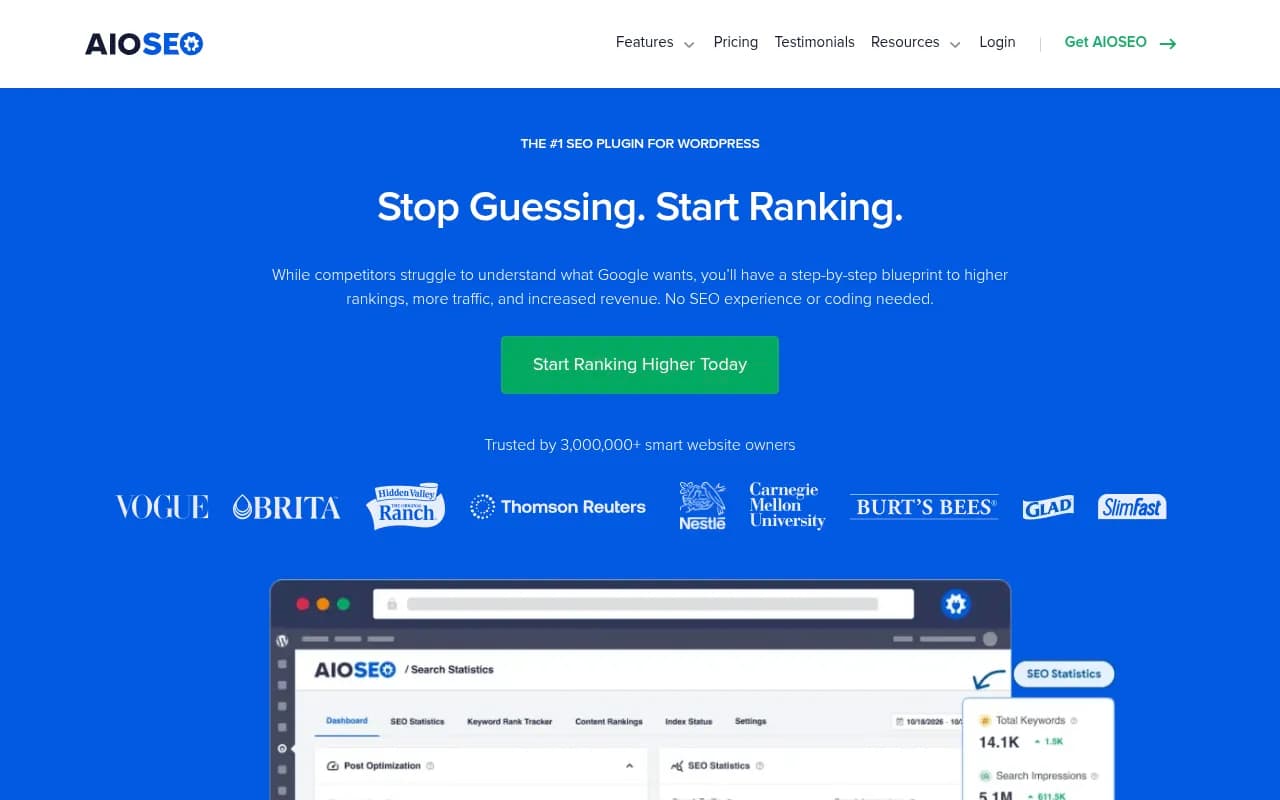
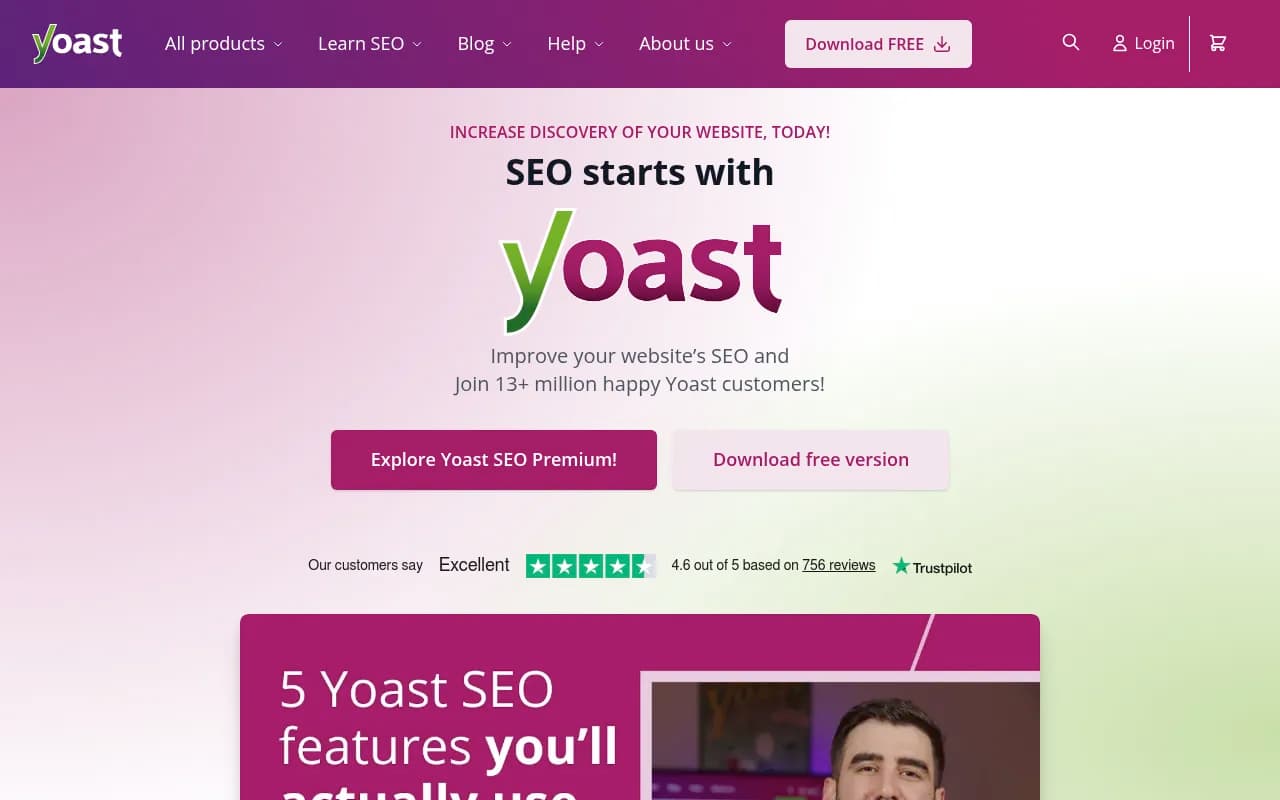
AIOSEO tends to pack more into its free and mid-tier plans, which is why it appeals to agencies managing several sites. Yoast leans on brand recognition and a genuinely good content readability analysis that's held up for over a decade. If you're picking between just these two for classic on-page SEO, the honest answer is that either one beats running nothing, and the deciding factor is usually price structure (AIOSEO scales by site count, Yoast charges per site) rather than any dramatic feature gap.
What AIOSEO and Yoast's "AI features" actually do
Here's where it gets murky. Both plugins market AI features prominently in 2026, but look closely at what they actually measure.
AIOSEO's AI Keyword Report checks whether specific pages surface when you query ChatGPT and Gemini about a keyword. That's useful as a spot-check, but it's a manual, keyword-by-keyword report inside a plugin whose core architecture is meta tags and schema, not a continuous monitoring system.
Yoast's AI Brand Insights does something similar, paired with an llms.txt generator so AI crawlers can, in theory, better understand your site structure. Worth having. Not the same thing as knowing whether your product pages get cited in ChatGPT Shopping results, whether Reddit threads about your brand are shaping how Perplexity describes you, or which of your blog posts AI crawlers actually read versus which ones they skip and never cite.
Both plugins also offer AI-written titles and meta descriptions, which is a content generation feature, not a visibility tracking feature. Useful for saving time. Doesn't tell you anything about how AI search engines are treating your content once it's published.
Where Finseo AI fits into this
Finseo AI approaches the problem from the other direction. Instead of starting from the WordPress editor and adding an AI check as an afterthought, it starts from the assumption that AI visibility is the primary job and builds monitoring around that. If you're comparing it against AIOSEO and Yoast, you're really comparing a WordPress plugin against a category of tool built specifically for tracking brand presence across AI search engines.
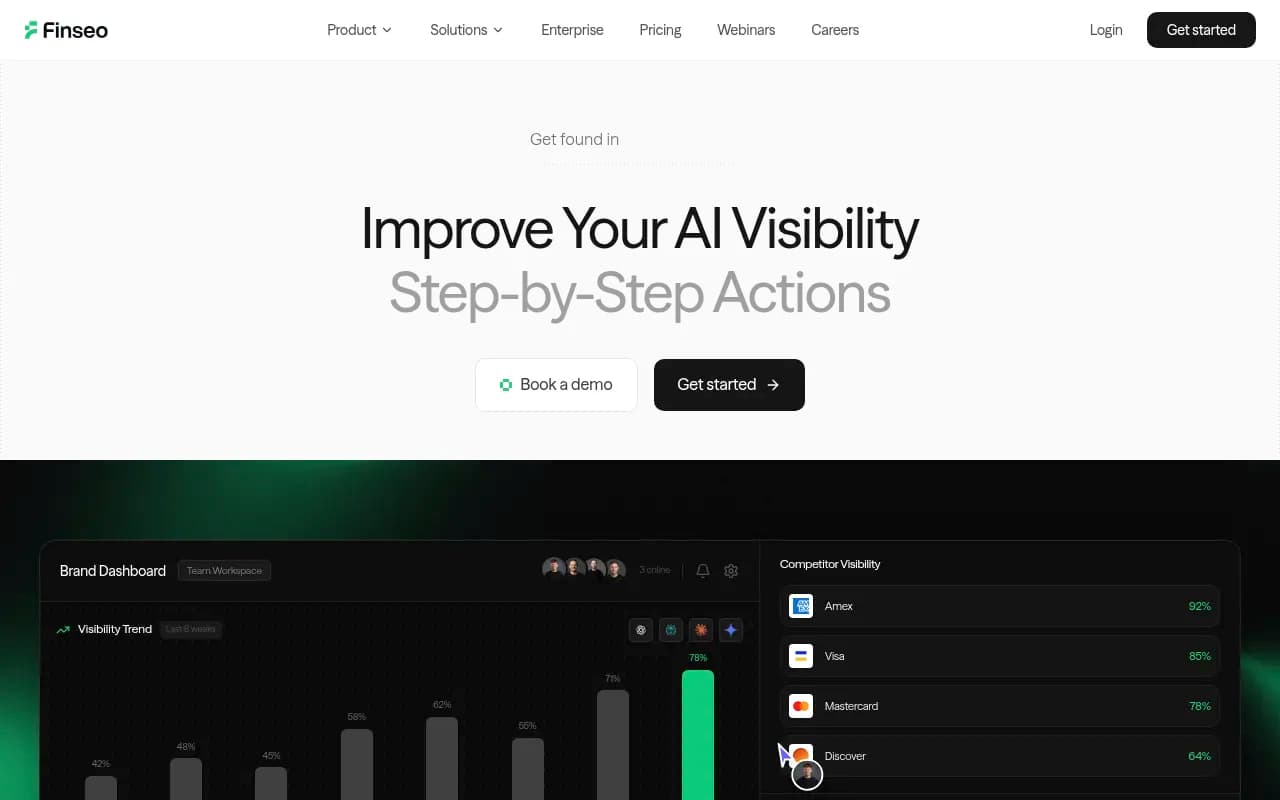
That distinction matters because the two jobs require completely different data pipelines. On-page SEO plugins read your own content and check it against known ranking factors. AI visibility tools have to run actual prompts against ChatGPT, Gemini, Perplexity, and others, parse the responses, extract citations, and track how that changes over time. AIOSEO and Yoast were not architected to do that at scale, which is why their AI features feel bolted on rather than core.
The gap none of these three fully close
This is the part that surprised me when I dug into it. Even purpose-built AI visibility tools split into two camps: trackers that answer "was I mentioned" and platforms that answer "why wasn't I mentioned, and what do I do about it." Most of the WordPress plugin AI features, and a lot of standalone AI visibility tools, stop at the first question.
A fuller stack needs to show you why you're visible or not (crawler logs revealing what AI bots actually read on your site, and where they hit errors), where AI finds your content (which specific pages get cited, which Reddit threads or YouTube videos shape the answer), and what to do about it (content gap analysis and actual content generation, not just a report you have to act on manually).
This is the piece Promptwatch is built around, and it's worth understanding even if you never touch it, because it clarifies what a WordPress plugin's AI Keyword Report is and isn't doing. Promptwatch tracks citations across ChatGPT, Claude, Gemini, Perplexity, Grok, and Google AI Overviews and AI Mode, logs real AI crawler traffic (ChatGPTBot, ClaudeBot, PerplexityBot, and 400+ others) hitting your site, and then closes the loop with Content Agents that draft and publish GEO-optimized pages straight to your CMS, including WordPress, on a schedule you set.

According to Promptwatch's research on AI Overviews citation types, product pages overtook listicles as the most cited content format in Google AI Overviews in late July 2026, which is exactly the kind of signal that should inform how a product-heavy WordPress site prioritizes its content work, and it's not something any WordPress plugin currently surfaces on its own.
Side-by-side: what each tool is actually for
| Tool | Core job | AI visibility depth | Content publishing | Best for |
|---|---|---|---|---|
| AIOSEO | On-page SEO, schema, redirects | Shallow (AI Keyword Report) | AI-assisted titles/meta | Agencies managing multiple WP sites |
| Yoast | On-page SEO, readability | Shallow (AI Brand Insights) | AI-assisted titles/meta | Content teams wanting familiar UX |
| Finseo AI | AI visibility tracking | Purpose-built for AI search | Limited | Teams whose main question is "does AI know we exist" |
| Promptwatch | AI visibility + action | Crawler logs, citations, Reddit/YouTube, shopping, Ads Radar | Content Agents publish to CMS | Teams that want to fix visibility, not just measure it |
So which one should you actually install?
If you're running a WordPress site and haven't touched SEO basics yet, install AIOSEO or Yoast first. Neither choice is wrong. AIOSEO's free tier gets you further if budget is the constraint, Yoast's readability tooling is genuinely good if your team writes a lot of long-form content and wants the guardrails.
Once your on-page foundation is solid, that's when the real question becomes whether AI search engines are actually finding and citing you, and that's a separate layer of tooling. A WordPress plugin's bolted-on AI Keyword Report will tell you a keyword surfaced once. It won't tell you that your competitor's comparison page is what ChatGPT keeps citing instead of yours, or that your product pages are getting crawled by GPTBot but never cited because of a technical issue the crawler logs would have caught.
If AI visibility monitoring across models is the actual goal, worth checking a broader directory like the GEO software listings at bestgeosoftware.com to compare the full field before settling on one platform, since the category has moved fast and options differ a lot in whether they just monitor or actually help you fix what they find.
The honest bottom line
AIOSEO and Yoast are still doing their original job well: meta tags, schema, sitemaps, internal linking, all inside the WordPress editor where content teams already work. Their AI features are real but narrow, more of a spot-check than a system.
Finseo AI and tools in its category exist because that spot-check isn't enough anymore. If your traffic increasingly comes from AI answers rather than blue links, you need something that treats AI visibility as the primary job, with the crawler-level and citation-level detail to back it up, and ideally the ability to act on what it finds rather than just reporting it back to you.