Key takeaways
- Finseo tracks ChatGPT Shopping, Google AI Overviews, and Google AI Mode for product-level visibility, but e-commerce teams comparing SKUs against competitors, or wanting feed enrichment, may need a more commerce-specific tool.
- Ranketta, Azoma, and Yotpo Discover build their entire product around individual SKU tracking and feed optimization rather than treating shopping as one module inside a general AI visibility suite.
- Product pages are still the single most-cited format on ChatGPT (28.7% average in August 2026, per Promptwatch), but that share dropped from roughly 30% to 25% during the month, while how-to and documentation content grew fast, a sign that pure product-page optimization won't be enough on its own.
- Google Merchant Center now ships a free native AI performance report, but it only covers Google's own surfaces (AI Mode, AI Overviews, the Gemini app), so brands selling across ChatGPT and Perplexity still need a third-party tracker.
- For teams that want tracking plus the content and technical work to actually fix visibility gaps, tools like Promptwatch pair citation and crawler data with automated content generation rather than stopping at a dashboard.
Why e-commerce teams outgrow Finseo's shopping module
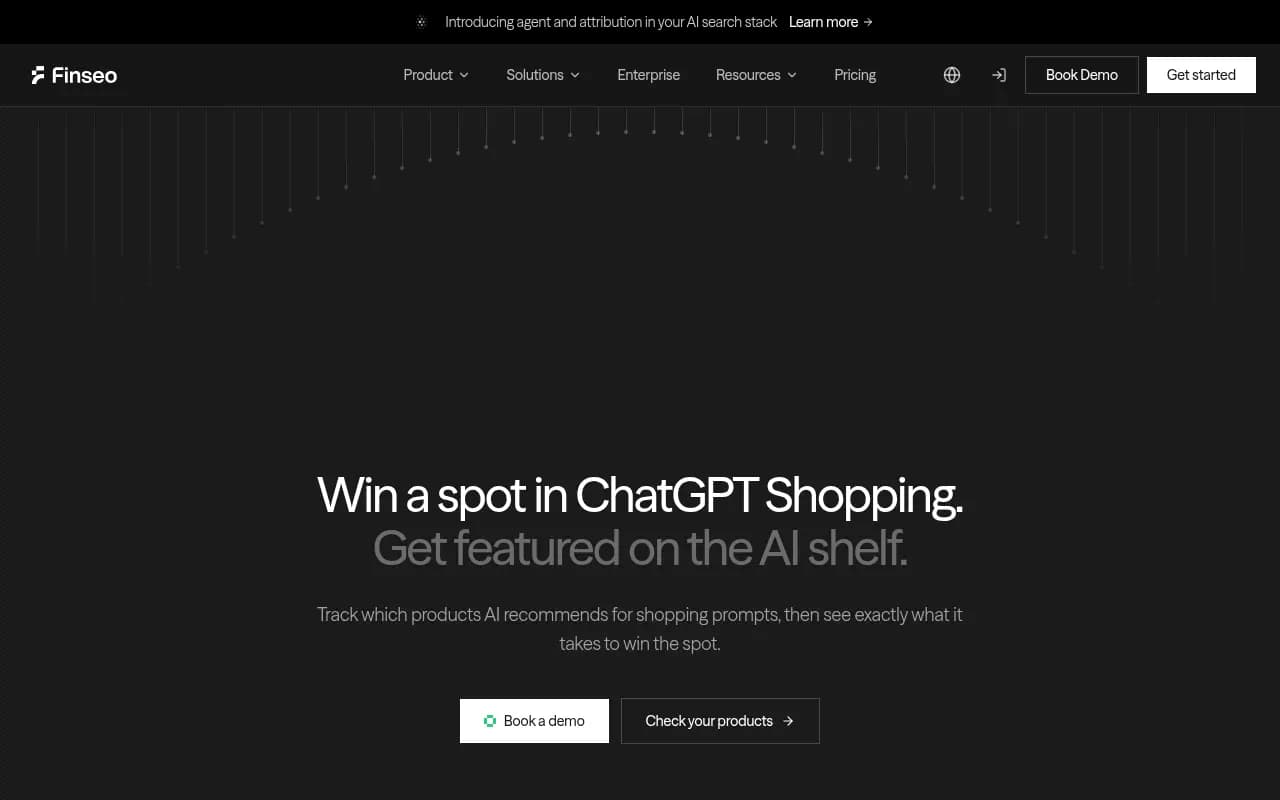
Finseo is a solid general-purpose AI visibility tracker. It covers ChatGPT, Gemini, Claude, Perplexity, Copilot, Grok, DeepSeek, and Mistral, and its shopping page shows product-level rankings, competitor shelves, and store-mention share. For a brand that mostly cares about being mentioned by name, that's plenty.
But e-commerce is a different beast. You're not tracking one brand name, you're tracking hundreds or thousands of SKUs, each competing for a handful of slots in a shopping carousel. You need to know which specific product AI recommended, at what price, from which retailer, and why a competitor's version beat yours. That's a product-catalog problem as much as it's a visibility problem, and it's why a wave of commerce-native alternatives have shown up in 2026: Ranketta, Azoma, Yotpo Discover, and Ecomtent all treat the product feed itself as the thing to optimize, not just the thing to report on.
The scarcity problem nobody talks about
Here's something worth sitting with: Promptwatch's data shows ChatGPT surfaces only around 5 sources per web-search response on average, roughly half of what Google AI Overviews and Perplexity show (both closer to 10). That means the shelf space for any given shopping query on ChatGPT is genuinely tiny. If you're not one of maybe three or four products ChatGPT decides to name, you're invisible for that query, full stop. This is exactly why commerce-focused tools obsess over SKU-level tracking instead of brand-level mentions, a single missed product card is a real revenue loss, not a rounding error.
What to look for in a Finseo alternative for e-commerce
Before comparing tools, it helps to know which capabilities actually matter for a commerce use case:
- SKU-level tracking, not just brand mentions, so you can see which individual products AI recommends and at what position
- Coverage of ChatGPT Shopping specifically, plus Google AI Mode Shopping and, ideally, Amazon Rufus
- Feed or catalog enrichment, since a messy product feed is often the actual reason AI skips your SKUs
- Competitor shelf visibility, so you can see who's winning the carousel and why
- A path from insight to fix: content generation, schema recommendations, or feed corrections, not just a chart
Comparison: Finseo vs. commerce-specific alternatives
| Platform | Shopping coverage | SKU-level tracking | Feed enrichment | Starting price |
|---|---|---|---|---|
| Finseo | ChatGPT Shopping, Google AI Overviews, AI Mode | Yes | No | ~€84/mo |
| Ranketta | ChatGPT, Gemini, Perplexity, AI Overviews, AI Mode | Yes, plus MCP server | Yes (add-on/Starter tier) | €29/mo tracker; €79/mo with enrichment |
| Azoma | ChatGPT, Gemini, Amazon Rufus, Alexa Shopping, Walmart Sparky, Perplexity | Yes | Yes | No public pricing, enterprise-only (~$1,000+/mo estimated) |
| Yotpo Discover | ChatGPT, Gemini, Claude, Perplexity | Yes, tied to reviews/UGC data | Indirect, via review content | Custom |
| Ecomtent | ChatGPT, Google AI Overviews | Limited, content-focused | Yes, images/copy for Rufus and COSMO | $599/mo (25 SKUs) |
| Semrush Enterprise AIO | ChatGPT Shopping, Google AI Mode Shopping | Yes | No | Enterprise/custom |
Pricing above is drawn from each vendor's published site or the most recent third-party comparisons available; commerce-tier pricing especially at Azoma and Ecomtent tends to move quickly, so confirm current numbers before budgeting.
Tool-by-tool breakdown
Ranketta: the SKU-and-feed specialist
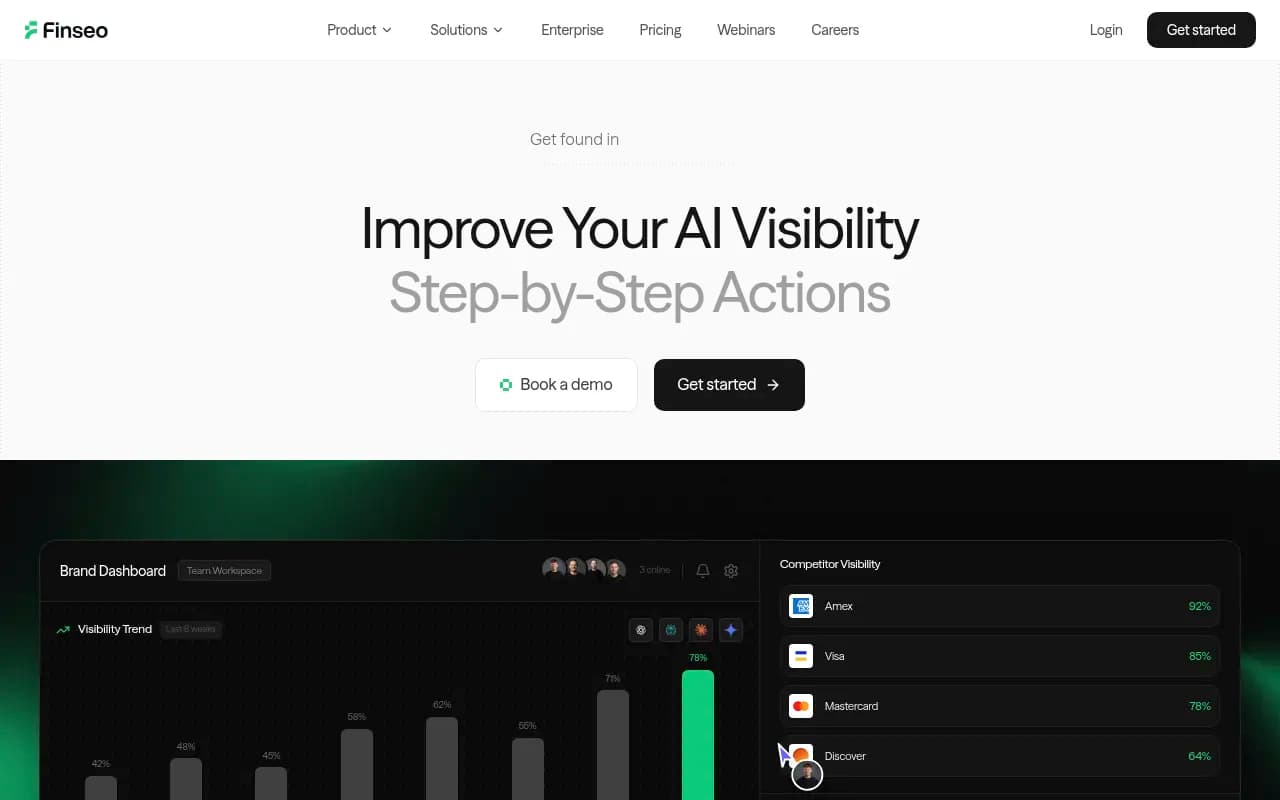
Ranketta's whole pitch is "agentic commerce" visibility: it tracks individual SKUs, yours and competitors', across ChatGPT, Gemini, Perplexity, and both Google AI surfaces, then layers in a product-data enrichment service designed to make your feed more legible to shopping agents. It also ships an MCP server, which matters if your team is already wiring AI agents into internal tooling. At €29/month for a bare-bones tracker plan and €79/month once you add enrichment, it's priced well below enterprise tools, and the company claims over 1,200 e-commerce and D2C brands as customers. If your core problem is "my feed is a mess and AI can't parse it," this is a reasonable first stop.
Azoma: broadest shopping-agent coverage, enterprise price
Azoma is the only tool in this list tracking Amazon Rufus, Alexa Shopping, and Walmart Sparky alongside ChatGPT and Gemini. That breadth matters if a meaningful share of your revenue comes through Amazon rather than direct-to-consumer channels; Azoma's own research pegs Rufus at roughly 274 million daily questions as of late 2024, with usage projected to climb sharply through 2025 (treat that projection as Azoma's own estimate, not independently verified). Its client roster (L'Oréal, Unilever, Mars, Beiersdorf) signals it's built for large CPG catalogs, and the lack of public pricing, with third-party estimates starting around $1,000/month, confirms it's not aimed at smaller merchants.
Yotpo Discover: built on review and loyalty data you already have
If you already run Yotpo for reviews and loyalty, Discover is worth a look because it reuses that UGC data rather than asking you to build a new content pipeline from scratch. Yotpo cites case studies claiming a 62% increase in first-place product placements for one customer and a 33% lift in awareness-stage visibility for another, though these are vendor-reported figures, so weigh them accordingly. Pricing is fully custom, which Yotpo explains by saying visibility work scales with catalog size and market coverage rather than order volume the way its other products do.
Ecomtent: content generation, not a tracker
Ecomtent sits in a different category. It's primarily built to generate product images, infographics, and copy tuned for Amazon Rufus and Amazon's COSMO algorithm, with lighter tracking across ChatGPT and Google AI Overviews bolted on. At $599/month for just 25 SKUs (reportedly up from $165/month in early 2025), it's a meaningful spend, and it's best thought of as a companion to a real tracker rather than a replacement for one.
Semrush Enterprise AIO: the safe choice if you already run Semrush
Semrush expanded its Enterprise AI Optimization suite in March 2026 to cover both ChatGPT Shopping and Google AI Mode Shopping with a unified Merchant view and Product view. One of its own experiments found that ChatGPT's top shopping result matched Google Shopping's first result 75% of the time across 100 test runs, which suggests optimizing your Google Shopping feed may do double duty for ChatGPT visibility too. This is a strong option if you're already deep in the Semrush ecosystem and don't want another vendor to manage, but it's an enterprise add-on, not a standalone e-commerce tool.

What the citation data actually tells e-commerce brands
A few Promptwatch data points are worth building your strategy around rather than guessing.
First, Promptwatch's ChatGPT citation types data shows product pages held close to 30% of ChatGPT's citation share through most of August 2026, then fell to about 25% in the last third of the month. At the same time, how-to content climbed from 4.3% to over 9%, and documentation nearly doubled. If your GEO plan is "just make product pages," you're optimizing for a format whose dominance is already softening.
Second, Promptwatch's shopping usage data shows ChatGPT's rate of attaching shopping cards to responses moves in sudden step changes rather than a steady climb, roughly doubling overnight in late May 2026 and then falling back weeks later. That's OpenAI actively turning shopping features on and off for categories, which means a tracker that only checks in weekly will miss the window entirely.
Third, if you're leaning on Reddit-style UGC content as part of your GEO push, know that Reddit's share of ChatGPT citations collapsed from roughly 4% to 0.5% in a single day, August 14, 2026. That's not a slow decline you can course-correct mid-quarter, it's the kind of overnight shift only daily monitoring catches.
Don't forget Google's own free option
Google Merchant Center quietly rolled out an "AI performance insights" report starting in a limited US pilot around May-July 2026, expanding to more regions afterward. It covers AI Mode, AI Overviews, and the Gemini app with four report types: share of voice against competitors, funnel performance by stage, product term insights, and an attribute-completeness score that flags missing color, material, or dimension data. It's free and lives right inside a tool most merchants already use. The catch is obvious, it only sees Google's ecosystem. If ChatGPT or Perplexity drive meaningful traffic for you, and BrightEdge's holiday-season analysis found ChatGPT citing retailer domains in 36% of shopping responses versus just 4% for Google AI Overviews, a 9x gap, you still need a cross-platform tool on top of it.
Where Promptwatch fits for e-commerce teams
Most of the tools above are strong at monitoring, some are strong at content, few do both well. Promptwatch is built around the idea that tracking is only half the job. It monitors ChatGPT, Gemini, Claude, Perplexity, Grok, and Google's AI surfaces, and includes a dedicated ChatGPT Shopping and Ads Radar module that tracks product recommendations and which competitors are bidding on your prompts. Where it separates from pure trackers is the rest of the stack: AI crawler logs that show exactly when GPTBot or PerplexityBot hit your product pages, citation trend data broken into 22 content types, and Content Agents that can write and publish GEO-optimized product and category content straight to Shopify-connected CMS platforms like Webflow or WordPress on a schedule.

For a retailer trying to decide between Finseo's shopping module and a commerce specialist, the honest answer is that it depends on whether you need a dashboard or a fix. If you just need visibility numbers, Finseo, Ranketta, or Semrush's AI Shopping report will all tell you where you stand. If you need something to close the gap, whether that's crawler-level diagnosis of why AI isn't reading your product pages, or automated content that actually gets published, a platform with the full loop built in is worth the extra look.
For a broader sweep of GEO and AI visibility platforms beyond the e-commerce-specific ones covered here, the directory at bestgeosoftware.com is a useful next stop.
Final recommendation
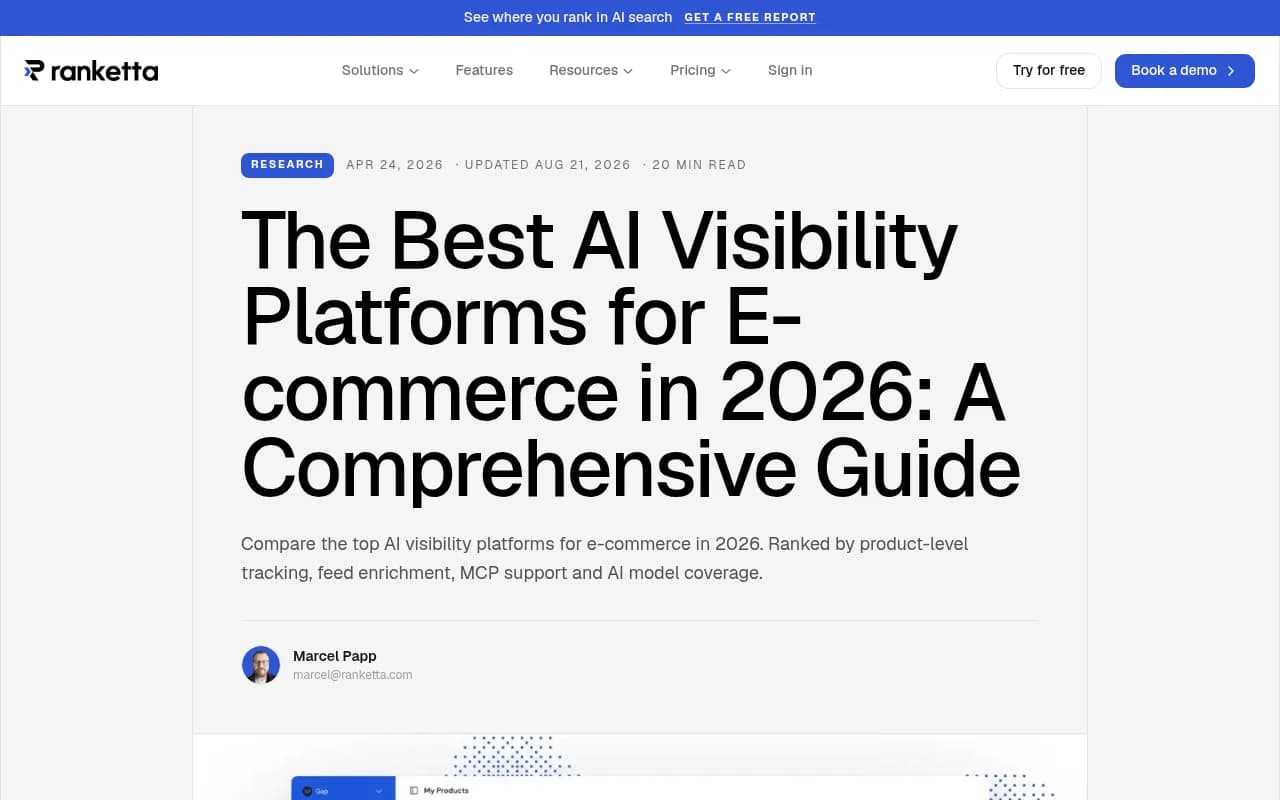
If your catalog is under a few hundred SKUs and budget is tight, start with Ranketta's Tracker plan at €29/month and add its enrichment tier once you see where the gaps are. If you're an enterprise CPG brand selling heavily through Amazon, Azoma's breadth into Rufus, Alexa, and Walmart Sparky justifies its enterprise pricing. If you already run Semrush or Yotpo, their AI Shopping modules save you a new vendor relationship. And if you want a single platform that tracks citations, watches AI crawlers hit your product pages, and then writes and publishes the content needed to fix visibility gaps, without waiting on a separate content team, Promptwatch is the one built for that full workflow rather than just the reporting half of it.