Key takeaways
- Ahrefs Brand Radar builds its prompt sets from search and "People Also Ask" data, which skews heavily toward Google's AI Overviews/AI Mode ecosystem and leaves Claude essentially untracked (each Claude check costs 8x a normal check) and Grok temporarily broken.
- Finseo queries the actual front-end UI of most AI platforms (not a sanitized API), which better reflects what a real user sees, and falls back to API only where the UI can't be automated, like Claude.
- Full AI coverage on Ahrefs realistically costs $828-$1,148/month once you add the base Ahrefs plan plus the Brand Radar bundle. Finseo's comparable tier runs roughly €210-€479/month.
- Neither tool solves the deeper problem: research cited by SatelliteAI suggests a meaningful share of AI-generated citations don't actually support the claims attached to them, so "was I cited" and "was the AI right about me" are different questions.
- If you need genuine multi-model accuracy, including Claude, Reddit-native citation tracking, and crawler-level verification, look past both of these and consider a dedicated GEO platform like Promptwatch.
Why this question is harder than it sounds
"Which tool is more accurate" sounds like it should have a clean answer. It doesn't, because Ahrefs Brand Radar and Finseo aren't really measuring the same thing in the same way. One pulls from a search-keyword-derived prompt database and checks it against a handful of AI surfaces on a monthly cadence. The other queries live AI interfaces on a rolling basis and tries to reconstruct what an actual user sees. Both call the resulting number "visibility." They're not calculating it the same way, and that matters more than either vendor's marketing admits.
I spent time in both products, read the methodology pages, and pulled together what independent reviewers found when they tested the tools side by side. Here's where they actually differ, and where I'd put my money if I were picking one for a real brand-tracking program.
How Ahrefs Brand Radar builds its data
Ahrefs Brand Radar, according to its own methodology page (updated in late February 2026), frames its scoring as "behavioral relevance + semantic coverage." In practice that means it takes prompts from Ahrefs' existing keyword database (over 110 billion keywords) and Google's "People Also Ask" corpus, then expands those into a broader question set using two systems: one based on real search refinements, one based on topic-structure completeness. Question sets get refreshed and tested against chatbots monthly, with a 90-day reporting window.
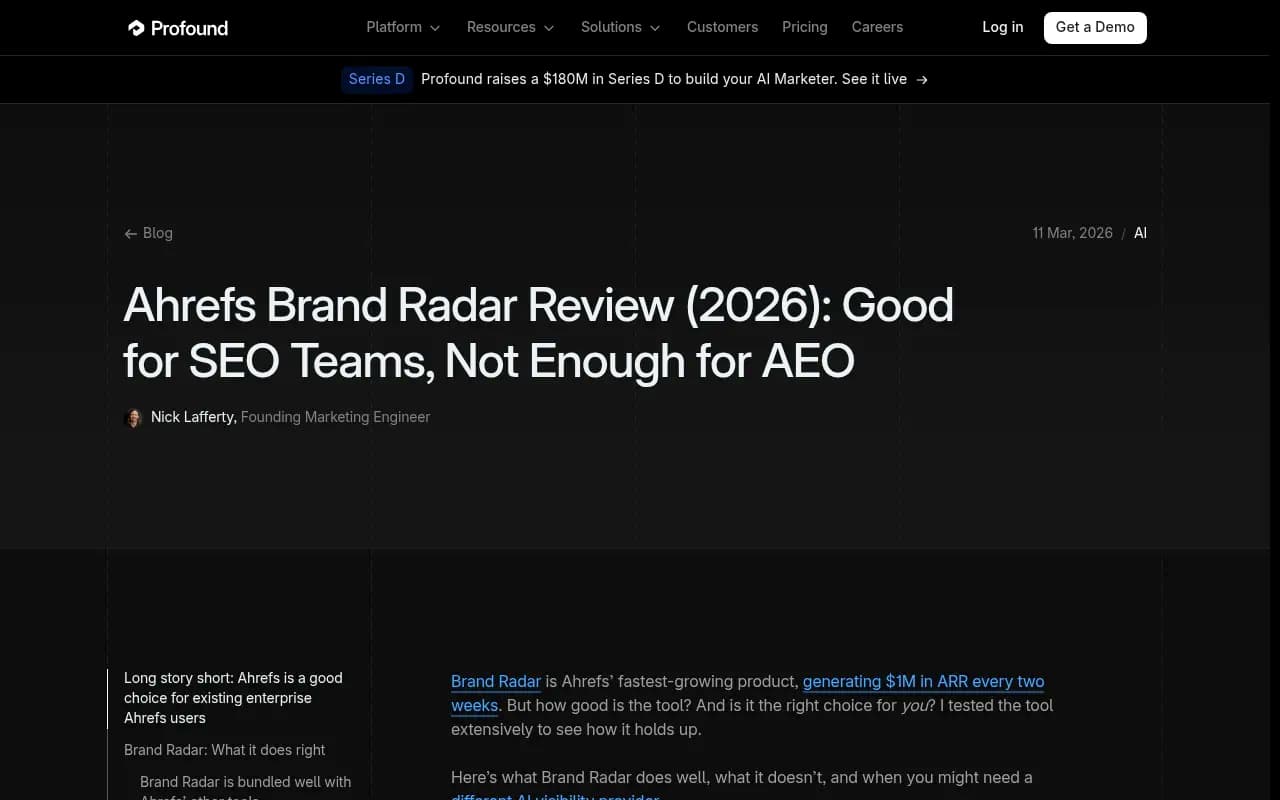
That's a solid approach if what you care about is AI Overviews and AI Mode, because those surfaces are literally built on top of Google's search index, which is the same data Ahrefs already has. But it's a search-first lens applied to a conversational-AI problem. Independent testing by Profound found Brand Radar's prompt set skews heavily toward Google's ecosystem, meaning ChatGPT and Perplexity coverage can end up thinner for the same brand than it should be.
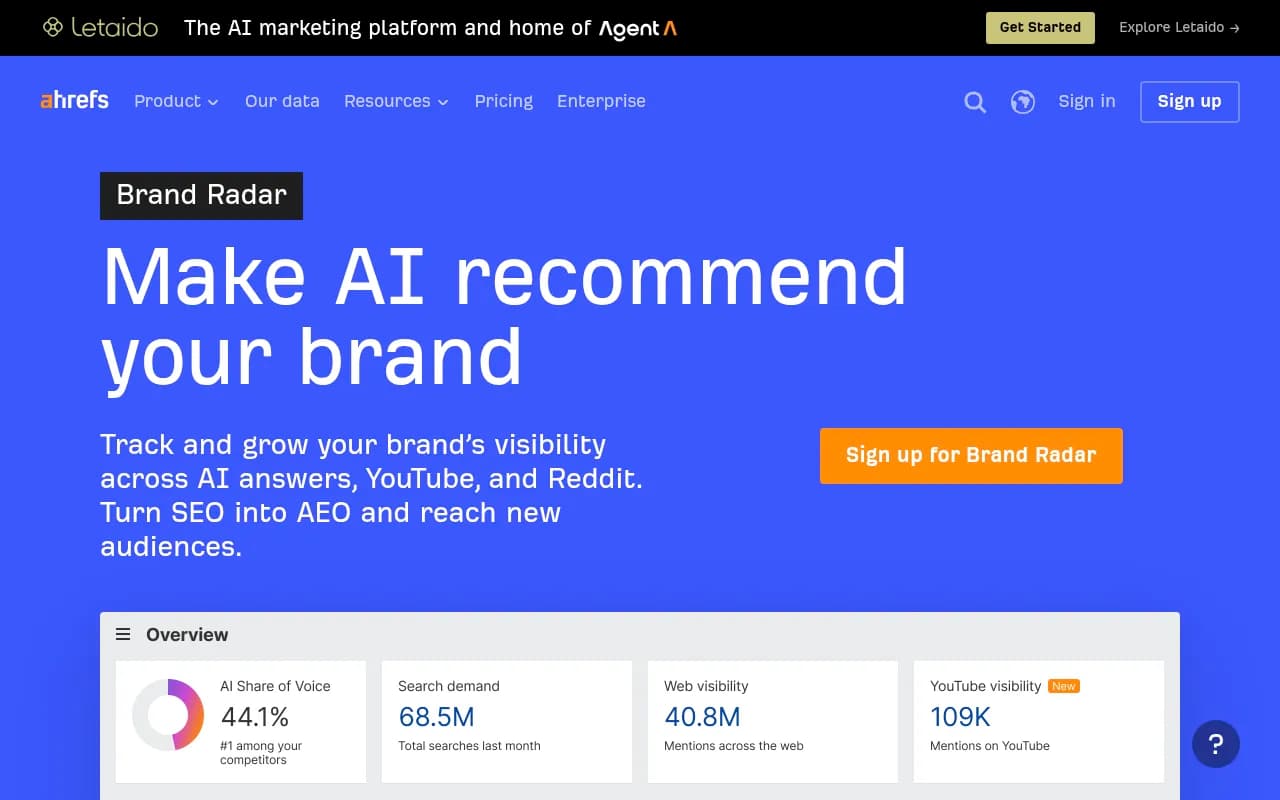
The bigger gap is platform coverage. As of the current Ahrefs Help Center documentation, AI Overviews, AI Mode, ChatGPT, Perplexity, Gemini, and Copilot are fully tracked. Grok was added in April 2026, but Ahrefs' own docs admit: "Following recent policy changes by Grok, we are temporarily unable to gather new data." Claude isn't a standard tracked index at all. You can get Claude data through custom prompts via API, but each Claude check consumes eight checks from your quota, which quietly multiplies your costs if Claude matters to your category.
Ahrefs Brand Radar also doesn't run sentiment analysis, doesn't split citations by owned/earned/paid/competitor, and its Reddit tracking is really Reddit-in-Google-SERPs, not Reddit-as-cited-by-AI. An EWR Digital review from February 2026 went further, explicitly flagging "documented accuracy issues in its AI tracking modules" and describing beta channels like YouTube and TikTok cross-referencing as "directional at best."
How Finseo builds its data
Finseo takes a different technical route. For most tracked models it queries the live web interface, not an API, specifically so "the data reflects what a real user would see instead of a sanitized API response." That distinction is worth sitting on for a second. An API call to a model often skips the retrieval and grounding steps that happen in the actual consumer product, meaning API-based tools can miss the citations and sources a real person would actually see in ChatGPT or Perplexity. Finseo's UI-first approach is built to catch what's genuinely on screen. The tradeoff, and Finseo is upfront about it, is that some models don't expose a stable UI to automate against. Claude is the named exception, where Finseo falls back to the official API.
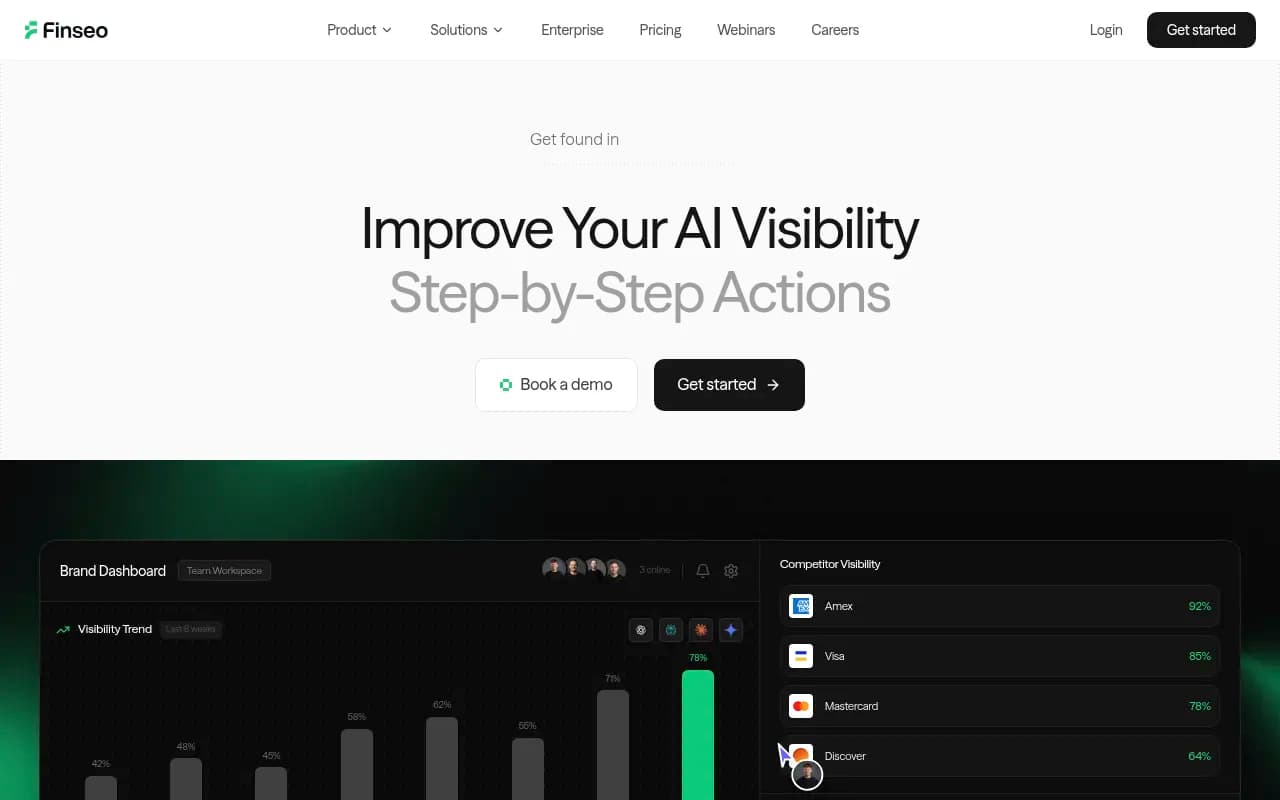
Finseo's atomic unit of measurement is clean and well-defined: one AI answer equals one prompt times one model times one day. A 150-prompt plan tracked across three models for 30 days works out to roughly 13,500 AI answers a month, which lines up with what the Business plan advertises. Visibility is calculated as the percentage of tracked answers that mention your brand at least once; mentions count every individual name-check, even multiple in the same answer. It also lets you calculate Share of Voice two ways, against only your defined competitor set, or against every brand the AI actually names in a response, which can be a useful reality check if you've been quietly winning against a competitor set that doesn't reflect who's really showing up.
Finseo covers ten core AI platforms (ChatGPT, Claude, Gemini, Google AI Overviews, Google AI Mode, Perplexity, Copilot, Grok, Mistral, DeepSeek) plus regional add-ons like Meta AI, Qwen, Kimi, and Naver AI Briefing. That's broader native coverage than Brand Radar offers today, and crucially it includes Claude without the 8x-cost penalty.
Side-by-side comparison
| Factor | Ahrefs Brand Radar | Finseo |
|---|---|---|
| Data source | Search/PAA-derived prompt database, checked monthly | Live UI simulation (API fallback for Claude) |
| Claude coverage | Custom prompts only, 8x check cost | Native, included in standard plans |
| Grok coverage | Added April 2026, currently paused by Grok's own policy change | Native tracking |
| Reddit coverage | Tracks Reddit-in-Google-SERPs, not native AI citations | Tracks citation sources directly, including Reddit domains |
| Sentiment analysis | None in core report | Included on Business tier and above |
| Entry pricing for full AI coverage | ~$828-$1,148/month (base plan + Brand Radar bundle) | ~€84-€479/month depending on tier |
| Best fit | Teams already paying for Ahrefs' SEO suite | Teams that want AI-native tracking as the primary tool |
What "accuracy" actually means here
Both vendors use the word "accurate," but they're solving different accuracy problems. Ahrefs is optimizing for scale and search-panel breadth, it has a genuinely massive prompt database, but the cost of that scale is a search-shaped lens on a conversational medium, plus real, documented gaps in Claude and Grok. Finseo is optimizing for fidelity to the real user experience through UI simulation, but it's a newer entrant with a smaller historical baseline and fewer third-party reviews to lean on; its G2 presence, for instance, is still only a handful of reviews.
There's a data point worth grounding this in. Promptwatch's research on average sources per response found that ChatGPT's web-search-triggered answers cite roughly five sources on average, while Google AI Overviews cite around ten and Perplexity sits close to ten as well (source: Promptwatch's average sources per response data). That means ChatGPT is a much scarcer citation surface than AI Overviews. If a tracking tool only samples a limited set of prompts per day against that thin an inventory, small-sample noise can swing your reported citation share more than actual brand performance does. This is exactly why Brand Radar's monthly refresh cadence and search-skewed prompt set matters: a tool checking ChatGPT less frequently, against fewer truly conversational prompts, is more exposed to that noise than one running continuous UI checks.
There's also a broader industry caveat that applies to both tools equally. Research cited by SatelliteAI suggests somewhere between 50% and 90% of AI-generated citations don't fully support the claim they're attached to. In other words, a citation existing doesn't mean the AI got the facts about your brand right. Neither Ahrefs nor Finseo, nor most tools in this category, measure the correctness of what's said about you, only whether you were mentioned or cited at all. Keep that in mind before you treat either platform's "visibility score" as gospel.
Where each tool clearly wins
Ahrefs Brand Radar makes the most sense if you're already paying for Ahrefs' SEO suite and want a bolt-on view of how AI associates topics with your brand, plus YouTube/TikTok visibility beta features. If your priority is AI Overviews specifically, since that's Google's own surface and Ahrefs' data foundation is Google-adjacent, it's a reasonable fit. The catch is cost. Once you add the $199/platform or $699/bundle add-on to a base plan, you're often at $800+/month before touching custom prompt overages.
Finseo makes more sense if AI visibility is your primary concern rather than a side feature of an existing SEO subscription, and if Claude or Grok matter to your category. Its pricing is also considerably lower at every comparable tier, and its Query Fan-Out Analysis and Bot Traffic Analytics modules (which ingest server logs to show which AI crawlers actually hit your site) give you signal that Brand Radar doesn't offer at all.
Where both tools fall short
Neither Finseo nor Ahrefs Brand Radar gives you AI-crawler-log analysis tied to actual citation outcomes, nor do they connect AI visibility to attributed revenue with the depth that a purpose-built GEO platform does. If you want to go beyond "were we mentioned" and get to "why weren't we cited, and what do we fix," you're looking at a different category of tool entirely, ones with crawler logs, content gap analysis, and automated content generation built in.
Promptwatch is worth a look here. It tracks the same core platforms (ChatGPT, Claude, Gemini, Perplexity, Grok, AI Overviews, AI Mode, Copilot, and more) using real UI data rather than sanitized API output, but adds crawler logs that show exactly when GPTBot, ClaudeBot, or PerplexityBot visited a given page, whether they hit an error, and what that page's actual citation rate is. It also tracks Reddit and YouTube citations directly (channels both Finseo and Ahrefs handle thinly or not at all), and its Content Agents can turn a content gap into a published, GEO-optimized article on your CMS without a human in the loop for every step. Over 1,840 brands use it, and it's rated 4.7/5 on G2.

The verdict
If forced to pick purely on citation-tracking fidelity, Finseo's UI-first methodology and full model coverage (Claude included, at no cost penalty) edges out Ahrefs Brand Radar's search-derived, Google-leaning prompt panel with its broken Grok tracking and expensive Claude workaround. But "more accurate than Brand Radar" isn't the same as "accurate enough to run a GEO program on." Both tools measure presence, not correctness, and neither gives you the crawler-level verification that tells you why a citation happened in the first place.
If you're already deep in the Ahrefs ecosystem and only need a directional read on AI Overviews, Brand Radar is a fine add-on. If AI visibility is a standalone priority, Finseo's approach and pricing make it the stronger of the two. And if you want a platform that closes the loop from tracking to action, it's worth comparing both against the broader field of GEO software at bestgeosoftware.com before committing a budget line to either one.