Key takeaways
- Most AI search monitoring tools stop at data — they show you visibility scores but don't help you fix them, leaving teams to manually research, brief, and write content.
- The teams saving 10+ hours per week aren't just using more AI tools — they're using platforms that complete the full loop: find gaps, generate content, track results.
- Action-oriented platforms like Promptwatch combine answer gap analysis, AI content generation, and citation tracking in one workflow, replacing what used to take multiple tools and multiple people.
- The productivity gap between teams using monitoring-only tools and those using full-loop platforms is widening fast in 2026.
- Choosing the right platform comes down to one question: does it just show you data, or does it help you act on it?
The problem with "just tracking" in 2026
Here's a scenario that plays out on marketing teams every week. Someone pulls up the AI visibility dashboard, sees that a competitor is getting cited in ChatGPT and Perplexity for five prompts you're not appearing in, and then... the meeting ends. Everyone agrees it's a problem. No one is quite sure what to do next.
That's the monitoring trap. You have data. You don't have a path from data to done.
According to a LinkedIn analysis from earlier this year, average AI users are saving 40-60 minutes a day, but "frontier users" — the ones who've embedded AI into actual workflows rather than just using it for one-off tasks — are saving 10+ hours a week. The difference isn't which tools they have. It's whether those tools produce outputs or just produce reports.
This is exactly the problem with most AI search visibility platforms right now. The category has exploded since 2024, and the majority of tools are built around the same core feature: run prompts, see who gets cited, show you a score. That's useful for about five minutes. After that, you need to know what to do.
Vellum's 2026 guide to AI agents for marketing operations makes the same point from a different angle: the agents teams find most valuable aren't the ones that generate content in isolation — they're the ones that "connect existing marketing ops tools and surface insights" and carry work from trigger to outcome. Most teams save 5-10 hours weekly when they deploy agents that actually complete tasks, not just surface data.
The same logic applies to AI search visibility. A platform that shows you a gap is a starting point. A platform that shows you the gap, tells you what content would close it, generates a draft, and then tracks whether that content gets cited — that's where the hours come back.
What the action loop actually looks like
The difference between a monitoring tool and an action-oriented platform comes down to whether there's a closed loop. Here's what that loop looks like in practice:
Step 1: Find the gaps. You need to know which prompts your competitors are visible for that you're not. Not just "your visibility score is 34%" — but the specific questions, the specific models, the specific competitors winning. Answer gap analysis at this level tells you exactly which content your site is missing.
Step 2: Create content that closes those gaps. This is where most platforms stop being useful. They give you the gap data and then wave goodbye. Action-oriented platforms use that same data — prompt volumes, citation patterns, competitor analysis, your brand guidelines — to generate content briefs or full drafts. Not generic SEO filler. Content engineered around the exact questions AI models are already trying to answer.
Step 3: Track what happens. Once you publish, you need to know if it worked. Which pages are getting cited? By which models? How long did it take from publish to first citation? This closes the loop and tells you whether to double down or try a different angle.
That three-step cycle — find gaps, create content, track results — is what separates a tool that saves you hours from one that just adds another dashboard to your morning routine.
Why monitoring-only tools leave teams stuck
It's worth being specific about what "monitoring-only" actually means, because a lot of platforms market themselves as comprehensive when they're really just step one.
Tools like Otterly.AI, Peec.ai, and several others in the category are genuinely useful for tracking visibility. They'll show you brand mentions across ChatGPT, Perplexity, Google AI Overviews, and other models. Some have decent competitor comparison features. But when you ask "okay, what do I do now?" — they don't have an answer.
Otterly.AI

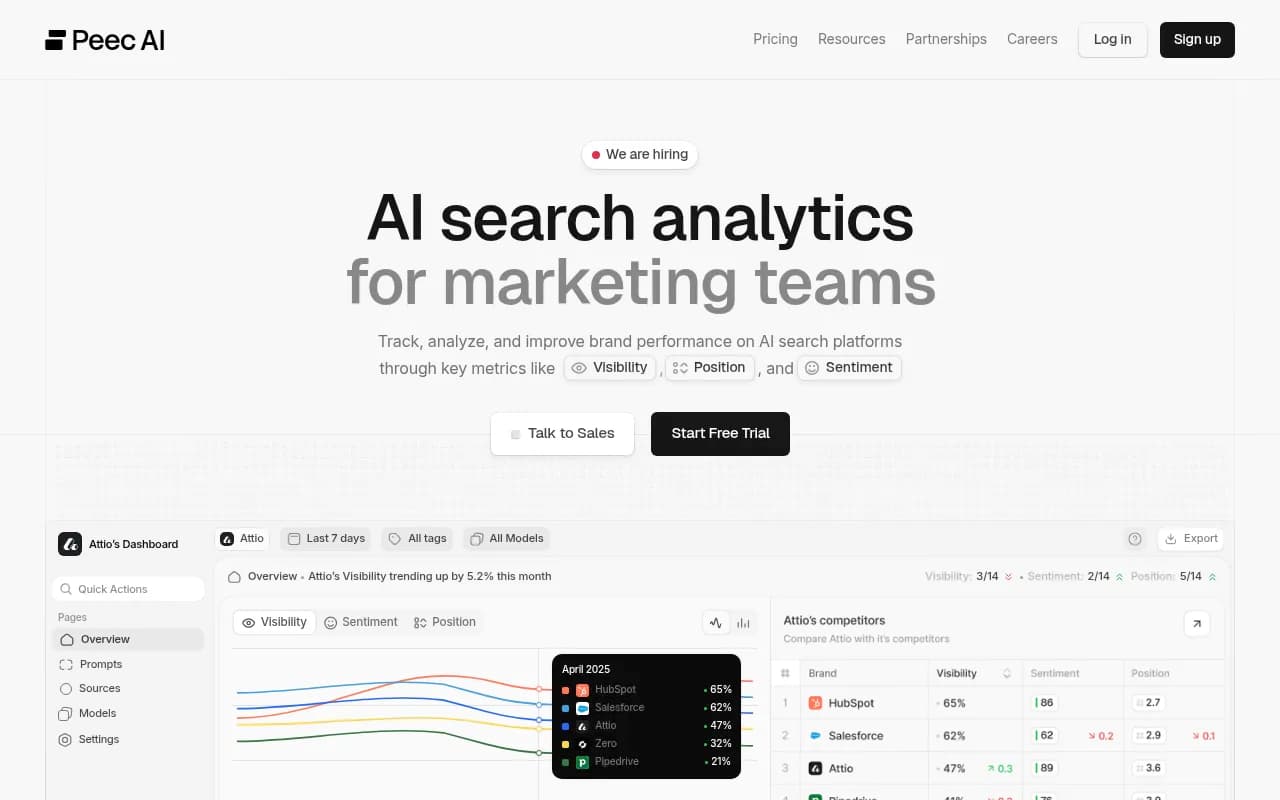
The result is that teams using these tools end up doing the rest of the work manually: researching which content to create, writing briefs, producing drafts, publishing, and then manually re-running prompts weeks later to see if anything changed. That process easily eats 3-5 hours per piece of content. Multiply that across a team trying to close 10-15 visibility gaps per month and you're looking at a significant time sink.
Nick Lafferty from Profound, speaking on the Exposure Ninja Growth Leaders Series in June 2026, made the point that velocity is a moat in AI search. The brands winning aren't just the ones with the best content — they're the ones who can identify gaps and respond to them faster than competitors. A manual workflow, even with good monitoring data, can't match that pace.
Profound

The tools that actually complete the loop
Not every platform in this space is built the same way. Here's an honest look at where different tools sit on the spectrum from "shows you data" to "helps you act on it."
| Platform | Gap analysis | Content generation | Crawler logs | Citation tracking | Prompt volume data |
|---|---|---|---|---|---|
| Promptwatch | Yes | Yes (Content Agents) | Yes | Yes (page-level) | Yes |
| Profound | Yes | No | Limited | Yes | Limited |
| AthenaHQ | Yes | No | No | Yes | No |
| Otterly.AI | Basic | No | No | Basic | No |
| Peec.ai | Basic | No | No | Basic | No |
| Search Party | Limited | No | No | Limited | No |
| Semrush | Limited | Partial | No | No | No |
Promptwatch is the clearest example of a platform built around the full loop. The Answer Gap Analysis shows you which prompts competitors rank for that you don't — not just as a number, but as a list of specific questions with prompt volume estimates and difficulty scores. Content Agents then use that data, combined with citation patterns, brand guidelines, and competitor analysis, to generate articles, listicles, and comparisons built around those exact gaps. Page-level tracking shows which published pages are getting cited, by which models, and when.

That's a genuinely different workflow from logging into a monitoring dashboard, exporting a CSV, and then figuring out what to do with it.
Where the hours actually go (and come back from)
Let's be concrete about the time math, because "10+ hours per week" sounds like a marketing claim until you break it down.
A typical AI search optimization workflow without an action-oriented platform looks something like this:
- Run prompts manually across ChatGPT, Perplexity, Gemini to check visibility: 2-3 hours/week
- Analyze which competitors are winning and why: 1-2 hours/week
- Research what content would close the gaps: 2-3 hours/week
- Write content briefs: 1-2 hours/week
- Draft and edit content: 3-5 hours/piece
- Re-check visibility after publishing: 1-2 hours/week
That's 10-15 hours before you've even accounted for the back-and-forth of getting briefs approved, revising drafts, or coordinating with writers.
An action-oriented platform compresses most of this. Automated prompt monitoring replaces the manual checking. Gap analysis replaces the competitor research. Content generation with real prompt data replaces the brief-writing and much of the drafting. Automated citation tracking replaces the manual re-checking.
The Vellum guide on AI agents for marketing operations puts the savings at 5-10 hours weekly for teams using agents that handle "operational glue work" — the connecting tissue between data and output. AI search optimization is exactly that kind of glue work: it requires pulling data from multiple sources, making decisions based on that data, and producing content outputs. It's the kind of workflow that benefits most from automation.
What to look for when evaluating platforms
If you're currently using a monitoring-only tool and wondering whether to switch, here are the questions worth asking:
Does it tell you what to create, not just what's missing? Gap data is only useful if it's specific enough to act on. You want prompt-level detail: which exact questions, what volume, how hard to win, which competitors are currently cited.
Does it generate content from that data? Not generic AI writing — content built around the specific prompts, citations, and competitor angles that matter for your category. The difference is whether the content generation is grounded in real AI search data or just a general-purpose LLM.
Does it track crawler activity on your site? This is a feature most platforms skip entirely. Knowing when GPTBot or ClaudeBot crawls your pages, which pages they read, and whether errors are blocking them is important for understanding why some content gets cited and some doesn't.
Does it connect visibility to traffic and revenue? Visibility scores are vanity metrics unless you can tie them to actual clicks and conversions. Attribution that connects AI citations to site traffic closes the loop on whether the work is actually paying off.
Does it cover the models your customers actually use? ChatGPT and Perplexity get most of the attention, but Google AI Overviews, Google AI Mode, Gemini, Claude, Grok, and others are increasingly important depending on your audience. A platform that only covers two or three models is giving you a partial picture.
Other tools worth knowing about
Beyond the core AI visibility platforms, a few other tools fit into an action-oriented workflow:
For content generation that's grounded in SEO and search data, tools like AirOps and Search Atlas take a similar "data to content" approach for traditional SEO, and are worth considering if you're building a broader content operation.
For understanding what AI models are actually citing and why, Scrunch AI and AthenaHQ both have solid citation analysis features, even if they stop short of content generation.

For teams that want to track AI visibility alongside traditional SEO metrics in one place, Semrush has been adding AI search features, though its approach uses fixed prompts rather than dynamic gap analysis.
The adoption gap is widening
One thing worth sitting with: the gap between teams using AI effectively and teams using it superficially is compounding. A team that's running a full loop — finding gaps weekly, publishing content monthly, tracking what gets cited — is building a visibility advantage that's increasingly hard to close.
The teams on the other side of that gap aren't necessarily using worse tools. They're often using the same monitoring platforms, but stopping at the data layer. They know they're invisible in AI search. They just don't have a workflow that turns that knowledge into published content fast enough to matter.
That's the real case for action-oriented platforms in 2026. It's not that monitoring is useless — it's that monitoring without action is just an expensive way to watch competitors win.
The question for any marketing team right now is: how much of your AI search workflow is producing reports, and how much of it is producing content?
If the answer is mostly reports, the 10 hours are probably sitting right there.