Key takeaways
- Tracking prompts is the easy part. The hard part is a repeatable weekly loop that ends with a published page and a check on whether it worked.
- Run the loop in five steps: review, pick gaps, brief and write, publish, verify. Cap each week at a few pages so the work actually ships.
- Match the page type to the prompt intent. ChatGPT cites product and landing pages most for commercial prompts, and how-tos and docs for informational ones.
- Add a refresh step. Product pages, how-tos and reviews in ChatGPT reach their half-life after roughly 74 to 77 days, according to Promptwatch Data.
- Most tools stop at the dashboard. Pick one that carries you through writing, publishing and measuring, or stitch that chain together yourself.
Why dashboards alone don't change anything
I've watched a lot of teams set up AI visibility tracking, stare at a score for a month, and then ask what they're supposed to do on Monday. The score is not the work. A drop from 34 to 29 tells you something moved. It doesn't tell you which page to write.
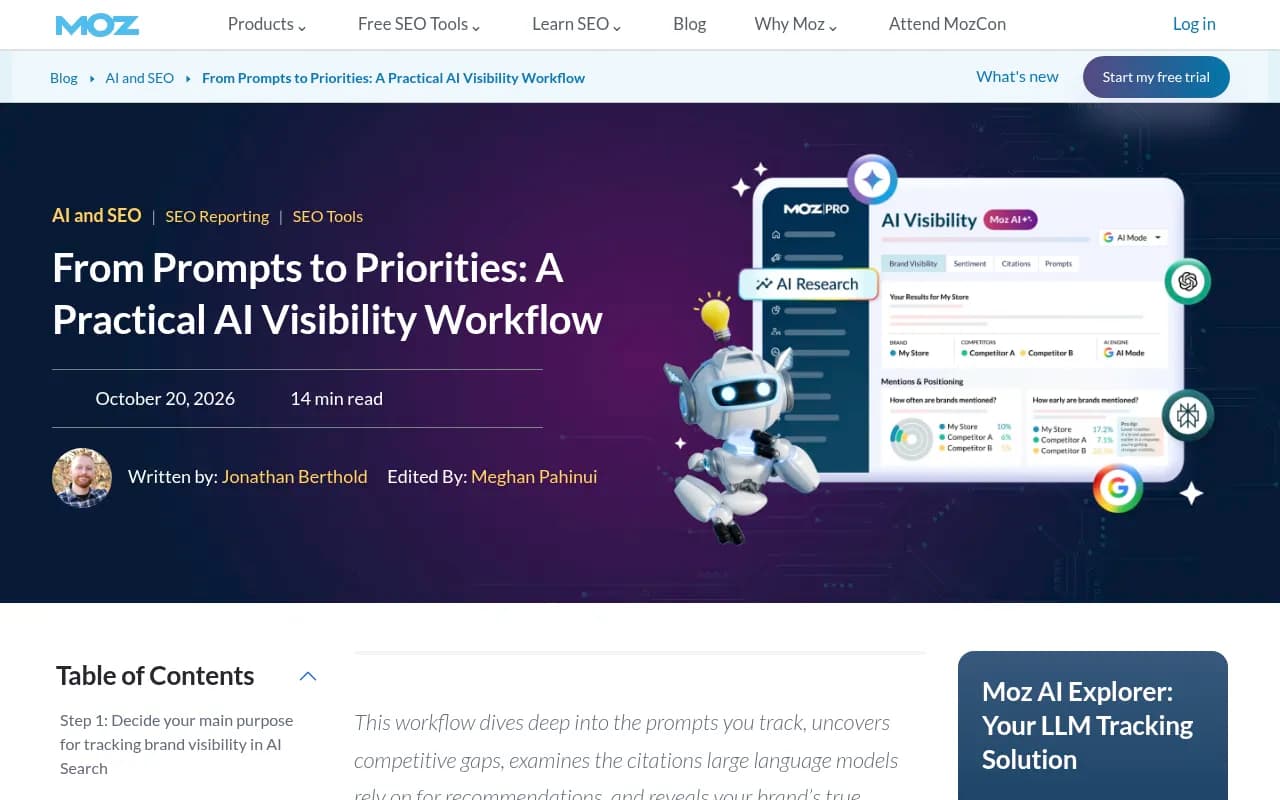
The fix is boring and effective: a fixed weekly rhythm that turns a gap in your tracked prompts into a published page, then checks the result. Moz's recent walkthrough, From Prompts to Priorities, makes a similar argument. It moves from purpose, to top-level metrics, to the responses behind the gaps, to citations as a separate evidence layer, and finally to next steps. Profound's piece on building an AI content workflow adds the point I agree with most: a workflow inherits the priorities of the data you feed it and the metric you grade it by. Feed it keywords and score it on sessions, and you get pages built for blue links. Feed it buyer prompts and score it on citations, and you get pages built to be quoted.
This guide turns those ideas into a calendar. It assumes you already track a set of prompts. If you don't, start there: ZeroRank's walkthrough suggests 20 to 25 prompts to begin with, which is enough signal without drowning in noise.
The weekly loop at a glance
| Day | Step | Output |
|---|---|---|
| Monday | Review visibility and citation changes | A short list of what moved and why |
| Tuesday | Pick the gaps worth closing | 2 to 4 target prompts, each with a page type |
| Wednesday | Brief and draft | Drafts with sources, internal links and a clear answer up top |
| Thursday | Edit and publish | Live pages, in your CMS, with titles and headings that match fanout queries |
| Friday | Verify and log | Notes on crawls, citations and what to refresh next |
You can compress this into two days if you have an automated pipeline. Don't stretch it past a week. A gap you identified three weeks ago is stale, because AI answers shift faster than most editorial calendars.
Step 1: Review what moved (Monday)
Start with a narrow set of questions, not a tour of every chart.
- Which tracked prompts gained or lost visibility since last week?
- For the ones that dropped, who replaced you?
- Did your cited pages change, or did the engine change its behavior?
That third question matters more than people admit. Promptwatch Data recorded reddit.com's share of ChatGPT citations falling from about 4% to about 0.5% on August 14, 2026 (Reddit citations are dropping in ChatGPT), and ChatGPT's use of the site: operator jumped from about 0.4% to about 17% of fanout queries on August 8 (ChatGPT site: operator report). If your visibility fell the same week, no amount of content work would have prevented it. Check the platform before you blame your pages.
Read the metrics together
A single number hides the diagnosis. Read them as a set:
- Low share of voice usually means a coverage problem: you aren't in the answer at all.
- Late position means you appear but aren't prominent.
- Mentions without citations to your domain point at a content or crawlability problem.
- Weak sentiment is a reputation problem, and no new blog post fixes it alone.
Only the first three are solved by publishing. If the issue is sentiment, send it to whoever owns reviews and PR, and keep it off your content list.
Step 2: Pick the gaps worth closing (Tuesday)
You will find more gaps than you can fill. That is normal. The skill is choosing.
I score each candidate prompt on four things, quickly, in a spreadsheet or on a board:
- Volume or business value: does a buyer ask this when they're close to a decision?
- Gap size: is a competitor cited and you aren't?
- Winnability: are the pages being cited ones you could realistically match or beat? Third-party review sites and government sources are harder to displace than another vendor's blog.
- Existing asset: do you already have a page that nearly covers it? A refresh beats a new page.
SeRanking has a useful framework for choosing prompts to track, and the same logic applies when choosing which to act on. Take two to four prompts. Resist the urge to take ten.
Match the page type to the prompt
This is where most weekly workflows quietly go wrong. People write a blog post for every gap, when the engine is citing something else entirely. Promptwatch Data on ChatGPT citations by content type (Sep 28 to Oct 4, 2026) breaks it down (full report):
| Prompt intent | Most cited types in ChatGPT | What to publish |
|---|---|---|
| Commercial | Product pages 26.0%, landing pages 20.6%, listicles 15.0%, comparisons 7.9% | A comparable product page, your own comparison page |
| Informational | Product pages 19.1%, landing pages 13.9%, listicles 13.6%, how-tos 10.7%, docs 8.5% | A step-by-step guide, public docs |
| Branded | Product pages 23.3%, landing pages 22.8%, reviews 5.6%, FAQ 4.8% | An FAQ page, a clear landing page, third-party reviews |
Overall, product and landing pages together make up about 39% of ChatGPT citations. Editorial formats like listicles, how-tos and comparisons add up to 28%. If your weekly output is all blog posts, you're aiming at the smaller pool.
Step 3: Brief and draft (Wednesday)
A good brief for AI search is different from a classic SEO brief. Two things change.
First, write against the fanout query, not the prompt. Promptwatch's ChatGPT query fanout data advises that your content needs to match one of the searches the engine actually runs, such as "X vs Y", pricing, alternatives or how-tos. Their report cautions that the measured averages moved around between December 2025 and April 2026, so check the current figures before you quote any. The practical advice holds regardless: focused pages with headings that read like short queries, entity and category up front, beat one mega-page.
Second, start from the evidence. Your brief should list the pages currently cited for the prompt, what they have in common, and what yours will add that they don't: your own data, clearer pricing, a better comparison table.
A brief template that fits on one screen
Target prompt:
Intent (commercial / informational / branded):
Page type:
Fanout queries to cover:
Currently cited pages (top 3) and what they do well:
Our unique angle or data:
Internal pages to link to:
Single-sentence answer to put in the first paragraph:
An AI draft is fine as a first pass. Profound's version of this step has one agent create the brief, another draft the page, and a person approve before publishing. I'd keep that human sign-off. The failure mode of automated drafts is confident, generic text that adds nothing a model hasn't already seen.
Step 4: Edit and publish (Thursday)
Publishing is where weekly workflows die, because the draft sits in a doc waiting for someone to paste it into the CMS. Remove that friction. Connect your CMS so a draft can go straight to WordPress, Webflow or Framer, and decide up front who can press publish.
Before it goes live, run a short checklist:
- The first paragraph answers the prompt directly.
- Headings read like the fanout queries.
- Pricing, specs and audience are stated plainly. Comparable product pages get cited more.
- The page is crawlable and in the sitemap.
- It links to, and is linked from, related pages. Orphans rarely get cited.
One format note: don't bother publishing markdown files for AI search. Promptwatch Data found markdown makes up just 0.05% of AI search citations (report). It serves agents, not answer engines.
Step 5: Verify and log (Friday)
This step separates a workflow from a content treadmill. For each page you published, answer three questions in order:
- Did AI crawlers fetch it?
- Did any tracked prompt cite it?
- Did it send visits or conversions?
The order matters because it tells you where the problem is. No crawl means an access problem: robots rules, a CDN block, a missing sitemap entry. Crawled but not cited means a content problem. Cited but no traffic means you're getting mentions without clicks, which may be acceptable or may mean the page needs a clearer reason to visit.
Give a new page a couple of weeks before judging. Profound notes you can often see within days whether new pages are being cited, but a single week of data on a page is thin.
Add a refresh lane
New pages are half the job. Promptwatch Data tracked every page ChatGPT cited on July 6, 2026 for 90 days (content half-life report):
| Content type | Still cited after 30 days | Still cited after 60 days |
|---|---|---|
| Landing pages | 78% | 69% |
| Docs | 76% | 67% |
| Comparisons | 72% | 63% |
| Listicles | not reported | 60% |
| Product pages, reviews, how-tos | not reported | 55% |
| News | not reported | 41% |
News lost half its pages after 36 days. Product pages, reviews and how-tos reached their half-life after 74 to 77 days. So once a month, add a refresh item to Monday's review: take any product page, how-to or listicle approaching 60 days old and update it. Treat news and press releases as short bursts and don't expect them to hold.
Tools for each step
You can run this loop with a spreadsheet, a tracker, a writing tool and a CMS. It works. It's also where the handoffs pile up. Here is how the options split.
| Need | Examples from the catalog | Notes |
|---|---|---|
| Tracking only | Otterly.AI, Peec AI, Rankshift | Good for step 1, nothing after it |
| Tracking plus some guidance | Profound, Scrunch AI, AthenaHQ | Stronger monitoring, you still build the content workflow |
| Content generation without visibility data | Jasper, Copy.ai, AirOps | Fast drafts, but not grounded in what AI cites |
| Whole loop in one product | Promptwatch | Monitoring, gap analysis, writing, publishing, measurement |
| SEO suite add-ons | Semrush, Ahrefs Brand Radar | Familiar, but AI data is usually a secondary module |
Promptwatch is the one I'd point to for running this exact loop in a single place. It tracks prompts across the real interfaces of ChatGPT, Google AI Overviews, Gemini, Perplexity and others, maps your pages against the prompts AI answers with content gap analysis, and ranks to-dos on its Action Board. Its Content Agent writes and publishes to WordPress, Webflow or Framer, and IP-verified crawler logs plus visitor analytics tell you on Friday whether the page was read, cited and clicked. The Content Agent starts on the Business plan at $579 per month, so confirm current plans at promptwatch.com/pricing. A 7-day free trial is available on monthly billing, and the free AI visibility report gives you a starting baseline without signing up.

Profound is a capable monitoring platform if your team wants to run the content steps in its own stack.
Profound

For the drafting step alone, AirOps is a content engineering platform you can wire to your own data.
If you already live in an SEO suite, Semrush has added AI tracking, though the AI-specific depth is thinner than in dedicated platforms.
For more options by category, the GEO software directory lists dozens of trackers and optimizers side by side.
Mistakes that break the loop
Taking too many gaps. Ten half-finished pages teach you less than three shipped ones. Keep the weekly cap.
Writing only blog posts. Look at the citation mix above. If the gap is a commercial prompt, a better product page or comparison page may do more than another article.
Skipping Friday. If nobody checks whether pages were crawled and cited, you'll repeat the same unproductive pages for months.
Chasing a platform's quirks. When ChatGPT changes how it cites Reddit or how it uses search operators, your Monday review should catch it. Adjust the plan, don't panic-publish.
Ignoring ownership. A weekly brief with named owners for each action, which is how the AI Workflow Atlas template frames it, beats a shared dashboard nobody opens.
A starter plan for week one
- Pick 20 to 25 prompts across your core topics, split into commercial, informational and branded.
- Run them for a week to get a baseline.
- Next Monday, review what the data says, then pick two gaps using the four-point score.
- Match each gap to a page type from the intent table.
- Brief, draft, edit, publish by Thursday.
- Friday: log crawl, citation and traffic status for each page. Schedule a refresh review for anything older than 60 days.
Repeat. After a month you'll have eight or so pages, a feel for which formats get cited in your category, and, more usefully, a record of what actually worked. That record is worth more than any score.