Key takeaways
- Treat every market as its own cell: one country, one language, one prompt set, one time series. Blending markets hides real gains and losses.
- Country and language are two separate settings. Country is where the engine thinks the user is. Language is the language of the prompt. Both have to be right.
- Headline country counts (80+, 140+, 240+) say little. Ask how the country is actually set, and whether you see the real user interface or an API.
- Translate intent, not words. Local phrasing, local brand names and local competitors change the prompt set.
- Compare markets inside one engine, because engines cite very different numbers of sources.
Why mixed markets wreck your data
Imagine you track 20 markets in one bucket. Germany improves, France drops, and the blended visibility score barely moves. The dashboard says "flat". Two regional teams are having completely different quarters, and nobody sees it.
That is the core problem with global AI visibility tracking. The answer to "what is the best CRM for mid-sized banks" is not one answer. It changes with the user's location, the language of the question, the sources the engine can retrieve in that language, and sometimes the model version routed to that region.
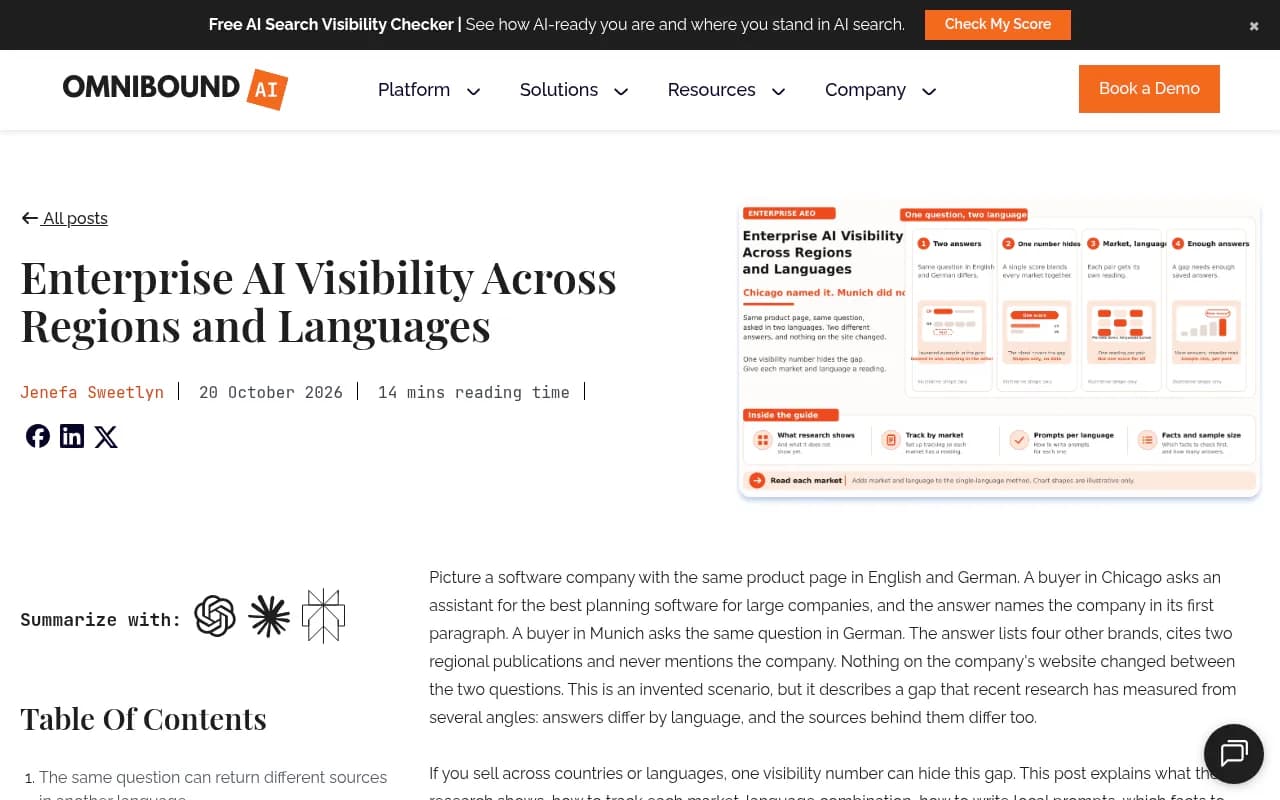
One audit shows how large the gap can get. Omnibound's write-up describes free, logged-out ChatGPT sessions run between June 25 and July 20, 2026, with 20 English questions and translated versions in Spanish, Japanese, Ukrainian, Hindi, Nepali and Twi. ChatGPT averaged 17.5 sources in English against 4.3 in Twi, and returned no sources at all for 33 percent of Twi and 23 percent of Japanese responses. That is a small, third-party audit, not a universal rule. But it makes the point: a brand that looks well cited in English can be close to invisible in another language, and an average across both hides it.
Country and language are two different settings
People use "market" as if it were one variable. It is two.
- Country is where the engine believes the user is sitting. Tools set it through server or residential IP routing, matched browser locale and timezone, or a location parameter.
- Language is the language of the prompt you send.
You need both. A German prompt run from a US location is neither a German market nor a US market. It is a third thing nobody cares about. Belgium makes it concrete: you may want French (Belgium) and Dutch (Belgium) as separate cells, and neither equals France or the Netherlands.
This is also why vendor documentation matters. Promptwatch's own comparison (vendor-authored, so read it with that in mind) notes that most vendors don't document how the country is set, which makes it hard to tell whether results reflect a real local user.
Coverage claims: breadth is not depth
Every vendor has a big number. They do not mean the same thing, and some don't agree with each other.
| Vendor | Claimed coverage | Notes |
|---|---|---|
| Rankscale | 240+ countries, all languages | 17+ engines in one plan, role-based teams, white-label reports |
| Evertune | 100+ countries, 35+ languages (own page) | OptimizeGEO's comparison says 140+ countries and 33 languages; the two sources disagree |
| Profound | 80+ countries | Custom regions on Enterprise; trial includes one region |
| Scrunch | 88 for primary country, any country per prompt | Any language |
| Semrush AI Visibility Toolkit | 220+ countries and territories for Prompt Tracking | $99/mo for 25 prompts, extra Brand Performance locations $99/mo each |
| SE Ranking (SE Visible) | 7 countries, 5 languages | From $99/mo |
| AthenaHQ | One region on Starter, multiple on Enterprise | Custom pricing for multi-market |
| Promptwatch | Country, language and optional city set per monitor | Every plan from $95/mo |
Sources: vendor pages and Promptwatch's October 2026 comparison. Verify current numbers on each vendor's site before you buy.
A few things to take from this. First, a list of 240 countries is a procurement line, not a methodology. Second, pricing structure matters as much as coverage: some vendors charge per extra location, others reserve multi-region for Enterprise contracts. Third, when two pages about the same vendor disagree (Evertune does), go to the vendor's own page and flag the gap in your evaluation.
The cell model: one market, one monitor
The cleanest structure I know is to stop thinking in countries and start thinking in cells. Omnibound calls it tracking cells, not countries, and that framing is right.
A cell is the combination of:
- Country (and optionally state or city)
- Prompt language
- Engine
- Prompt set
Each cell gets its own time series. You never average across cells to make a headline number until you have looked at each one.
In practice with 20 markets that looks like this:
- One monitor per market: for example "DE, German", "FR, French, Paris", "BE, French (Belgium)".
- A fixed prompt set per monitor that you only change deliberately, with a changelog.
- The same engines tracked in every market, so differences come from the market and not from the tool.
- Reporting per market first, then a side-by-side comparison.
Promptwatch works this way: monitors are panels of prompts that run across the models, countries and languages you pick, and a monitor's language and location are fixed once it is created, so markets never mix. Each monitor keeps its own history.

Promptwatch also scrapes the live interface of engines such as ChatGPT, Google AI Overviews and Gemini rather than relying on APIs, which matters because user-facing answers and citations can differ from API output. City and state monitors route through a geo-located residential proxy. A "Visibility by Country" world map shipped on August 28, 2026, which is handy for the exec view once the per-market data is clean.
Building the 20-market rollout
Step 1: Pick markets by revenue and risk, not by ambition
Start with the 20 markets that matter. Rank them by revenue, pipeline, and brand risk (where AI could be saying something wrong about you). If you only have budget for 8 at first, track those 8 properly instead of 20 shallowly.
Step 2: Decide the language list per country
Switzerland, Belgium, Canada, India and the UAE are multi-language. Decide which language cells you need and be explicit. "Canada" is two cells (English, French), possibly more.
Step 3: Write prompts natively
Word-for-word translation of English prompts is a weak start. People in each market phrase questions differently, use local brand names, and compare you against local competitors. A French bank buyer does not ask the same question as an American one translated into French.
A workable process:
- Start from intent categories (best-of, comparison, pricing, how-to, local).
- Have a native speaker or in-market team write or rewrite the prompts.
- Add local competitors and local retailers or marketplaces to the brand set.
- Pull real queries from Search Console per country to seed the list.
Some tools help here. Promptwatch's prompt intelligence includes volumes, difficulty and query fan-outs per prompt, and personas let you prompt the way a specific buyer would. The ChatGPT query fan-out generator is a free way to see what searches an engine might run for a prompt.
Step 4: Fix the brand book per market
Brand names collide with common words in some languages. Define what counts as a mention for each market, include local aliases, and merge variants. Promptwatch's Brand Book analysis instructions (plain-language rules up to 1,000 characters) handle this, and similar alias features exist elsewhere.
Step 5: Choose cadence
Daily is fine for most markets. Launch markets or campaign periods can justify faster tracking: on Promptwatch's Business plan a monitor can run every 12, 6 or 1 hours. Rankscale offers 8 monitoring schedules per brand.
Step 6: Report per market, then compare
Per market, report visibility, share of voice and sentiment. Then compare markets side by side, not blended. Read the metrics together to locate the problem:
- Low share of voice is a coverage problem.
- Late position in the answer is a prominence problem.
- Mentions without citations to your domain is a content or crawlability problem.
- Weak sentiment is a reputation problem.
Promptwatch documents these in its metrics overview, Visibility Score and Share of Voice guides.
Compare inside one engine
Engines differ in how many sources they cite, so cross-engine comparisons per market are misleading. Promptwatch's average sources per response data (covering responses where web search was triggered) shows ChatGPT citing about 5 sources per answer, Google AI Overviews about 10 and steady, and Perplexity almost exactly 10 every day. Copilot swung from under 2 to nearly 17 within weeks, then settled at the low end.
So if Germany shows 12 citations in Perplexity and 4 in ChatGPT, that tells you about the engines, not about Germany. Compare Germany-Perplexity to France-Perplexity.
Two more checks help. ChatGPT's search behavior also shifts over time, such as the August 2026 jump in site: operator fan-outs, so annotate your time series with engine changes before blaming a regional team. And ChatGPT's unique domains per response data shows almost half of responses cite 10 or more domains in a Sep 28 to Oct 4, 2026 sample, so third-party and local sources matter in every market, not only your own site.
What to do when a market underperforms
Once the data is separated, diagnosis gets easier.
The market has few or no citations
Check whether AI crawlers can read the localized pages at all. Hreflang mistakes, geo-redirects and blocked bots are common. Log-level crawler data shows whether bots reach the page and where they fail. Promptwatch's AI crawler logs cover this, and the free Agentic Readiness Check is a quick first pass.
You are mentioned but never cited
This usually means the content in that language is thin or missing. A content gap analysis against the prompts AI actually answers in that market shows what to write. The content gap guide explains the method, and Promptwatch's Content Agent can write in the prompt's language and publish to WordPress, Webflow or Framer if you want to scale it (Business and Enterprise plans).
Sentiment or facts are wrong
Brand Narrative pulls the individual claims AI makes about you per response, grouped by theme such as pricing or support. Fact Check then points to the page on your site that teaches the wrong thing (Business, Agency Scale and Enterprise). For regulated sectors with several languages, this is often the highest-value report.
Competitors are different per market
Your global competitor list is rarely the real list in Brazil or Japan. Track auto-discovered competitors per monitor and keep local ones in the market's own brand set.
Governance for an enterprise rollout
The tracking logic is half the job. The other half is who sees what.
- Give regional teams access to their own markets and a read-only view of the rest.
- Keep one methodology across markets. Rankscale's pitch of one contract and one methodology for all brands applies to any serious setup.
- Check security and procurement needs early. Promptwatch is ISO/IEC 27001 certified and GDPR compliant; ask every vendor for equivalent evidence.
- Look for audit logs and API access so your BI team can pipe per-market data into Looker Studio or a warehouse.
Tools worth shortlisting
For multi-market work, I would shortlist a handful and test the same 10 prompts in two or three markets before committing.
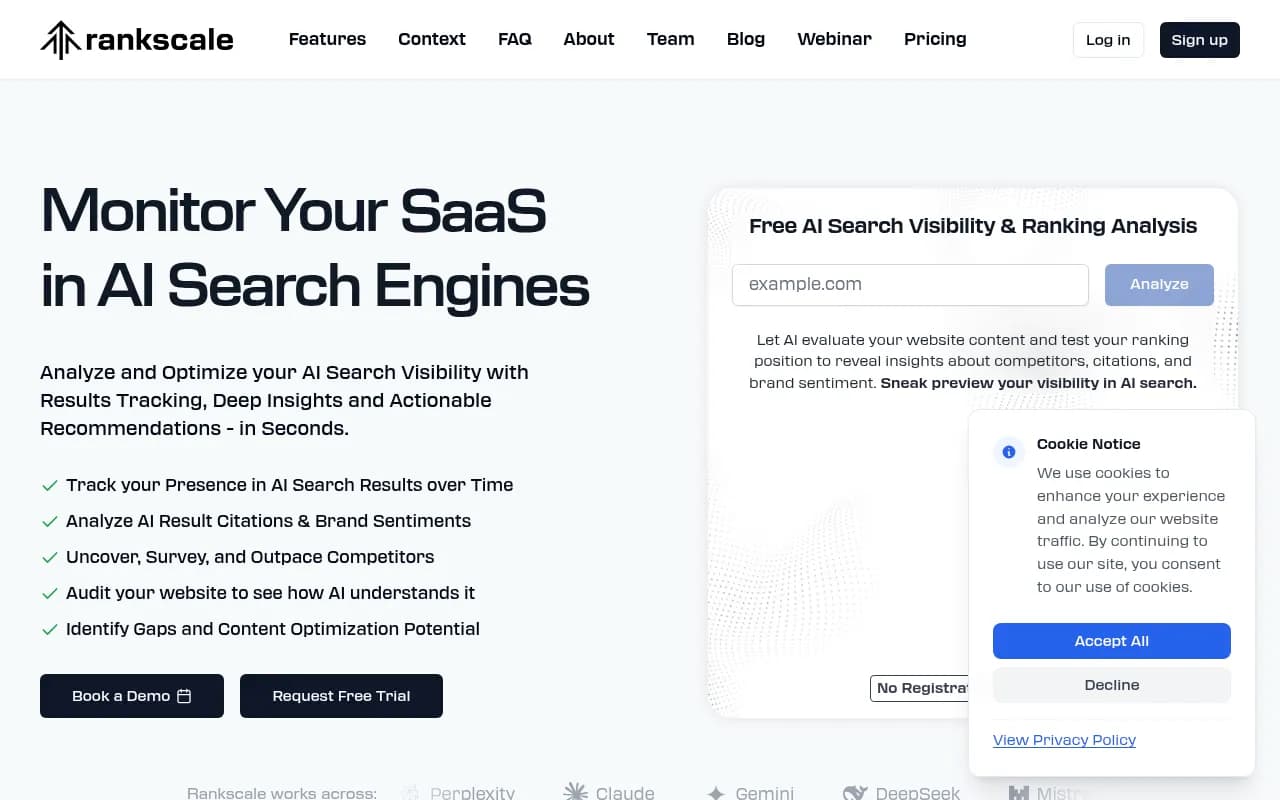
Rankscale is agency and enterprise oriented, with a large country footprint, multi-brand management and white-label reporting.
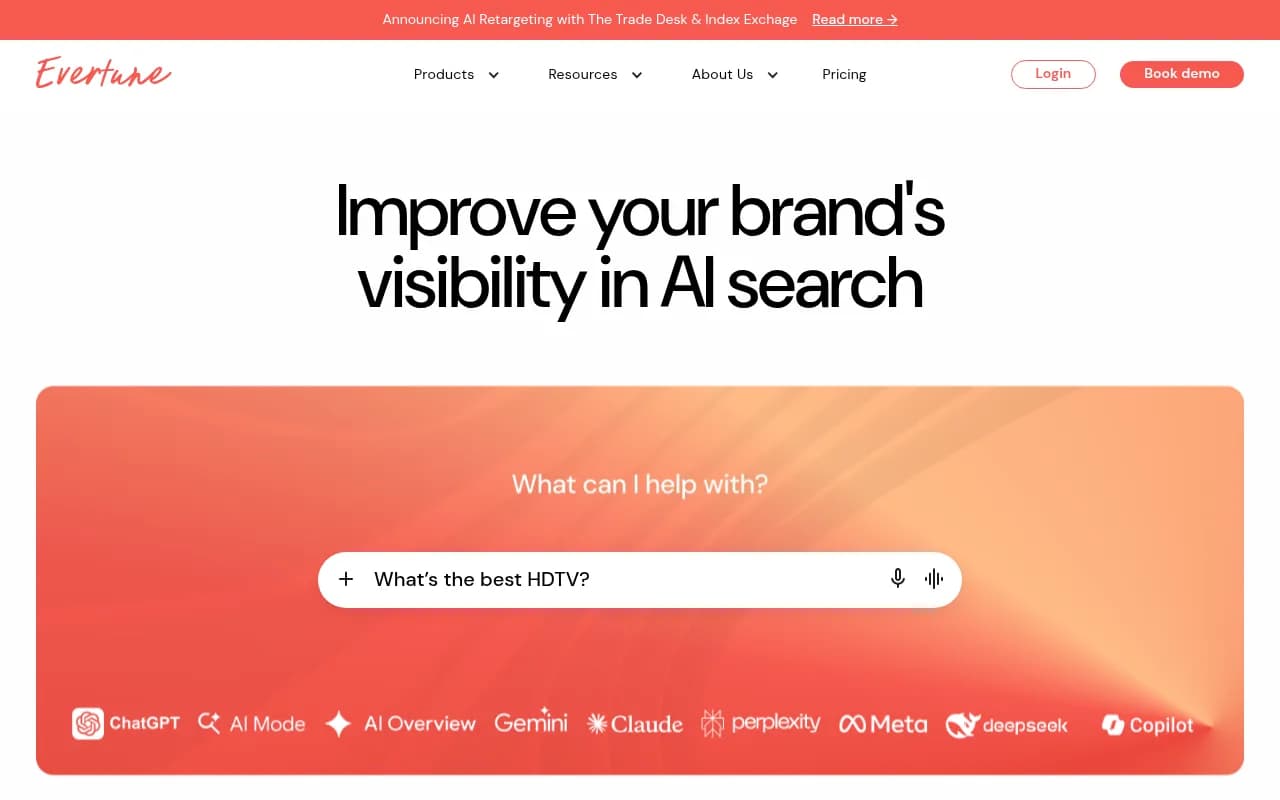
Evertune focuses on international GEO with country-level server routing and language-native prompting. Note the coverage numbers differ between sources.
Profound

Profound is a strong enterprise monitor, though regions beyond the trial depend on an Enterprise contract.
Semrush is useful if you already live in its suite and want a broad country list, but it prices per extra location.

AthenaHQ gates multi-region and multi-language behind Enterprise.
If you want to browse more options, the GEO software directory at bestgeosoftware.com lists dozens of trackers.
| Need | What to look for | Good fit |
|---|---|---|
| Strict market separation | One monitor per country and language, immutable settings | Promptwatch |
| Huge country list for brand portfolio | Multi-brand, white-label, role-based teams | Rankscale |
| Language-native prompting | Country-level routing, native prompts | Evertune |
| Already in an SEO suite | Location add-ons, familiar interface | Semrush |
| Tracking plus fixing | Content gaps, publishing, crawler logs | Promptwatch |
Questions to ask every vendor
- How exactly is the country set? Residential IP, datacenter IP, a parameter?
- Are results from the real user interface or an API?
- Can I set country and language independently, including regional variants like French (Belgium)?
- Does each market keep its own time series, and can I lock the prompt set?
- How is pricing structured per market: per location, per prompt, per brand?
- Can I export per-market raw responses and citations?
- What happens when an engine changes behavior? Is it annotated?
A simple 90-day plan
Days 1-14: Choose markets, list language cells, write native prompt sets for the top 5 markets, set up monitors, and run a baseline.
Days 15-45: Add remaining markets in waves. Validate prompts with local teams. Run crawler and site audits for each localized domain or folder.
Days 46-90: Ship content for the biggest gaps in each market, track whether the pages are crawled, cited and clicked, and report market by market. Promptwatch's 90-day GEO program is a decent template.
If you would rather have a team run this, an agency can set up the market structure and prompt sets. 1001 SEO Media works on GEO and international SEO and uses Promptwatch for this kind of tracking.
Bottom line
Tracking 20 markets is not hard because of the tooling. It is hard because averaging hides everything. Keep one country, one language and one prompt set per monitor, compare within an engine, and let regional teams own their cells. Pick a vendor on how it sets location and what it shows you, not on the biggest country number on its homepage.
To start, run the free AI visibility report on your home market, then spin up two or three additional monitors in markets where you suspect the story is different. Confirm current plan details at promptwatch.com/pricing.