Key takeaways
- Goodie AI is best for mid-market brands that want straightforward AI visibility monitoring and narrative control, but it lacks deep content optimization and attribution features.
- Bluefish AI positions itself as a full enterprise GEO platform with strong source influence analysis and competitive benchmarking, though pricing and transparency remain concerns.
- Evertune is built specifically for executive reporting and measurement, making it the right fit for large enterprises that need board-ready AI visibility metrics -- but it's not an optimization tool.
- None of the three platforms close the full loop from gap identification to content creation to traffic attribution. For that, you need a platform like Promptwatch.
- Your choice should depend on what you actually need: monitoring, reporting, or optimization. These are different jobs, and these three tools aren't equally good at all of them.
The GEO platform market has gotten crowded fast. Two years ago, most brands weren't tracking their AI search visibility at all. Now there are dozens of tools claiming to solve the problem, and the enterprise segment in particular has attracted some well-funded, well-marketed players.
Goodie AI, Bluefish AI, and Evertune are three of the names that come up most often when enterprise marketing teams go looking for a serious GEO solution. They're all targeting roughly the same buyer: a brand with real budget, real stakes, and real pressure to show that AI search is being managed, not ignored.
But they're solving different problems. And if you pick the wrong one, you'll spend six months staring at dashboards that tell you you're invisible without giving you any way to fix it.
This comparison cuts through the positioning to look at what each platform actually does, who it's built for, and where it falls short.
What "enterprise GEO" actually means in 2026
Before getting into the tools, it's worth being specific about what enterprise GEO requires. It's not just "more prompts" or "more AI models." Enterprise brands have distinct needs:
- Multi-brand or multi-product tracking across different categories and geographies
- Competitive benchmarking against specific named competitors, not just industry averages
- Attribution -- connecting AI visibility to actual traffic and revenue, not just mention counts
- Content workflows that can scale across teams and regions
- Executive reporting that non-technical stakeholders can actually understand
- Security, compliance, and data governance requirements
A tool that works fine for a startup tracking 20 prompts across two competitors will break down at enterprise scale. So when evaluating Goodie AI, Bluefish, and Evertune, the question isn't just "does it track AI visibility" -- it's "does it handle the full complexity of enterprise GEO."
Goodie AI
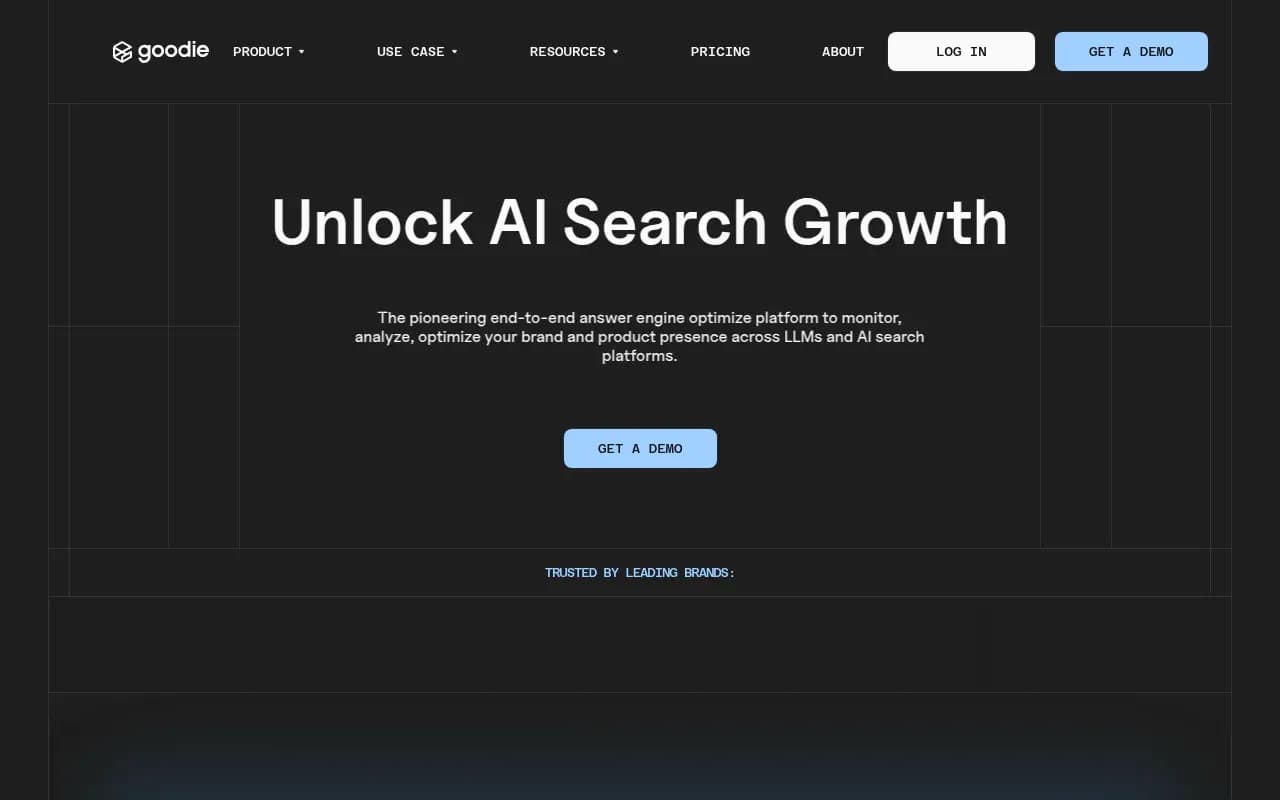
Goodie AI describes itself as a platform for brands that want to own their narrative and improve visibility across AI answers. The positioning is clear: it's for mid-market brands that care about how AI models describe them and want to catch inaccuracies or gaps before they become reputation problems.
What it does well
Goodie's core strength is narrative monitoring. It tracks how AI models describe your brand -- not just whether you appear, but what they say about you. That's a meaningful distinction. A brand can appear in ChatGPT's response and still be described inaccurately, unfavorably, or in a way that undercuts its positioning. Goodie surfaces those issues.
It also has a reasonably clean interface for prompt management, which matters when you're running dozens of queries across multiple AI engines. Setting up a prompt library and reviewing results isn't painful.
For mid-market brands that are just getting started with GEO and want to understand their baseline, Goodie is a reasonable entry point.
Where it falls short
The honest assessment: Goodie is a monitoring tool. It shows you what's happening. It doesn't tell you what to do about it, and it doesn't help you do it.
There's no content gap analysis that identifies which prompts your competitors are winning that you're not. There's no built-in content generation to help you create the pages or articles that would improve your visibility. There's no traffic attribution to connect AI mentions to actual website visits or conversions.
For a mid-market brand with a small team, that might be acceptable -- you can take the monitoring data and hand it to your content team. But for an enterprise brand that needs to move fast and show results, the absence of optimization capabilities is a real gap.
The "enterprise" label also feels stretched. Multi-brand tracking, advanced user permissions, and the kind of data governance that large organizations require aren't areas where Goodie has distinguished itself.
Bluefish AI
Bluefish AI has been aggressive in positioning itself as the enterprise GEO leader. Its own blog (which, to be fair, is a self-published ranking) puts Bluefish at the top of the GEO platform list, describing it as an "enterprise GEO powerhouse." The marketing is confident.
What it does well
Bluefish has invested in source influence analysis -- understanding which domains, publications, and content types actually shape what AI models say about a category. This is genuinely useful. Knowing that a particular trade publication or Reddit community is heavily cited by Claude when answering questions in your category tells you where to focus your content and PR efforts.
Competitive benchmarking is also a real feature, not a checkbox. You can compare your AI visibility against specific competitors across different AI engines and prompt types, which gives you a clearer picture of where you're losing ground and to whom.
The platform covers multiple AI engines -- ChatGPT, Perplexity, Claude, Gemini, and others -- which is table stakes for enterprise use in 2026.
Where it falls short
The main concern with Bluefish is transparency. Pricing isn't publicly listed, which is fine for enterprise software, but the sales process has been described by some practitioners as opaque. You're committing significant budget without a clear sense of what you're getting.
The content optimization story is also thinner than the marketing suggests. Bluefish can tell you which sources are influential and which prompts you're missing -- but the path from that insight to actually improving your visibility requires you to do the work yourself. There's no native content generation, no AI writing agent, no built-in workflow for turning gap analysis into published content.
For brands with large content teams and established workflows, that might not matter. But for teams that need the platform to do more of the heavy lifting, Bluefish stops short.
Evertune
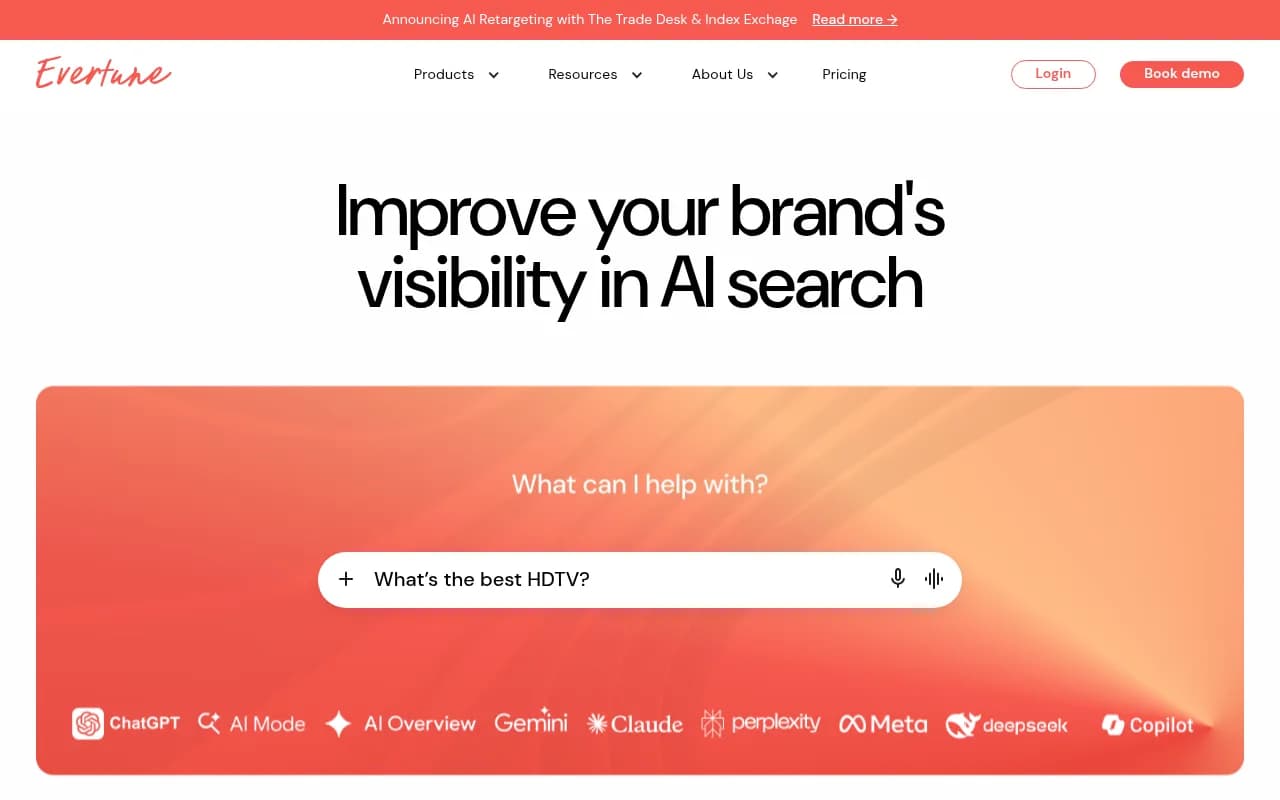
Evertune takes a different approach entirely. Rather than trying to be a full GEO platform, it's built specifically for executive measurement and reporting. The pitch is that CMOs and VPs of Marketing need to show the board that AI search is being managed, and Evertune gives them the metrics to do that.
What it does well
Evertune is genuinely good at what it's designed for. The reporting layer is polished and executive-friendly in a way that most GEO tools aren't. Visibility scores, trend lines, competitive positioning -- all presented in a format that works for a quarterly business review, not just a technical SEO meeting.
For Fortune 500 brands where the primary challenge is internal alignment and executive buy-in, Evertune solves a real problem. It makes AI visibility legible to people who don't live in dashboards.
It also has solid multi-engine coverage and handles the kind of scale that large enterprises need -- multiple brands, multiple markets, multiple stakeholders with different access levels.
Where it falls short
Evertune is explicitly a measurement tool. It measures. It doesn't optimize.
If you're a CMO who needs to show the board a visibility score, Evertune delivers. If you're a content strategist who needs to know which specific pages to create or update to improve that score, Evertune doesn't help you. The gap between "here's your visibility score" and "here's how to improve it" is left entirely to the user.
That's a deliberate product choice, not an oversight. But it means Evertune needs to be paired with other tools to actually move the needle. You're paying for measurement, and then paying again (in time or money) for optimization.
Head-to-head comparison
| Feature | Goodie AI | Bluefish AI | Evertune |
|---|---|---|---|
| Primary use case | Narrative monitoring | Enterprise GEO tracking | Executive measurement |
| AI engines covered | Multiple | Multiple | Multiple |
| Competitive benchmarking | Basic | Strong | Moderate |
| Source influence analysis | Limited | Strong | Limited |
| Content gap analysis | No | Partial | No |
| Built-in content generation | No | No | No |
| Traffic attribution | No | Limited | No |
| Executive reporting | Basic | Moderate | Strong |
| Multi-brand support | Limited | Yes | Yes |
| Pricing transparency | Moderate | Low | Low |
| Best for | Mid-market brands | Enterprise with large content teams | Fortune 500 reporting |
The pattern is clear: all three platforms are strong at monitoring and weak at optimization. They show you the problem. None of them help you fix it in any meaningful, integrated way.
The gap none of them fill
Here's the honest assessment of where all three fall short: GEO isn't just a monitoring problem. It's an optimization problem.
Knowing that your competitor appears in 73% of ChatGPT responses for "best enterprise CRM" while you appear in 12% is useful information. But what do you do with it? Which pages do you create? What topics are missing from your site? Which questions is ChatGPT asking that your content doesn't answer?
That's the gap. And it's where most enterprise GEO platforms -- including these three -- leave you stranded.
The platforms that are actually closing this loop combine monitoring with content gap analysis, then add a content generation layer that produces articles and pages engineered to get cited by AI models, then track whether those pages actually improve visibility scores over time. That's a fundamentally different product from a monitoring dashboard.
Promptwatch is one of the few platforms that's built around this full cycle -- finding gaps, generating content grounded in real citation data, and tracking results back to traffic and revenue. It's worth understanding what that looks like before committing to a monitoring-only solution.

Which platform should you choose?
The right answer depends on what you actually need right now.
If you're a mid-market brand that's just starting to take AI visibility seriously and wants to understand your baseline before investing in optimization, Goodie AI is a reasonable starting point. It's accessible, focused, and won't overwhelm a small team.
If you're an enterprise brand with a large content team and established workflows, and you primarily need strong competitive benchmarking and source influence data to inform your existing content strategy, Bluefish AI has real capabilities worth evaluating -- just go in with clear expectations about what the platform does and doesn't do.
If you're a CMO at a Fortune 500 company whose primary challenge is internal reporting and executive alignment, Evertune is purpose-built for that job. It won't help your content team, but it will help you make the case to leadership that AI search is being managed.
If you need the full loop -- gap analysis, content creation, visibility tracking, and traffic attribution -- none of these three platforms delivers it end-to-end. That's a different category of tool, and you should be evaluating platforms built around optimization, not just monitoring.
A note on the broader GEO platform landscape
These three platforms exist in a market with dozens of competitors, and the category is moving fast. The distinction that matters most in 2026 isn't which AI engines a platform covers (most cover the major ones) or how clean the dashboard looks. It's whether the platform helps you take action.
Monitoring tells you where you are. Optimization moves you somewhere better. The platforms that will matter in 2027 are the ones that do both -- and do them in an integrated way that doesn't require you to stitch together five different tools to get from insight to result.
When evaluating any GEO platform, ask one simple question: after I see my visibility score, what does this platform help me do next? If the answer is "export the data and figure it out yourself," that's not an optimization platform. That's an expensive dashboard.