Key takeaways
- Hall AI is a solid entry-level GEO monitoring tool with clean citation tracking, sentiment analysis, and AI crawler logs
- It covers four major AI engines (ChatGPT, Perplexity, Claude, Gemini) and shows you the full conversation context around citations
- The agent analytics feature is genuinely useful and rare among tools at this price point
- The main limitation: Hall AI is a monitoring dashboard. It shows you what's happening but doesn't help you fix it
- Teams that need content gap analysis, AI-native content generation, or traffic attribution will need to look elsewhere or pair it with another tool
AI search visibility has gone from a niche concern to something marketing teams are actively budgeting for. The question isn't whether to track your brand in ChatGPT and Perplexity anymore -- it's which tool actually helps you do something about what you find.
Hall AI sits in an interesting position in that market. It's not trying to be everything. It's a focused, lightweight citation tracking platform that does a few things cleanly. Whether that's enough depends entirely on what you need.
I went through the platform in detail, cross-referenced it against the broader GEO tool landscape, and here's my honest take.
What Hall AI actually does
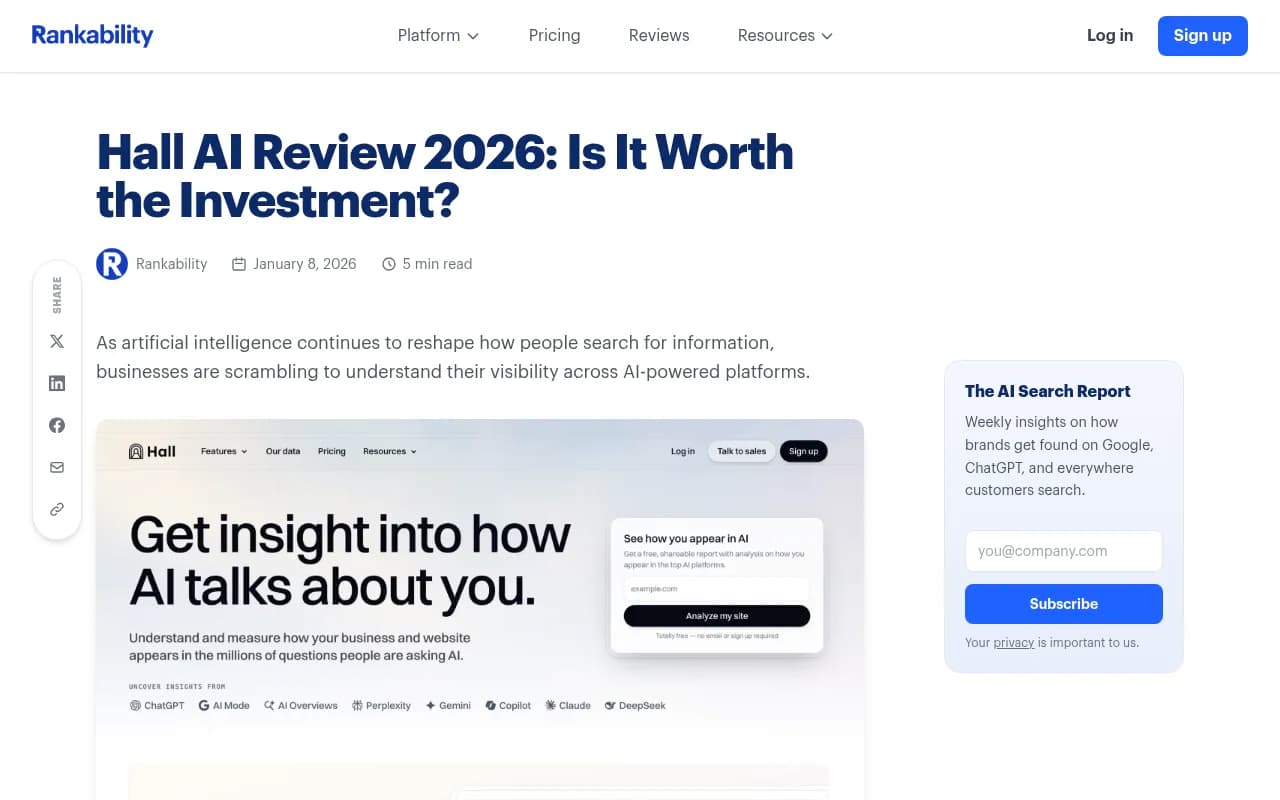
Hall AI describes itself as a Generative Engine Optimization (GEO) platform. In practice, it's a brand monitoring tool built specifically for AI search engines. The core use case: you set up your brand, define some prompts, and Hall AI queries ChatGPT, Perplexity, Claude, and Gemini to track where and how your brand appears.
There are three main feature areas worth understanding.
Generative answer insights
This is the core monitoring layer. You get visibility scores, sentiment analysis, and competitor comparisons across the four AI engines Hall AI supports. The interface is clean -- you can see at a glance whether your brand sentiment is trending positive or negative in AI responses, and how that compares to competitors.
The sentiment analysis is more nuanced than a simple positive/negative flag. Hall AI shows you how AI platforms describe your brand in context, which is genuinely useful for understanding whether you're being positioned as a leader, a budget option, or something else entirely.
Website citation insights
This is where Hall AI gets more interesting. Rather than just telling you "your brand was mentioned," it shows you which specific pages are being cited inside AI answers, the full conversation context (the user query plus how your content was used), and flags potential optimization opportunities.
Seeing the actual query that triggered a citation is valuable. It tells you what questions your content is already answering for AI models -- and by extension, what adjacent questions you might want to target.
Agent analytics
This is the feature that surprised me most. Hall AI monitors how AI crawlers (GPTBot, ChatGPT-User, OAI-SearchBot, and others) actually access your website. You can see which pages they're reading, how often they return, and any errors they're hitting.
This kind of server-side crawler logging is genuinely rare. Most monitoring tools show you what AI models say about you -- they don't show you how AI models are reading your site. For technical teams trying to understand why certain pages aren't getting cited, this is useful diagnostic data.
What Hall AI does well
The interface is clean. This sounds minor but it matters. A lot of GEO tools have dashboards that feel like they were designed by engineers for engineers. Hall AI's UI is approachable. You can get oriented quickly without a lengthy onboarding process.
Citation context is genuinely useful. Seeing the full conversation around a citation -- not just "your page was cited" but "here's the user query and here's how your content appeared in the response" -- gives you something actionable. You can see which content is working and start to understand why.
Agent analytics fills a real gap. As mentioned above, crawler monitoring is something most tools skip. If you're trying to understand why AI models aren't citing your content, knowing that GPTBot is hitting 404 errors or ignoring certain sections of your site is a real starting point.
Lightweight implementation. Hall AI's server-side logging is described as lightweight to implement. For teams without dedicated engineering resources, that matters.
Where Hall AI hits a wall
Here's the honest part.
Hall AI is a monitoring tool. It's a good monitoring tool. But monitoring is step one of a three-step problem.
Step one is finding out where you're invisible. Hall AI does this.
Step two is understanding why you're invisible and what content would fix it. Hall AI gives you hints -- the citation context and optimization flags point in the right direction -- but it doesn't have a systematic answer gap analysis that shows you exactly which prompts competitors rank for that you don't.
Step three is actually creating content that gets cited. Hall AI doesn't do this at all.
For a team that already has strong content operations and just needs visibility data to inform their strategy, Hall AI might be enough. But for most marketing teams, finding the gaps is only useful if you can close them.
A few other specific limitations:
Four AI engines. ChatGPT, Perplexity, Claude, and Gemini are the big four, so this isn't a dealbreaker. But tools that also cover Google AI Overviews, Grok, DeepSeek, Copilot, and Meta AI give you a more complete picture, especially as the AI search landscape fragments.
No traffic attribution. Hall AI can tell you your pages are being cited, but it can't close the loop to actual traffic or revenue. You can't see whether those citations are driving clicks or conversions.
No prompt volume data. Knowing that you're not visible for a prompt is useful. Knowing that the prompt gets asked 50,000 times a month is more useful. Hall AI doesn't appear to surface prompt volume or difficulty scores, which makes it harder to prioritize.
No Reddit or YouTube tracking. AI models frequently cite Reddit threads and YouTube videos in their responses. Understanding which off-site content is influencing AI recommendations about your brand is something Hall AI doesn't address.
How Hall AI compares to the broader market
The GEO tool market has split into two camps: monitoring-only dashboards and full optimization platforms.
Hall AI is firmly in the monitoring camp. That's not a criticism -- it's just a description. The question is whether monitoring-only is enough for your use case.
| Feature | Hall AI | Monitoring-only tools | Full optimization platforms |
|---|---|---|---|
| Brand mention tracking | Yes | Yes | Yes |
| Sentiment analysis | Yes | Varies | Yes |
| Citation context | Yes | Rarely | Yes |
| AI crawler logs | Yes | Rarely | Some |
| Prompt volume/difficulty | No | No | Yes |
| Content gap analysis | No | No | Yes |
| AI content generation | No | No | Yes |
| Traffic attribution | No | No | Yes |
| Reddit/YouTube tracking | No | No | Some |
| AI engines covered | 4 | 2-5 | 10+ |
Tools like Promptwatch sit at the other end of this spectrum -- they're built around the full loop of finding gaps, generating content to fill them, and tracking whether that content actually improves your visibility scores. The difference matters if your goal is to improve your AI visibility, not just measure it.

For teams that just want a clean monitoring dashboard without the complexity of a full optimization platform, Hall AI is a reasonable choice. For teams that need to actually move the needle, the monitoring-only approach will leave you with data but no clear path forward.
Other tools worth considering in this space:
Otterly.AI -- another monitoring-focused option with a simple interface, though it lacks crawler logs.
Otterly.AI

Profound -- stronger feature set, enterprise-oriented, higher price point.
Profound

Rankshift -- lightweight brand tracking across ChatGPT, Perplexity, and AI search.

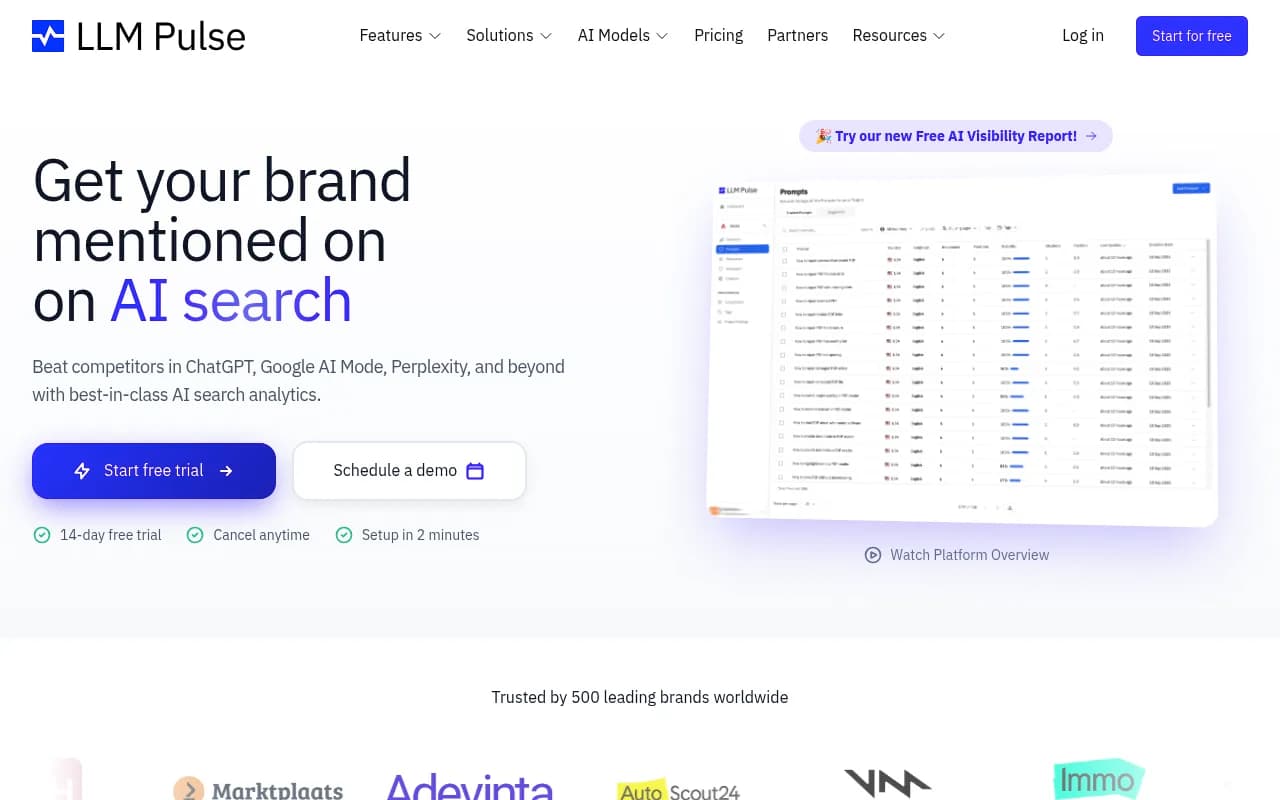
LLM Pulse -- tracks AI search visibility with a focus on brand mentions.
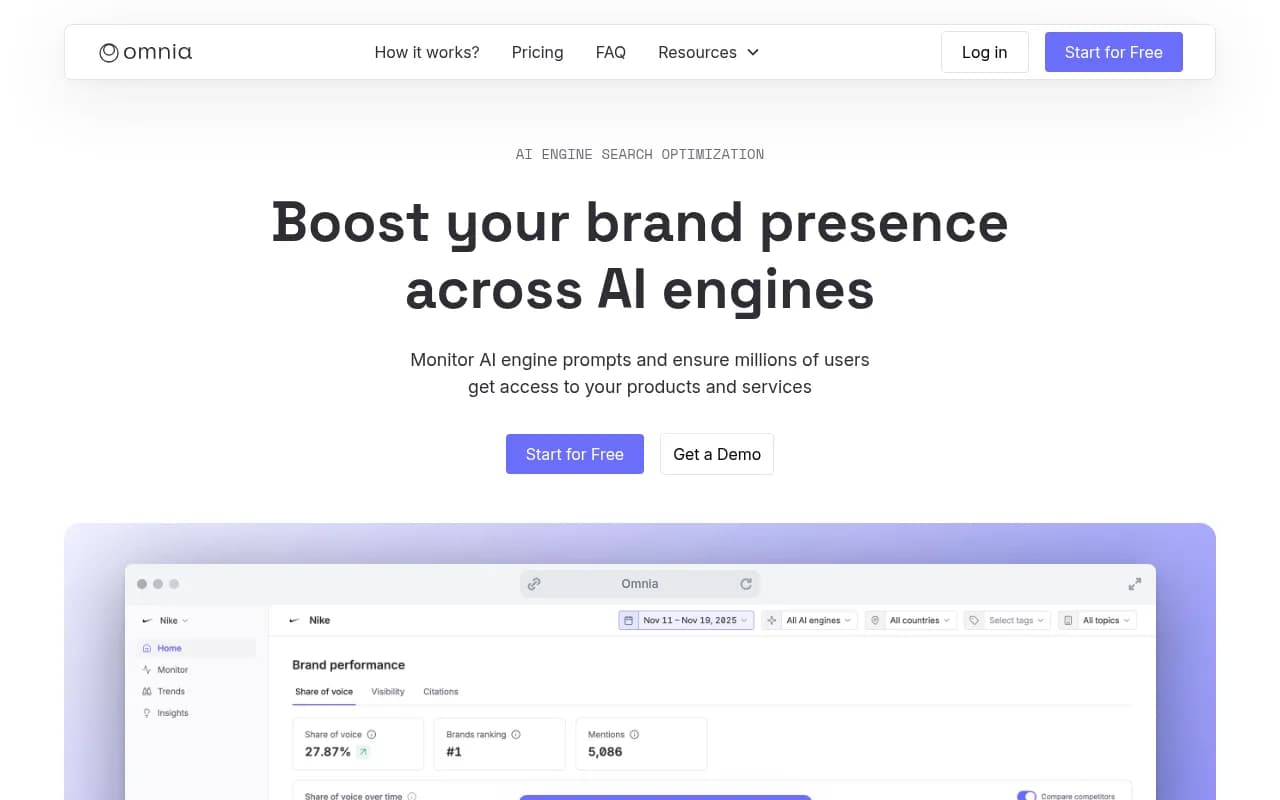
Omnia -- measures brand presence in AI-generated answers with citation analysis.
Who should use Hall AI
Hall AI makes sense for a specific type of user:
- You're new to GEO and want to understand your current AI visibility without committing to a complex platform
- You have a technical team that will actually use the crawler log data
- You're primarily concerned with the four major AI engines (ChatGPT, Perplexity, Claude, Gemini)
- You have separate content operations and just need monitoring data to inform your team's work
It's less suited for:
- Teams that need to act on what they find, not just observe it
- Brands competing in crowded categories where understanding prompt-level competitive gaps matters
- Anyone who needs to connect AI visibility to traffic and revenue
The bigger picture on AI citation tracking in 2026
One thing worth stepping back to acknowledge: the entire category of AI citation tracking is still young. Tinuiti's research on AI citation patterns in 2026 makes the point that AI citation data can help brands understand how millions of consumers see them while using platforms like ChatGPT and Gemini. That's true. But the value of that data depends entirely on what you do with it.
The brands that will win in AI search aren't the ones with the best dashboards. They're the ones that use visibility data to identify content gaps and fill them systematically. Hall AI gives you part of that picture. Whether it gives you enough depends on your situation.
If you're evaluating Hall AI, the honest question to ask yourself is: "Once I know where I'm invisible, what's my plan?" If you have a clear answer, Hall AI might serve you well. If you don't, you probably need a platform that answers that question for you.
Final verdict
Hall AI is a competent, focused monitoring tool. The citation context and agent analytics features are genuinely useful and not common at this level of the market. The interface is clean and the implementation is lightweight.
The ceiling is real, though. It's a dashboard that tells you what's happening in AI search. It doesn't tell you what to do about it, and it doesn't help you do it. For teams that need to move from visibility data to actual content strategy and execution, Hall AI will be a starting point, not a destination.
If you're just getting started with GEO monitoring and want something straightforward, it's worth a look. If you're past the "what's my current visibility?" question and into "how do I improve it?", you'll need more than Hall AI offers.