Key takeaways
- Google AI Mode launched as a default experience for millions of users in 2025, fundamentally changing how queries work — each search now fans out into dozens of sub-questions before returning an answer.
- Most AEO/GEO tools were built around static prompt monitoring and weren't designed for multi-step, session-based AI responses.
- Platforms that adapted quickly added fan-out query tracking, freshness signals, and page-level citation data. Many others still show you the same snapshot-style dashboards they had before AI Mode existed.
- The tools that matter most in 2026 are the ones that don't just track visibility — they help you fix it.
- If you're evaluating platforms right now, the gap between "monitoring only" and "monitoring + optimization" has never been wider.
What Google AI Mode actually changed
When Google AI Mode started rolling out in 2025, the initial reaction from most SEO and AEO practitioners was something like: "Okay, this is just AI Overviews but bigger." That turned out to be wrong.
AI Mode doesn't just generate a summary at the top of the results page. As SEO consultant John Doherty described it on LinkedIn: AI Mode turns every query into a multi-query fan-out. Google fires off dozens of sub-questions, stitches the answers together, and returns a synthesized response. The user never sees the individual sub-queries. The page that gets cited might be answering a sub-question the user didn't even consciously ask.
That's a fundamentally different problem than optimizing for a single featured snippet or a standard AI Overview. You're no longer trying to answer one question well. You're trying to be the best answer to a web of related questions — and you often don't know which sub-questions your content is being evaluated against.
By Q4 2025, Google AI Overviews were already triggering on 13.14% of searches, with projections putting that figure above 25% by end of year. AI Mode accelerated that trajectory significantly for users who had it enabled. For brands that hadn't started thinking about AEO yet, this was the moment the urgency became undeniable.
Why most AEO tools weren't ready
The AEO tool market in 2025 was still relatively young. Most platforms had been built around a simple idea: send a prompt to an AI model, record whether your brand appears in the response, repeat across a list of prompts. That works fine for basic brand monitoring. It doesn't work well for AI Mode.
Here's why. AI Mode responses are:
- Session-based (the AI maintains context across a conversation)
- Multi-step (sub-queries fire in sequence, not all at once)
- Freshness-sensitive (AI Mode appears to weight recent content more heavily than standard AI Overviews)
- Harder to replicate (the same prompt can produce different sub-query fan-outs depending on context)
Tools built around static prompt lists and periodic API polling weren't designed for any of this. They could tell you whether your brand appeared in a response — but not which sub-query triggered the citation, how fresh the cited content was, or whether the fan-out pattern had shifted since last week.
The platforms that adapted quickly had to rebuild significant parts of their data collection and analysis layers. The ones that didn't are still showing you dashboards that look the same as they did in 2024.
The platforms that moved fast
Full-stack optimization platforms
The clearest winners from the AI Mode rollout were platforms that had already invested in going beyond monitoring. Promptwatch is the most complete example — it tracks how AI search engines behave in real user interfaces (not just through API calls), which matters because user-facing answers and citations can differ meaningfully from what you'd see querying an API directly.

What made Promptwatch particularly well-positioned for AI Mode was its query fan-out tracking. When a prompt branches into sub-queries, Promptwatch surfaces those branches — so you can see not just whether you appeared in the final response, but which underlying questions your content was (or wasn't) answering. That's the kind of data that actually tells you what to fix.
Its AI Crawler Logs also became more valuable after AI Mode launched. Real-time logs of AI crawlers hitting your site — which pages they read, how often they return, what errors they encounter — give you a window into how Google's AI is actually discovering and evaluating your content. Most competitors lack this entirely.
Enterprise-grade trackers
Profound and Scrunch AI both have strong feature sets for enterprise brands and moved reasonably quickly to incorporate AI Mode tracking. They're solid choices for large organizations that need robust monitoring across multiple AI engines.
Profound

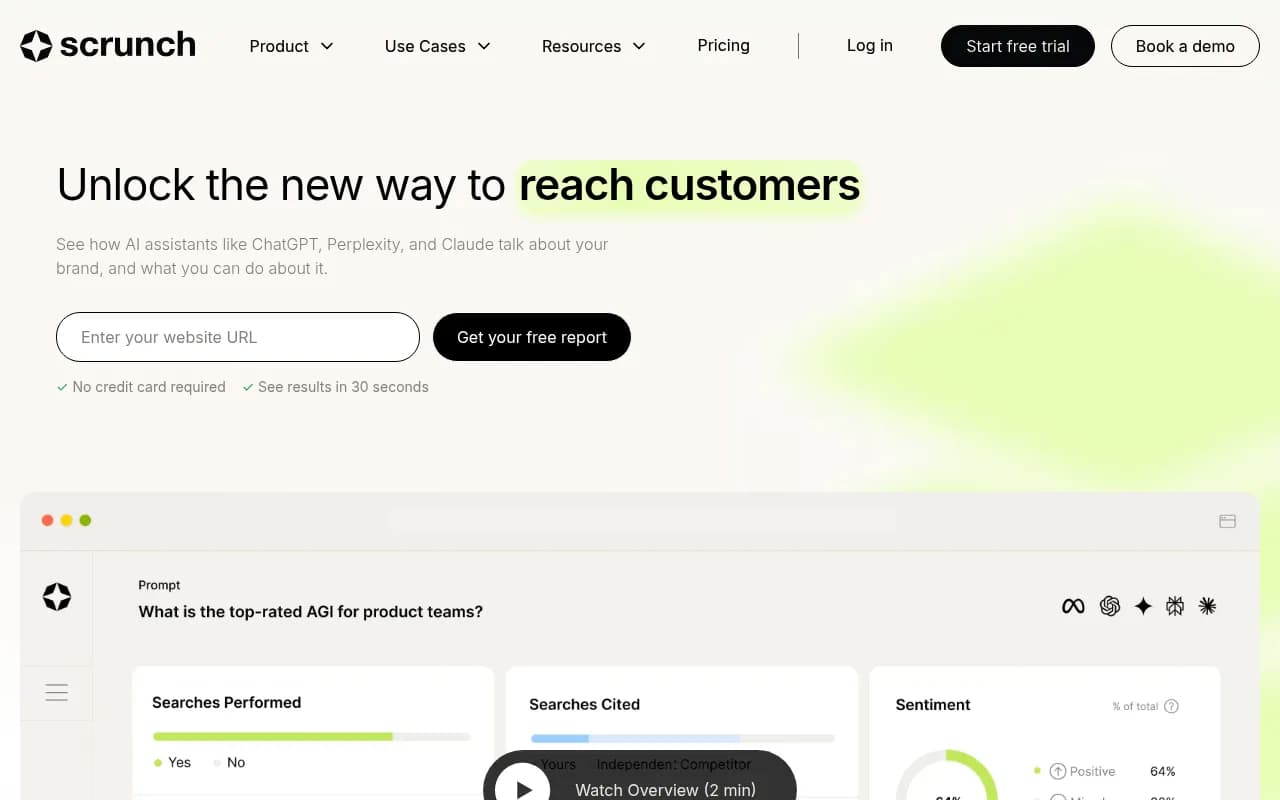
The limitation with both is that they remain primarily monitoring platforms. They'll show you where you're visible and where you're not — but the "what to do about it" layer is thin. For AI Mode specifically, where the optimization work is more complex (you're optimizing for a web of sub-queries, not a single prompt), that gap matters.
AEO-native platforms
AthenaHQ and Search Party both adapted their interfaces to surface AI Mode data, but neither has moved significantly into content optimization. AthenaHQ in particular is strong on monitoring and competitive analysis — you get a clear picture of where competitors are winning — but the platform stops short of helping you create the content that would close those gaps.

Search Party
The platforms still catching up
Basic monitoring tools
Several tools in the AEO space are still operating on the same model they launched with: send prompts, record responses, show a visibility score. For standard AI Overviews, this is fine. For AI Mode, it's insufficient.
Otterly.AI and Peec AI fall into this category. Both are legitimate monitoring tools with clean interfaces and reasonable prompt coverage. But neither has added the fan-out tracking, freshness analysis, or content optimization capabilities that AI Mode demands.
Otterly.AI


If your main goal is knowing whether your brand appears in AI responses — and you're not yet trying to systematically improve that visibility — these tools still do the job. But if you're trying to compete seriously in AI Mode, you'll hit their ceiling quickly.
Traditional SEO platforms adding AI features
Semrush and Ahrefs both added AI search tracking features in 2025, and both deserve credit for moving faster than many expected. Semrush's AI Overviews tracking is genuinely useful for teams already living in the Semrush ecosystem. Ahrefs' Brand Radar gives you a starting point for understanding AI visibility.
The problem is structural. Both platforms use fixed prompt sets, which means you're seeing visibility data for prompts the platform chose — not necessarily the prompts your actual customers are using. Neither has AI traffic attribution that connects AI visibility to actual revenue. And neither has the crawler log infrastructure to tell you how AI engines are actually crawling your site.
They're useful supplements to a proper AEO stack. They're not a replacement for one.
What the AI Mode adaptation gap looks like in practice
Here's a concrete way to think about the difference. Say you're a B2B SaaS company selling project management software. Before AI Mode, you might track 50 prompts like "best project management software for remote teams" and see whether you appear in the AI response.
After AI Mode, a user asking that question might trigger sub-queries like:
- "What features matter most in project management software for distributed teams?"
- "How does [your competitor] handle async communication?"
- "What do users say about onboarding experience for project management tools?"
- "Which project management tools integrate with Slack and Notion?"
Your visibility in the final AI Mode response depends on how well your content answers all of those sub-questions — not just the top-level prompt. A monitoring-only tool will tell you whether you appeared. A tool with fan-out tracking will show you which sub-questions you're losing on. A full optimization platform will help you create the content that fills those gaps.
That's the difference between knowing you have a problem and being able to fix it.
A comparison of how major platforms handled AI Mode
| Platform | AI Mode tracking | Fan-out query data | Crawler logs | Content generation | Traffic attribution |
|---|---|---|---|---|---|
| Promptwatch | Yes | Yes | Yes | Yes | Yes |
| Profound | Yes | Partial | No | No | No |
| Scrunch AI | Yes | Partial | No | No | No |
| AthenaHQ | Yes | No | No | No | No |
| Otterly.AI | Partial | No | No | No | No |
| Peec AI | Partial | No | No | No | No |
| Semrush | Partial | No | No | No | No |
| Ahrefs | Partial | No | No | No | No |
| Search Party | Yes | No | No | No | No |
"Partial" here means the platform tracks AI Overviews but hasn't fully adapted to AI Mode's multi-step session behavior.
What to actually look for when evaluating AEO tools in 2026
The AI Mode rollout made a few capabilities non-negotiable for any serious AEO effort:
Real interface tracking, not just API calls. AI Mode responses in actual Google search look different from what you get querying Google's API. If a tool only polls APIs, it's missing what real users see.
Fan-out visibility. You need to know which sub-queries your content is being evaluated against, not just whether you appeared in the final response. Without this, you're optimizing blind.
Freshness signals. AI Mode appears to weight recent content more heavily. Tools that don't track content freshness relative to citation patterns are missing a key optimization lever.
Crawler log access. Understanding when and how AI crawlers visit your site — and what errors they encounter — is the foundation of technical AEO. This was a nice-to-have before AI Mode. It's essential now.
Content gap analysis that connects to creation. Knowing you're missing visibility for certain sub-queries is only useful if you can do something about it. The best platforms close the loop between gap identification and content production.
The broader picture
The AI Mode rollout accelerated something that was already happening: the gap between brands that treat AEO as a monitoring exercise and brands that treat it as an optimization discipline is getting wider.
Monitoring tells you where you stand. Optimization changes where you stand. In a world where AI Mode is the default experience for a growing share of Google users, standing still is the same as falling behind.
The tools that moved fast after AI Mode launched — the ones that added fan-out tracking, crawler logs, and content generation — did so because they were already thinking about AEO as an action loop, not a reporting function. The tools that are still catching up are the ones that built dashboards first and asked "what do we do with this data?" second.
For teams evaluating platforms right now, that distinction is the most important one to get right. The monitoring data is table stakes. What you do with it is where the competitive advantage lives.
Platforms like Promptwatch that have built the full loop — find gaps, generate content, track results — are the ones worth serious evaluation. Everything else is a piece of the puzzle, not the whole picture.