Key takeaways
- ChatGPT answers are shared, not winner-take-all. In Promptwatch Data, 47.6% of citation-bearing responses cite 10 or more domains (Sep 28 to Oct 4, 2026), so your goal is a bigger slice, not a single top spot.
- A city-by-city audit needs the same prompt set run once per market, with each city's results kept in its own bucket so they never mix.
- One prompt tells you almost nothing. Run dozens of organic prompts per city and score mentions across all of them.
- Low share of voice, late position, and mentions without citations each point to a different fix, so track all three.
- You can do the first pass by hand in a spreadsheet. Past two or three cities, a tracker saves you from burning a week on copy and paste.
Why a city-level audit is different from a brand audit
Most AI visibility advice assumes one brand, one market. Local businesses don't live there. A dental group with clinics in Leeds, Bristol, and Glasgow is not competing with the same set of rivals in each city. The competitor that dominates Leeds may not exist in Bristol.
That is the whole reason to run the audit city by city. A single blended number hides the fact that you are the default recommendation in one town and invisible in the next.
There is also a sourcing problem. When someone asks ChatGPT for the best plumber, dentist, or accountant in a city, the answer is rarely built from the competitors' own websites alone. It leans on aggregators, directories, listicles, and review pages. Promptwatch's industry reports show the same pattern elsewhere: in the automotive citation data for August 2026, marketplaces like Autotrader and Cars.com outrank every car brand. In travel, booking and search sites earn more than half of the citations shown. Expect local categories to behave similarly, though I haven't found a published dataset that proves it for city-level queries. Treat that as a hypothesis your audit will confirm or kill.
One honest caveat. I couldn't find verified data on exactly how ChatGPT localizes answers, meaning how much it relies on your IP, your stated location, or the city named in the prompt. So the audit below puts the city in the prompt text and keeps the testing conditions identical, rather than assuming anything about hidden location signals.
Step 1: Define your markets and your competitor set
Start with a plain table. One row per city you serve, and a list of the competitors you actually lose deals to there.
| City | Your location(s) | Known competitors | Aggregators to watch |
|---|---|---|---|
| Leeds | 2 | Competitor A, B, C | Directory X, review site Y |
| Bristol | 1 | Competitor D, E | Directory X, local listicle Z |
| Glasgow | 1 | Competitor A, F | Directory X |
Two rules that save pain later:
- Cap each city at 5 to 10 named competitors. That is the standard size for a share of voice denominator, and it keeps the math readable.
- Leave room for strangers. Waikay's write-up on AI competitive maps makes a point worth stealing: companies often run their first audit and find brands they have never heard of showing up in ChatGPT answers. Add an "other" column and promote anything that appears in more than a couple of answers.
Step 2: Build the prompt set
This is where most audits fall apart. People test one prompt, screenshot the result, and call it data.
Build a set of 20 to 40 prompts per city, split across intent. Promptwatch Data separates prompts into organic (no brand named), brand-specific, and competitor comparison, and the citation behavior differs a lot between them. In the unique-domains report, 52.5% of organic prompts cite 10 or more domains, while brand-specific prompts cite 10 or more only 21.3% of the time. Organic prompts are the ones where competitors can steal you, so weight your set toward them.
A workable mix per city:
- Category plus city: "best [service] in [city]"
- Urgency and situation: "emergency [service] open now in [city]"
- Neighborhood level: "[service] near [neighborhood], [city]"
- Qualifier prompts: "affordable", "family friendly", "top rated", "for small businesses"
- Comparison prompts: "[you] vs [competitor] in [city]"
- A few branded prompts so you can see what ChatGPT says when it already knows the name
Write them the way a customer talks, then vary the wording. If you have buyer segments, write some prompts as each persona would. A student and a facilities manager don't ask the same question.
If you need ideas for how ChatGPT itself breaks a question into searches, the ChatGPT query fan-out generator is a free way to see likely sub-queries. Promptwatch's fan-out data shows ChatGPT's own search strings are short and keyword-style, which tells you something about how your service pages should be headed.
Step 3: Run the audit manually (the free method)
The cheapest approach is the one skya.one describes: run the same queries against your top competitors and calculate share of voice by hand. It is slow, but it teaches you what the answers look like before you pay for anything.
For consistent results:
- Use a fresh chat for every prompt. Context from earlier messages bends later answers.
- Log out of personalized memory, or use a clean browser profile, so your own history doesn't leak in.
- Run each prompt at least three times. Answers vary, and a single run is an anecdote.
- Record every brand named, the order it appears in, and every cited domain.
- Keep each city in its own sheet. Don't paste Leeds and Bristol into the same tab.
Your sheet needs these columns: city, prompt, run number, brands mentioned (in order), domains cited, and whether your brand was named.
Honestly, this gets old fast. Twenty prompts, three runs, three cities is 180 manual answers. That's fine for a pilot and miserable as a monthly routine.
Step 4: Score share of voice per city
Share of voice here is simple. For one city:
Share of voice = (responses that mention your brand) / (total brand mentions across all responses)
Using Promptwatch's definition, each brand counts once per response, so a brand named three times in one answer still counts as one mention. Otherwise a chatty answer inflates whoever got listed repeatedly.
Then add the metrics that tell you what kind of problem you have. Promptwatch's metrics overview covers the full set, and the share of voice definition is worth reading before you build your sheet.
| Symptom | What it usually means | Where to look |
|---|---|---|
| Low share of voice | Coverage problem: you aren't in the answer set | Missing pages, thin city content, no third-party mentions |
| Mentioned but listed late | Prominence problem | Stronger comparisons, reviews, clearer positioning |
| Mentioned, but your site is never cited | Content or crawlability problem | Whether your pages answer the prompt, whether bots can read them |
| Mentioned with weak or wrong claims | Reputation or accuracy problem | Review sites, outdated pages |
A sample city scorecard might look like this:
| City | Your SoV | Top competitor SoV | Avg. position | Self-citation rate |
|---|---|---|---|---|
| Leeds | 22% | 31% | 3.1 | 18% |
| Bristol | 9% | 38% | 4.6 | 5% |
| Glasgow | 27% | 24% | 2.4 | 22% |
Those numbers are illustrative, not benchmarks. The point is the shape: you can see Bristol is a coverage emergency, while Glasgow is already fine.
Step 5: Find out who ChatGPT is actually citing
Mentions are half the story. The other half is which pages ChatGPT used to build the answer.
For each city, list the cited domains and sort them into types: competitor sites, directories, listicles, review platforms, local news, forums. Expect a long tail. Promptwatch's data shows almost half of ChatGPT responses cite 10 or more unique domains, and the full report recommends checking which competitors are cited in the same responses as you and earning mentions on third-party review sites, listicles, and forums.
Content type matters too. In Promptwatch's content type report, product pages made up 22.4% of ChatGPT citations, landing pages 16.8%, and listicles 13.6% (Sep 28 to Oct 4, 2026). For commercial prompts like "best CRM for small businesses", product pages hit 26.0% and landing pages 20.6%. Translate that to local: a dedicated, specific service page for each city probably matters more than a blog post about the city. Reviews are only 1.7% overall, but they rise to 5.6% of citations on branded prompts, so reviews matter most once the customer already knows your name.
One more thing about the sources. Reddit used to be a reliable lever, but Promptwatch's data shows reddit.com's share of ChatGPT citations fell from about 4% to 0.5% on August 14, 2026. If your local strategy was "seed some threads", re-check that against your own citation data before spending more time on it.
Step 6: Choose tools if you outgrow the spreadsheet
Once you cover more than a few cities, the tracking side is worth automating. The sensible split is: use a GEO platform for the AI answers, and a local SEO tool for the listings and map data that feed them.
AI visibility trackers
Promptwatch is the one I'd look at first for this job, mainly because the setup matches how the audit works. Monitors are fixed to one language and location at creation, so markets never mix, and on Business, Agency Scale, and Enterprise you can pin a monitor to exact coordinates so ChatGPT, AI Overviews, and AI Mode answer as if asked from that spot. State and city tracking is on Business and the agency plans. It then goes past reporting: the Action Board turns gaps into a prioritized to-do list, and the Content Agent can draft and publish the pages AI is missing. Business is $579/mo, and agency plans start at $199/mo (Kick-off) with unlimited projects, which suits a multi-city client roster. Confirm current numbers at promptwatch.com/pricing.

Agencies running this for several clients should also read the agency solutions page.
Other trackers worth a look for monitoring-focused setups:
Otterly.AI tracks prompts, brand and competitor mentions, citations, and share of voice, and has a GEO audit for crawlability. A June 2026 review video is clear about its limits: it won't write content or guarantee citations. I didn't verify pricing.
Otterly.AI


Profound


For a broader shortlist, the GEO software directory at bestgeosoftware.com lists far more options than I can cover here.
Local SEO tools for the inputs
AI answers about local businesses draw on listings, reviews, and map presence, so the classic local stack still matters. I couldn't verify which specific local sources ChatGPT favors, so use these to keep your data consistent rather than as a guaranteed lever.
| Tool | Main job in this audit | Best for |
|---|---|---|
| Promptwatch | City-level AI share of voice, citations, fixes, crawler logs | Multi-location brands and agencies |
| Otterly.AI | Prompt and competitor monitoring, GEO audit | Teams that only need measurement |
| BrightLocal | Local listings, reviews, rank tracking | Local SEO baselines |
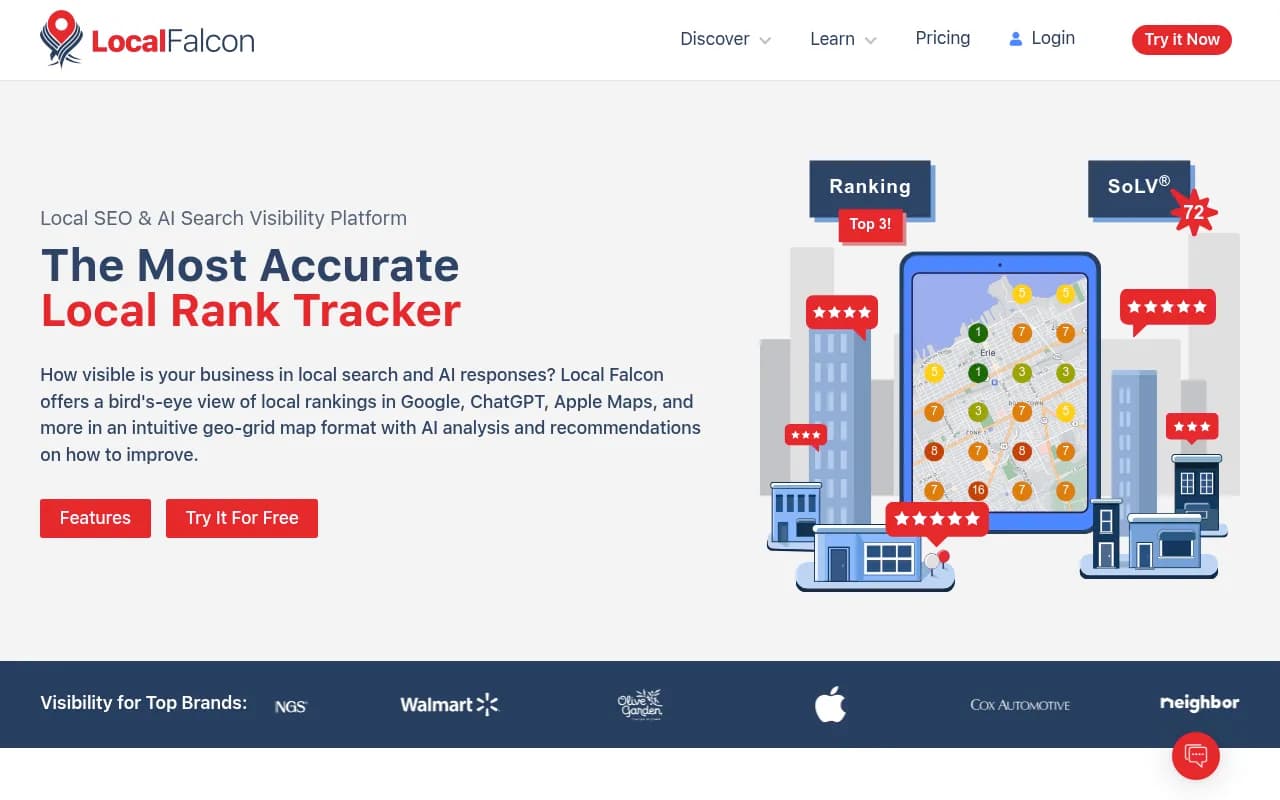
| Local Falcon | Map grid rank tracking | Seeing geographic spread in Google Maps |
| Yext | Listing consistency across directories | Many-location brands |
| Spreadsheet | Manual pilot | One to two cities, first pass |
Step 7: Turn the gaps into actions
An audit that ends in a slide deck is a waste. Sort findings into three buckets.
Coverage gaps
Cities where you rarely appear. Check whether you even have a page for that city and that service. If the best match on your site is a generic homepage, ChatGPT has little to cite. Write a specific page with the entity and category first, since the fan-out data shows short keyword-style searches. The content gap guide explains how to map your pages against the prompts AI answers.
Source gaps
Cities where competitors are cited from listicles or directories you aren't on. Get listed, get reviewed, or get included. Because ChatGPT pulls from so many domains per answer, being present on several third-party pages beats polishing one.
Access gaps
Pages exist, but AI bots can't read them. Check robots.txt and rendering before you blame the content. Tools like the free AI crawler URL inspector and the robots.txt generator for AI help here, and Promptwatch's AI crawler logs show which bots actually reached which pages.
Step 8: Set a cadence
Run the audit monthly at minimum. ChatGPT's behavior shifts without warning: Promptwatch recorded a site: operator rollout on August 8, 2026 that took those queries from about 0.4% to about 17% of fan-outs overnight. A quarterly check would have missed a change like that.
Track the same prompts each time so trends mean something, and note the date next to every run. Content half-life matters as well. Promptwatch's half-life report found landing pages and docs stayed cited longest, while news lost half its pages within 36 days. Evergreen city service pages are a better bet than timely posts.
If you'd rather have a team run the whole thing, an agency such as 1001 SEO Media does GEO and local SEO work, and the free AI visibility report is a no-login way to get a first read before you decide.
Common mistakes
- Testing one prompt and generalizing
- Mixing cities in one scorecard
- Counting repeat mentions within a single answer
- Ignoring aggregators and counting only direct rivals
- Changing the prompt wording between runs and then comparing results
- Treating a single good run as proof of a trend
Bottom line
Run the same 20 to 40 prompts per city, score share of voice separately for each, and read the cited domains as closely as the brand names. Start with a spreadsheet for your two biggest markets, find the city where you're weakest, and fix that one first. For anything beyond that, a tool built for multi-market monitoring will pay back the setup time quickly.